

What Is the Centripetal Force Formula? Equation, 4 Forms, and 6 Solved Examples
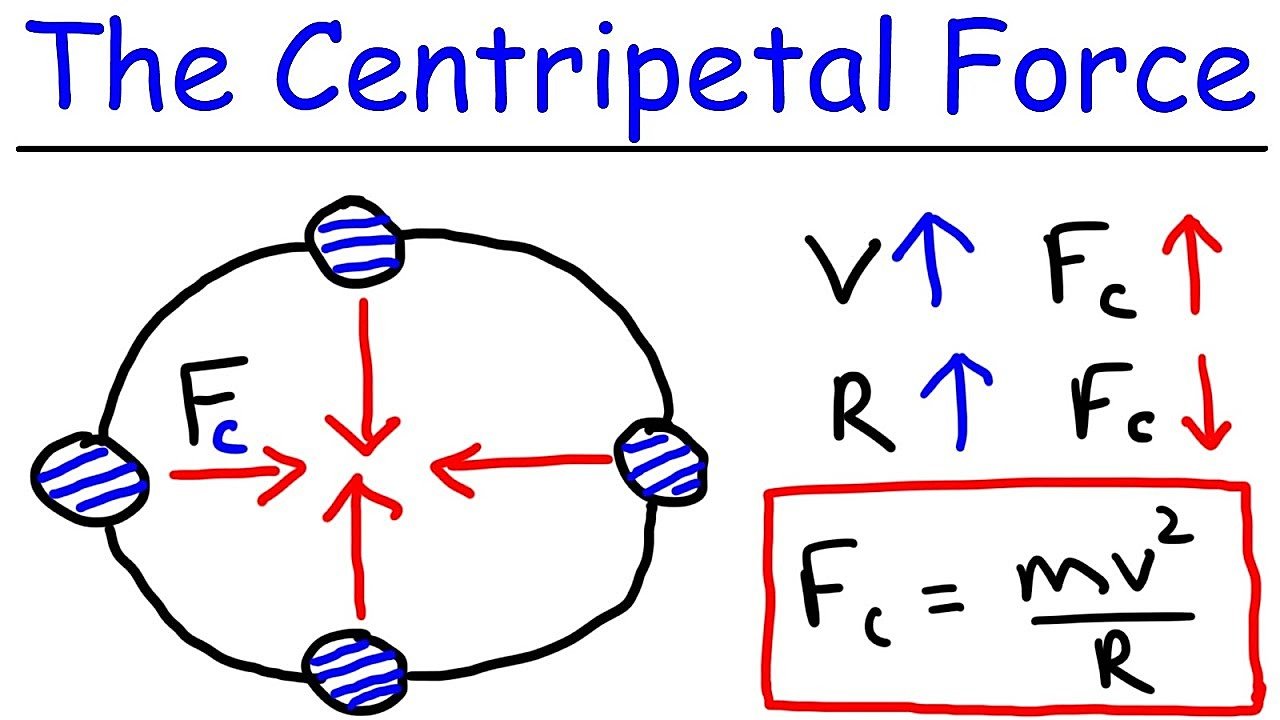
The centripetal force formula is F_c = mv²/r. In the formula, m is mass, v is speed, and r is the radius of the circular path. Centripetal force is measured in newtons (N) and points toward the center of the circle.
For a reliable reference, consult OpenStax section on uniform circular motion.
What Is Centripetal Force?
Centripetal force is any net force that causes uniform circular motion. The direction of centripetal force is toward the center of curvature, the same as the direction of centripetal acceleration. Any force or combination of forces causes centripetal acceleration.
Examples of centripetal force include tension in a string, friction between tires and a road, and gravity on a satellite.
What Is the Unit of Centripetal Force?
The SI unit of centripetal force is the newton (N). One newton equals 1 kg·m/s².
What Is the Formula for Centripetal Force?
The formula for centripetal force is F_c = m × v² / r. Newton's second law produces this formula. Net force equals mass times acceleration, and the acceleration in uniform circular motion is the centripetal acceleration.
Table 1 defines the 4 variables in F_c = mv²/r.
| Symbol | Quantity | SI unit | Unit symbol |
|---|---|---|---|
| F_c | Centripetal force | Newton | N |
| m | Mass of the object | Kilogram | kg |
| v | Speed along the circular path | Meter per second | m/s |
| r | Radius of the circular path | Meter | m |
What Is the Formula for Centripetal Acceleration?
Centripetal acceleration is a_c = v²/r. The unit of centripetal acceleration is m/s², and the direction is toward the center. Centripetal force equals mass multiplied by centripetal acceleration: F_c = m × a_c.
What Are the 4 Forms of the Centripetal Force Equation?
The 4 forms of the centripetal force equation are F_c = mv²/r, F_c = mω²r, F_c = 4π²mr/T², and F_c = ma_c. OpenStax states that the choice of form depends on which quantities are known.
Table 2 lists each form, its known quantities, and its use case.
| Form | Equation | Known quantities | Use case |
|---|---|---|---|
| Linear speed form | F_c = mv²/r | m, v, r | Speed in m/s is known |
| Angular speed form | F_c = mω²r | m, ω, r | Angular speed in rad/s is known |
| Period form | F_c = 4π²mr/T² | m, r, T | Time for 1 revolution in seconds is known |
| Acceleration form | F_c = ma_c | m, a_c | Centripetal acceleration in m/s² is known |
In these equations, ω is angular speed in radians per second, T is the period in seconds, and a_c is centripetal acceleration in m/s². The relationships v = ωr and v = 2πr/T convert between the forms.
How Is the Centripetal Force Formula Derived?
The centripetal force formula derives from Newton's second law and centripetal acceleration. The 3 derivation steps are:
- Start with Newton's second law: F_net = m × a.
- Substitute centripetal acceleration for a: a_c = v²/r.
- Combine the terms: F_c = m × v²/r.
Substituting v = ωr gives F_c = mω²r. Substituting v = 2πr/T gives F_c = 4π²mr/T².
What Are the 5 Steps to Calculate Centripetal Force?
Calculate centripetal force by converting all values to SI units, substituting mass, speed, and radius into F_c = mv²/r, and stating the result in newtons toward the center. The 5 steps are:
- Identify the mass m in kilograms.
- Identify the speed v in meters per second, converting from km/h by dividing by 3.6.
- Identify the radius r in meters, measured from the center of the circle to the object.
- Substitute the values into F_c = mv²/r.
- State the result in newtons, directed toward the center of the circle.
What Are 6 Solved Examples of the Centripetal Force Formula?
The 6 solved examples cover a car on a curve, a ball on a string, a satellite, a washing machine drum, the Moon, and a child on a merry-go-round. Table 3 lists the formula, given values, and centripetal force for each example.
| Example | Formula used | Given values | Centripetal force |
|---|---|---|---|
| Car on a flat curve | F_c = mv²/r | m = 1,200 kg; v = 20 m/s; r = 50 m | 9,600 N |
| Ball swung on a string | F_c = mv²/r | m = 0.5 kg; v = 4 m/s; r = 1 m | 8 N |
| Satellite in orbit | F_c = mv²/r | m = 1,000 kg; v = 7,500 m/s; r = 7.0 × 10⁶ m | About 8,036 N |
| Washing machine drum | F_c = mω²r | m = 2 kg; ω = 100 rad/s; r = 0.25 m | 5,000 N |
| Moon orbiting Earth | F_c = 4π²mr/T² | m = 7.35 × 10²² kg; r = 3.84 × 10⁸ m; T = 2.36 × 10⁶ s | About 2.0 × 10²⁰ N |
| Child on a merry-go-round | F_c = mv²/r | m = 30 kg; v = 2 m/s; r = 2 m | 60 N |
The car calculation is F_c = (1,200 kg × (20 m/s)²) / 50 m = 480,000 / 50 = 9,600 N. Friction between the tires and the road supplies the centripetal force for a car turning on a flat curve.
What Provides the Centripetal Force?
Tension, friction, gravity, and the normal force provide centripetal force. The 4 providers are:
- Tension: supplies centripetal force for a ball swung on a string
- Friction: supplies centripetal force for a car turning on a flat road
- Gravity: supplies centripetal force for satellites and planets in orbit
- Normal force: supplies centripetal force for clothes pressed against a washing machine drum
How Does Centripetal Force Change With Mass, Speed, and Radius?
Centripetal force increases in direct proportion to mass, increases with the square of speed, and decreases in inverse proportion to radius. A large centripetal force produces a small radius of curvature and a sharper curve, for a given mass and velocity.
Table 4 shows the effect of changing 1 variable while the other variables stay constant.
| Change | Effect on F_c | Relationship |
|---|---|---|
| Mass doubles | F_c doubles | Direct proportion to m |
| Speed doubles | F_c becomes 4 times larger | Proportion to v² |
| Speed halves | F_c becomes one quarter | Proportion to v² |
| Radius doubles | F_c halves | Inverse proportion to r |
| Angular speed doubles | F_c becomes 4 times larger | Proportion to ω² |
How Is the Centripetal Force Formula Applied to Banked Curves and Vertical Circles?
The formula applies to banked curves and vertical circles by identifying the force components that point toward the center.
What Is the Centripetal Force Formula for a Banked Curve?
The ideal banking angle satisfies tan θ = v²/(rg), if friction is absent. For ideal banking without friction, the net external force equals the horizontal centripetal force. In this case, F_c = mg tan θ.
A curve with v = 20 m/s and r = 100 m has tan θ = 400 / (100 × 9.8) = 0.408. The banking angle is 22.2 degrees.
What Is the Centripetal Force Formula for a Vertical Circle?
The centripetal force at the top of a vertical circle is F_c = T + mg, and the centripetal force at the bottom is F_c = T − mg. In both cases, F_c equals mv²/r, and T is the tension in the string. Weight points toward the center at the top and away from the center at the bottom.
The minimum speed at the top is v = √(gr), if the string stays taut.
What Is the Difference Between Centripetal Force and Centrifugal Force?
Centripetal force points toward the center of the circle, while centrifugal force is an apparent outward force observed in a rotating frame of reference. Centrifugal force is an effect of inertia and is often called a fictitious force.
Table 5 compares centripetal force and centrifugal force across 5 attributes.
| Attribute | Centripetal force | Centrifugal force |
|---|---|---|
| Direction | Toward the center | Away from the center |
| Type | Real net force | Fictitious (inertial) force |
| Reference frame | Inertial frame | Rotating (non-inertial) frame |
| Magnitude | mv²/r | mv²/r |
| Example | Tension in a string on a swung ball | Outward push felt by a passenger in a turning car |
Who Derived the Centripetal Force Formula?
Christiaan Huygens derived the centripetal force formula in 1659. Huygens derived the standard formulae for centripetal and centrifugal force geometrically in his work De vi Centrifuga in 1659. The modern formula for uniform circular motion first appears in his 1673 treatise Horologium Oscillatorium.
Isaac Newton introduced the term centripetal force (vis centripeta) in a 1684 manuscript titled De motu corporum in gyrum.
What Are 4 Common Misconceptions About Centripetal Force?
Physics education research identifies 4 common misconceptions about centripetal force. A physics education project at the University of Dayton reports that students struggle with the apparent centrifugal force and with the belief that constant-speed circular motion has no acceleration. A study at Universitas Pendidikan Indonesia found that most students still held misconceptions about centrifugal force after instruction with computer simulation.
OpenStax states that an object in uniform circular motion always accelerates, even though the magnitude of its velocity is constant. Centripetal force is perpendicular to velocity.
Table 6 pairs each misconception with the correct physics.
| Misconception | Correct physics |
|---|---|
| Centripetal force is a separate force in addition to tension, friction, or gravity | Centripetal force is the name for the net inward force |
| A real outward centrifugal force acts on an object in circular motion | The outward effect is inertia, observed in a rotating frame |
| Constant speed in a circle means zero acceleration | Changing direction produces centripetal acceleration |
| Centripetal force changes the speed of the object | Centripetal force is perpendicular to velocity and changes direction only |
Where Is the Centripetal Force Formula Applied?
The centripetal force formula is applied in 4 fields. The fields and their uses are:
- Road engineering: determining banking angles and safe curve speeds
- Aerospace engineering: calculating orbital forces on satellites
- Laboratory science: operating centrifuges that separate mixtures
- Amusement park engineering: estimating loads on loop tracks
People Also Ask About the Centripetal Force Formula
What is the centripetal force formula in terms of angular velocity?
The formula is F_c = mω²r, where ω is angular velocity in radians per second.
Does centripetal force do work?
Centripetal force does no work in uniform circular motion because the force is perpendicular to the velocity.
What happens to centripetal force when the radius doubles?
Centripetal force halves, if mass and speed stay constant.
Is centripetal force equal to net force?
Yes, centripetal force is the net force that causes uniform circular motion.
What is the orbital speed formula from centripetal force?
Gravity supplies the centripetal force in a circular orbit, so GMm/r² = mv²/r and v = √(GM/r).
Can centripetal force be zero?
Centripetal force is 0 N, if the object moves in a straight line at constant velocity.
What Is the Centripetal Force Formula? Summary of 5 Key Facts
The 5 key facts about the centripetal force formula are:
- The centripetal force formula is F_c = mv²/r.
- Centripetal force points toward the center of the circle.
- Centripetal force is measured in newtons (N).
- Centripetal force equals mass multiplied by centripetal acceleration.
- Tension, friction, gravity, and the normal force supply centripetal force.
Title tag: Measuring Unit of Velocity: SI Unit, 6 Units, and Conversions

The University of the West Indies
My passion as a teacher and leader in education is to contribute to students’ enhanced learning by creation of a positive teaching/learning environment, where they are motivated to develop strong critical thinking, analytical and problem-solving skills.
As acting Vice-Principal and head of Physics, I have amassed five years of experience in leading meetings, implementing strategies to maintain discipline and school ethos, liaise with stakeholders in planning for future development of the institution; successfully negotiated the implementation of various projects for student development as well as supervising effective execution of such. For the past 19 years, I have incorporated discovery learning within the classroom through practical activities, problem solving and cooperative learning and have realized that students retention in Physics and Mathematics have increased significantly.
I am always cognizant that students have different learning styles, and as such teaching strategies during planning and delivery must take this crucial factor into consideration and be tailored to meet such differences.