

SUVAT Equations: All 5 Equations, Derivations, Examples and When to Use Them
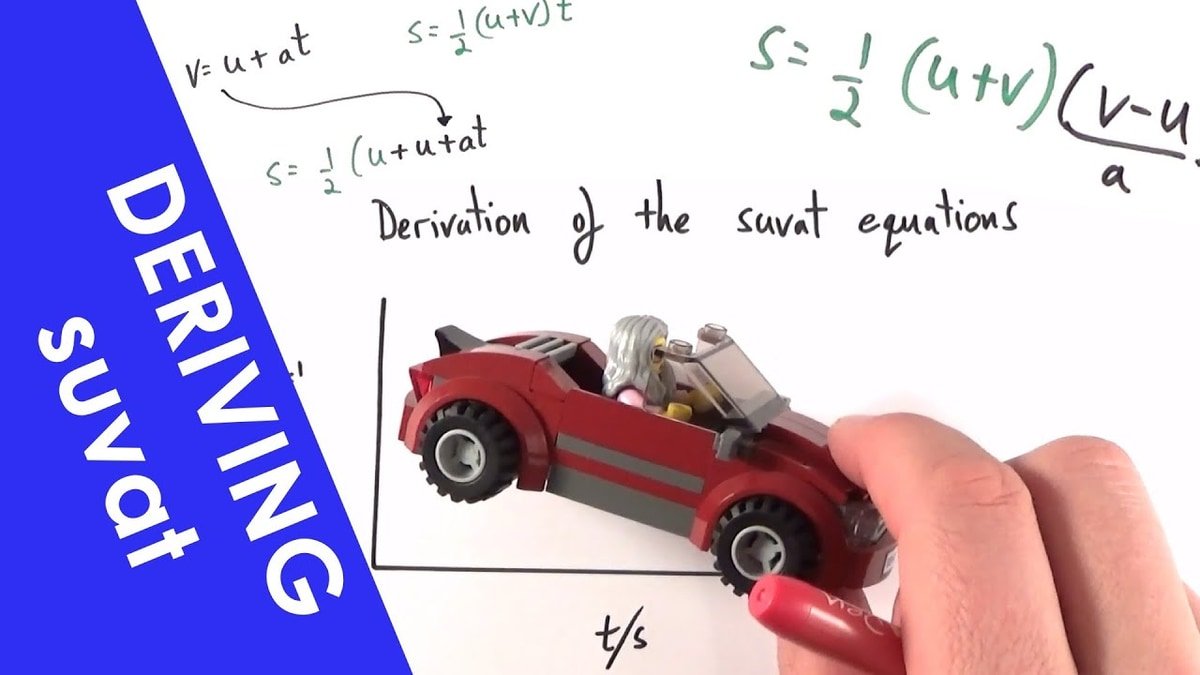
SUVAT equations are five kinematic equations used to solve motion problems involving constant acceleration in a straight line. Each equation connects four of five physical variables: displacement (s), initial velocity (u), final velocity (v), acceleration (a), and time (t). Know any three and the right equation finds the rest.
Contents
- What are the SUVAT equations?
- How many SUVAT equations are there?
- All 5 SUVAT equations
- Are they in the formula booklet?
- How to derive the SUVAT equations
- How to use the SUVAT equations
- Sign conventions
- SUVAT equations rearranged
- Worked examples
- SUVAT in projectile motion
- When SUVAT does not apply
- How to remember SUVAT
- Who invented SUVAT?
- Common exam mistakes
- SUVAT calculator
- Cheat sheet
- Practice questions
- FAQ
What Are the SUVAT Equations? (What Do the Letters Stand For?)
SUVAT represents the five kinematic variables used in these equations: s (displacement), u (initial velocity), v (final velocity), a (acceleration), and t (time). The letters are the conventional mathematical symbols for each quantity, not abbreviations of the quantity names. The symbol s for displacement comes from the Latin spatium (space); u and v are the traditional British physics symbols for initial and final speed respectively.
| Letter | Quantity | SI Unit | Notes |
|---|---|---|---|
| s | Displacement | metres (m) | Vector: positive, negative, or zero |
| u | Initial velocity | m/s | Speed at the start of the motion |
| v | Final velocity | m/s | Speed at the end of the time period |
| a | Acceleration | m/s² | Must be constant for SUVAT to apply |
| t | Time | seconds (s) | Always positive |
Displacement (s) is not the same as distance. Displacement is a vector measuring straight-line change in position and can be zero, positive, or negative. Distance is the total path length and is always positive. A ball thrown upward that returns to the same height has s = 0 but distance = 2 × maximum height. This distinction matters whenever the object changes direction mid-problem.
SUVAT is a British curriculum term. In American and IB courses the same equations appear as the kinematic equations, using x for displacement and v₀ for initial velocity.
How Many SUVAT Equations Are There? (4 or 5?)
There are five SUVAT equations. Many textbooks list only four, omitting the fifth (s = vt − ½at²). The shorter four-form version is covered in the equations of motion guide. All five appear in the Edexcel A-Level Maths formula booklet and any can be tested.
All 5 SUVAT Equations
How to Choose the Right Equation Every Time
Write all five letters (s, u, v, a, t) in a column, fill in the known values, and circle the unknown. The variable left blank that you also do not need is the omitted variable. Use the equation that omits it.
Interactive selector: Click the variable you have neither been given nor need to find. The matching equation highlights.
Are SUVAT Equations Given in the Formula Booklet?
| Qualification | Equations provided? | Where |
|---|---|---|
| Edexcel A-Level Maths | Yes: all 5 | Formula booklet, Mechanics section |
| AQA A-Level Physics | Yes: 4 core equations | Data booklet, Mechanics and Materials |
| OCR A-Level Maths / Physics | Yes | Formula booklet / data sheet |
| GCSE Separate/Triple Science | Yes: 4 equations provided | Equation sheet: v=u+at, v²=u²+2as, s=½(u+v)t, s=ut+½at² |
| GCSE Combined Science | Partial | Typically v=u+at only; check your board specification |
| IB Physics | Yes: kinematic equations provided | IB Physics data booklet (check current syllabus year) |
How to Derive the SUVAT Equations
All five equations come from two starting definitions only.
Definition 1: a = (v − u) / t, which rearranges directly to v = u + at (Equation 1).
Definition 2: For constant acceleration, the velocity-time graph is a straight line from u to v over time t. Displacement equals the area under that graph, which is a trapezium:
Deriving Equation 2: s = ut + ½at²
Substitute v = u + at (Eq 1) into s = ½(u + v)t (Eq 4):
s = ½(u + u + at) × t = ½(2u + at) × t
s = ut + ½at²
The ut term is the blue rectangle on the v-t graph (constant-speed displacement). The ½at² term is the green triangle (extra displacement from acceleration).
Deriving Equation 3: v² = u² + 2as
From Eq 1: t = (v − u)/a. Substitute into s = ½(u + v)t:
s = ½(u + v)(v − u)/a = (v² − u²)/(2a)
Rearrange: v² = u² + 2as
Energy connection: Multiply both sides by ½m and you get ½mv² = ½mu² + mas (the work-energy theorem). Equation 3 is the energy equation in disguise.
Deriving Equation 5: s = vt − ½at²
From Eq 1: u = v − at. Substitute into Eq 2:
s = (v − at)t + ½at² = vt − at² + ½at²
s = vt − ½at²
How to Use the SUVAT Equations: The 6-Step Method
- Confirm constant acceleration. If the problem mentions air resistance, springs, or circular motion, SUVAT may not apply.
- Define your positive direction. Write “upward positive” or “rightward positive” at the top of your working. Do not skip this.
- List all five variables. Write s, u, v, a, t in a column. Fill in every known value with correct signs.
- Identify what you are solving for. Circle the unknown.
- Identify the omitted variable. This is the one you have neither been given nor need. Use the equation that omits it.
- Substitute, solve, and sense-check. Does your answer make physical sense? A negative time or implausible displacement signals an error.
Sign Conventions: The Most Common Source of Exam Errors
More marks are lost on sign errors in SUVAT problems than on anything else.
The Core Rule
Every SUVAT variable except t is a vector. Define one direction as positive and write it down before touching any numbers. Every vector pointing in that direction is positive; every vector pointing the opposite way is negative, regardless of what the object is doing at that moment.
| Scenario | Positive direction | Gravity (a) |
|---|---|---|
| Vertical motion (standard) | Upward | −9.8 m/s² |
| Downward launches | Downward | +9.8 m/s² |
| Horizontal motion | Rightward | Not applicable |
| Inclined plane | Up the slope | −g sin θ |
Displacement vs Distance
If an object changes direction during the motion, the value of s from a single SUVAT equation is the net displacement, not the total distance. To find total distance, split the journey at the turning point (where v = 0), calculate s for each phase, and add the absolute values.
Example: Ball thrown upward at 25 m/s, returns to launch height. Displacement = 0 m. Total distance = 2 × 31.9 m = 63.8 m.
Which Value of g?
Use g = 9.8 m/s² unless the question states otherwise. AQA, Edexcel, and OCR specify the value on each individual paper. Check it every time.
SUVAT Equations Rearranged: Quick Reference
| Find | Use | Rearranged form |
|---|---|---|
| t (simple) | Eq 1 or Eq 4 | t = (v − u) / a or t = 2s / (u + v) |
| t (quadratic) | Eq 2 | t = (−u ± √(u² + 2as)) / a |
| s (no t) | Eq 3 | s = (v² − u²) / (2a) |
| a | Eq 1 or Eq 3 | a = (v − u) / t or a = (v² − u²) / (2s) |
| u | Eq 1 | u = v − at |
| v | Eq 3 | v = √(u² + 2as) |
Worked Examples: Five Problems at Increasing Difficulty
A stone is dropped from rest from a 120 m cliff. Find (a) the time to reach the ground and (b) the impact speed. (g = 9.8 m/s², positive direction: downward)
s = 120 m, u = 0, a = 9.8 m/s². Find t and v.
(a) Omit v → use s = ut + ½at²
120 = 4.9t² → t = √(120/4.9) = 4.95 s
(b) v = u + at = 0 + 9.8 × 4.95 = 48.5 m/s
Check: v² = 2(9.8)(120) = 2352 → v = 48.5 m/s ✓
A ball is thrown upward at 25 m/s. (upward positive, g = 9.8 m/s²) Find: (a) maximum height, (b) total time of flight, (c) total distance.
u = +25 m/s, a = −9.8 m/s²
(a) At max height v = 0. Omit t → v² = u² + 2as
0 = 625 + 2(−9.8)s → s = 31.9 m
(b) On return s = 0. s = ut + ½at²
0 = 25t − 4.9t² → t(25 − 4.9t) = 0 → t = 5.10 s
(c) Up 31.9 m + down 31.9 m = 63.8 m total distance
Note: displacement = 0 m. Distance ≠ displacement here.
A car travelling at 20 m/s brakes to rest in 4 s. Find (a) the deceleration and (b) the stopping distance.
u = 20, v = 0, t = 4. Rightward positive.
(a) Omit s → v = u + at: 0 = 20 + 4a → a = −5 m/s² (deceleration = 5 m/s²)
(b) s = ½(u + v)t = ½(20 + 0)(4) = 40 m
Check: v² = u² + 2as → 0 = 400 + 2(−5)s → s = 40 m ✓
A particle starts from the origin with u = 8 m/s, decelerating at 2 m/s². Find the times when it is 7 m from the origin.
s = 7, u = 8, a = −2. Omit v → s = ut + ½at²
7 = 8t − t² → t² − 8t + 7 = 0 → (t − 1)(t − 7) = 0
t = 1 s and t = 7 s: both are valid.
At t = 1s: particle passes 7 m heading outward.
At t = 4s: particle stops (v = 8 − 2(4) = 0), turns back.
At t = 7s: particle passes 7 m again on its return.
Car A travels at a constant 15 m/s. At that moment, stationary car B begins accelerating at 2 m/s². Find (a) when B overtakes A, (b) the distance from start, (c) B’s speed at overtake.
s_A = 15t | s_B = ½(2)t² = t²
(a) Set equal: 15t = t² → t(t − 15) = 0 → t = 15 s
(b) s_A = 15 × 15 = 225 m; check: s_B = 15² = 225 m ✓
(c) v_B = 0 + 2(15) = 30 m/s (twice Car A’s speed, which is a characteristic result in constant-acceleration pursuit problems)
SUVAT Equations in Projectile Motion
Projectile motion applies SUVAT simultaneously in two independent directions linked by the same time t.
| Axis | Acceleration | Key equation | Notes |
|---|---|---|---|
| Horizontal (x) | 0 | s_x = u_x × t | Horizontal velocity never changes |
| Vertical (y) | g = 9.8 m/s² | All 5 SUVAT equations | At max height, v_y = 0 |
Method: Resolve initial velocity into components (u_x = u cos θ, u_y = u sin θ). Solve whichever axis gives t first, then substitute into the other.
Ball kicked horizontally at 12 m/s from a 45 m cliff. Find (a) time of flight, (b) range, (c) impact speed.
Vertical (downward +): u_y = 0, a = 9.8, s = 45
(a) 45 = ½(9.8)t² → t = 3.03 s
(b) s_x = 12 × 3.03 = 36.4 m
(c) v_y = 9.8(3.03) = 29.7 m/s | v_x = 12 m/s
Speed = √(12² + 29.7²) = 32.0 m/s

Rotational Kinetic Energy Equation: Formula, 7 Forms, and Worked
Angular Momentum and Conservation of Angular Momentum: Definition, Formulas,
Formula for Change in Momentum: Final Momentum Minus Initial

Who Created Math? 5 Civilizations and Their Contributions
SI Unit for Electric Potential: The Volt, Its Definition,
Units of Momentum: SI, CGS, US Customary, and Particle

Electric Potential Energy Formula: Equations, Units, Sign Rules, and

Net Force Definition: Formula, Calculation Steps, and Examples

Newton’s Third Law: Definition, Formula, and 5 Examples
- 1
- 2
When Can You NOT Use SUVAT Equations?
SUVAT requires constant acceleration throughout the entire motion. It gives wrong answers whenever acceleration varies.
| Situation | Why SUVAT fails | Use instead |
|---|---|---|
| Air resistance / drag | Drag ∝ v², so acceleration decreases as speed increases | F = ma with calculus |
| Springs (SHM) | F = −kx, so acceleration varies with position | SHM equations: x = A cos(ωt) |
| Rocket burning fuel | Decreasing mass → increasing acceleration | Tsiolkovsky rocket equation |
| Circular motion | Centripetal acceleration changes direction continuously | a = v²/r = rω² |
| Object on curved path | Normal force and net acceleration vary continuously | Resolve forces at each point |
How to Remember the SUVAT Equations
Method 1: The Omitted Variable System (Most Reliable)
Memorise what each equation omits, not the equation itself:
- v = u + at omits s
- s = ut + ½at² omits v
- v² = u² + 2as omits t
- s = ½(u + v)t omits a
- s = vt − ½at² omits u
Omitted sequence in order: s, v, t, a, u. Before every problem, list all five variables, cross out the one you neither have nor need, and the correct equation reveals itself.
Method 2: Derive on the Spot (Under Exam Pressure)
Memorise only two things: a = (v − u)/t and s = ½(u + v)t. Every other equation follows by algebra in under 60 seconds. This is faster and more reliable than rote memorisation under pressure.
Method 3: Spot the Patterns
Equations 2 and 5 are mirrors: one starts with u and adds ½at², the other starts with v and subtracts ½at². Remember one and flip to get the other. Equation 3 is the only one with v² and u². Equation 4 is the only one without a.
Who Invented the SUVAT Equations?
Galileo Galilei discovered the kinematic relationships underlying SUVAT around 1604, not as algebra but through experiment. He rolled balls down inclined planes to slow gravity enough to measure, and proved that distance is proportional to time squared (confirming s = ½at²) and that acceleration is independent of mass.
Isaac Newton later explained why objects accelerate. His second law F = ma (Philosophiae Naturalis Principia Mathematica, 1687) is the dynamic foundation; SUVAT describes the resulting kinematics. The acronym SUVAT is a British educational convention from the 20th century. In the US and internationally the same equations are called the kinematic equations or equations of uniform acceleration.
Common SUVAT Exam Mistakes and How to Avoid Them
- Not defining a positive direction. Write it before any numbers. Every sign follows from this.
- Wrong sign for gravity. When upward is positive, a = −9.8 m/s² even when the object is falling.
- Using s as distance when the object changes direction. Split at the turning point (v = 0) and sum absolute displacements.
- Applying SUVAT when acceleration varies. Check for air resistance, springs, or curved paths first.
- Discarding both quadratic roots. When solving for t, both positive values can be physically valid.
- Mixed units. Convert everything to SI before substituting. km/h and m/s cannot coexist.
- Picking an equation before listing variables. List s, u, v, a, t first. The omitted variable tells you the equation.
- Wrong value of g. Check whether the paper specifies 9.8 or 10 m/s².
SUVAT Equations Calculator
Enter any three known values and click Calculate to solve for the remaining unknowns. Full working is shown.
SUVAT Equations Quick-Reference Cheat Sheet
Get the SUVAT equations worksheet with answers (PDF)
All 5 SUVAT Equations
Use SUVAT only when: acceleration is constant AND motion is in a straight line.
To choose an equation: identify the omitted variable → use that equation.
g values: 9.8 m/s² standard | 10 m/s² approximation (only if question states it)
Practice Questions
Attempt each question before revealing the answer. Use the 6-step method for each.
(a) v = u + at = 0 + 4(10) = 40 m/s
(b) s = ut + ½at² = 0 + ½(4)(100) = 200 m
s = ut + ½at² → 0 = 20t − 4.9t² → t(20 − 4.9t) = 0
t = 0 (launch) or t = 20/4.9 = 4.08 s
35² = 0 + 2(9.8)s → s = 1225/19.6 = 62.5 m
(a) v² = u² + 2as → 0 = 324 + 108a → a = −3 m/s²
(b) v = u + at → 0 = 18 − 3t → t = 6 s
Set equal: 25t = 1.5t² → t = 25/1.5 = 16.67 s
Distance = 25 × 16.67 = 416.7 m
Check: s_B = 1.5 × 16.67² = 416.7 m ✓
Q1: Which SUVAT equation does not contain time (t)?
Q2: A car brakes from 30 m/s to rest over 90 m. What is the deceleration?
Q3: You know s, u, and a, but not v or t. Which equation should you use first to find t?
Q4: When upward is chosen as the positive direction, what is the correct sign for gravitational acceleration?
Q5: In projectile motion (no air resistance), what is the horizontal acceleration?
Frequently Asked Questions About SUVAT Equations