

Kinematics Equations: 5 Equations of Motion, Variables, and Solved Examples
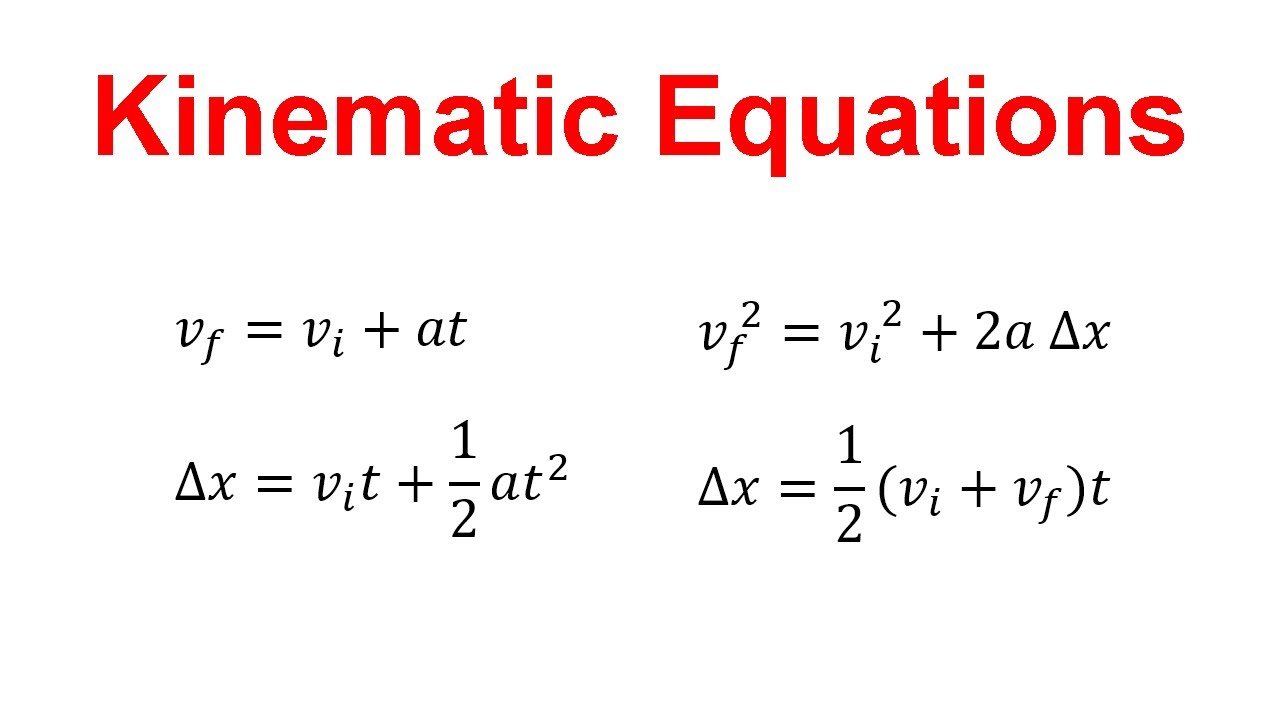
Kinematics equations are 5 mathematical formulas that describe the motion of objects under constant acceleration. They connect displacement, initial velocity, final velocity, acceleration, and time. Physicists and engineers use them to solve motion problems without knowing all variables upfront. In UK courses, the same constant-acceleration formulas are usually taught as SUVAT equations; the shorter four-form version is explained in the equations of motion guide.
For a supporting reference, The Physics Classroom’s kinematic equations guide explains when the equations apply and how the motion variables relate.
What Are Kinematics Equations?
Kinematics equations are 5 formulas used to calculate motion when acceleration is constant. They apply to linear motion only and exclude forces as variables. The 5 equations derive from 2 definitions: acceleration is the rate of change of velocity, and velocity is the rate of change of displacement.
What Are the 5 Kinematics Equations?
The 5 kinematics equations use 5 variables: s, u, v, a, and t. Each equation contains 4 of the 5 variables, which means one variable per equation is always absent.
| Equation | Formula | Missing Variable |
|---|---|---|
| First equation | v = u + at | s (displacement) |
| Second equation | s = ut + ½at² | v (final velocity) |
| Third equation | v² = u² + 2as | t (time) |
| Fourth equation | s = ½(u + v)t | a (acceleration) |
| Fifth equation | s = vt − ½at² | u (initial velocity) |
What Does Each Variable in the Kinematics Equations Mean?
Each variable in the kinematics equations represents a measurable physical quantity. The 5 variables are:
- s = displacement (meters, m)
- u = initial velocity (meters per second, m/s)
- v = final velocity (meters per second, m/s)
- a = acceleration (meters per second squared, m/s²)
- t = time (seconds, s)
Displacement measures the change in position, not the total distance traveled. A car that moves 10 m forward and 4 m back has a displacement of 6 m, not 14 m.
How Do You Choose the Right Kinematics Equation?
Identify the 3 known variables and 1 unknown variable, then select the equation that contains all 4. Every kinematics problem provides at least 3 values. The missing variable from the problem matches the missing variable column in the table above.
For example, if a problem gives u, a, and t but asks for s, the second equation (s = ut + ½at²) applies because it contains u, a, t, and s while missing v.
What Are the Conditions for Using Kinematics Equations?
Kinematics equations apply only when acceleration is constant throughout the motion. 3 conditions must hold for the equations to be valid:
- The object moves in a straight line (linear motion).
- Acceleration does not change during the time interval.
- All vector quantities (displacement, velocity, acceleration) point along the same axis.
Circular motion, projectile motion in 2 dimensions, and variable acceleration require different methods. For projectile motion, the equations apply separately to the horizontal and vertical components.
How Are the Kinematics Equations Derived?
The kinematics equations derive from the definitions of acceleration and average velocity.
The first equation comes from the definition of acceleration:
a = (v − u) / t → v = u + at
The fourth equation comes from the definition of average velocity when acceleration is constant:
s = average velocity × t = ½(u + v) × t → s = ½(u + v)t
Substituting the first equation into the fourth gives the second equation:
s = ½(u + u + at)t = ut + ½at² → s = ut + ½at²
Eliminating t between the first and fourth equations gives the third:
v² = u² + 2as → v² = u² + 2as
The fifth equation follows from substituting the first equation into the fourth and eliminating u:
s = vt − ½at²
How Do You Solve Kinematics Equations? Worked Examples
List the known values, identify the unknown, select the matching equation, then substitute and solve.
Example 1: Finding Final Velocity
A car starts from rest and accelerates at 3 m/s² for 8 seconds. Find the final velocity.
Known values: u = 0 m/s, a = 3 m/s², t = 8 s. Unknown: v. Missing variable in the problem: s.
Use the first equation: v = u + at
v = 0 + (3)(8) = 24 m/s
Example 2: Finding Displacement
A ball rolls with an initial velocity of 5 m/s and decelerates at 2 m/s². Find the displacement after 3 seconds.
Known values: u = 5 m/s, a = −2 m/s², t = 3 s. Unknown: s. Missing variable: v.
Use the second equation: s = ut + ½at²
s = (5)(3) + ½(−2)(3²) = 15 − 9 = 6 m
Example 3: Finding Acceleration Without Time
A cyclist accelerates from 4 m/s to 10 m/s over a distance of 21 m. Find the acceleration.
Known values: u = 4 m/s, v = 10 m/s, s = 21 m. Unknown: a. Missing variable: t.
Use the third equation: v² = u² + 2as
100 = 16 + 2a(21) → 84 = 42a → a = 2 m/s²
What Are Common Mistakes When Using Kinematics Equations?
The 3 most common errors are sign mistakes, using the wrong equation, and misreading displacement as distance.
- Sign errors: Assign a positive direction at the start. Deceleration is negative acceleration. A ball thrown upward has a = −9.8 m/s² due to gravity.
- Wrong equation: Choosing an equation that does not contain the unknown variable leads to unsolvable expressions.
- Displacement versus distance: Displacement is a vector. An object returning to its starting point has s = 0, not s = total path length.
What Are the Applications of Kinematics Equations?
Kinematics equations apply to 5 real-world fields: vehicle safety testing, spacecraft trajectory planning, sports biomechanics, robotics, and structural engineering.
- Vehicle safety engineers use v² = u² + 2as to calculate stopping distances at different speeds.
- Aerospace engineers use s = ut + ½at² to model rocket ascent trajectories.
- Sports scientists use v = u + at to measure athlete acceleration over short sprint distances.
- Robotics engineers use kinematics equations to program precise arm movements.
- Structural engineers apply them to model falling objects and impact forces during safety assessments.
What Is the Difference Between Kinematics and Dynamics?
Kinematics describes how objects move; dynamics explains why they move by including forces. Kinematics uses the 5 equations above without referencing mass or force. Dynamics uses Newton’s second law (F = ma) to find acceleration, which then feeds into the kinematics equations.
What Should You Know Before Using Kinematics Equations?
Kinematics equations solve constant-acceleration motion problems using 5 variables: s, u, v, a, and t. Each of the 5 equations omits one variable. Identifying the 3 known values and 1 unknown in a problem determines which equation to apply. The equations are valid only for straight-line motion under constant acceleration, and sign conventions must be set before substituting values.

The University of the West Indies
My passion as a teacher and leader in education is to contribute to students’ enhanced learning by creation of a positive teaching/learning environment, where they are motivated to develop strong critical thinking, analytical and problem-solving skills.
As acting Vice-Principal and head of Physics, I have amassed five years of experience in leading meetings, implementing strategies to maintain discipline and school ethos, liaise with stakeholders in planning for future development of the institution; successfully negotiated the implementation of various projects for student development as well as supervising effective execution of such. For the past 19 years, I have incorporated discovery learning within the classroom through practical activities, problem solving and cooperative learning and have realized that students retention in Physics and Mathematics have increased significantly.
I am always cognizant that students have different learning styles, and as such teaching strategies during planning and delivery must take this crucial factor into consideration and be tailored to meet such differences.
2 Comments
Pingback: Derivative of 1/x: 3 Methods, Proof, and Examples
Pingback: Physics 1 Formula Sheet: Equations, Constants, and Exam Rules for 8 Units