

What Is the Measuring Unit of Velocity? SI Unit, 6 Common Units, and Conversion Factors
The SI unit of velocity is the meter per second (m/s). Velocity measures displacement per unit of time in a specific direction. Other velocity units include kilometer per hour, mile per hour, foot per second, knot, and centimeter per second.
For a reliable reference, consult OpenStax section on velocity and speed.
What Is Velocity?
Velocity is the rate of change of an object's position in a specific direction. Velocity is a vector quantity with magnitude and direction. Examples of velocity include a car moving 20 m/s east, an aircraft flying 250 m/s north, and a runner moving 8 m/s south.
What Is the Difference Between Speed and Velocity?
Speed is a scalar quantity with magnitude only, and velocity is a vector quantity with magnitude and direction. Both quantities share the same SI unit, the meter per second.
Table 1 compares speed and velocity across 4 attributes.
| Attribute | Speed | Velocity |
|---|---|---|
| Quantity type | Scalar | Vector |
| Includes direction | No | Yes |
| Example | 20 m/s | 20 m/s east |
| SI unit | m/s | m/s |
What Is the Measuring Unit of Velocity?
The measuring unit of velocity in the International System of Units is the meter per second (m/s). NIST lists the meter per second as the SI derived unit for speed and velocity. One meter per second equals the velocity of a body that covers 1 meter in 1 second.
The meter per second became the official SI derived unit for speed and velocity in 1960, when the General Conference on Weights and Measures established the SI. Before 1960, feet per second, miles per hour, and knots were more common, depending on region and application.
What Is the Symbol for the Unit of Velocity?
The symbol for the unit of velocity is m/s. The forms m·s⁻¹ and m s⁻¹ are also valid SI symbols.
What Is the Dimension of Velocity?
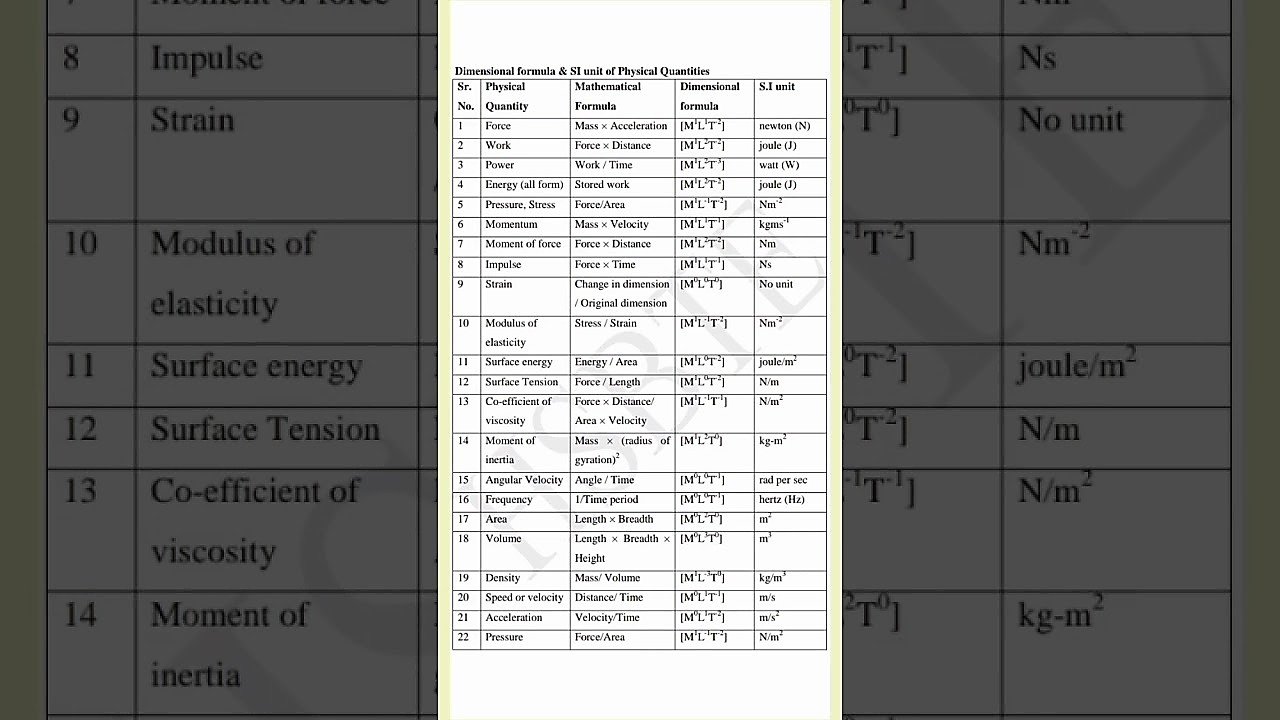
The dimension of velocity is length divided by time, written as LT⁻¹. The dimensional formula of velocity is [M⁰L¹T⁻¹].
How Is the Meter per Second Defined?
The meter per second derives from 2 SI base units, the meter and the second. The meter equals the distance light travels in a vacuum in 1/299,792,458 of a second. The second is tied to the vibration frequency of caesium atoms, at 9,192,631,770 oscillations. Therefore, the speed of light in a vacuum is exactly 299,792,458 m/s.
What Are the 6 Common Units of Velocity?
The 6 common units of velocity are meter per second, kilometer per hour, mile per hour, foot per second, knot, and centimeter per second.
Table 2 lists each unit with its symbol, measurement system, value in m/s, and typical use.
| Unit | Symbol | Measurement system | Value in m/s | Typical use |
|---|---|---|---|---|
| Meter per second | m/s | SI | 1 | Physics, engineering, and science |
| Kilometer per hour | km/h | Metric, accepted with the SI | 0.277778 | Road vehicles in most countries |
| Mile per hour | mph | US customary and imperial | 0.44704 (exact) | Road vehicles in the US and UK |
| Foot per second | ft/s | US customary and imperial | 0.3048 (exact) | US engineering and ballistics |
| Knot | kn | Non-SI, accepted with the SI | 0.514444 | Maritime and air navigation |
| Centimeter per second | cm/s | CGS | 0.01 | Laboratory measurements |
The knot equals 1 nautical mile per hour, or exactly 1.852 km/h, and is used in meteorology, maritime navigation, and air navigation. ISO uses the symbol kn for the knot, and ICAO recommends kt for aviation.
Is Mach Number a Unit of Velocity?
No, Mach number is a dimensionless ratio of speed to the speed of sound, not a unit. NASA describes the Mach number as unitless. The speed of sound depends on the type and temperature of the gas. Therefore, Mach 1 has no fixed value in m/s.
What Are the Conversion Factors Between Velocity Units?
Multiply the original value by a fixed conversion factor to change velocity units. The factor between m/s and km/h is 3.6, and 1 mph equals exactly 0.44704 m/s.
Table 3 lists the conversion factors for 8 velocity unit pairs.
| Conversion | Multiply by |
|---|---|
| m/s to km/h | 3.6 |
| km/h to m/s | 0.277778 |
| mph to m/s | 0.44704 |
| m/s to mph | 2.236936 |
| ft/s to m/s | 0.3048 |
| knot to m/s | 0.514444 |
| knot to km/h | 1.852 |
| mph to km/h | 1.609344 |
How Do You Convert km/h to m/s?
Divide the value in km/h by 3.6. A speed of 72 km/h equals 20 m/s.
How Do You Convert m/s to km/h?
Multiply the value in m/s by 3.6. A speed of 25 m/s equals 90 km/h.
How Do You Convert mph to m/s?
Multiply the value in mph by 0.44704. A speed of 60 mph equals 26.82 m/s.
How Do You Convert Knots to km/h?
Multiply the value in knots by 1.852. A speed of 20 knots equals 37.04 km/h.
What Is the Formula for Velocity?
The formula for velocity is v = Δx / Δt, where Δx is displacement and Δt is the time interval. Dividing displacement in meters by time in seconds gives velocity in m/s. Average velocity uses the total displacement and the total time.
Table 4 defines the 3 variables in v = Δx / Δt.
| Symbol | Quantity | SI unit | Unit symbol |
|---|---|---|---|
| v | Velocity | Meter per second | m/s |
| Δx | Displacement | Meter | m |
| Δt | Time interval | Second | s |
A cyclist who travels 150 m east in 30 s has an average velocity of 5 m/s east.
What Is the Unit of Angular Velocity?
The SI unit of angular velocity is the radian per second (rad/s). NIST lists the radian per second as the SI unit for angular velocity. One revolution per minute (rpm) equals 0.10472 rad/s.
Linear velocity relates to angular velocity by v = ω × r, where ω is angular velocity in rad/s and r is the radius in meters.
Which Unit of Velocity Is Used in Each Field?
Physics and engineering use m/s, road transport uses km/h or mph, and navigation uses knots. Table 5 lists the common unit and an example measurement for 6 fields.
| Field | Common velocity unit | Example measurement |
|---|---|---|
| Physics and engineering | Meter per second (m/s) | Projectile launched at 30 m/s |
| Road transport in most countries | Kilometer per hour (km/h) | Speed limit of 100 km/h |
| Road transport in the US and UK | Mile per hour (mph) | Speed limit of 65 mph |
| Aviation and maritime navigation | Knot (kn) | Wind speed of 15 kn |
| Meteorology | m/s, km/h, or knots | Wind speed of 25 m/s |
| Ballistics in the US | Foot per second (ft/s) | Muzzle velocity of 2,800 ft/s |
What Are 4 Common Mistakes With Velocity Units?
The 4 common mistakes with velocity units are writing knots per hour, omitting direction, mixing units in 1 equation, and treating Mach as a unit.
Unit mismatches cause measurable errors. NASA's Mars Climate Orbiter mission was lost in 1999 after ground software produced thruster data in pound-force seconds instead of newton-seconds. The navigation software underestimated the effect of the thruster firings on the trajectory by a factor of 4.45.
Table 6 pairs each mistake with the correct usage.
| Mistake | Correct usage |
|---|---|
| Writing "knots per hour" for speed | A knot already means 1 nautical mile per hour, and "knots per hour" describes acceleration |
| Omitting direction from a velocity value | State the direction with the magnitude, such as 20 m/s east |
| Mixing km/h and m/s in 1 equation | Convert all values to m/s before calculating |
| Treating Mach as a unit | Mach number is a dimensionless ratio of speed to the speed of sound |
The phrase "knots per hour" would mean nautical miles per hour per hour, which refers to acceleration.
People Also Ask About the Unit of Velocity
What is the SI unit of velocity?
The SI unit of velocity is the meter per second (m/s).
What is the CGS unit of velocity?
The CGS unit of velocity is the centimeter per second (cm/s).
What is the FPS unit of velocity?
The FPS unit of velocity is the foot per second (ft/s).
What is the dimensional formula of velocity?
The dimensional formula of velocity is [M⁰L¹T⁻¹].
How many km/h is 1 m/s?
One meter per second equals 3.6 km/h.
What is the speed of light in m/s?
The speed of light in a vacuum is exactly 299,792,458 m/s.
Can velocity be negative?
Velocity is negative, if the motion points opposite to the chosen positive direction. The unit stays m/s.
What Is the Measuring Unit of Velocity? Summary of 5 Key Facts
The 5 key facts about the measuring unit of velocity are:
- The SI unit of velocity is the meter per second (m/s).
- Velocity equals displacement divided by the time interval.
- Other velocity units include km/h, mph, ft/s, knots, and cm/s.
- The conversion between m/s and km/h uses the factor 3.6.
- Mach number is a ratio, not a unit.
Title tag: Define the Normal Force: Definition, Formula, and 6 Examples

The University of the West Indies
My passion as a teacher and leader in education is to contribute to students’ enhanced learning by creation of a positive teaching/learning environment, where they are motivated to develop strong critical thinking, analytical and problem-solving skills.
As acting Vice-Principal and head of Physics, I have amassed five years of experience in leading meetings, implementing strategies to maintain discipline and school ethos, liaise with stakeholders in planning for future development of the institution; successfully negotiated the implementation of various projects for student development as well as supervising effective execution of such. For the past 19 years, I have incorporated discovery learning within the classroom through practical activities, problem solving and cooperative learning and have realized that students retention in Physics and Mathematics have increased significantly.
I am always cognizant that students have different learning styles, and as such teaching strategies during planning and delivery must take this crucial factor into consideration and be tailored to meet such differences.