

How Is the Normal Force Defined? Definition, Formula, and 6 Examples of a Perpendicular Contact Force
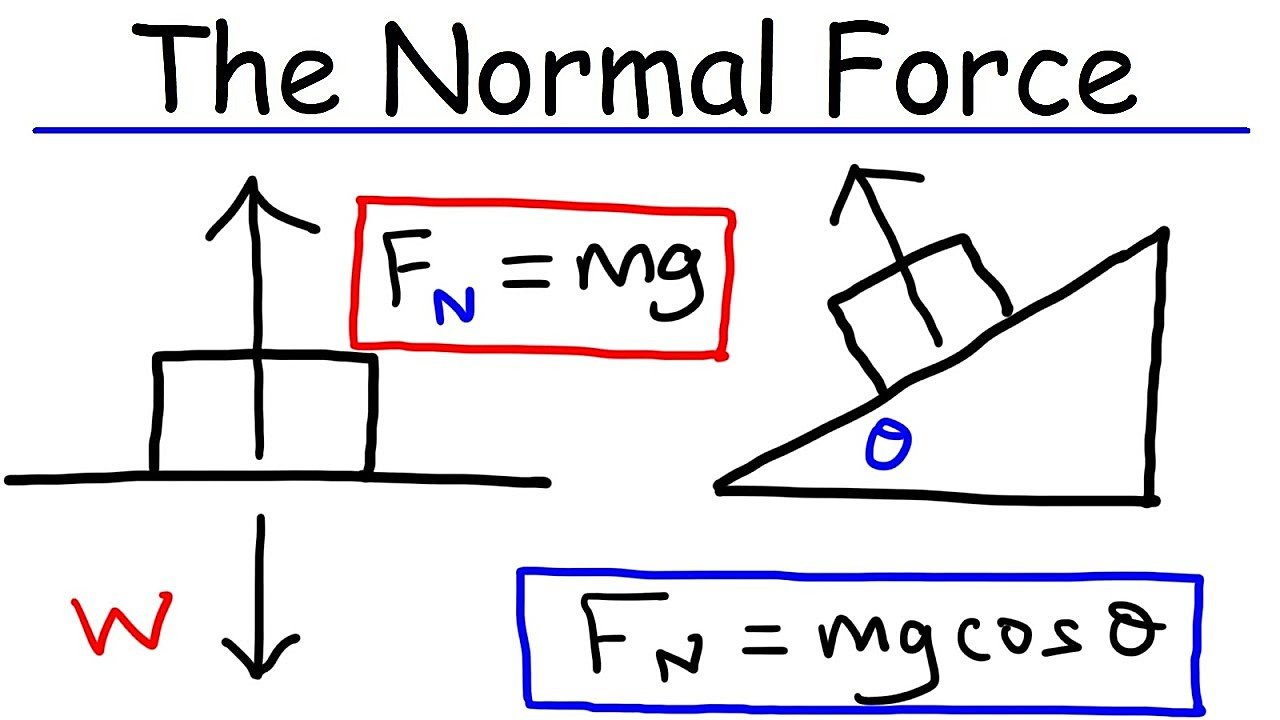
The normal force is the contact force that a surface exerts on an object, directed perpendicular to the surface. The symbol is N or F_N, and the SI unit is the newton (N). The normal force equals mg, if the object rests on a flat surface with no other vertical forces.
For a reliable reference, consult OpenStax section on forces.
How Is the Normal Force Defined?
The normal force is the force that a surface exerts on an object in contact with it, directed perpendicular to the surface. OpenStax defines a supporting force perpendicular to the surface of contact as a normal force. The normal force is the perpendicular component of the contact force, and this component prevents the object from passing through the surface.
Examples of normal force include the push of a table on a book, the push of a floor on a person, and the push of a ramp on a box.
What Is the Symbol for the Normal Force?
The normal force is written as N or F_N. The symbol N for normal force differs from the symbol N for the newton, because normal force is a vector and the newton is a unit.
What Is the Unit of the Normal Force?
The SI unit of normal force is the newton (N). Normal force is a vector quantity with magnitude and direction.
Why Is It Called the Normal Force?
The name comes from the mathematical meaning of normal, which is perpendicular. The name derives from this mathematical meaning. The word does not mean usual or average.
What Is the Direction of the Normal Force?
The normal force points perpendicular to the contact surface, away from the surface. The normal force does not always point vertically, and the normal force does not always equal the weight of an object.
Table 1 lists the normal force direction for 4 surface orientations.
| Surface orientation | Normal force direction | Example |
|---|---|---|
| Horizontal floor | Vertically upward | Book resting on a table |
| Vertical wall | Horizontal, away from the wall | Box pressed against a wall |
| Slope at angle θ | Perpendicular to the slope, tilted θ from vertical | Skier on a hill |
| Horizontal ceiling | Vertically downward | Balloon pressed against a ceiling |
What Is the Normal Force Formula?
The normal force has no single formula, so find the normal force by applying Newton's second law perpendicular to the surface. The normal force has no standalone formula because the force adjusts to the situation. OpenStax finds the normal force on a slope from Newton's second law perpendicular to the slope.
Table 2 lists 4 common cases and the formula for each.
| Case | Formula | Condition |
|---|---|---|
| Flat surface at rest | N = mg | No other vertical forces |
| Slope at angle θ | N = mg cos θ | No other forces perpendicular to the slope |
| Elevator with vertical acceleration a | N = m(g + a) | a is positive upward and negative downward |
| Flat surface with a vertical force F | N = mg + F, or N = mg − F | F points downward in the first formula and upward in the second |
In these formulas, m is mass in kilograms, g is 9.8 m/s², a is acceleration in m/s², and F is force in newtons. In an elevator accelerating upward, the normal force exceeds the weight of a person at rest.
What Are the 5 Steps to Find the Normal Force?
Find the normal force by drawing a free-body diagram, resolving forces perpendicular to the surface, applying Newton's second law, and solving for N. The 5 steps are:
- Draw a free-body diagram of the object.
- Choose axes parallel and perpendicular to the surface.
- Resolve every force into components along the axes.
- Write Newton's second law for the perpendicular axis: ΣF = m × a.
- Solve the equation for N.
The parallel and perpendicular axes simplify slope problems because no motion occurs perpendicular to the slope, and friction acts parallel to the surface.
What Are 6 Examples of Normal Force?
Six examples of normal force are a book on a table, a person on the ground, a box against a wall, a skier on a slope, a passenger in an elevator, and a box under a downward push.
Table 3 lists the given values, normal force, and direction for each example, using g = 9.8 m/s².
| Example | Given values | Normal force | Direction |
|---|---|---|---|
| Book on a table | m = 1 kg | 9.8 N | Upward |
| Person standing on the ground | m = 70 kg | 686 N | Upward |
| Box held against a wall | Horizontal push = 30 N | 30 N | Horizontal, away from the wall |
| Skier on a slope | m = 60 kg; θ = 25° | 533 N | Perpendicular to the slope |
| Passenger in an accelerating elevator | m = 80 kg; a = 1.5 m/s² upward | 904 N | Upward |
| Box with a downward push | m = 10 kg; F = 20 N downward | 118 N | Upward |
How Does the Normal Force Differ From Weight?
The normal force is a contact force from a surface, while weight is the gravitational force from Earth. On a flat surface, the normal force is typically equal in magnitude and opposite in direction to the weight.
Table 4 compares the normal force and weight across 5 attributes.
| Attribute | Normal force | Weight |
|---|---|---|
| Source | Surface in contact with the object | Gravitational pull of Earth |
| Direction | Perpendicular to the surface | Toward the center of Earth |
| Symbol | N or F_N | W or mg |
| Exists without contact | No | Yes |
| Value | Adjusts to the situation | Fixed by mass and g (W = mg) |
How Does the Normal Force Relate to Friction?
Friction is proportional to the normal force through f = μN, where μ is the coefficient of friction. Friction depends directly on the normal force through f = μN. Friction is the component of the contact force parallel to the surface.
A 10 kg box on a flat floor has N = 98 N. With μ = 0.5, the friction force is 0.5 × 98 N = 49 N. Doubling the normal force doubles the friction force.
What Causes the Normal Force?
The normal force arises from electromagnetic interactions between atoms at the contact surfaces. A material resists compression through internal electromagnetic bonds and exerts a force perpendicular to the surface. The normal force results from the Pauli exclusion principle and the interactions of electrons at the surfaces.
A table sags under a load until the elastic restoring force grows as large as the weight of the load.
When Is the Normal Force Zero?
The normal force is 0 N, if the object loses contact with the surface. Examples include a ball in free fall, a passenger in a freely falling elevator, and a roller coaster rider at the top of a loop at the minimum speed v = √(gr).
How Does the Normal Force Relate to Newton's Third Law?
The normal force on an object and the force of the object on the surface form a Newton's third law pair. The reaction to the normal force on a book is the downward force the book exerts on the table. Third-law pairs never act on the same body, so the weight and the normal force on the book are not a pair. The third-law partner of weight is the gravitational force that the object exerts on Earth.
What Are 4 Common Misconceptions About the Normal Force?
Physics education research identifies 4 common misconceptions about the normal force. In an interview study by Clement (1987), 14 of 21 high school students with no prior physics instruction initially said a table does not exert an upward force on a book. Minstrell (1982) found that only half of the students noted that the table exerts an upward force on the book. A university teaching thesis reports that students confuse the weight and the normal force on a block with an action-reaction pair.
Table 5 pairs each misconception with the correct physics.
| Misconception | Correct physics |
|---|---|
| A table or floor exerts no force and only gets in the way | A compressed surface exerts an elastic restoring force on the object |
| The normal force always equals the weight | The normal force equals the weight only without other vertical forces or vertical acceleration |
| The normal force is the reaction to weight | Weight and normal force act on the same object, so they are not a third-law pair |
| The normal force always points upward | The normal force points perpendicular to the surface |
Where Is the Normal Force Applied?
Normal force analysis is applied in 4 fields. The fields and their uses are:
- Civil engineering: designing floors and bridges that support specified loads
- Automotive engineering: calculating tire friction from the normal force on each wheel
- Biomechanics: measuring ground reaction forces with force plates
- Amusement ride design: limiting the normal force on riders in loops and drops
People Also Ask About the Normal Force
What is the normal force in simple terms?
The normal force is the push of a surface on an object that touches the surface.
Is the normal force a contact force?
Yes, the normal force exists only when 2 surfaces touch.
Is the normal force equal to weight?
The normal force equals weight, if the object rests on a flat surface with no other vertical forces and no vertical acceleration.
What is the normal force on an incline?
The normal force on an incline is N = mg cos θ, where θ is the angle of the slope.
Can the normal force be greater than weight?
Yes, the normal force exceeds weight, if the object accelerates upward or if a downward force presses on it.
What does a bathroom scale measure?
A weighing scale measures the normal force, not the gravitational force.
Does the normal force do work?
The normal force does no work on an object sliding along a surface, because the force is perpendicular to the displacement.
How Is the Normal Force Defined? Summary of 5 Key Facts
The 5 key facts about the normal force are:
- The normal force is the perpendicular contact force that a surface exerts on an object.
- The normal force is written as N or F_N and measured in newtons (N).
- The normal force equals mg, if an object rests on a flat surface with no other vertical forces.
- The normal force equals mg cos θ on a slope of angle θ.
- The normal force and weight are not a Newton's third law pair.
Title tag: How to Find Speed: Formula, 5 Steps, and Solved Examples

The University of the West Indies
My passion as a teacher and leader in education is to contribute to students’ enhanced learning by creation of a positive teaching/learning environment, where they are motivated to develop strong critical thinking, analytical and problem-solving skills.
As acting Vice-Principal and head of Physics, I have amassed five years of experience in leading meetings, implementing strategies to maintain discipline and school ethos, liaise with stakeholders in planning for future development of the institution; successfully negotiated the implementation of various projects for student development as well as supervising effective execution of such. For the past 19 years, I have incorporated discovery learning within the classroom through practical activities, problem solving and cooperative learning and have realized that students retention in Physics and Mathematics have increased significantly.
I am always cognizant that students have different learning styles, and as such teaching strategies during planning and delivery must take this crucial factor into consideration and be tailored to meet such differences.