

How to Calculate Acceleration: 7 Formulas and Solved Examples for Velocity, Force, Distance, and Circular Motion
Meta title: How to Calculate Acceleration: 7 Formulas, Units, and Step-by-Step Examples
For a reliable reference, see OpenStax on average and instantaneous acceleration.
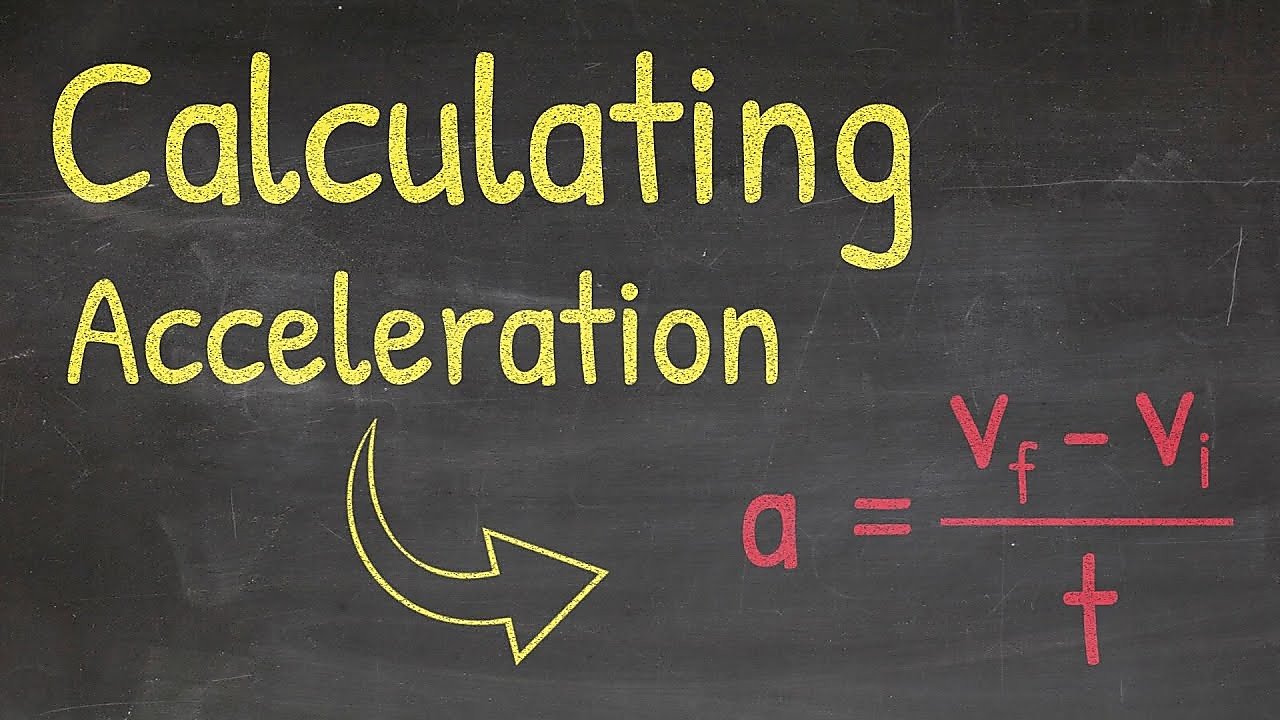
Calculate acceleration by dividing the change in velocity by the change in time (a = Δv/Δt). The result is measured in meters per second squared (m/s²).
What Is Acceleration?
Acceleration is the rate at which the velocity of an object changes with time. Acceleration occurs when an object speeds up, slows down, or changes direction. Examples include a car leaving a stop, a ball falling, and a satellite orbiting Earth.
What Are the Units of Acceleration?
The SI unit of acceleration is the meter per second squared (m/s²). An acceleration of 1 m/s² means velocity changes by 1 m/s every second.
The table below lists 5 units of acceleration. Rows list the units, and columns show the symbol and the equivalent value in m/s².
| Unit | Symbol | Equivalent in m/s² |
|---|---|---|
| Meter per second squared | m/s² | 1 |
| Kilometer per hour per second | km/h/s | 0.2778 |
| Mile per hour per second | mph/s | 0.4470 |
| Foot per second squared | ft/s² | 0.3048 |
| Standard gravity | g | 9.80665 (about 9.81) |
Is Acceleration a Vector or a Scalar?
Acceleration is a vector quantity with magnitude and direction. The direction of acceleration matches the direction of the net force on the object.
What Is the Basic Formula to Calculate Acceleration?
The basic formula for acceleration is a = Δv/Δt = (v_f − v_i)/(t_f − t_i). The formula gives average acceleration over a time interval.
The table below defines each symbol. Rows list the quantities, and columns show the symbol, the meaning, and the SI unit.
| Quantity | Symbol | Meaning | SI Unit |
|---|---|---|---|
| Acceleration | a | Rate of change of velocity | m/s² |
| Final velocity | v_f | Velocity at the end of the interval | m/s |
| Initial velocity | v_i | Velocity at the start of the interval | m/s |
| Time interval | Δt | Final time minus initial time | s |
How Do You Calculate Acceleration Step by Step?
Calculate acceleration from velocity and time in 6 steps:
- Identify the initial velocity.
- Identify the final velocity.
- Measure the time interval.
- Convert all quantities to meters, seconds, and meters per second.
- Subtract the initial velocity from the final velocity.
- Divide the result by the time interval, and keep the sign.
How Do You Calculate the Acceleration of a Car?
Example 1: A car accelerates from rest to 27 m/s (about 97 km/h) in 9 s.
- a = (27 − 0) ÷ 9 = 3 m/s²
How Do You Calculate Deceleration?
Example 2: A car slows from 20 m/s to rest in 5 s.
- a = (0 − 20) ÷ 5 = −4 m/s²
The negative sign shows the acceleration points opposite to the direction of motion.
How Do You Calculate Acceleration From km/h?
Convert km/h to m/s by dividing by 3.6, then apply the formula. Example 3: A car accelerates from 0 to 100 km/h in 8 s.
- Final velocity: 100 ÷ 3.6 = 27.78 m/s
- a = 27.78 ÷ 8 = 3.47 m/s²
How Do You Calculate Acceleration From Force and Mass?
Acceleration equals net force divided by mass (a = F_net/m). The formula comes from Newton's second law, published in 1687. Net force is the vector sum of all forces on the object.
Example 4: A net force of 20 N acts on a 5 kg object.
- a = 20 ÷ 5 = 4 m/s²
Example 5: A 12 kg box receives a 60 N push, and friction exerts 24 N in the opposite direction.
- Net force: 60 − 24 = 36 N
- a = 36 ÷ 12 = 3 m/s²
How Do You Calculate Acceleration Without Time?
Calculate acceleration without time by using a = (v_f² − v_i²)/(2Δx), where Δx is the displacement. The formula applies if acceleration is constant.
Example 6: A car speeds up from 10 m/s to 30 m/s over 80 m.
- a = (30² − 10²) ÷ (2 × 80) = 800 ÷ 160 = 5 m/s²
Example 7: A car brakes from 25 m/s to rest over 50 m.
- a = (0 − 25²) ÷ (2 × 50) = −625 ÷ 100 = −6.25 m/s²
How Do You Calculate Acceleration From Distance and Time?
Calculate acceleration from distance and time by using a = 2Δx/t², if the object starts from rest and acceleration is constant. Galileo Galilei showed in 1638 that distance from rest grows in proportion to the square of time.
Example 8: An object starting from rest travels 45 m in 3 s.
- a = 2 × 45 ÷ 3² = 90 ÷ 9 = 10 m/s²
If the object has an initial velocity, use a = 2(Δx − v_i t)/t². Example 9: An object with v_i = 4 m/s travels 60 m in 5 s.
- a = 2 × (60 − 4 × 5) ÷ 5² = 80 ÷ 25 = 3.2 m/s²
How Do You Calculate Acceleration From a Velocity-Time Graph?
Calculate acceleration from a velocity-time graph by finding the slope of the line, which equals rise divided by run. A steeper slope indicates a larger acceleration.
Example 10: A graph passes through (2 s, 6 m/s) and (6 s, 18 m/s).
- a = (18 − 6) ÷ (6 − 2) = 12 ÷ 4 = 3 m/s²
The area under a velocity-time graph equals displacement. A curved line indicates changing acceleration, and the slope of the tangent at a point gives the acceleration at that instant.
How Do You Calculate Acceleration Using Calculus?
Calculate instantaneous acceleration as the first derivative of velocity or the second derivative of position (a = dv/dt = d²x/dt²). Calculus applies when acceleration changes with time.
Example 11: The position of an object is x(t) = 3t³ − 2t² + 5t, in meters.
- Velocity: v = dx/dt = 9t² − 4t + 5
- Acceleration: a = dv/dt = 18t − 4
- At t = 2 s: a = 18 × 2 − 4 = 32 m/s²
How Do You Calculate Centripetal Acceleration?
Calculate centripetal acceleration with a_c = v²/r = ω²r, where v is speed, r is the radius of the circular path, and ω is angular speed. The acceleration points toward the center of the circle. An object moving at constant speed on a circle still accelerates because its direction changes.
Example 12: A car travels at 20 m/s on a curve with a radius of 50 m.
- a_c = 20² ÷ 50 = 400 ÷ 50 = 8 m/s²
- Check with ω = v/r = 0.4 rad/s: a_c = 0.4² × 50 = 8 m/s²
How Do You Calculate Angular Acceleration?
Calculate angular acceleration with α = Δω/Δt or α = τ/I, where ω is angular speed, τ is torque, and I is rotational inertia. The SI unit is radians per second squared (rad/s²).
Example 13: A wheel speeds up from rest to 12 rad/s in 4 s.
- α = (12 − 0) ÷ 4 = 3 rad/s²
- Torque check: τ = 6 N·m and I = 2 kg·m² give α = 6 ÷ 2 = 3 rad/s²
How Do You Calculate Acceleration Due to Gravity?
Calculate gravitational acceleration with g = GM/r², where G is the gravitational constant, M is the mass of the body, and r is the distance from its center. Near Earth's surface, g is about 9.81 m/s². The 3rd General Conference on Weights and Measures defined standard gravity as 9.80665 m/s² in 1901.
Example 14: Earth has M = 5.972 × 10²⁴ kg and a mean radius of 6.371 × 10⁶ m.
- g = (6.674 × 10⁻¹¹ × 5.972 × 10²⁴) ÷ (6.371 × 10⁶)² = 9.82 m/s²
The table below lists surface gravity for 4 bodies. Rows list the bodies, and columns show the acceleration due to gravity.
| Body | Surface Gravity (m/s²) |
|---|---|
| Earth | 9.81 |
| Moon | 1.62 |
| Mars | 3.71 |
| Jupiter | 24.8 |
Example 15: An object falls from rest for 3 s near Earth's surface, and air resistance is negligible.
- Speed: v = gt = 9.81 × 3 = 29.4 m/s
- Distance: Δx = ½gt² = ½ × 9.81 × 3² = 44.1 m
What Is the Difference Between Average and Instantaneous Acceleration?
Average acceleration is the change in velocity over a finite time interval, and instantaneous acceleration is the acceleration at a single moment. Average acceleration uses a = Δv/Δt. Instantaneous acceleration uses a = dv/dt, the limit of Δv/Δt as Δt approaches zero.
What Does Negative Acceleration Mean?
Negative acceleration means the acceleration points in the negative direction of the chosen axis. The object slows down if acceleration and velocity have opposite signs. The table below shows the 4 sign combinations. Rows list the combinations, and columns show the effect on speed.
| Velocity Sign | Acceleration Sign | Effect on Speed |
|---|---|---|
| Positive | Positive | Speeds up |
| Positive | Negative | Slows down |
| Negative | Negative | Speeds up |
| Negative | Positive | Slows down |
Which Acceleration Formula Applies to Which Situation?
Select the formula that contains the known quantities and the unknown acceleration. The table below summarizes 7 formulas. Rows list the known quantities, and columns show the formula and the result from the examples above.
| Known Quantities | Formula | Example Result |
|---|---|---|
| Initial velocity, final velocity, time | a = (v_f − v_i)/Δt | 3 m/s² (Example 1) |
| Net force, mass | a = F_net/m | 4 m/s² (Example 4) |
| Initial velocity, final velocity, distance | a = (v_f² − v_i²)/(2Δx) | 5 m/s² (Example 6) |
| Distance, time, start from rest | a = 2Δx/t² | 10 m/s² (Example 8) |
| Speed, radius of circular path | a_c = v²/r | 8 m/s² (Example 12) |
| Change in angular speed, time | α = Δω/Δt | 3 rad/s² (Example 13) |
| Position as a function of time | a = d²x/dt² | 32 m/s² at t = 2 s (Example 11) |
What Are Common Mistakes When Calculating Acceleration?
Research on student understanding shows that velocity and acceleration are often confused. Trowbridge and McDermott (1981) documented difficulties among introductory physics students in distinguishing the 2 concepts.
The table below lists 6 mistakes. Rows show each mistake, and columns show the error and the correct approach.
| Mistake | Error | Correct Approach |
|---|---|---|
| Unit mismatch | Using km/h with seconds | Convert km/h to m/s by dividing by 3.6 |
| Sign error | Dropping the negative sign in deceleration | Keep the sign, and define the positive direction first |
| Time exponent | Dividing displacement by t instead of t² | Use a = 2Δx/t² for motion from rest |
| Force choice | Using applied force instead of net force | Subtract opposing forces such as friction first |
| Variable acceleration | Applying constant-acceleration formulas when acceleration changes | Use calculus or a graph slope |
| Speed and velocity | Assuming constant speed means zero acceleration | Include direction, because circular motion at constant speed accelerates |
People Also Ask About How to Calculate Acceleration
What Is the Formula for Acceleration?
The formula for acceleration is a = Δv/Δt, the change in velocity divided by the change in time.
How Do You Calculate Acceleration With Mass and Force?
Divide the net force by the mass (a = F_net/m).
How Do You Calculate Acceleration With Distance and Time?
Use a = 2Δx/t² for motion from rest at constant acceleration.
How Do You Calculate Acceleration Without Time?
Use a = (v_f² − v_i²)/(2Δx) with the velocities and the displacement.
What Is the Unit of Acceleration?
The SI unit of acceleration is the meter per second squared (m/s²).
Can Acceleration Be Negative?
Yes, negative acceleration points in the negative direction of the chosen axis, and it slows an object that moves in the positive direction.
What Is the Acceleration Due to Gravity?
The acceleration due to gravity near Earth's surface is about 9.81 m/s².
What Is the Main Summary of How to Calculate Acceleration?
Calculate acceleration by dividing the change in velocity by the change in time, and select other formulas based on the known quantities. There are 6 key facts:
- The basic formula is a = Δv/Δt, with the unit m/s².
- The force formula is a = F_net/m.
- Acceleration without time uses a = (v_f² − v_i²)/(2Δx).
- Acceleration from rest uses a = 2Δx/t², and a velocity-time graph gives acceleration as slope.
- Centripetal acceleration uses a_c = v²/r, and calculus gives a = d²x/dt².
- Near Earth's surface, free-fall acceleration is about 9.81 m/s².
Sources:
- Isaac Newton, Philosophiæ Naturalis Principia Mathematica (1687)
- Galileo Galilei, Discourses and Mathematical Demonstrations Relating to Two New Sciences (1638)
- Bureau International des Poids et Mesures (BIPM), The International System of Units (SI Brochure), definition of standard gravity (3rd CGPM, 1901)
- Trowbridge, D. E., and McDermott, L. C. (1981), "Investigation of student understanding of the concept of acceleration in one dimension," American Journal of Physics, volume 49

The University of the West Indies
My passion as a teacher and leader in education is to contribute to students’ enhanced learning by creation of a positive teaching/learning environment, where they are motivated to develop strong critical thinking, analytical and problem-solving skills.
As acting Vice-Principal and head of Physics, I have amassed five years of experience in leading meetings, implementing strategies to maintain discipline and school ethos, liaise with stakeholders in planning for future development of the institution; successfully negotiated the implementation of various projects for student development as well as supervising effective execution of such. For the past 19 years, I have incorporated discovery learning within the classroom through practical activities, problem solving and cooperative learning and have realized that students retention in Physics and Mathematics have increased significantly.
I am always cognizant that students have different learning styles, and as such teaching strategies during planning and delivery must take this crucial factor into consideration and be tailored to meet such differences.