

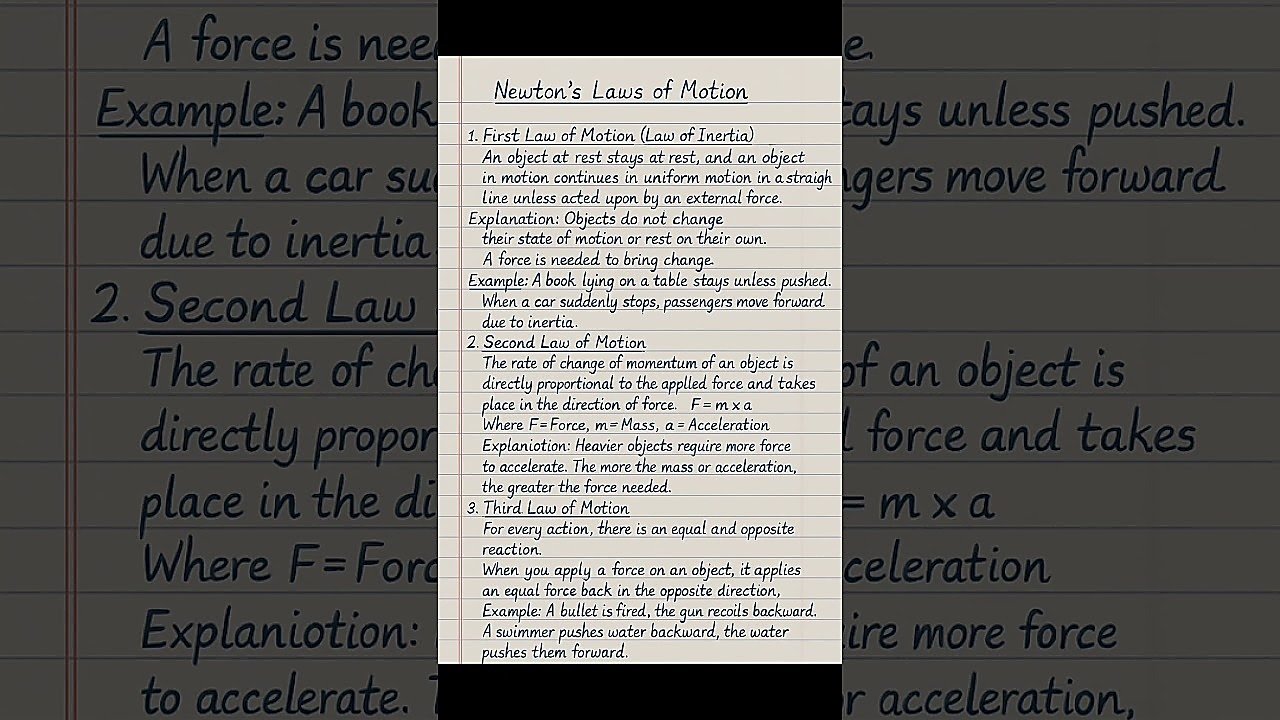
Newton's First Law of Motion Explained: The Law of Inertia, 3 Types of Inertia, and 15 Examples of Balanced Forces
Meta title: Newton's First Law of Motion Explained: Law of Inertia, Formula, and 15 Examples
For a reliable reference, see OpenStax on forces and Newton’s laws.
Newton's first law of motion states that an object stays at rest or keeps moving at constant velocity, if the net force on the object is zero. The law is also called the law of inertia.
What Is Newton's First Law of Motion?
Newton's first law of motion states that an object remains at rest or in uniform motion in a straight line unless a net external force acts on it. Isaac Newton published the law in 1687 in Philosophiæ Naturalis Principia Mathematica. Examples include a book resting on a table, a hockey puck sliding on ice, and a spacecraft coasting between planets.
What Is the Formula for Newton's First Law?
The formula for Newton's first law is ΣF = 0, which gives a = 0 and constant velocity. The symbol ΣF is the net force, the vector sum of all forces on the object. The symbol a is acceleration.
The table below shows the 3 cases that follow from the law. Rows list the net force, and columns show the initial condition and the result.
| Net Force | Initial Condition | Result |
|---|---|---|
| Zero | At rest (v = 0) | The object stays at rest |
| Zero | Moving at constant velocity | The object keeps the same speed and direction |
| Not zero | Any condition | Velocity changes, and Newton's second law applies |
What Is Inertia?
Inertia is the tendency of an object to resist changes in its state of motion. Mass measures inertia, and the SI unit of mass is the kilogram (kg). A larger mass requires a larger force for the same acceleration.
The table below shows the force needed to produce an acceleration of 2 m/s² (F = ma). Rows list the objects, and columns show the mass and the force.
| Object | Mass | Force for a = 2 m/s² |
|---|---|---|
| Book | 1 kg | 2 N |
| Cyclist and bicycle | 80 kg | 160 N |
| Car | 1,000 kg | 2,000 N |
What Are the 3 Types of Inertia?
The 3 types of inertia describe resistance to a change in rest, motion, or direction:
- Inertia of rest: a passenger leans backward when a stationary bus starts moving.
- Inertia of motion: a passenger leans forward when a moving bus brakes.
- Inertia of direction: a passenger slides toward the outside edge when a car turns sharply.
What Is Net Force?
Net force is the vector sum of all forces acting on an object. Forces are balanced if the net force is zero. A 10 N push to the right and a 10 N push to the left on the same box give a net force of 0 N.
Who Discovered the First Law of Motion?
Galileo Galilei and René Descartes developed the idea of inertia before Isaac Newton stated it as Law I in 1687. Aristotle held the opposite view in the 4th century BCE.
The table below shows 4 contributors. Rows list the scientists, and columns show the year and the contribution.
| Scientist | Year | Contribution |
|---|---|---|
| Aristotle | 4th century BCE | Taught that a continuing force is required to keep an object moving |
| Galileo Galilei | 1632 and 1638 | Showed that motion on a smooth horizontal surface persists as friction decreases |
| René Descartes | 1644 | Stated that a body keeps its state of motion in a straight line |
| Isaac Newton | 1687 | Published the law of inertia as the first of 3 laws of motion |
What Are Examples of Newton's First Law in Daily Life?
Daily life examples of Newton's first law include a book on a table, a coin on a card, and a pulled tablecloth. The table below lists 5 examples. Rows list the examples, and columns show the forces and the observed behavior.
| Example | Forces | Observed Behavior |
|---|---|---|
| Book on a table | Weight balances the normal force | The book stays at rest |
| Coin on a card over a glass | Flicked card has friction on the coin for a brief time | The coin stays in place and drops into the glass |
| Tablecloth pulled quickly | Friction acts on the dishes for a very short time | The dishes stay at rest |
| Beating dust from a carpet | The stick stops the carpet | The dust keeps moving and leaves the carpet |
| Shaking a ketchup bottle downward | The hand stops the bottle | The ketchup keeps moving and leaves the bottle |
What Are Examples of Newton's First Law in Transportation?
Transportation examples include passengers in braking buses, turning cars, cruising cars, and elevators. The table below lists 5 examples. Rows list the examples, and columns show the type of inertia or force balance and the observed behavior.
| Example | Type or Balance | Observed Behavior |
|---|---|---|
| Bus starts moving | Inertia of rest | Passengers lean backward |
| Bus brakes | Inertia of motion | Passengers lean forward |
| Car turns sharply | Inertia of direction | Passengers slide toward the outside of the turn |
| Car cruising at 20 m/s on a level road | Engine force equals drag and friction | Velocity stays constant |
| Elevator rising at constant velocity | Cable tension equals weight | Velocity stays constant |
What Are Examples of Newton's First Law in Sports?
Sports examples include sliding pucks, sliding stones, and tripping runners. The table below lists 3 examples. Rows list the examples, and columns show the forces and the observed behavior.
| Example | Forces | Observed Behavior |
|---|---|---|
| Hockey puck on ice | Friction is very small | The puck slides at nearly constant velocity |
| Curling stone | Friction is small | The stone glides across the ice for several seconds |
| Runner tripping | Obstacle stops the feet | The upper body keeps moving forward |
What Are Examples of Newton's First Law in Space?
Space examples include coasting spacecraft and released tools. The table below lists 2 examples. Rows list the examples, and columns show the forces and the observed behavior.
| Example | Forces | Observed Behavior |
|---|---|---|
| Spacecraft with engines off, far from planets | Gravity and drag are very small | The spacecraft keeps constant velocity |
| Tool released by an astronaut in deep space | No net force | The tool moves at constant velocity |
How Do You Solve Newton's First Law Problems?
Solve first law problems by setting the net force to zero and solving for the unknown force. The method has 5 steps:
- Draw a free-body diagram of the object.
- List all forces with their directions.
- Confirm that the velocity is constant or zero.
- Set ΣF = 0 along each axis.
- Solve for the unknown force.
How Do You Find Friction When a Box Moves at Constant Velocity?
Example 1: A person pushes a box with a 30 N force, and the box moves at constant velocity. The normal force is 100 N.
- Net force: 30 N − f = 0, so f = 30 N
- Coefficient of kinetic friction: μ = f ÷ N = 30 ÷ 100 = 0.30
How Do You Find the Tension in an Elevator Cable?
Example 2: An 800 kg elevator moves upward at constant velocity.
- Net force: T − mg = 0
- Tension: T = 800 × 9.81 = 7,848 N
How Far Does an Object Travel Under Zero Net Force?
Example 3: A 1,500 kg car moves at 20 m/s on a level road with zero net force.
- Acceleration: 0 m/s²
- Distance in 10 s: 20 × 10 = 200 m
What Is the Difference Between Balanced and Unbalanced Forces?
Balanced forces give zero net force and constant velocity, and unbalanced forces give nonzero net force and changing velocity. The table below compares them. Rows list the properties, and columns show the values for each type.
| Property | Balanced Forces | Unbalanced Forces |
|---|---|---|
| Net force | 0 N | Not 0 N |
| Acceleration | 0 m/s² | a = F/m |
| Velocity | Constant | Changes |
| Example | Book on a table | Ball falling in air |
| Governing law | First law | Second law |
What Is an Inertial Reference Frame?
An inertial reference frame is a frame in which Newton's first law holds. Frames at rest or moving at constant velocity are inertial. Earth's surface is approximately inertial for most problems.
An accelerating bus is a non-inertial frame. A 60 kg passenger in a bus accelerating at 2 m/s² feels a backward push equal to ma = 60 × 2 = 120 N in the bus frame. The push is a fictitious force, and no object exerts it.
What Is the Difference Between the First Law and the Second Law?
The first law describes motion when net force is zero, and the second law quantifies acceleration when net force is not zero. The table below compares the 2 laws. Rows list the features, and columns show the details for each law.
| Feature | First Law | Second Law |
|---|---|---|
| Condition | ΣF = 0 | ΣF ≠ 0 |
| Equation | a = 0 | ΣF = ma |
| Result | Constant velocity | Acceleration |
| Role | Defines inertial frames and inertia | Calculates acceleration from force and mass |
The first law is the zero-force case of the second law in equations. The first law also identifies the inertial frames in which the second law holds.
How Is Newton's First Law Used in Safety and Engineering?
Newton's first law guides designs that protect objects and people from sudden changes in motion. There are 5 main applications:
- Seat belts: restrain passengers who continue forward when a vehicle stops.
- Headrests: limit head motion backward when a vehicle is struck from behind.
- Airbags: slow forward motion of occupants over a longer time.
- Cargo restraints: hold loads in place during braking and turns.
- Spacecraft coasting: reduce fuel use between engine burns.
What Are Common Misconceptions About Newton's First Law?
Studies of introductory physics students document the belief that motion requires a continuing force. McCloskey (1983) described this impetus belief, and the Force Concept Inventory by Hestenes, Wells, and Swackhamer (1992) tests it.
The table below lists 5 misconceptions. Rows show each misconception, and columns show the incorrect belief and the correct fact.
| Misconception | Incorrect Belief | Correct Fact |
|---|---|---|
| Force and motion | A force is required to keep an object moving | Constant velocity requires zero net force |
| Slowing down | Objects slow down naturally | Friction and air resistance slow objects |
| Objects at rest | An object at rest has no forces on it | Forces are balanced, and the net force is zero |
| Nature of inertia | Inertia is a force | Inertia is a property of mass |
| Speed and inertia | Faster objects have more inertia | Inertia depends only on mass, and momentum depends on mass and speed |
People Also Ask About the First Law of Motion
What Is Newton's First Law in Simple Words?
An object keeps its current motion, whether at rest or at constant velocity, unless a net force changes it.
Why Is the First Law Called the Law of Inertia?
The law describes inertia, the resistance of an object to changes in its motion.
Who Gave the First Law of Motion?
Isaac Newton published the first law in 1687, building on the work of Galileo and Descartes.
What Is an Example of the First Law of Motion?
A passenger leans forward when a moving bus brakes suddenly.
Does the First Law Apply in Space?
Yes, a spacecraft far from planets keeps constant velocity because the net force is very small.
Why Do Objects Slow Down if the First Law Says They Keep Moving?
Friction and air resistance exert a net force that reduces the velocity.
What Is the Formula for Newton's First Law?
The formula is ΣF = 0, which gives a = 0.
What Is the Main Summary of Newton's First Law of Motion?
Newton's first law of motion states that an object keeps its state of motion, if the net force is zero. There are 6 key facts:
- The formula is ΣF = 0, which gives constant velocity.
- Inertia is resistance to changes in motion, and mass measures it.
- The 3 types of inertia are rest, motion, and direction.
- Balanced forces keep velocity constant, and unbalanced forces change it.
- The law holds in inertial reference frames.
- Seat belts, headrests, and airbags apply the law.
Sources:
- Isaac Newton, Philosophiæ Naturalis Principia Mathematica (1687)
- Galileo Galilei, Dialogue Concerning the Two Chief World Systems (1632) and Two New Sciences (1638)
- René Descartes, Principles of Philosophy (1644)
- NASA Glenn Research Center, Newton's Laws of Motion educational pages
- McCloskey, M. (1983), "Intuitive Physics," Scientific American, volume 248
- Hestenes, D., Wells, M., and Swackhamer, G. (1992), "Force Concept Inventory," The Physics Teacher, volume 30

The University of the West Indies
My passion as a teacher and leader in education is to contribute to students’ enhanced learning by creation of a positive teaching/learning environment, where they are motivated to develop strong critical thinking, analytical and problem-solving skills.
As acting Vice-Principal and head of Physics, I have amassed five years of experience in leading meetings, implementing strategies to maintain discipline and school ethos, liaise with stakeholders in planning for future development of the institution; successfully negotiated the implementation of various projects for student development as well as supervising effective execution of such. For the past 19 years, I have incorporated discovery learning within the classroom through practical activities, problem solving and cooperative learning and have realized that students retention in Physics and Mathematics have increased significantly.
I am always cognizant that students have different learning styles, and as such teaching strategies during planning and delivery must take this crucial factor into consideration and be tailored to meet such differences.