

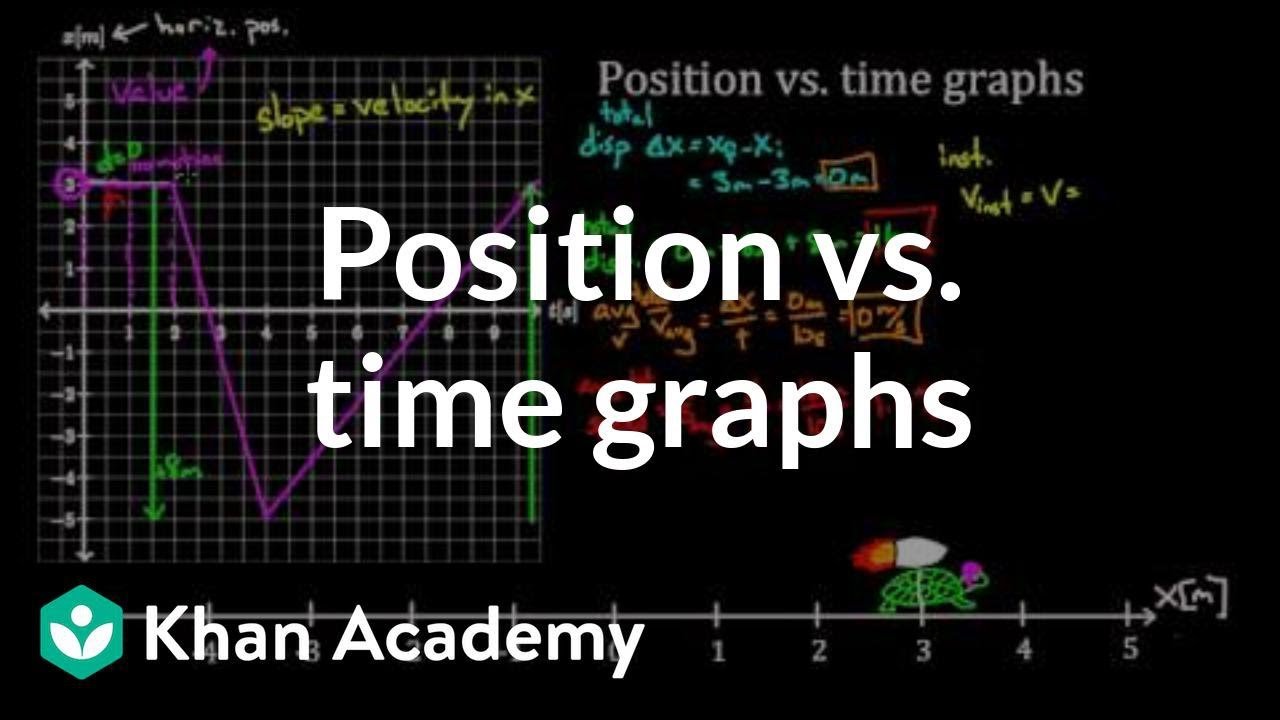
Position Time Graph to Velocity Time Graph: How to Convert Between Both Graphs
The slope of a position time graph at any point equals the velocity at that moment. To convert a position time graph to a velocity time graph, calculate the slope of each section and plot those values on the velocity time graph’s y-axis at the corresponding times. For the equations behind constant-acceleration graph problems, see the SUVAT equations guide.
For a supporting reference, Khan Academy’s position vs. time graphs guide explains how slope on a position-time graph represents velocity.
What Is the Relationship Between a Position Time Graph and a Velocity Time Graph?
The slope of a position time graph gives velocity. The y-axis value of a velocity time graph gives position change per unit time. These 2 graphs describe the same motion from different perspectives.
On a position time graph, the y-axis shows position in metres (m) and the x-axis shows time in seconds (s). On a velocity time graph, the y-axis shows velocity in metres per second (m/s) and the x-axis shows time in seconds (s).
How Do You Calculate Velocity from a Position Time Graph?
Velocity equals the slope of the position time graph, calculated using the formula: v = Δx / Δt, where Δx is the change in position and Δt is the change in time.
Select 2 points on the line, read their position and time values from the axes, and apply the formula:
v = (x₂ – x₁) / (t₂ – t₁)
For example: a position time graph shows position increasing from 0 m at t = 0 s to 15 m at t = 3 s.
v = (15 – 0) / (3 – 0) = 5 m/s
This value of 5 m/s becomes the y-axis value on the velocity time graph across that 3-second interval.
What Does Each Line Shape on a Position Time Graph Produce on a Velocity Time Graph?
There are 5 position time graph shapes, each producing a distinct line on the velocity time graph. The table below shows every conversion.
| Position Time Graph Line | Slope Value | Velocity Time Graph Line |
|---|---|---|
| Straight line, positive slope | Constant positive | Horizontal line above x-axis |
| Straight line, negative slope | Constant negative | Horizontal line below x-axis |
| Horizontal line (flat) | Zero | Horizontal line on x-axis (v = 0) |
| Curve, concave up (steepening) | Increasing positive | Straight line sloping upward |
| Curve, concave down (flattening) | Decreasing positive | Straight line sloping downward |
A straight line on a position time graph always produces a horizontal line on the velocity time graph. A curve on a position time graph always produces a sloped straight line on the velocity time graph, assuming uniform acceleration.
How Do You Convert a Position Time Graph to a Velocity Time Graph Step by Step?
Converting a position time graph to a velocity time graph follows 5 steps.
- Split the position time graph into separate sections. Each section is a segment where the line shape is consistent: straight, curved, or flat.
- Identify the slope of each section. Determine whether it is positive, negative, or zero, and whether it is constant or changing.
- Calculate the slope numerically for each straight-line section using v = Δx / Δt.
- Plot each slope value as a horizontal line on the velocity time graph across the same time interval.
- For curved sections, note whether the slope is increasing or decreasing and draw a sloped line on the velocity time graph in the corresponding direction.
How to Convert a Position Time Graph to a Velocity Time Graph: Worked Example
Consider a position time graph with 3 sections over 8 seconds.
Section 1: Constant Positive Slope (0 s to 3 s)
Position increases from 0 m to 12 m in 3 seconds.
Slope = (12 – 0) / (3 – 0) = 4 m/s
On the velocity time graph: draw a horizontal line at v = 4 m/s from t = 0 s to t = 3 s.
Section 2: Zero Slope (3 s to 5 s)
Position stays constant at 12 m. The line is flat.
Slope = 0 m/s
On the velocity time graph: draw a horizontal line at v = 0 m/s from t = 3 s to t = 5 s.
Section 3: Constant Negative Slope (5 s to 8 s)
Position decreases from 12 m to 0 m in 3 seconds.
Slope = (0 – 12) / (8 – 5) = -12 / 3 = -4 m/s
On the velocity time graph: draw a horizontal line at v = -4 m/s from t = 5 s to t = 8 s.
What Does a Curved Position Time Graph Look Like on a Velocity Time Graph?
A curved position time graph produces a sloped straight line on the velocity time graph, provided the acceleration is uniform. There are 2 types of curve.
- Concave up curve (slope increasing): the position time graph steepens over time. Velocity is increasing. On the velocity time graph, this produces a straight line with a positive slope.
- Concave down curve (slope decreasing): the position time graph flattens over time. Velocity is decreasing. On the velocity time graph, this produces a straight line with a negative slope.
To find velocity at a specific point on a curve, draw a tangent line at that point and calculate its slope. The slope of the tangent line on a position time graph represents the instantaneous velocity at that moment.
What Does a Parabola on a Position Time Graph Look Like on a Velocity Time Graph?
A parabola on a position time graph produces a straight diagonal line on the velocity time graph. This is because a parabola has a slope that increases or decreases at a constant rate, meaning acceleration is constant.
There are 2 cases.
- Upward parabola (concave up, increasing slope): the object accelerates in the positive direction. The velocity time graph shows a straight line with a positive slope, starting from the initial velocity at t = 0.
- Downward parabola (concave down, decreasing slope): the object decelerates. The velocity time graph shows a straight line with a negative slope.
For example, an object in free fall follows a parabolic position time graph. On the velocity time graph, this appears as a straight line with slope -9.8 m/s², representing constant gravitational acceleration.
What Are the 3 Rules for Converting Any Position Time Graph to a Velocity Time Graph?
There are 3 rules that apply to every conversion.
- Slope becomes y-value: the slope of the position time graph at any time equals the y-axis value (velocity) on the velocity time graph at that same time.
- Constant slope becomes flat line: any straight-line section on a position time graph becomes a horizontal line on the velocity time graph. The height of that horizontal line equals the slope of the position time graph section.
- Changing slope becomes a sloped line: any curved section on a position time graph becomes a sloped straight line on the velocity time graph. A steepening curve produces an upward slope. A flattening curve produces a downward slope.
What Is the Difference Between a Position Time Graph and a Velocity Time Graph?
A position time graph and a velocity time graph each reveal different information about the same motion. There are 4 key differences.
| Feature | Position Time Graph | Velocity Time Graph |
|---|---|---|
| Y-axis quantity | Position (m) | Velocity (m/s) |
| Slope represents | Velocity (m/s) | Acceleration (m/s²) |
| Flat horizontal line means | Object at rest | Constant velocity |
| Area under graph | Not directly useful | Displacement (m) |
What Are Common Errors When Converting from a Position Time Graph to a Velocity Time Graph?
There are 4 errors that occur frequently during conversion.
- Plotting position values instead of slope values: the y-axis of the velocity time graph shows slope, not position. Do not copy position values directly onto the velocity time graph.
- Missing sign changes: a slope changing from positive to negative on the position time graph means the object reversed direction. The velocity time graph line must cross the x-axis at that point.
- Ignoring turning points: a peak or trough on a position time graph means velocity = 0 at that moment. The velocity time graph must touch the x-axis at the same time.
- Confusing a curve with a straight line: a straight line on a position time graph produces a flat horizontal line on the velocity time graph, not a diagonal one. Only a curved position time graph produces a sloped line on the velocity time graph.

The University of the West Indies
My passion as a teacher and leader in education is to contribute to students’ enhanced learning by creation of a positive teaching/learning environment, where they are motivated to develop strong critical thinking, analytical and problem-solving skills.
As acting Vice-Principal and head of Physics, I have amassed five years of experience in leading meetings, implementing strategies to maintain discipline and school ethos, liaise with stakeholders in planning for future development of the institution; successfully negotiated the implementation of various projects for student development as well as supervising effective execution of such. For the past 19 years, I have incorporated discovery learning within the classroom through practical activities, problem solving and cooperative learning and have realized that students retention in Physics and Mathematics have increased significantly.
I am always cognizant that students have different learning styles, and as such teaching strategies during planning and delivery must take this crucial factor into consideration and be tailored to meet such differences.