

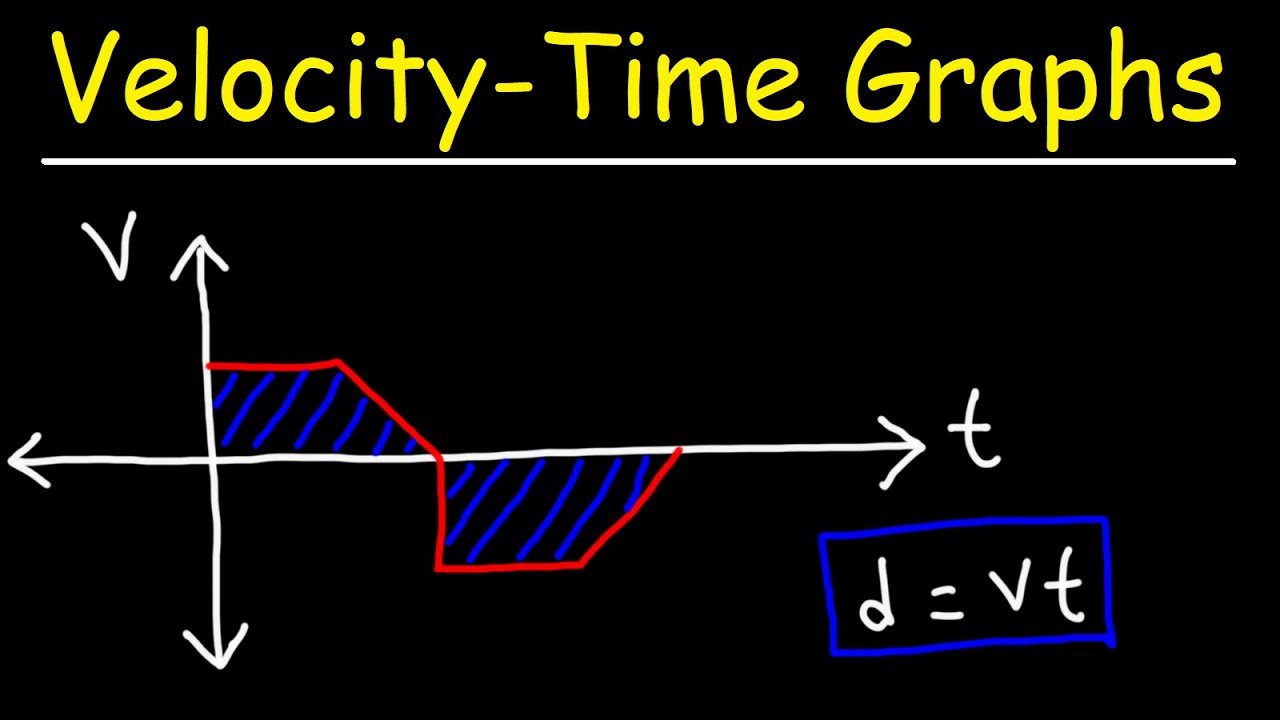
How to Find Distance / Displacement from a Velocity Time Graph: 3 Area Methods with Worked Examples
The area under a velocity time graph equals the distance (GB) or displacement (US) of the object during that time interval. The shape formed between the graph line and the x-axis determines which area formula to use. There are 3 shapes: rectangles, triangles, and trapezoids. That displacement is the s variable in the SUVAT equations.
For a supporting reference, The Physics Classroom’s velocity-time graph displacement tutorial explains how area under a velocity-time graph gives displacement.
What Does the Area Under a Velocity Time Graph Represent?
The area under a velocity time graph represents how far an object has travelled during a given time period. In UK curricula (GCSE Physics), this is called distance. In US curricula (AP Physics), it is called displacement. Both terms refer to the same calculated value when the object moves in one direction only.
The unit of the area is always metres (m). This comes from multiplying the y-axis unit (m/s) by the x-axis unit (s), giving m/s × s = m.
What Is the Difference Between Distance and Displacement on a Velocity Time Graph?
Distance and displacement are equal on a velocity time graph when the object moves in one direction only. They differ when the graph line crosses the x-axis, indicating a change in direction.
There are 2 outcomes to distinguish:
- Net displacement (US) or net distance (GB): positive areas minus negative areas. This gives the overall change in position from start to finish.
- Total distance: the sum of all areas, treating areas below the x-axis as positive. This gives the full length of path travelled regardless of direction.
What Are the 3 Shapes Formed Under a Velocity Time Graph?
The shape formed under a velocity time graph depends on whether velocity is constant, increasing from zero, or changing between 2 non-zero values. There are 3 main shapes. These are rectangles, triangles, and trapezoids.
| Shape | When It Appears | Area Formula |
|---|---|---|
| Rectangle | Constant velocity (horizontal line) | base × height |
| Triangle | Velocity starts or ends at zero (line from/to axis) | ½ × base × height |
| Trapezoid | Velocity changes between 2 non-zero values | ½ × (v₁ + v₂) × t |
How Do You Find Distance from a Velocity Time Graph Using a Rectangle?
A rectangle forms under a velocity time graph when the object travels at constant velocity. The area equals base multiplied by height, where base is the time interval and height is the velocity.
Worked example: An object travels at a constant velocity of 30 m/s for 6 seconds.
- Shape: rectangle
- Base = 6 s
- Height = 30 m/s
- Area = 6 × 30 = 180 m
The object travels a distance of 180 metres during those 6 seconds.
How Do You Find Displacement from a Velocity Time Graph Using a Triangle?
A triangle forms when velocity increases from zero (or decreases to zero) and the graph line begins or ends at the x-axis. The area equals ½ multiplied by base multiplied by height.
Worked example: An object accelerates uniformly from 0 m/s to 20 m/s over 4 seconds.
- Shape: triangle
- Base = 4 s
- Height = 20 m/s
- Area = ½ × 4 × 20 = 40 m
The displacement of the object over those 4 seconds is 40 metres.
A triangle also forms during deceleration to rest. If an object slows from 16 m/s to 0 m/s over 8 seconds, displacement = ½ × 8 × 16 = 64 m.
How Do You Calculate the Area Under a Velocity Time Graph for a Trapezoid?
A trapezoid forms when the object accelerates or decelerates uniformly between 2 non-zero velocity values. The area formula is ½ × (v₁ + v₂) × t, where v₁ is the initial velocity, v₂ is the final velocity, and t is the time interval.
Worked example: An object accelerates from 3 m/s to 10 m/s over 5 seconds.
- Shape: trapezoid
- v₁ = 3 m/s, v₂ = 10 m/s, t = 5 s
- Area = ½ × (3 + 10) × 5 = ½ × 13 × 5 = 32.5 m
The displacement of the object over those 5 seconds is 32.5 metres.
How Do You Split a Trapezoid into a Rectangle and Triangle?
The trapezoid method has an alternative. Split the trapezoid into a rectangle (the lower section at the initial velocity) and a triangle (the upper section representing the increase in velocity).
Using the same example (3 m/s to 10 m/s over 5 seconds):
- Rectangle: 3 × 5 = 15 m
- Triangle: ½ × (10 – 3) × 5 = ½ × 7 × 5 = 17.5 m
- Total: 15 + 17.5 = 32.5 m
Both methods give the same result. Use whichever is easier to identify visually from the graph.
How Do You Find Displacement When the Graph Has Multiple Sections?
When a velocity time graph has multiple sections, split the graph into individual shapes and calculate the area of each one separately. The total displacement or distance is the sum of all individual areas.
Worked example: A car journey has 3 phases over 10 seconds.
- Phase 1 (0 to 3 s): accelerates from 0 to 12 m/s (triangle)
Area = ½ × 3 × 12 = 18 m
- Phase 2 (3 to 7 s): constant velocity at 12 m/s (rectangle)
Area = 4 × 12 = 48 m
- Phase 3 (7 to 10 s): decelerates from 12 m/s to 0 m/s (triangle)
Area = ½ × 3 × 12 = 18 m
Total displacement = 18 + 48 + 18 = 84 metres.
What Happens When the Velocity Time Graph Goes Below the X-Axis?
When the graph line drops below the x-axis, the object is moving in the negative direction (reverse). The area below the x-axis represents negative displacement.
There are 2 calculations to understand:
- Net displacement: subtract the area below the x-axis from the area above it.
- Total distance: add all areas together, treating the area below the x-axis as positive.
Worked example: An object moves forward for 4 seconds (area above x-axis = 20 m), then reverses for 2 seconds (area below x-axis = 6 m).
- Net displacement = 20 – 6 = 14 m (forward)
- Total distance = 20 + 6 = 26 m
UK GCSE questions typically ask for total distance. US AP Physics questions more commonly ask for net displacement.
How Do You Find the Area Under a Curved Velocity Time Graph?
A curved velocity time graph indicates non-uniform acceleration. The area under the curve cannot be calculated with a single rectangle, triangle, or trapezoid formula. There are 2 methods to handle this.
- Strip method: divide the area under the curve into narrow vertical strips. Treat each strip as a rectangle or trapezoid. Calculate each strip’s area and add them together. Narrower strips give a more accurate result.
- Calculus integration: this gives an exact result by summing infinitely thin strips.
According to The Physics Classroom, even without calculus, dividing a curved area into small trapezoids provides a reliable estimate of displacement, particularly when time intervals are kept small.
How Do You Find Distance or Displacement from a Velocity Time Graph Step by Step?
Finding distance (GB) or displacement (US) from a velocity time graph follows 5 steps:
- Identify the time interval for which you need the area (start time and end time on the x-axis).
- Identify the shape or shapes formed between the graph line and the x-axis within that interval.
- Read the relevant values from the axes: velocity values from the y-axis, time values from the x-axis.
- Apply the correct area formula for each shape: rectangle (base × height), triangle (½ × base × height), or trapezoid (½ × (v₁ + v₂) × t).
- Add all individual areas together to find the total. Subtract any area below the x-axis if net displacement is required.
What Is the Area Under a Velocity Time Graph Summary Table?
The table below summarises the 3 area calculation methods for a velocity time graph.
| Shape | Condition | Formula | Example Result |
|---|---|---|---|
| Rectangle | Constant velocity, horizontal line | base × height | 6 s × 30 m/s = 180 m |
| Triangle | Velocity starts or ends at zero | ½ × base × height | ½ × 4 × 20 = 40 m |
| Trapezoid | Velocity between 2 non-zero values | ½ × (v₁ + v₂) × t | ½ × 13 × 5 = 32.5 m |
For graphs with multiple sections, calculate each shape separately and sum the results. For graphs with a curved line, use the strip method or integration. Subtract areas below the x-axis for net displacement, or add all areas for total distance.

The University of the West Indies
My passion as a teacher and leader in education is to contribute to students’ enhanced learning by creation of a positive teaching/learning environment, where they are motivated to develop strong critical thinking, analytical and problem-solving skills.
As acting Vice-Principal and head of Physics, I have amassed five years of experience in leading meetings, implementing strategies to maintain discipline and school ethos, liaise with stakeholders in planning for future development of the institution; successfully negotiated the implementation of various projects for student development as well as supervising effective execution of such. For the past 19 years, I have incorporated discovery learning within the classroom through practical activities, problem solving and cooperative learning and have realized that students retention in Physics and Mathematics have increased significantly.
I am always cognizant that students have different learning styles, and as such teaching strategies during planning and delivery must take this crucial factor into consideration and be tailored to meet such differences.