

Inclined Plane Physics: Forces, Formulas, Friction, and Worked Examples
An inclined plane in physics is a flat surface tilted at an angle to the horizontal. It is one of the 6 classical simple machines, and it reduces the force needed to raise an object by increasing the distance over which that force is applied. This article covers the forces acting on an inclined plane, every core formula, friction, mechanical advantage, and 2 fully worked examples.
For a supporting reference, The Physics Classroom’s Inclined Planes video tutorial explains free-body diagrams, gravity components, and Newton’s second law on ramps.
What Is an Inclined Plane in Physics?
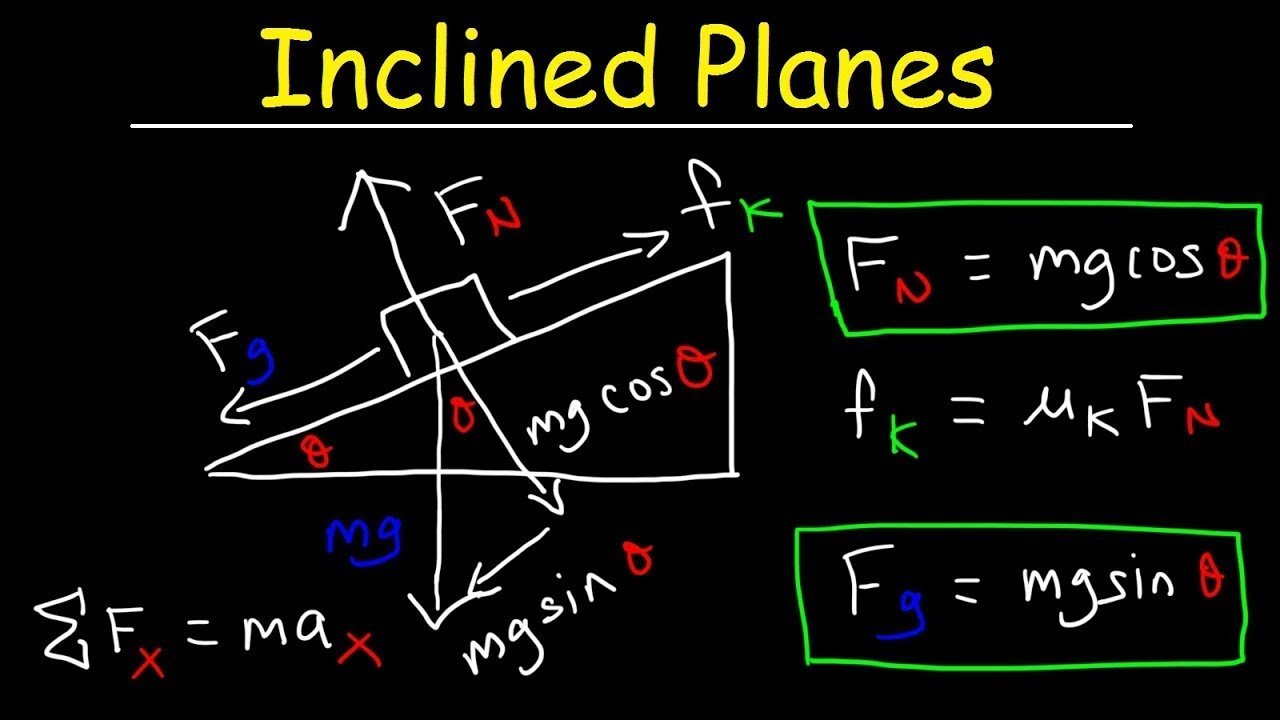
An inclined plane is a flat, tilted surface that makes an angle θ with the horizontal. When an object is placed on an inclined plane, its weight vector resolves into the normal force, which acts perpendicular to the plane, and a parallel force, which pulls the object down the inclined plane. Examples include ramps, ski slopes, staircases, and embankments.
What Forces Act on an Object on an Inclined Plane?
There are always at least 2 forces acting on any object positioned on an inclined plane: the force of gravity and the normal force. The force of gravity acts in a downward direction, while the normal force acts perpendicular to the surface. When friction is present, a 3rd force acts parallel to the surface opposing motion.
| Force | Symbol | Direction | Formula |
|---|---|---|---|
| Weight | W | Vertically downward | W = mg |
| Normal force | N | Perpendicular to surface | N = mg cos θ |
| Parallel component | F∥ | Down the slope | F∥ = mg sin θ |
| Kinetic friction | fk | Up the slope (opposing motion) | fk = μk × mg cos θ |
Why Is Weight Resolved Into 2 Components on an Inclined Plane?
Weight is resolved into 2 components because it acts vertically downward while the surface is tilted. The weight force is decomposed into mg sin θ parallel to the incline and mg cos θ perpendicular to it.
The perpendicular component balances the normal force. The parallel component is the net unbalanced force that causes acceleration down the slope. The parallel component of the force of gravity is not balanced by any other force on a frictionless surface, so the object accelerates down the inclined plane due to this unbalanced force.
How Do You Calculate Normal Force on an Inclined Plane?
The normal force on an inclined plane is calculated using Fn = mg cos θ, where m is mass, g is 9.8 m/s², and θ is the angle of inclination.
For a 10 kg object on a 30° incline: N = 10 × 9.8 × cos 30° = 10 × 9.8 × 0.866 = 84.9 N
As θ increases toward 90°, cos θ approaches 0 and the normal force decreases toward zero. As θ decreases toward 0°, the surface becomes flat and the normal force equals the full weight mg.
How Do You Calculate Acceleration on a Frictionless Inclined Plane?
For an object sliding down a frictionless inclined plane, the acceleration along the slope equals g sin θ. This formula comes from applying Newton’s second law along the axis parallel to the incline, where the net force is the component of weight down the slope. The mass cancels out, so acceleration depends only on g and θ.
a = g sin θ
| Angle (θ) | sin θ | Acceleration (m/s²) |
|---|---|---|
| 15° | 0.259 | 2.54 |
| 30° | 0.500 | 4.90 |
| 45° | 0.707 | 6.93 |
| 60° | 0.866 | 8.49 |
How Does Friction Affect an Object on an Inclined Plane?
Friction on an inclined plane is given by fk = μk mg cos θ, where μk is the coefficient of kinetic friction. All objects slide down a slope with constant acceleration when friction and gravity are the only forces.
For an object sliding down with friction, the net force is: Fnet = mg sin θ – μk mg cos θ = mg(sin θ – μk cos θ)
Acceleration with kinetic friction becomes: a = g(sin θ – μk cos θ)
What Is the Angle of Repose on an Inclined Plane?
The angle of repose is the critical angle at which an object begins to slide under its own weight. At this angle, the parallel component of gravity equals the maximum static friction force.
θrepose = arctan(μs)
The critical angle depends solely on the coefficient of friction and is independent of the mass of the object, which may seem counterintuitive but results from the gravitational forces canceling out in the equations.
For μs = 0.4: θrepose = arctan(0.4) = 21.8° For μs = 0.6: θrepose = arctan(0.6) = 31.0°
How Do You Solve an Inclined Plane Problem?
The method for solving inclined plane problems involves drawing a free body diagram, adjusting the coordinate system to align with the incline, decomposing the weight force into its components, and applying Newton’s laws to find the acceleration and normal force.
Worked Example 1: Object sliding down a rough incline
A 5 kg block slides down a 25° incline with μk = 0.20. Find the acceleration.
Step 1: Resolve weight. F∥ = 5 × 9.8 × sin 25° = 20.7 N F⊥ = 5 × 9.8 × cos 25° = 44.4 N
Step 2: Normal force. N = 44.4 N
Step 3: Kinetic friction. fk = 0.20 × 44.4 = 8.9 N
Step 4: Newton’s second law parallel to incline. Fnet = 20.7 – 8.9 = 11.8 N a = 11.8 / 5 = 2.36 m/s² down the incline
How Do You Find Acceleration When Pushing an Object Up an Incline?
When pushing an object up an incline, friction acts down the slope, so both the parallel gravity component and friction oppose the applied force.
Fnet = Fapplied – mg sin θ – μk mg cos θ
Worked Example 2: Object pushed up a rough incline
A 200 N applied force pushes a 20 kg box up a 15° incline with μk = 0.15. Find the acceleration.
F∥ = 20 × 9.8 × sin 15° = 50.7 N N = 20 × 9.8 × cos 15° = 189.4 N fk = 0.15 × 189.4 = 28.4 N Fnet = 200 – 50.7 – 28.4 = 120.9 N a = 120.9 / 20 = 6.05 m/s² up the incline
What Is the Mechanical Advantage of an Inclined Plane?
The mechanical advantage of an inclined plane equals the length of the slope divided by its height. A longer, shallower slope requires less force to move an object, although it takes a longer distance to reach the same elevation.
MA = L / h = 1 / sin θ
| Angle (θ) | sin θ | Mechanical Advantage |
|---|---|---|
| 10° | 0.174 | 5.76 |
| 20° | 0.342 | 2.92 |
| 30° | 0.500 | 2.00 |
| 45° | 0.707 | 1.41 |
| 60° | 0.866 | 1.15 |
A ramp 6 m long rising to a height of 1 m has MA = 6. Only 1/6 of the object’s weight is needed as applied force on a frictionless surface. Steeper ramps require more force and offer less mechanical advantage.
What Are Real-World Applications of Inclined Plane Physics?
Inclined plane physics applies to 6 common systems: loading ramps, road embankment design, wheelchair access ramps, roof pitch analysis, conveyor belts, and vehicle braking on slopes.
Building codes in many countries set accessibility ramp angles at a maximum of 4.76° (1:12 ratio). This reflects the mechanical advantage requirement: at 4.76°, MA = 1/sin 4.76° = 12, meaning a person in a wheelchair exerts roughly 1/12 of their total weight as force to ascend. Road engineers apply the angle of repose when designing embankments to prevent soil from sliding. A vehicle parked on a 10° slope with no brakes experiences a parallel force of mg × sin 10° = 0.174mg pulling it downhill. Static friction must meet or exceed this to prevent rolling.
Inclined Plane Formula Summary
| Formula | Equation |
|---|---|
| Normal force | N = mg cos θ |
| Parallel force | F∥ = mg sin θ |
| Kinetic friction | fk = μk mg cos θ |
| Acceleration (frictionless) | a = g sin θ |
| Acceleration (with friction, sliding down) | a = g(sin θ – μk cos θ) |
| Angle of repose | θ = arctan(μs) |
| Mechanical advantage | MA = L/h = 1/sin θ |
Resolving weight into its 2 components before applying Newton’s second law is the required first step in every inclined plane calculation. Every problem, regardless of complexity, reduces to the same sequence: resolve weight, find normal force, account for friction, then apply Newton’s second law parallel to the slope.

The University of the West Indies
My passion as a teacher and leader in education is to contribute to students’ enhanced learning by creation of a positive teaching/learning environment, where they are motivated to develop strong critical thinking, analytical and problem-solving skills.
As acting Vice-Principal and head of Physics, I have amassed five years of experience in leading meetings, implementing strategies to maintain discipline and school ethos, liaise with stakeholders in planning for future development of the institution; successfully negotiated the implementation of various projects for student development as well as supervising effective execution of such. For the past 19 years, I have incorporated discovery learning within the classroom through practical activities, problem solving and cooperative learning and have realized that students retention in Physics and Mathematics have increased significantly.
I am always cognizant that students have different learning styles, and as such teaching strategies during planning and delivery must take this crucial factor into consideration and be tailored to meet such differences.