

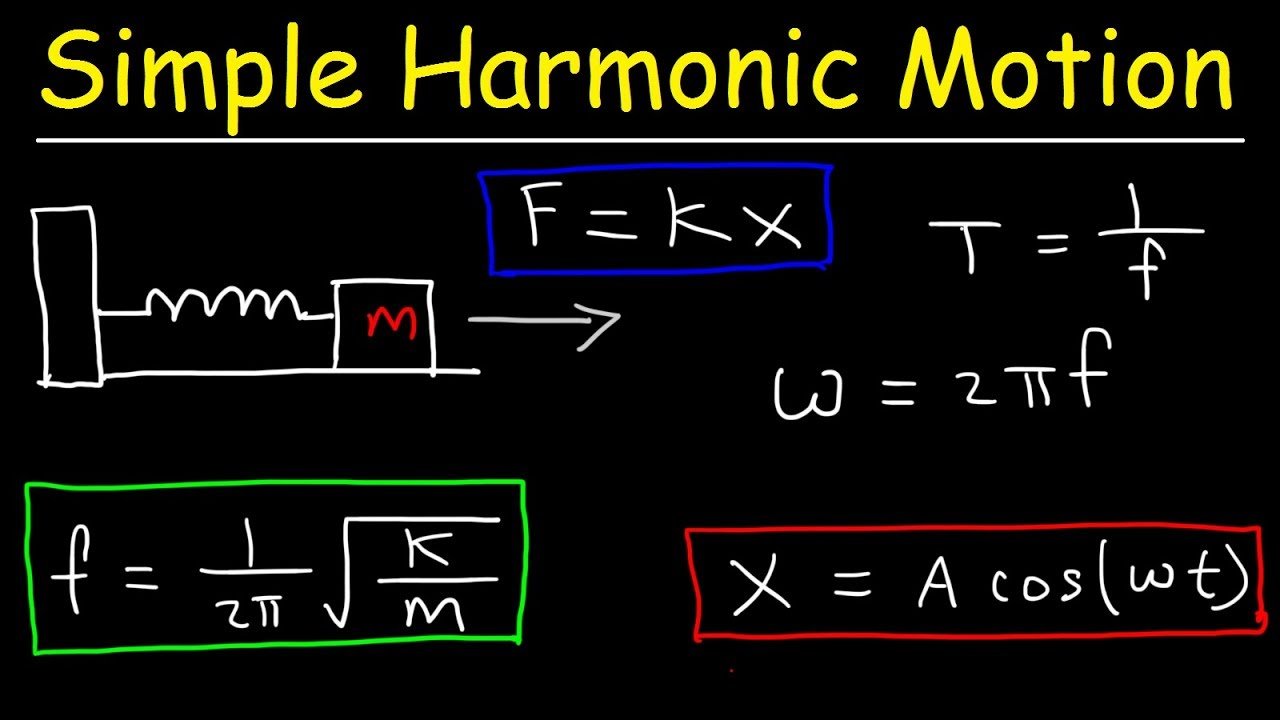
Simple Harmonic Motion: Definition, Equations, and Worked Examples
Simple harmonic motion (SHM) is oscillatory motion for a system where the restoring force is proportional to the displacement and acts in the direction opposite to the displacement. It is the foundation of wave mechanics, acoustics, and oscillation physics. This article covers the definition, 3 equations of motion, mass-spring and pendulum formulas, energy distribution, and 2 fully worked examples. Because acceleration changes with displacement, SHM is one of the cases where the SUVAT equations do not apply.
For a supporting reference, OpenStax’s simple harmonic motion section explains SHM as oscillatory motion produced when the restoring force follows Hooke’s law.
What Is Simple Harmonic Motion?
Simple harmonic motion is a repetitive motion where an object moves back and forth through an equilibrium position. When the mass is displaced from equilibrium, a restoring force proportional to the displacement acts on it, as described by Hooke’s law: F = -kx, where F is the restoring force, x is the displacement, and k is the spring constant.
The negative sign in F = -kx is not optional. It defines the direction of the restoring force as always opposing displacement. Without the negative sign, the equation describes a force that pushes away from equilibrium, which is not SHM.
What Is the Restoring Force in Simple Harmonic Motion?
The restoring force in simple harmonic motion is the force that pulls or pushes an object back toward its equilibrium position whenever it is displaced. It equals F = -kx at every instant.
At maximum displacement, the restoring force and acceleration are at their greatest, while velocity is zero. At the equilibrium position, velocity is at its maximum and acceleration is zero. These 2 states alternate continuously throughout the oscillation.
What Are Amplitude, Period, and Frequency in Simple Harmonic Motion?
3 key properties define SHM: amplitude, period, and frequency. Amplitude is the maximum displacement from the equilibrium position. Period is the time required for one complete cycle of motion. Frequency is the number of cycles per unit of time and is the inverse of the period.
| Quantity | Symbol | Unit | Definition |
|---|---|---|---|
| Amplitude | A | metres (m) | Maximum displacement from equilibrium |
| Period | T | seconds (s) | Time for 1 complete oscillation |
| Frequency | f | hertz (Hz) | Oscillations per second |
| Angular frequency | ω | rad/s | Rate of oscillation in radians |
The relationship between period and frequency is:
f = 1/T and T = 1/f
One critical property of SHM is that the period T and frequency f of a simple harmonic oscillator are independent of amplitude. Doubling the amplitude does not change how fast the object oscillates.
What Is Angular Frequency in Simple Harmonic Motion?
Angular frequency ω is given by ω = 2π/T and is measured in radians per second. The frequency f = 1/T = ω/2π gives the number of complete oscillations per unit time.
ω = 2πf = 2π/T
For a system oscillating at 5 Hz: ω = 2π × 5 = 31.4 rad/s
What Are the Equations of Motion for Simple Harmonic Motion?
The 3 equations of motion for SHM, starting from F = -kx and F = ma, are position x(t) = A cos(ωt + φ), velocity v(t) = -Aω sin(ωt + φ), and acceleration a(t) = -ω²x(t). The variable φ is the initial phase, determined by initial conditions.
What Is the Position Equation in Simple Harmonic Motion?
The position of an object in SHM at any time t is given by:
x(t) = A cos(ωt + φ)
where A is amplitude (m), ω is angular frequency (rad/s), t is time (s), and φ is the initial phase angle (rad).
When φ = 0 and the object starts at maximum displacement: x(t) = A cos(ωt). When the object starts at equilibrium moving in the positive direction: x(t) = A sin(ωt).
What Is Velocity in Simple Harmonic Motion?
Velocity in SHM at any displacement x is given by:
v = ω√(A² – x²)
Maximum velocity occurs at equilibrium (x = 0):
vmax = Aω
Velocity is zero at maximum displacement (x = ±A) because the object momentarily stops before reversing direction.
What Is Acceleration in Simple Harmonic Motion?
Acceleration in SHM is always proportional to and opposite in sign to displacement: a(t) = -ω²x(t). This relationship is the mathematical definition of SHM.
a = -ω²x
Maximum acceleration occurs at maximum displacement (x = ±A):
amax = ω²A
At equilibrium, x = 0, so acceleration = 0. These 3 relationships are summarized below:
| Position | Displacement (x) | Velocity (v) | Acceleration (a) |
|---|---|---|---|
| Equilibrium | 0 | Maximum = Aω | 0 |
| Maximum displacement | A | 0 | Maximum = ω²A |
| Any point | x | ω√(A² – x²) | -ω²x |
What Is the Period of a Mass-Spring System?
The angular frequency, period, and frequency of a spring-mass simple harmonic oscillator are given by ω = √(k/m), T = 2π√(m/k), and f = (1/2π)√(k/m), where m is the mass of the system and k is the force constant.
T = 2π√(m/k)
The mass m and the force constant k are the only 2 factors that affect the period and frequency of simple harmonic motion. The stiffer the spring, the smaller the period T. The greater the mass, the greater the period T.
Worked Example 1: Mass-Spring System
A 0.5 kg mass is attached to a spring with k = 20 N/m. Find T, f, ω, and vmax if A = 0.1 m.
T = 2π√(0.5/20) = 2π × 0.158 = 0.99 s f = 1/T = 1.01 Hz ω = √(20/0.5) = √40 = 6.32 rad/s vmax = Aω = 0.1 × 6.32 = 0.632 m/s
What Is the Period of a Simple Pendulum?
A simple pendulum approximates SHM for small angles less than about 15°. At small angles, the restoring component of gravity is approximately proportional to displacement, satisfying the SHM condition.
T = 2π√(L/g)
where L is the length of the pendulum (m) and g is gravitational acceleration (9.8 m/s²).
The period of a pendulum depends on length and gravitational acceleration only. It is independent of both mass and amplitude for small angles.
Worked Example 2: Simple Pendulum
A pendulum has a length of 1.5 m. Find its period and frequency.
T = 2π√(1.5/9.8) = 2π × 0.391 = 2.46 s f = 1/2.46 = 0.41 Hz
| System | Period Formula | Variables |
|---|---|---|
| Mass-spring | T = 2π√(m/k) | m = mass (kg), k = spring constant (N/m) |
| Simple pendulum | T = 2π√(L/g) | L = length (m), g = 9.8 m/s² |
How Is Energy Distributed in Simple Harmonic Motion?
The total mechanical energy in SHM is E = ½kA². Changing amplitude does not change the period or frequency. It only changes how far the object travels and how much energy the system carries.
At any displacement x, energy splits into 2 components:
Kinetic energy: KE = ½mω²(A² – x²) Potential energy: PE = ½kx² Total energy: E = KE + PE = ½kA²
| Position | Kinetic Energy | Potential Energy |
|---|---|---|
| Equilibrium (x = 0) | Maximum = ½kA² | 0 |
| Maximum displacement (x = A) | 0 | Maximum = ½kA² |
| Any point x | ½mω²(A² – x²) | ½kx² |
Total mechanical energy remains constant throughout the oscillation. Energy converts continuously between kinetic and potential forms.
If amplitude doubles from A to 2A, total energy increases by a factor of 4, since E = ½k(2A)² = 4 × ½kA².
What Is the Difference Between SHM and Damped Oscillation?
As long as the system has no energy loss, the mass continues to oscillate. Simple harmonic motion is therefore a type of periodic motion. If energy is lost in the system, then the mass exhibits damped oscillation instead.
Damped oscillation occurs in 3 forms: underdamped (oscillates with decreasing amplitude), critically damped (returns to equilibrium in the shortest time without oscillating), and overdamped (returns slowly to equilibrium without oscillating). Real-world systems including car suspensions and door closers use damping intentionally.
What Are Real-World Applications of Simple Harmonic Motion?
SHM principles apply to 6 common systems: clock pendulums, car suspension, ultrasound machines, musical instruments, seismographs, and electrical LC circuits.
Ultrasound medical imaging devices produce sound by oscillating with a period of 0.400 microseconds, giving a frequency of 2.5 MHz. This frequency is far above the 20 Hz to 20,000 Hz range of human hearing and is used for noninvasive medical diagnoses such as imaging a fetus in the womb.
Car suspension systems oscillate when a vehicle hits a bump. If shock absorbers go bad, the car oscillates at the least provocation, bouncing repeatedly after every bump because the damping force that suppresses SHM has been removed.
Clock pendulums exploit the isochronous property of SHM. Period depends only on length and g, not on amplitude, making the oscillation reliable for timekeeping.
Simple Harmonic Motion Formula Summary
| Formula | Equation | Use |
|---|---|---|
| Restoring force | F = -kx | Force at displacement x |
| Angular frequency | ω = √(k/m) | Radians per second |
| Period (spring) | T = 2π√(m/k) | Time per oscillation |
| Period (pendulum) | T = 2π√(L/g) | Small angles only |
| Frequency | f = 1/T | Oscillations per second |
| Position | x(t) = A cos(ωt + φ) | Displacement at time t |
| Velocity at x | v = ω√(A² – x²) | Speed at displacement x |
| Max velocity | vmax = Aω | Speed at equilibrium |
| Acceleration | a = -ω²x | Proportional to displacement |
| Max acceleration | amax = ω²A | At maximum displacement |
| Total energy | E = ½kA² | Constant throughout motion |
The 2 non-negotiable rules for all SHM problems are: restoring force must always point toward equilibrium (confirmed by the negative sign in F = -kx), and period is calculated using mass and spring constant only, never amplitude.

The University of the West Indies
My passion as a teacher and leader in education is to contribute to students’ enhanced learning by creation of a positive teaching/learning environment, where they are motivated to develop strong critical thinking, analytical and problem-solving skills.
As acting Vice-Principal and head of Physics, I have amassed five years of experience in leading meetings, implementing strategies to maintain discipline and school ethos, liaise with stakeholders in planning for future development of the institution; successfully negotiated the implementation of various projects for student development as well as supervising effective execution of such. For the past 19 years, I have incorporated discovery learning within the classroom through practical activities, problem solving and cooperative learning and have realized that students retention in Physics and Mathematics have increased significantly.
I am always cognizant that students have different learning styles, and as such teaching strategies during planning and delivery must take this crucial factor into consideration and be tailored to meet such differences.