

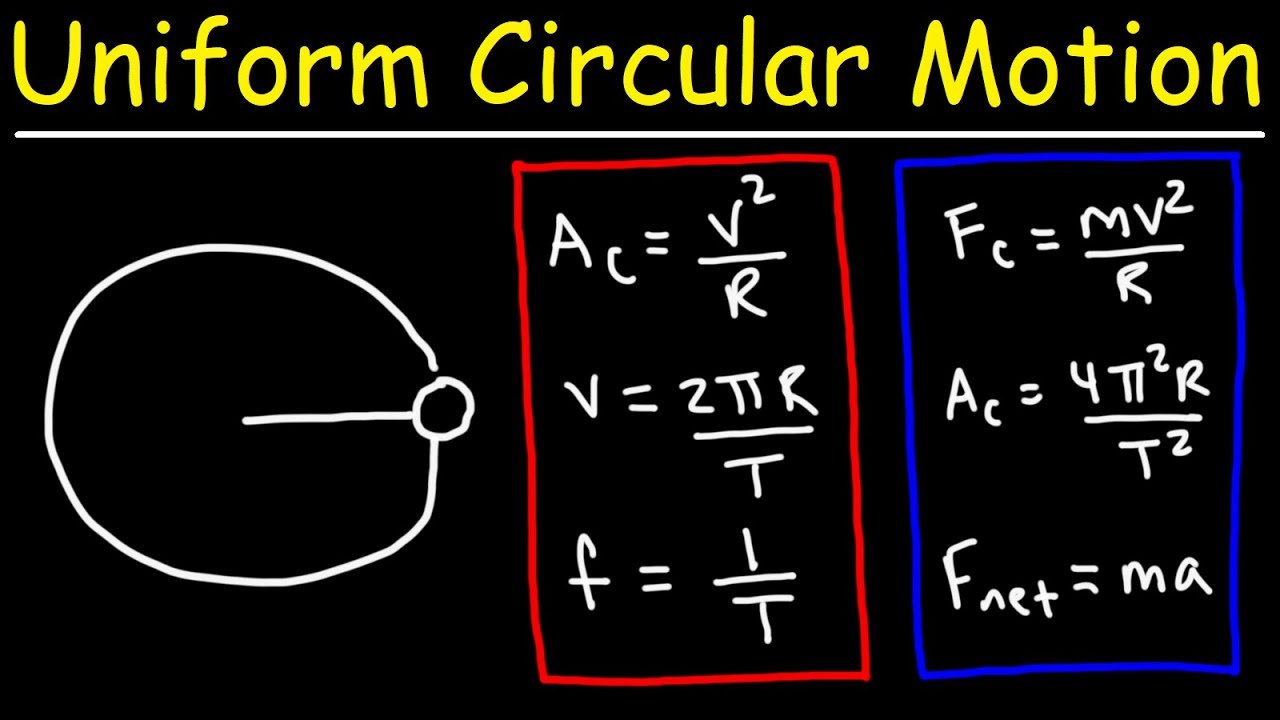
Circular Motion Physics: Angular Velocity, Centripetal Force, Formulas, and Worked Examples
Circular motion is the movement of an object along the circumference of a circle. Any object undergoing circular motion is accelerating, even at constant speed, because the direction of velocity continuously changes. This article covers uniform circular motion, angular velocity, centripetal acceleration and force, the 6 core formulas, and 2 fully worked examples. That changing direction is why circular motion sits outside straight-line SUVAT equations.
For a supporting reference, LibreTexts/OpenStax’s centripetal force section explains that the net force for uniform circular motion points toward the centre of curvature.
What Is Circular Motion in Physics?
Circular motion is motion along a circular path, where an object’s velocity vector is always tangent to the circle. There are 2 types: uniform circular motion, where speed is constant but direction changes continuously, and non-uniform circular motion, where both speed and direction change.
In uniform circular motion, the magnitude of velocity remains constant while its direction changes at every point. Because velocity is changing direction, an acceleration exists even when speed does not change. That acceleration always points toward the center of the circle.
What Is the Difference Between Uniform and Non-Uniform Circular Motion?
Uniform circular motion has constant speed and constant centripetal acceleration directed toward the center. Non-uniform circular motion has a changing speed, which produces a tangential acceleration in addition to the centripetal acceleration.
| Property | Uniform Circular Motion | Non-Uniform Circular Motion |
|---|---|---|
| Speed | Constant | Changing |
| Centripetal acceleration | Constant | Changing |
| Tangential acceleration | Zero | Non-zero |
| Net acceleration direction | Toward center | Combination of centripetal and tangential |
What Is Angular Velocity in Circular Motion?
Angular velocity (ω) is the rate at which an object rotates through an angle, measured in radians per second (rad/s). It equals the angle swept divided by the time taken.
ω = θ/t = 2π/T = 2πf
where θ is the angle in radians, T is the period in seconds, and f is the frequency in hertz.
The relationship between linear velocity v and angular velocity ω is:
v = ωr
where r is the radius of the circular path. A point farther from the center moves faster in linear terms, even when ω is the same.
What Is the Period and Frequency of Circular Motion?
The period T is the time for one complete revolution. Frequency f is the number of complete revolutions per second. They are related by:
T = 1/f and f = 1/T
For a car going around a roundabout every 8 seconds: T = 8 s, f = 1/8 = 0.125 Hz, ω = 2π/8 = 0.785 rad/s
| Quantity | Symbol | Unit | Formula |
|---|---|---|---|
| Angular velocity | ω | rad/s | ω = 2π/T = 2πf |
| Period | T | seconds (s) | T = 2π/ω = 1/f |
| Frequency | f | hertz (Hz) | f = 1/T = ω/2π |
| Linear velocity | v | m/s | v = ωr |
| Arc length | s | metres (m) | s = rθ |
What Is Centripetal Acceleration in Circular Motion?
Centripetal acceleration is the acceleration directed toward the center of a circular path that keeps an object moving in that circle. It is calculated using:
ac = v²/r = ω²r
where v is the linear speed (m/s) and r is the radius of the circular path (m). The direction of centripetal acceleration is always toward the center of rotation.
Centripetal means center-seeking. The acceleration is not in the direction of motion but perpendicular to it, which is why speed does not change but direction does.
How Does Radius Affect Centripetal Acceleration?
Centripetal acceleration increases as radius decreases. For a fixed speed, halving the radius doubles the centripetal acceleration. For a fixed angular velocity, doubling the radius doubles the centripetal acceleration.
| Speed (m/s) | Radius (m) | Centripetal Acceleration (m/s²) |
|---|---|---|
| 10 | 5 | 20.0 |
| 10 | 10 | 10.0 |
| 10 | 20 | 5.0 |
| 20 | 10 | 40.0 |
This is why sharper road bends require greater centripetal force from friction at the same speed.
What Is Centripetal Force in Circular Motion?
Centripetal force is any net force causing uniform circular motion, directed toward the center of rotation. According to Newton’s second law, the magnitude is:
Fc = mac = mv²/r = mω²r
Centripetal force is not a new type of force. It is the label given to whatever existing force (tension, gravity, friction, normal force) acts as the inward-directed net force in a circular system. Examples include: tension in a string swinging a ball, gravitational force keeping a satellite in orbit, friction keeping a car on a curved road, and normal force at the top of a loop.
When centripetal force is removed, the object moves in a straight line tangent to the circle at the point of release, due to inertia.
What Is the Difference Between Centripetal and Centrifugal Force?
Centripetal force is a real force directed toward the center of rotation, observed from an inertial (stationary) reference frame. Centrifugal force is a fictitious force, observed only from within a rotating (non-inertial) reference frame.
A passenger in a turning car feels pushed outward. No outward force actually acts on them. Their body resists the direction change due to inertia. The centripetal force from friction is the only real horizontal force, and it points inward.
How Do You Solve Circular Motion Problems?
Circular motion problems are solved in 4 steps: identify the source of centripetal force, set it equal to mv²/r, substitute known values, and solve for the unknown.
Worked Example 1: Ball on a String
A 0.3 kg ball is swung in a horizontal circle of radius 0.8 m at 4 m/s. Find the centripetal acceleration and the tension in the string.
ac = v²/r = 4²/0.8 = 16/0.8 = 20 m/s² Fc = mac = 0.3 × 20 = 6 N
Tension in the string provides the centripetal force. Tension = 6 N directed toward the center.
ω = v/r = 4/0.8 = 5 rad/s T = 2π/ω = 2π/5 = 1.26 s
Worked Example 2: Car on a Curved Road
A 1,200 kg car travels around a flat circular bend of radius 50 m at 15 m/s. Find the centripetal force and the minimum coefficient of static friction needed.
Fc = mv²/r = 1200 × 15²/50 = 1200 × 225/50 = 5,400 N
On a flat road, friction provides centripetal force. N = mg = 1200 × 9.8 = 11,760 N
μs = Fc/N = 5400/11760 = 0.46
A minimum static friction coefficient of 0.46 is required. If μs falls below 0.46 on a wet or icy road, the car slides outward along a larger radius path.
What Provides Centripetal Force in Different Systems?
There are 5 common circular motion systems, each with a different source of centripetal force.
| System | Centripetal Force Source |
|---|---|
| Ball on a string | Tension in the string |
| Satellite orbiting Earth | Gravitational attraction |
| Car turning on flat road | Static friction |
| Car on a banked road | Component of normal force |
| Clothes in a washing machine drum | Normal force from drum wall |
For a satellite orbiting Earth at orbital radius r, gravity provides centripetal force. Setting gravitational force equal to centripetal force: GMm/r² = mv²/r, which gives orbital speed v = √(GM/r), where G = 6.67 × 10⁻¹¹ Nm²/kg² and M is Earth’s mass (5.97 × 10²⁴ kg).
What Is a Banked Curve in Circular Motion?
A banked curve is a road surface tilted at angle θ to the horizontal, allowing vehicles to navigate bends at higher speeds without relying entirely on friction. The horizontal component of the normal force provides centripetal force.
tan θ = v²/rg
For a bend of radius 80 m at a design speed of 20 m/s:
tan θ = 20²/(80 × 9.8) = 400/784 = 0.51 θ = arctan(0.51) = 27°
A steeper bank allows higher design speed. As banking angle approaches 90°, the horizontal component of normal force approaches the full normal force, allowing much higher speeds with no friction needed.
What Happens at the Top and Bottom of a Vertical Circle?
At the top of a vertical loop, both gravity and normal force point downward toward the center. At the bottom, normal force points upward and gravity downward, so the net centripetal force is N minus mg.
At the top of the loop: N + mg = mv²/r, so N = mv²/r – mg. The minimum speed to maintain contact is when N = 0: vmin = √(gr).
At the bottom of the loop: N – mg = mv²/r, so N = mg + mv²/r. The normal force at the bottom always exceeds weight, which is why riders feel heavier at the lowest point of a loop.
Circular Motion Formula Summary
| Formula | Equation | Use |
|---|---|---|
| Angular velocity | ω = 2π/T = 2πf | Rate of rotation |
| Linear velocity | v = ωr | Speed at radius r |
| Period | T = 2π/ω = 2πr/v | Time per revolution |
| Centripetal acceleration | ac = v²/r = ω²r | Inward acceleration |
| Centripetal force | Fc = mv²/r = mω²r | Net inward force |
| Banked curve angle | tan θ = v²/rg | Design speed for bend |
| Minimum loop speed | vmin = √(gr) | Speed at top of loop |
The 1 common error in circular motion problems is treating centrifugal force as real. Centripetal force is real and inward. Centrifugal force is a fictitious effect of inertia in a rotating frame. Setting the correct source of centripetal force equal to mv²/r resolves every circular motion problem.

The University of the West Indies
My passion as a teacher and leader in education is to contribute to students’ enhanced learning by creation of a positive teaching/learning environment, where they are motivated to develop strong critical thinking, analytical and problem-solving skills.
As acting Vice-Principal and head of Physics, I have amassed five years of experience in leading meetings, implementing strategies to maintain discipline and school ethos, liaise with stakeholders in planning for future development of the institution; successfully negotiated the implementation of various projects for student development as well as supervising effective execution of such. For the past 19 years, I have incorporated discovery learning within the classroom through practical activities, problem solving and cooperative learning and have realized that students retention in Physics and Mathematics have increased significantly.
I am always cognizant that students have different learning styles, and as such teaching strategies during planning and delivery must take this crucial factor into consideration and be tailored to meet such differences.