

How to Find Speed: Formula, 5 Steps, and 8 Methods With Solved Examples
Find speed by dividing distance by time: v = d / t. Speed is measured in meters per second (m/s), kilometers per hour (km/h), or miles per hour (mph). Average speed uses the total distance and the total time.
For a reliable reference, consult OpenStax University Physics Volume 1.
What Is Speed?
Speed is the rate at which an object covers distance. Speed is a scalar quantity because speed has magnitude and no direction. Examples of speed include a car at 90 km/h, a sprinter at 10 m/s, and an aircraft at 250 m/s.
What Is the Difference Between Average Speed and Instantaneous Speed?
Average speed is the total distance divided by the total time, and instantaneous speed is the speed at a specific moment. OpenStax defines average speed as the distance traveled divided by the time during which the motion occurs. A speedometer shows instantaneous speed.
What Is the Difference Between Speed and Velocity?
Speed is a scalar with magnitude only, and velocity is a vector with magnitude and direction. Average speed is the distance traveled divided by elapsed time, and average velocity is displacement divided by time.
What Is the Formula for Speed?
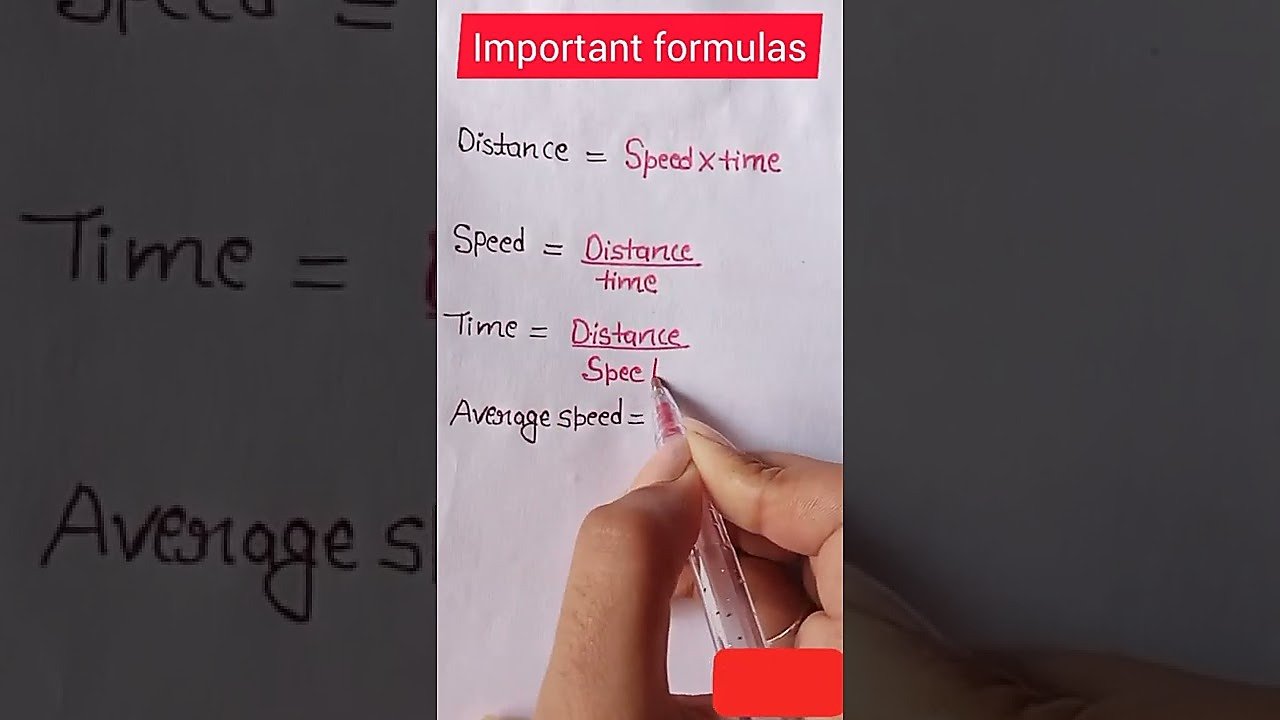
The formula for speed is v = d / t, where v is speed, d is distance, and t is time. The same relationship gives time as distance divided by average speed, and distance as average speed multiplied by time.
Table 1 defines the 3 variables in v = d / t.
| Symbol | Quantity | SI unit | Unit symbol |
|---|---|---|---|
| v | Speed | Meter per second | m/s |
| d | Distance | Meter | m |
| t | Time | Second | s |
How Do You Rearrange the Speed Formula?
Rearrange the formula to isolate the unknown variable. Table 2 lists the formula for each unknown quantity.
| Unknown quantity | Formula | Example values | Result |
|---|---|---|---|
| Speed | v = d / t | d = 150 m; t = 30 s | 5 m/s |
| Distance | d = v × t | v = 5 m/s; t = 30 s | 150 m |
| Time | t = d / v | d = 150 m; v = 5 m/s | 30 s |
What Are the 5 Steps to Find Speed?
Find speed by identifying the distance, identifying the time, converting to consistent units, dividing distance by time, and stating the result with a unit. The 5 steps are:
- Identify the total distance traveled.
- Identify the total time taken.
- Convert the distance and time to consistent units.
- Divide the distance by the time.
- State the result with a unit.
A car that travels 240 km in 3 h has a speed of 240 km / 3 h = 80 km/h. Dividing 80 by 3.6 converts the result to 22.2 m/s.
How Do You Find Average Speed for a Trip With Multiple Parts?
Find average speed by dividing the total distance by the total time, not by averaging the individual speeds. An OpenStax example covers 100 km in 2 parts, 50 km at 30 km/h and 50 km at 60 km/h, and gives an average speed of 40 km/h.
Table 3 shows the calculation for each segment and for the whole trip.
| Segment | Distance | Speed | Time |
|---|---|---|---|
| Segment 1 | 50 km | 30 km/h | 1.667 h |
| Segment 2 | 50 km | 60 km/h | 0.833 h |
| Whole trip | 100 km | 40 km/h (average) | 2.5 h |
The mean of 30 km/h and 60 km/h is 45 km/h, which is incorrect. The correct value is 100 km / 2.5 h = 40 km/h.
How Do You Find Speed From Other Quantities?
Speed derives from acceleration, circular motion, energy, height, wave properties, and orbital radius, if distance and time are unknown. Table 4 lists 8 methods with a formula, condition, and example for each.
| Known quantities | Formula | Condition | Example | Speed |
|---|---|---|---|---|
| Distance and time | v = d / t | Constant or average speed | d = 100 m; t = 12.5 s | 8 m/s |
| Initial speed, acceleration, and time | v = u + at | Constant acceleration | u = 5 m/s; a = 2 m/s²; t = 4 s | 13 m/s |
| Radius and period | v = 2πr / T | Uniform circular motion | r = 0.5 m; T = 2 s | 1.571 m/s |
| Angular speed and radius | v = ωr | Uniform circular motion | ω = 10 rad/s; r = 0.3 m | 3 m/s |
| Kinetic energy and mass | v = √(2KE / m) | Any object with speed v | KE = 200 J; m = 4 kg | 10 m/s |
| Fall height | v = √(2gh) | Free fall from rest, no air resistance | h = 20 m; g = 9.8 m/s² | 19.8 m/s |
| Frequency and wavelength | v = fλ | Wave motion | f = 440 Hz; λ = 0.78 m | 343.2 m/s |
| Orbital radius | v = √(GM / r) | Circular orbit | r = 7.0 × 10⁶ m; GM = 3.986 × 10¹⁴ m³/s² | 7,546 m/s |
In these formulas, u is initial speed, a is acceleration, T is the period, ω is angular speed, KE is kinetic energy, m is mass, h is height, f is frequency, λ is wavelength, G is the gravitational constant, and M is the mass of the central body.
How Do You Find Speed From a Distance-Time Graph?
Speed equals the slope of a distance-time graph, calculated as the change in distance divided by the change in time. A line that rises 60 m over 12 s shows a speed of 5 m/s.
How Do You Convert Speed Units?
Convert speed units by multiplying the value by a fixed conversion factor. Table 5 lists 4 conversion factors with an example for each.
| Conversion | Multiply by | Example |
|---|---|---|
| m/s to km/h | 3.6 | 25 m/s = 90 km/h |
| km/h to m/s | 0.277778 | 72 km/h = 20 m/s |
| mph to m/s | 0.44704 | 60 mph = 26.82 m/s |
| mph to km/h | 1.609344 | 60 mph = 96.56 km/h |
How Do Instruments Measure Speed?
Speedometers, GPS receivers, radar guns, and stopwatch-and-distance methods measure speed. Table 6 lists the measurement principle and output of each instrument.
| Instrument | Measurement principle | Output |
|---|---|---|
| Speedometer | Counts wheel rotations and converts them to speed using tire circumference | Instantaneous speed |
| GPS receiver | Measures the Doppler shift of satellite signals | Instantaneous speed |
| Radar gun | Measures the Doppler shift of reflected radio waves | Instantaneous speed |
| Stopwatch and measured distance | Divides a known distance by a measured time | Average speed |
GPS receivers derive speed from the Doppler shift of satellite signals, not from position changes over time. GPS.gov reports that the standard of 0.2 m/s or less velocity error at 95% on any axis was met in 2024.
UN Regulation 39 requires that the indicated speed is not less than the true speed of the vehicle. The indicated speed is limited to 110% of the true speed plus 4 km/h. A vehicle at a true 100 km/h shows between 100 km/h and 114 km/h. Worn tires raise the displayed speed above the true ground speed, because speed sensors count wheel rotations.
What Are 5 Solved Examples of Finding Speed?
Table 7 lists 5 solved examples with the distance, time, speed, and converted speed.
| Example | Distance | Time | Speed | Converted speed |
|---|---|---|---|---|
| Sprinter | 400 m | 50 s | 8 m/s | 28.8 km/h |
| Car | 240 km | 3 h | 80 km/h | 22.2 m/s |
| Cyclist | 15 km | 45 min (0.75 h) | 20 km/h | 5.56 m/s |
| Train | 360 km | 2.5 h | 144 km/h | 40 m/s |
| Sound wave | 686 m | 2 s | 343 m/s | 1,234.8 km/h |
What Are 4 Common Mistakes When Finding Speed?
The 4 common mistakes when finding speed are averaging segment speeds, mixing units, using displacement instead of distance, and treating a speedometer reading as exact.
In an OpenStax example, a round trip of 6 km has an average speed of 12 km/h and an average velocity of zero. The example shows that displacement and distance produce different results.
Table 8 pairs each mistake with the correct method.
| Mistake | Correct method |
|---|---|
| Averaging the speeds of 2 segments with the arithmetic mean | Divide the total distance by the total time |
| Mixing units, such as kilometers with seconds | Convert distance and time to consistent units before dividing |
| Using displacement instead of distance | Use the total path length for speed, and use displacement for velocity |
| Treating a speedometer reading as exact | Verify the reading with GPS or a timed distance, because a speedometer reads at or above the true speed |
People Also Ask About How to Find Speed
What is the formula for speed?
The formula for speed is v = d / t, where d is distance and t is time.
How do you find speed without time?
Find speed without time by using v² = u² + 2ad with constant acceleration, v = √(2KE / m) with kinetic energy, or v = ωr with angular speed.
How do you find speed in km/h?
Divide the distance in kilometers by the time in hours.
How do you find speed in m/s?
Divide the distance in meters by the time in seconds.
How do you find average speed?
Divide the total distance by the total time.
How do you find speed from a graph?
Calculate the slope of the distance-time graph, which equals the change in distance divided by the change in time.
Can speed be negative?
No, speed is a scalar with magnitude only, so speed is 0 or greater.
How Do You Find Speed? Summary of 5 Key Facts
The 5 key facts about finding speed are:
- Speed equals distance divided by time (v = d / t).
- Average speed equals total distance divided by total time.
- Speed uses consistent units, such as m/s or km/h.
- Speed derives from acceleration, energy, angular speed, or wave frequency, if distance and time are unknown.
- Speed is a scalar and is never negative.
Title tag: Final Velocity Equation: Formulas, 5 Steps, and Solved Examples

The University of the West Indies
My passion as a teacher and leader in education is to contribute to students’ enhanced learning by creation of a positive teaching/learning environment, where they are motivated to develop strong critical thinking, analytical and problem-solving skills.
As acting Vice-Principal and head of Physics, I have amassed five years of experience in leading meetings, implementing strategies to maintain discipline and school ethos, liaise with stakeholders in planning for future development of the institution; successfully negotiated the implementation of various projects for student development as well as supervising effective execution of such. For the past 19 years, I have incorporated discovery learning within the classroom through practical activities, problem solving and cooperative learning and have realized that students retention in Physics and Mathematics have increased significantly.
I am always cognizant that students have different learning styles, and as such teaching strategies during planning and delivery must take this crucial factor into consideration and be tailored to meet such differences.