

Gravitational Potential Energy Examples: Objects at Height Hold Energy Equal to Mass × g × Height, as 22 Examples from Homes, Nature, Technology, Sports, and Space Show
What Is Gravitational Potential Energy and What Are Examples of It?
Gravitational potential energy is the energy an object has because of its height above a reference level in a gravitational field. The term potential gravitational energy names the same quantity. The SI unit is the joule (J).
Near Earth's surface, the formula is U = mgh. Examples include a book on a shelf, water behind a dam, and a roller coaster car at the top of a hill.
William Rankine, a Scottish engineer and physicist, coined the term "potential energy" in 1853.
What Are 22 Examples of Gravitational Potential Energy?
The 22 examples below fall into 5 groups: everyday objects, nature, technology, sports, and space. Values use g = 9.8 m/s² and a reference level at the ground, if no other level is stated.
What Are 6 Everyday Examples of Gravitational Potential Energy?
Six everyday examples of gravitational potential energy are a book on a shelf, an apple on a branch, water in a rooftop tank, a raised hammer, a person on a staircase landing, and a hanging picture frame. The list gives the energy of each example.
- Book on a shelf: 29.4 J for a 1.5 kg book at 2 m
- Apple on a tree branch: 2.94 J for a 0.1 kg apple at 3 m, with a 7.7 m/s landing speed if air resistance is ignored
- Water in a rooftop tank: 294,000 J for 2,000 kg of water at 15 m
- Hammer raised above a nail: 1.96 J for a 0.5 kg hammer raised 0.4 m
- Person on a staircase landing: 2,058 J for a 70 kg person at 3 m
- Picture frame on a wall: 44.1 J for a 3 kg frame at 1.5 m
What Are 4 Examples of Gravitational Potential Energy in Nature?
Four natural examples are water at the top of a waterfall, snow on a mountain slope, a boulder on a cliff edge, and water in a mountain lake. Each holds energy because of its elevation above lower ground.
- Waterfall: 490 J per kilogram of water at a 50 m drop
- Snowpack on a mountain slope: 2,940,000 J for 1,000 kg of snow at 300 m above the valley, which an avalanche converts to kinetic energy
- Boulder on a cliff edge: 49,000 J for a 200 kg boulder at 25 m
- Mountain lake: 9.8 J per kilogram of water for each meter of elevation above the valley
What Are 6 Examples of Gravitational Potential Energy in Technology?
Six technology examples are a hydroelectric dam reservoir, a pumped storage plant, a roller coaster at its first peak, an elevator at the top floor, a pile driver hammer, and a pendulum at the top of its swing.
- Hydroelectric dam reservoir: 980,000 J (0.272 kWh) for 1,000 kg of water falling 100 m
- Pumped storage hydropower: 2.94 × 10¹² J (816.7 MWh) for 1.0 × 10⁶ m³ of water at 300 m
- Roller coaster at the first peak: 196,000 J for a 500 kg car at 40 m
- Elevator at the top floor: 294,000 J (0.0817 kWh) for a 1,000 kg car lifted 30 m
- Pile driver hammer: 14,700 J for a 500 kg hammer at 3 m
- Pendulum at the top of a swing: 9.8 J for a 2 kg bob raised 0.5 m
What Are 4 Examples of Gravitational Potential Energy in Sports?
Four sports examples are a diver on a platform, a hiker on a climb, a pole vaulter at the top of a vault, and a basketball at the peak of a shot.
- Diver on a 10 m platform: 6,860 J for a 70 kg diver, with a 14 m/s entry speed if air resistance is ignored
- Hiker on a 1,000 m climb: 686,000 J for a 70 kg hiker, which equals about 164 kcal
- Pole vaulter at the top of a vault: 3,430 J for a 70 kg vaulter whose center of mass rises 5 m
- Basketball at the peak of a shot: 23.5 J for a 0.6 kg ball at 4 m
What Are 2 Examples of Gravitational Potential Energy in Space?
Two space examples are the International Space Station in orbit and an astronaut on the Moon.
- International Space Station: 3.70 × 10⁶ J per kilogram gained from Earth's surface to about 400 km, which totals 1.66 × 10¹² J for the 450,000 kg station
- Astronaut on the Moon: 160 J for a 100 kg astronaut and equipment at 1 m, compared with 980 J on Earth
According to Wikipedia, the International Space Station orbits at about 400 km and has a mass of 450,000 kg.
What Is the Formula for Gravitational Potential Energy?
The formula is U = mgh, which gives gravitational potential energy in joules near Earth's surface.
The table below lists the 4 variables. Rows show each quantity. Columns show the symbol, SI unit, and value or meaning.
| Quantity | Symbol | SI unit | Value or meaning |
|---|---|---|---|
| Gravitational potential energy | U | joule (J) | zero at the reference level |
| Mass | m | kilogram (kg) | mass of the object |
| Gravitational field strength | g | meter per second squared (m/s²), equal to N/kg | 9.8 on Earth |
| Height | h | meter (m) | vertical distance above the reference level |
The exact standard gravity is 9.80665 m/s². The 3rd General Conference on Weights and Measures adopted this value in 1901.
How Is the Formula U = mgh Derived?
The formula follows from the work required to lift an object at constant speed. The derivation has 3 steps:
- Lifting at constant speed requires an upward force equal to the weight: F = mg.
- The work over a vertical distance h is W = Fh = mgh.
- The work equals the increase in gravitational potential energy: ΔU = mgh.
What Is the Formula for Gravitational Potential Energy at Large Distances?
The formula is U = −GMm/r, which gives the energy of 2 masses with U = 0 at infinite separation. The result is negative at every finite distance.
The table below lists the 4 variables. Rows show each quantity. Columns show the symbol and meaning.
| Quantity | Symbol | Meaning |
|---|---|---|
| Gravitational constant | G | 6.674 × 10⁻¹¹ N·m²/kg² |
| Larger mass | M | mass of the planet or star in kg |
| Smaller mass | m | mass of the object in kg |
| Separation | r | distance between the centers of the masses in m |
The expression U = mgh is accurate when h is small compared with Earth's radius of 6,371 km. At 400 km, mgh overestimates the energy change by about 6.1%.
What Factors Change Gravitational Potential Energy?
Four factors change gravitational potential energy: mass, height, gravitational field strength, and the reference level.
- Mass: doubling the mass doubles the energy
- Height: tripling the height triples the energy
- Gravitational field strength: the Moon's value of 1.6 m/s² gives 16.3% of the energy on Earth, where the value is 9.8 m/s²
- Reference level: moving the zero point shifts every energy value by the same amount
How Does Gravitational Potential Energy Differ on Other Planets?
Gravitational potential energy differs on other bodies because surface gravity differs. According to the NASA Planetary Fact Sheet, surface gravity is 9.8 m/s² on Earth, 1.6 m/s² on the Moon, 3.7 m/s² on Mars, and 23.1 m/s² on Jupiter.
The table below shows the energy of a 1 kg object raised 10 m. Rows show each body. Columns show the surface gravity, the energy, and the percentage of the Earth value.
| Body | Surface gravity (m/s²) | Energy of 1 kg at 10 m (J) | Percent of Earth value |
|---|---|---|---|
| Earth | 9.8 | 98 | 100% |
| Moon | 1.6 | 16 | 16.3% |
| Mars | 3.7 | 37 | 37.8% |
| Jupiter | 23.1 | 231 | 235.7% |
The same object at the same height holds 14.4 times as much energy on Jupiter as on the Moon.
How Much Gravitational Potential Energy Does a 1 kg Object Have at 3 Named Heights?
A 1 kg object holds 98 J at 10 m, 8,114 J at the height of the Burj Khalifa, and 86,719 J at the height of the Mount Everest summit.
The table below lists the 3 heights. Rows show each height reference. Columns show the height in meters and the energy of a 1 kg object relative to the base level.
| Height reference | Height (m) | Energy of 1 kg (J) |
|---|---|---|
| Diving platform | 10 | 98 |
| Burj Khalifa, above ground level | 828 | 8,114 |
| Mount Everest summit, above sea level | 8,848.86 | 86,719 |
The Council on Tall Buildings and Urban Habitat ratified the Burj Khalifa height of 828 m. Nepal and China announced the Mount Everest height of 8,848.86 m on December 8, 2020.
How Do You Calculate Gravitational Potential Energy Step by Step?
To calculate gravitational potential energy, choose a reference level, measure the vertical height, and multiply mass by g and height. Follow these 6 steps:
- Choose the reference level where U = 0.
- Convert the mass to kilograms (1 g = 0.001 kg).
- Measure the vertical height above the reference level in meters.
- Select the local g, which is 9.8 m/s² on Earth.
- Multiply the quantities: U = m × g × h.
- Report the result in joules, with a negative sign if the object is below the reference level.
What Are 8 Solved Examples of Gravitational Potential Energy?
Example 1: What Is the Gravitational Potential Energy of a 5 kg Object at 4 m?
The energy is 196 J. U = mgh = 5 × 9.8 × 4 = 196 J.
Example 2: At What Height Does a 0.2 kg Ball Hold 10 J?
The ball holds 10 J at a height of about 5.10 m. h = U/(mg) = 10/(0.2 × 9.8) ≈ 5.10 m.
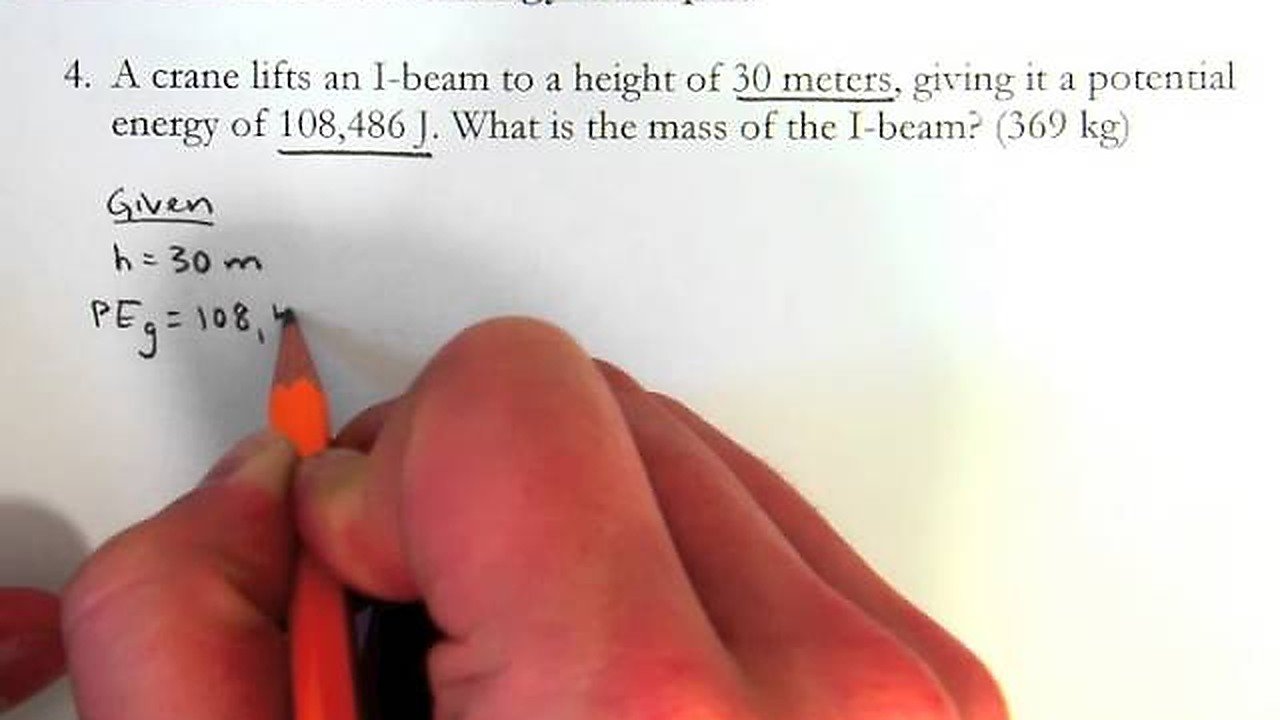
Example 3: What Is the Mass of an Object That Holds 588 J at 12 m?
The mass is 5.0 kg. m = U/(gh) = 588/(9.8 × 12) = 5.0 kg.
Example 4: How Much Energy Does a 60 kg Student Gain Climbing a 4.5 m Staircase?
The student gains 2,646 J. ΔU = mgΔh = 60 × 9.8 × 4.5 = 2,646 J.
Example 5: How Fast Is a 500 kg Roller Coaster Car at the Bottom of a 40 m Drop?
The car reaches 28 m/s at the bottom. Energy conservation gives mgh = ½mv², so v = √(2gh) = √(2 × 9.8 × 40) = 28 m/s. The mass cancels. The result assumes the car starts at rest and friction is negligible.
Example 6: How High Does a 0.15 kg Baseball Rise After a 20 m/s Throw Upward?
The baseball rises about 20.4 m. The initial kinetic energy is ½ × 0.15 × 20² = 30 J. At the top, all 30 J is gravitational potential energy, so h = 30/(0.15 × 9.8) ≈ 20.4 m, if air resistance is ignored.
Example 7: What Is the Energy of a 2 kg Book on a 0.8 m Table at 3 Reference Levels?
The energy is 15.68 J relative to the floor, 0 J relative to the table top, and −33.32 J relative to a ceiling at 2.5 m. The calculations are:
- Floor reference: 2 × 9.8 × 0.8 = 15.68 J
- Table top reference: 2 × 9.8 × 0 = 0 J
- Ceiling reference: 2 × 9.8 × (0.8 − 2.5) = −33.32 J
Example 8: How Much Energy Does Lifting a 1 kg Object to 400 km Require?
The lift requires about 3.70 × 10⁶ J, and mgh overestimates this value by 6.1%. The exact change is ΔU = GMm(1/R − 1/(R + h)), with GM = 3.986 × 10¹⁴ m³/s², R = 6.371 × 10⁶ m, and h = 4.00 × 10⁵ m. The estimate is mgh = 1 × 9.8 × 4.00 × 10⁵ = 3.92 × 10⁶ J.
How Does Gravitational Potential Energy Convert to Kinetic Energy?
Gravitational potential energy converts to kinetic energy as an object falls, and the sum of both stays constant when no friction or drag acts. Examples include a falling apple, a swinging pendulum, and a roller coaster car on a descent.
The table below follows a 500 kg roller coaster car released from rest at 40 m with no friction. Rows show the height above the bottom. Columns show the gravitational potential energy, the kinetic energy, the total, and the speed.
| Height (m) | Potential energy (J) | Kinetic energy (J) | Total energy (J) | Speed (m/s) |
|---|---|---|---|---|
| 40 | 196,000 | 0 | 196,000 | 0 |
| 30 | 147,000 | 49,000 | 196,000 | 14.0 |
| 20 | 98,000 | 98,000 | 196,000 | 19.8 |
| 10 | 49,000 | 147,000 | 196,000 | 24.2 |
| 0 | 0 | 196,000 | 196,000 | 28.0 |
Does All Gravitational Potential Energy Convert to Kinetic Energy?
No, air resistance and friction transfer part of the energy to thermal energy of the surroundings. An 80 kg skydiver who falls 1,000 m at an assumed constant speed of 55 m/s shows the effect:
- Gravitational potential energy lost: 80 × 9.8 × 1,000 = 784,000 J
- Kinetic energy at 55 m/s: ½ × 80 × 55² = 121,000 J
- Energy transferred to the air: 663,000 J, which equals 84.6% of the loss
How Do Hydropower and Pumped Storage Use Gravitational Potential Energy?
Hydropower uses water that falls from a high reservoir to turbines at a lower level, which converts gravitational potential energy to kinetic energy and then to electrical energy. Pumped storage hydropower raises water to an upper reservoir during low demand and releases the water through turbines during high demand.
According to the U.S. Department of Energy, pumped storage hydropower accounted for 93% of U.S. utility-scale storage power capacity in 2019. The same report counts 43 plants with a total power capacity of 21.9 GW.
An upper reservoir holding 1.0 × 10⁶ m³ of water (1.0 × 10⁹ kg) at 300 m above the turbines stores mgh = 1.0 × 10⁹ × 9.8 × 300 = 2.94 × 10¹² J, which equals 816.7 MWh before conversion losses.
Can Gravitational Potential Energy Be Negative?
Yes, gravitational potential energy is negative when the object is below the chosen reference level, and U = −GMm/r is negative at every finite distance. The reference level is a choice, and the change in energy between 2 heights stays the same for any choice.
Gravitational potential energy equals zero when the object sits at the reference level, where h = 0.
What Is the Difference Between Gravitational Potential Energy and Kinetic Energy?
Gravitational potential energy depends on position, while kinetic energy depends on motion.
The table below compares the 2 energy types across 6 features. Columns list the energy type. Rows list the feature.
| Feature | Gravitational potential energy | Kinetic energy |
|---|---|---|
| Formula | U = mgh | K = ½mv² |
| Depends on | mass, height, and g | mass and speed |
| Equals zero when | the object is at the reference level | the object is at rest |
| Pendulum position of maximum energy | top of the swing | bottom of the swing |
| SI unit | joule (J) | joule (J) |
| Example | book on a shelf | rolling ball |
What Are Other Types of Potential Energy?
Four other types of potential energy exist:
- Elastic potential energy: a stretched or compressed spring, with U = ½kx²
- Chemical potential energy: the bonds in gasoline or food
- Electrostatic potential energy: a charged capacitor, with U = kq₁q₂/r for 2 point charges
- Nuclear potential energy: the nucleons in an atomic nucleus
What Are the Units of Gravitational Potential Energy?
The SI unit is the joule (J), equal to 1 kg·m²/s². The dimensional formula is ML²T⁻².
The table below lists 5 energy units. Rows show each unit. Columns show the symbol and the equivalent in joules.
| Unit | Symbol | Equivalent in joules |
|---|---|---|
| Joule | J | 1 J |
| Kilojoule | kJ | 1,000 J |
| Kilowatt-hour | kWh | 3.6 × 10⁶ J |
| Kilocalorie | kcal | 4,184 J |
| Foot-pound force | ft·lbf | 1.356 J |
What Are Common Mistakes With Gravitational Potential Energy Calculations?
Six errors reduce accuracy in gravitational potential energy calculations:
- Using mgh at orbital altitudes, which overestimates the change by about 6.1% at 400 km
- Measuring height from the wrong reference level
- Skipping conversions from grams to kilograms and from centimeters to meters
- Using the slope length of an incline instead of the vertical height
- Assigning the energy to the object alone, since the energy belongs to the object-Earth system
- Assuming full conversion to kinetic energy, even when drag acts
What Do People Also Ask About Gravitational Potential Energy Examples?
What is gravitational potential energy in simple words?
Gravitational potential energy is the energy an object has because of its height above a reference level.
What is a simple example of gravitational potential energy for kids?
A ball held above the floor has gravitational potential energy, and the energy increases as the ball rises.
What are 5 examples of gravitational potential energy?
Five examples are a book on a shelf, water behind a dam, a roller coaster at the top of a hill, an apple on a tree, and a diver on a platform.
What is the formula for gravitational potential energy?
The formula is U = mgh, where m is mass, g is gravitational field strength, and h is height.
Is potential gravitational energy the same as gravitational potential energy?
Yes, both terms name the same quantity, and gravitational potential energy is the standard term.
What is the unit of gravitational potential energy?
The unit is the joule (J).
Does gravitational potential energy depend on mass?
Yes, the energy increases in direct proportion to mass.
Is gravitational potential energy a scalar or a vector?
Gravitational potential energy is a scalar.
Does gravitational potential energy depend on the path taken?
No, the gravitational force is conservative, so the energy depends only on the starting and ending heights.
When is gravitational potential energy zero?
The energy is zero when the object sits at the reference level, and U = −GMm/r reaches zero at infinite separation.
Why does an object have more gravitational potential energy on Jupiter than on the Moon?
Jupiter's surface gravity of 23.1 m/s² exceeds the Moon's 1.6 m/s², so the same mass at the same height holds 14.4 times as much energy.
Where is gravitational potential energy highest on a roller coaster?
The energy is highest at the top of the first hill, where the car has the greatest height and the lowest speed.
What Are the Key Facts About Gravitational Potential Energy Examples?
Gravitational potential energy examples show energy held by an object because of its height, calculated as U = mgh.
- Applies to 22 examples across everyday objects, nature, technology, sports, and space
- Equals 29.4 J for a 1.5 kg book at 2 m
- Reaches 2.94 × 10¹² J in a pumped storage reservoir of 1.0 × 10⁶ m³ at 300 m
- Converts to kinetic energy during a fall, with v = √(2gh) when no drag acts
- Changes with the planet, from 16 J on the Moon to 231 J on Jupiter for 1 kg at 10 m
- Requires the formula U = −GMm/r at orbital altitudes
Sources:
- Planetary Fact Sheet, NASA
- Standard gravity, Wikipedia
- Potential energy, Wikipedia
- International Space Station, Wikipedia
- U.S. Hydropower Market Report (2021 edition), U.S. Department of Energy
- CTBUH ratifies height of Burj Khalifa, KHL
- New height of Mount Everest, CNN

The University of the West Indies
My passion as a teacher and leader in education is to contribute to students’ enhanced learning by creation of a positive teaching/learning environment, where they are motivated to develop strong critical thinking, analytical and problem-solving skills.
As acting Vice-Principal and head of Physics, I have amassed five years of experience in leading meetings, implementing strategies to maintain discipline and school ethos, liaise with stakeholders in planning for future development of the institution; successfully negotiated the implementation of various projects for student development as well as supervising effective execution of such. For the past 19 years, I have incorporated discovery learning within the classroom through practical activities, problem solving and cooperative learning and have realized that students retention in Physics and Mathematics have increased significantly.
I am always cognizant that students have different learning styles, and as such teaching strategies during planning and delivery must take this crucial factor into consideration and be tailored to meet such differences.