

Electrostatic Potential Energy: The Energy of a System of Charges Equals the Work Required to Assemble the Charges, and for 2 Point Charges It Equals kq₁q₂ Divided by the Distance Between Them
What Is Electrostatic Potential Energy and What Are Examples of It?
Electrostatic potential energy is the energy stored in a system of charges because of the positions of the charges. The SI unit is the joule (J). According to the College Board AP Physics 2 course and exam description, the potential energy of 2 point charges equals the work an external force does to bring the charges from infinite separation to their current positions.
Examples of electrostatic potential energy include:
- The proton and electron in a hydrogen atom
- The sodium and chloride ions in a salt crystal
- The separated charges on the plates of a charged capacitor
What Is the Formula for Electrostatic Potential Energy?
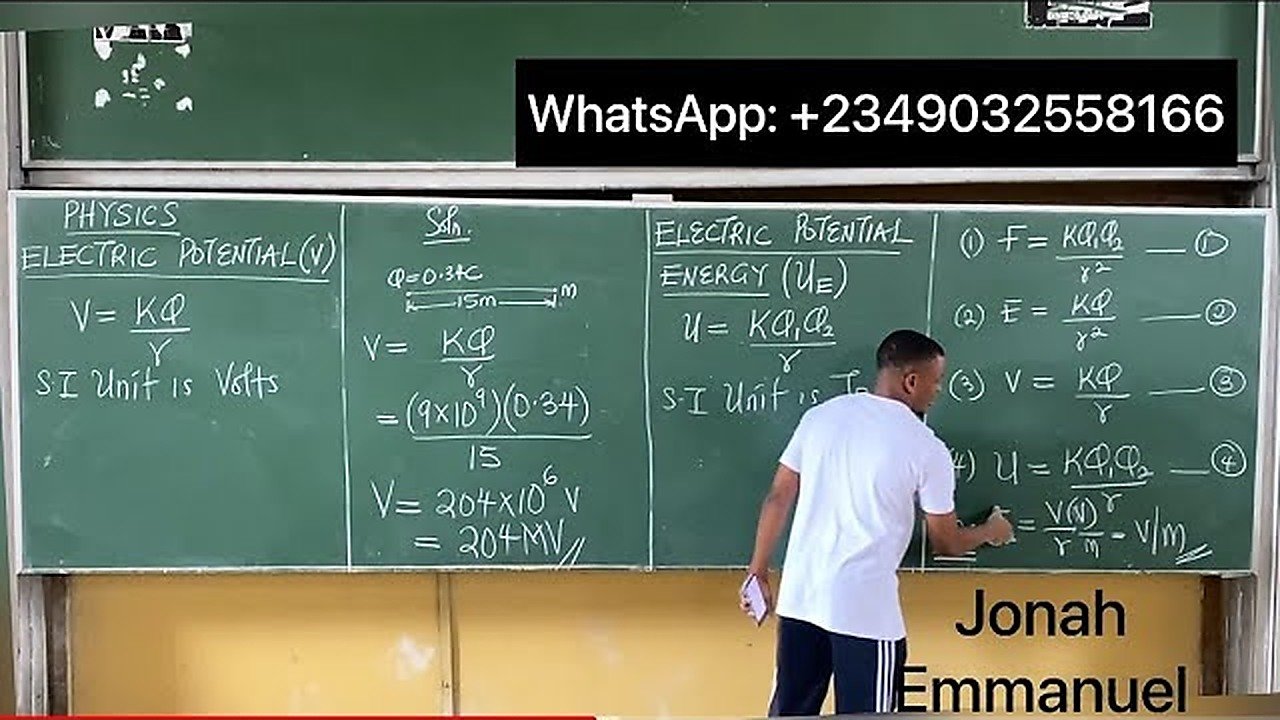
The formula is U = kq₁q₂/r, which gives the electrostatic potential energy of 2 point charges in joules, with U = 0 at infinite separation.
The table below lists the 4 variables. Rows show each quantity. Columns show the symbol, SI unit, and value or meaning.
| Quantity | Symbol | SI unit | Value or meaning |
|---|---|---|---|
| Electrostatic potential energy | U | joule (J) | zero at r = ∞ |
| Coulomb constant | k | N·m²/C² | 8.99 × 10⁹, where k = 1/(4πε₀) |
| Charges | q₁, q₂ | coulomb (C) | signed values |
| Separation | r | meter (m) | distance between the charges |
The equivalent form is U = q₁q₂/(4πε₀r), where ε₀ = 8.854 × 10⁻¹² F/m. A uniform dielectric medium with dielectric constant κ divides U by κ. Water at 20 °C has κ ≈ 80, so the energy is about 80 times smaller than in a vacuum.
How Is the Electrostatic Potential Energy Formula Derived?
The formula follows from the work done to move a charge from infinity to distance r against the Coulomb force. The derivation has 5 steps:
- Write the Coulomb force on charge q₂ at distance x: F = kq₁q₂/x².
- Move q₂ slowly from infinity to r, so the external force equals the negative of the Coulomb force at each point.
- Integrate the external work: W = −∫ kq₁q₂/x² dx, from x = ∞ to x = r.
- Evaluate the integral: W = kq₁q₂/r.
- Set U(∞) = 0, so U(r) = W = kq₁q₂/r.
The Coulomb force is conservative, so the work depends only on the initial and final separations and not on the path.
What Determines the Sign of Electrostatic Potential Energy?
The signs of the charges determine the sign: like charges give positive U, and opposite charges give negative U.
The table below lists the 3 charge-pair cases. Rows show each case. Columns show the force type, the sign of U, and the meaning.
| Charge pair | Force type | Sign of U | Meaning |
|---|---|---|---|
| Positive and positive | repulsive | positive | an external agent supplies energy to assemble the pair |
| Negative and negative | repulsive | positive | an external agent supplies energy to assemble the pair |
| Positive and negative | attractive | negative | an external agent supplies |U| to separate the pair to infinity |
Does Negative Electrostatic Potential Energy Mean the Charges Are Bound?
Negative U means the field does positive work as the charges move together from infinity. The charges are bound when the total energy, kinetic plus potential, is negative. A hydrogen atom in the ground state has a total energy of −13.6 eV.
How Do You Calculate Electrostatic Potential Energy for More Than 2 Charges?
Add the pair energies: U = k Σ q_i q_j / r_ij, summed over every distinct pair of charges. Electrostatic potential energy is a scalar, so the sum uses signed numbers and no direction.
A system of N charges has N(N − 1)/2 distinct pairs. The table below lists the pair counts. Rows show the number of charges. Columns show the number of pairs.
| Number of charges (N) | Number of distinct pairs |
|---|---|
| 2 | 1 |
| 3 | 3 |
| 4 | 6 |
| 5 | 10 |
| 10 | 45 |
How Is Electrostatic Potential Energy Related to Electric Potential and Electric Field?
The relation is U = qV, where V is the electric potential at the location of charge q. Three related equations apply to a point charge source Q:
- Electric potential: V = kQ/r
- Potential difference: ΔV = ΔU/q
- Uniform field magnitude between 2 points: E = ΔV/d
The table below compares 4 related quantities for point charges. Rows show each quantity. Columns show the formula, the SI unit, and the type.
| Quantity | Formula | SI unit | Type |
|---|---|---|---|
| Electric force | F = kq₁q₂/r² | newton (N) | vector |
| Electric field | E = kQ/r² | N/C, equal to V/m | vector |
| Electrostatic potential energy | U = kq₁q₂/r | joule (J) | scalar |
| Electric potential | V = kQ/r | volt (V), equal to J/C | scalar |
What Is the Electrostatic Potential Energy of a Charge in a Uniform Electric Field?
A charge q moved a distance d against the force of a uniform field E gains ΔU = qEd. A charge moved the same distance in the direction of the force loses the same amount, ΔU = −qEd.
A charge of 1 μC moved 0.02 m against the force of a 5,000 V/m field gains 1 × 10⁻⁶ × 5,000 × 0.02 = 1.0 × 10⁻⁴ J.
How Much Electrostatic Potential Energy Does a Capacitor Store?
A charged capacitor stores U = ½QΔV = ½C(ΔV)² = Q²/(2C). The energy resides in the electric field with an energy density of u = ½ε₀E² in joules per cubic meter.
A 10 μF capacitor charged to 12 V stores ½ × 10 × 10⁻⁶ × 12² = 7.2 × 10⁻⁴ J.
What Is the Electrostatic Potential Energy of a Charged Sphere?
A conducting sphere with charge Q and radius R has U = kQ²/(2R), and a uniformly charged insulating sphere has U = 3kQ²/(5R). Both values equal the work required to assemble the charge.
For Q = 1 μC and R = 0.10 m, the conducting sphere has 0.045 J and the insulating sphere has 0.054 J.
What Is the Electrostatic Potential Energy of an Electric Dipole?
An electric dipole in a uniform field has U = −pE cosθ, where p is the dipole moment in C·m and θ is the angle between p and E.
The table below lists 3 orientations. Rows show the angle. Columns show the energy and the state.
| Angle θ | Energy U | State |
|---|---|---|
| 0° | −pE | minimum energy |
| 90° | 0 | zero energy |
| 180° | +pE | maximum energy |
What Are the Units of Electrostatic Potential Energy?
The SI unit is the joule (J), and atomic physics also uses the electronvolt (eV). The 2019 SI redefinition fixes 1 eV at exactly 1.602176634 × 10⁻¹⁹ J. The dimensional formula of energy is ML²T⁻².
The table below lists common energy conversions. Rows show each unit. Columns show the equivalent in joules or kilojoules per mole.
| Unit | Equivalent |
|---|---|
| 1 eV | 1.602 × 10⁻¹⁹ J |
| 1 keV | 1.602 × 10⁻¹⁶ J |
| 1 MeV | 1.602 × 10⁻¹³ J |
| 1 eV per particle | 96.485 kJ/mol |
How Do You Calculate Electrostatic Potential Energy Step by Step?
To calculate electrostatic potential energy, convert units, keep the signs, compute each pair, and add the results. Follow these 6 steps:
- Convert each charge to coulombs (1 μC = 10⁻⁶ C, 1 nC = 10⁻⁹ C).
- Convert each distance to meters (1 cm = 0.01 m).
- Keep the sign of each charge.
- Compute kq_iq_j/r_ij for each distinct pair.
- Add the pair energies as signed scalars.
- Report the result in joules, or divide by 1.602 × 10⁻¹⁹ J/eV for electronvolts.
What Are Solved Examples of Electrostatic Potential Energy?
Example 1: What Is the Potential Energy of a 2 μC Charge and a 3 μC Charge 0.5 m Apart?
U = (8.99 × 10⁹ × 2 × 10⁻⁶ × 3 × 10⁻⁶) / 0.5 ≈ +0.108 J. The sign is positive because both charges are positive.
Example 2: What Is the Electrostatic Potential Energy of the Hydrogen Atom?
The proton and electron are 5.29 × 10⁻¹¹ m apart. U = −(8.99 × 10⁹ × (1.602 × 10⁻¹⁹)²) / (5.29 × 10⁻¹¹) ≈ −4.36 × 10⁻¹⁸ J, which equals −27.2 eV.
In the Bohr model, the total energy equals half the potential energy, so the total energy is −13.6 eV. NIST lists the ionization energy of ground-state hydrogen as 13.598433 eV.
Example 3: What Is the Potential Energy of 3 Charges on a Line?
Charge +2 μC sits at x = 0, charge −2 μC at x = 1 m, and charge +1 μC at x = 2 m. The system has 3 pairs:
- Pair 1 and 2: k(2 × 10⁻⁶)(−2 × 10⁻⁶)/1 ≈ −0.0360 J
- Pair 2 and 3: k(−2 × 10⁻⁶)(1 × 10⁻⁶)/1 ≈ −0.0180 J
- Pair 1 and 3: k(2 × 10⁻⁶)(1 × 10⁻⁶)/2 ≈ +0.0090 J
The total is U ≈ −0.045 J.
Example 4: How Much Work Moves a 2 nC Charge From 0.20 m to 0.10 m of a Fixed 4 μC Charge?
ΔU = kQq(1/r₂ − 1/r₁) = 8.99 × 10⁹ × 4 × 10⁻⁶ × 2 × 10⁻⁹ × (1/0.10 − 1/0.20) ≈ +3.6 × 10⁻⁴ J. An external agent supplies this work because both charges are positive.
Example 5: How Fast Is an Electron After a 100 V Potential Difference?
The potential energy change is ΔU = qΔV = −100 eV = −1.60 × 10⁻¹⁷ J. Energy conservation gives K = 1.60 × 10⁻¹⁷ J. The speed is v = √(2K/m) = √(2 × 1.60 × 10⁻¹⁷ / 9.11 × 10⁻³¹) ≈ 5.93 × 10⁶ m/s.
How Does Distance Change Electrostatic Potential Energy?
Electrostatic potential energy is inversely proportional to the distance, so doubling r halves U. Coulomb force follows an inverse-square law, so force falls faster with distance than energy does.
The table below shows the energy for a fixed pair of charges at different distances. Rows show distances as multiples of a reference distance r₀. Columns show the energy as a multiple and a percentage of the reference energy U₀.
| Distance (multiple of r₀) | Energy (multiple of U₀) | Energy (percent of U₀) |
|---|---|---|
| 0.5 r₀ | 2.00 U₀ | 200% |
| 1 r₀ | 1.00 U₀ | 100% |
| 2 r₀ | 0.50 U₀ | 50% |
| 3 r₀ | 0.333 U₀ | 33.3% |
| 10 r₀ | 0.10 U₀ | 10% |
What Is the Difference Between Electrostatic and Gravitational Potential Energy?
Both energies follow a 1/r dependence, but electrostatic energy can be positive or negative, while gravitational energy is always negative.
The table below compares 5 features. Columns list the energy type. Rows list the feature.
| Feature | Electrostatic potential energy | Gravitational potential energy |
|---|---|---|
| Formula | U = kq₁q₂/r | U = −Gm₁m₂/r |
| Source | electric charge (C) | mass (kg) |
| Constant | k = 8.99 × 10⁹ N·m²/C² | G = 6.674 × 10⁻¹¹ N·m²/kg² |
| Sign | positive or negative | always negative |
| Force direction | attractive or repulsive | attractive only |
For a proton and an electron, the electrostatic energy exceeds the gravitational energy by a factor of about 2.27 × 10³⁹ at every separation, calculated from CODATA constants.
What Are the Applications of Electrostatic Potential Energy?
Electrostatic potential energy applies to 6 areas of physics, chemistry, and engineering:
- Atomic structure: the hydrogen atom has an electrostatic potential energy of −27.2 eV in the ground state.
- Ionic crystals: lattice energy measures the electrostatic energy released when gaseous ions form a solid. The NaCl rock salt lattice has a Madelung constant of 1.7476. The Born-Haber cycle gives a lattice energy near −787 kJ/mol for NaCl. A Born-Landé calculation with an ion separation of 2.814 Å gives −766.5 kJ/mol.
- Capacitors: energy storage follows U = ½CV².
- Particle accelerators and electron beams: a charge q gains kinetic energy K = qΔV across a potential difference.
- Nuclear fusion: 2 protons 1 femtometer apart have an electrostatic potential energy of 1.44 MeV, which forms the Coulomb barrier.
- Molecular simulation: force fields add a Coulomb term, kq_iq_j/r_ij, for every pair of atoms.
What Are Common Mistakes When Calculating Electrostatic Potential Energy?
Five errors reduce accuracy: dropping signs, skipping unit conversion, counting pairs twice, confusing U with V, and misapplying qEd.
- Dropping the sign of a charge, which turns a negative energy into a positive one
- Skipping the conversion of μC, nC, and cm to C and m
- Counting the same pair twice in a multi-charge system
- Confusing energy U in joules with potential V in volts
- Applying U = qEd to a non-uniform field
What Do People Also Ask About Electrostatic Potential Energy?
What is electrostatic potential energy in simple words?
Electrostatic potential energy is the energy a system of charges has because of the distances between the charges.
Is electrostatic potential energy a scalar or a vector?
Electrostatic potential energy is a scalar.
Why is electrostatic potential energy negative for opposite charges?
The field does positive work as opposite charges move together from infinity, which leaves the system with less energy than at infinite separation.
What is the difference between electrostatic potential energy and electric potential?
Electrostatic potential energy is measured in joules and depends on the charge, while electric potential is measured in volts and equals energy per unit charge.
Is electrostatic potential energy the same as electric potential energy?
Yes, both terms name the same quantity.
What is the unit of electrostatic potential energy?
The SI unit is the joule, and the electronvolt is common in atomic physics.
What is the reference point for electrostatic potential energy?
The reference point is infinite separation, where U = 0.
Does electrostatic potential energy depend on the path?
No, the Coulomb force is conservative, so U depends only on the separation.
How many charges does AP Physics 2 require for electrostatic potential energy calculations?
The College Board course and exam description requires calculations for configurations of 4 or fewer point charges.
How does electrostatic potential energy relate to Coulomb's law?
The force equals the negative derivative of energy with respect to distance, F = −dU/dr, and U = kq₁q₂/r follows from integrating the Coulomb force.
What Are the Key Facts About Electrostatic Potential Energy?
Electrostatic potential energy is the energy stored in a system of charges because of the positions of the charges.
- Equals kq₁q₂/r for 2 point charges
- Takes the value zero at infinite separation
- Carries a positive sign for like charges and a negative sign for opposite charges
- Adds as a scalar over N(N − 1)/2 pairs
- Relates to electric potential through U = qV
- Uses joules or electronvolts, where 1 eV = 1.602176634 × 10⁻¹⁹ J
Sources:
- AP Physics 2 Course and Exam Description, College Board
- Electronvolt, Wikipedia
- NIST Handbook of Basic Atomic Spectroscopic Data: Hydrogen (H)
- NIST Fundamental Physical Constants
- 5.8.01: Born Haber Cycles for NaCl and Silver Halides, LibreTexts
- NPTEL Course 122101001, Lecture 16: Madelung constants table

The University of the West Indies
My passion as a teacher and leader in education is to contribute to students’ enhanced learning by creation of a positive teaching/learning environment, where they are motivated to develop strong critical thinking, analytical and problem-solving skills.
As acting Vice-Principal and head of Physics, I have amassed five years of experience in leading meetings, implementing strategies to maintain discipline and school ethos, liaise with stakeholders in planning for future development of the institution; successfully negotiated the implementation of various projects for student development as well as supervising effective execution of such. For the past 19 years, I have incorporated discovery learning within the classroom through practical activities, problem solving and cooperative learning and have realized that students retention in Physics and Mathematics have increased significantly.
I am always cognizant that students have different learning styles, and as such teaching strategies during planning and delivery must take this crucial factor into consideration and be tailored to meet such differences.