

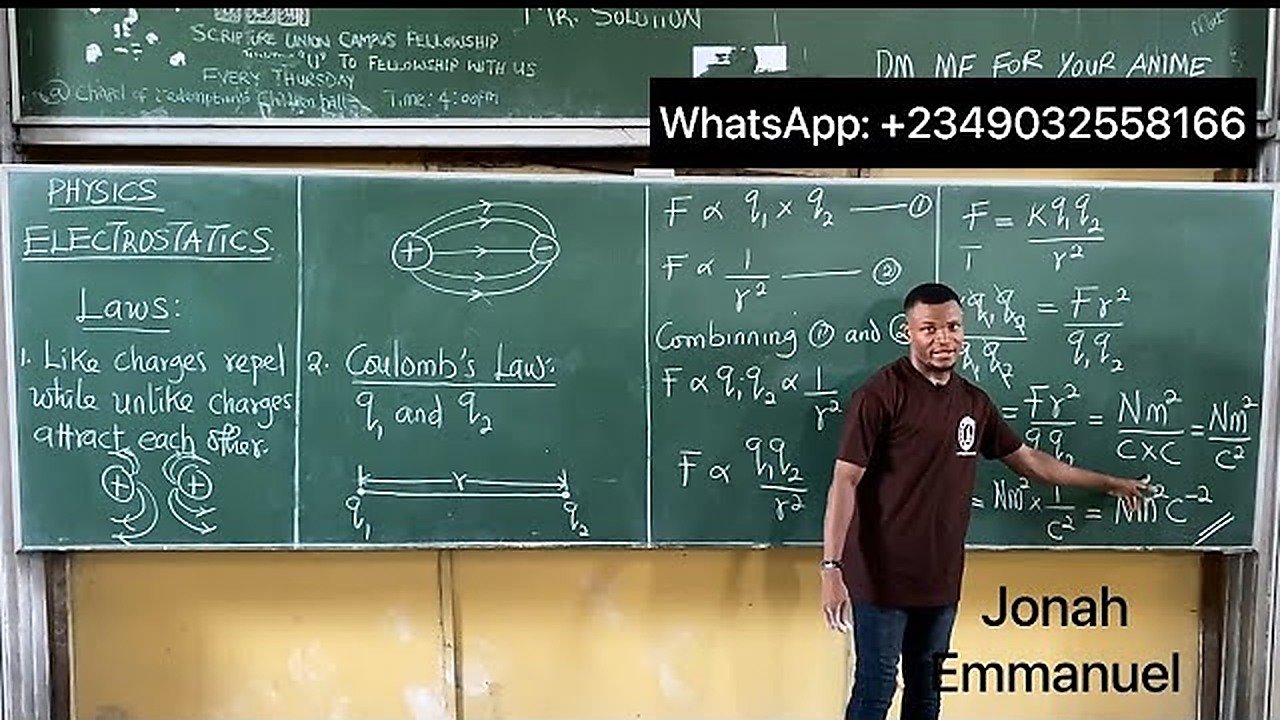
Coulomb's Law: Electrostatic Force Between Two Point Charges Is Directly Proportional to the Product of the Charges and Inversely Proportional to the Square of the Distance
What Is Coulomb's Law and What Are Examples of It?
Coulomb's law states that the electrostatic force between two stationary point charges is directly proportional to the product of the charges and inversely proportional to the square of the distance between them.
For a reliable reference, consult OpenStax section on Coulomb’s law.
French physicist Charles-Augustin de Coulomb is known for publishing the law in 1785. The force acts along the straight line joining the two charges.
Point charges are idealized charged objects. Examples include electrons, protons, and small charged spheres.
Three common examples of Coulomb force are:
- A rubbed balloon sticks to a wall because its charge induces an opposite charge on the wall surface.
- Two charged pith balls repel each other when both carry the same sign.
- A proton and an electron attract each other inside a hydrogen atom.
What Is the Coulomb's Law Formula?
The Coulomb's law formula is F = k × |q₁ × q₂| / r², which gives the magnitude of the electrostatic force in newtons.
The formula contains 4 variables:
- F: electrostatic force in newtons (N)
- k: Coulomb constant, 8.99 × 10⁹ N·m²/C²
- q₁ and q₂: charge magnitudes in coulombs (C)
- r: distance between the charges in meters (m)
What Is the Value of the Coulomb Constant?
The Coulomb constant is k = 1/(4πε₀) ≈ 8.99 × 10⁹ N·m²/C² in a vacuum. The symbol ε₀ represents the vacuum permittivity, valued at about 8.854 × 10⁻¹² F/m. NIST publishes the recommended values of these constants in its CODATA reference.
What Is the Vector Form of Coulomb's Law?
The vector form is F = k q₁ q₂ r̂ / r², which gives the force on charge 1 from charge 2. The unit vector r̂ points from charge 2 to charge 1. A positive result indicates repulsion. A negative result indicates attraction.
What Determines the Direction of the Coulomb Force?
Charge signs determine direction: like charges repel and unlike charges attract. Like charges include 2 positive charges or 2 negative charges. Unlike charges include 1 positive charge and 1 negative charge. The two forces form an action-reaction pair with equal magnitude and opposite direction, as Newton's third law states.
What Are the Properties of Coulomb's Law?
Coulomb's law has 6 main properties:
- Inverse-square dependence: doubling the distance reduces the force to 25 percent.
- Linear dependence on charge: doubling one charge doubles the force.
- Central force: the force acts along the line joining the charges.
- Conservative force: the work done between 2 points is independent of the path.
- Newton's third law: the 2 charges exert equal and opposite forces.
- Superposition: forces from multiple charges add as vectors.
What Is the Superposition Principle in Coulomb's Law?
The superposition principle states that the net force on a charge equals the vector sum of the forces from every other charge. Each pair of charges interacts independently. A system of 3 charges produces 2 force vectors on each charge.
How Do You Calculate Force Using Coulomb's Law?
To calculate Coulomb force, convert units, apply F = kq₁q₂/r², and assign direction from the charge signs.
What Are the Steps to Calculate Coulomb Force?
Follow these 6 steps:
- Convert each charge to coulombs (1 μC = 10⁻⁶ C, 1 nC = 10⁻⁹ C).
- Convert the distance to meters (1 cm = 0.01 m).
- Multiply the 2 charge magnitudes.
- Divide the product by the square of the distance.
- Multiply the result by 8.99 × 10⁹ N·m²/C².
- Assign repulsion for like charges or attraction for unlike charges.
What Are Solved Examples of Coulomb's Law?
Example 1: What Is the Force Between a 2 μC Charge and a 3 μC Charge Placed 0.5 m Apart?
F = (8.99 × 10⁹ × 2 × 10⁻⁶ × 3 × 10⁻⁶) / (0.5)² ≈ 0.216 N. The force is repulsive because both charges are positive.
Example 2: What Is the Electrostatic Force Between the Proton and Electron in a Hydrogen Atom?
The Bohr radius is 5.29 × 10⁻¹¹ m, and each particle carries 1.602 × 10⁻¹⁹ C. F = (8.99 × 10⁹ × (1.602 × 10⁻¹⁹)²) / (5.29 × 10⁻¹¹)² ≈ 8.2 × 10⁻⁸ N. The force is attractive.
Example 3: What Is the Net Force on a +1 μC Charge Midway Between +3 μC and −3 μC Charges Placed 2 m Apart?
The +1 μC charge sits 1 m from each charge. Each force equals 8.99 × 10⁹ × 3 × 10⁻⁶ × 1 × 10⁻⁶ / 1² ≈ 0.027 N. Both forces point toward the negative charge, so the net force is about 0.054 N in that direction.
How Does Distance Change the Coulomb Force?
Distance changes the force by the inverse square. The table below shows the force for a fixed pair of charges at different distances. Rows list distances as multiples of a reference distance r₀. Columns list the force as a multiple of the reference force F₀ and as a percentage of F₀.
| Distance (multiple of r₀) | Force (multiple of F₀) | Force (percent of F₀) |
|---|---|---|
| 0.5 r₀ | 4.00 F₀ | 400% |
| 1 r₀ | 1.00 F₀ | 100% |
| 2 r₀ | 0.25 F₀ | 25% |
| 3 r₀ | 0.111 F₀ | 11.1% |
| 10 r₀ | 0.01 F₀ | 1% |
What Is the History of Coulomb's Law?
Charles-Augustin de Coulomb published the inverse-square law of electrostatic force in 1785 after measuring charge interactions with a torsion balance.
The table below lists 4 milestones before and after Coulomb's publication. Rows are ordered by year. Columns show the year, the scientist, and the contribution.
| Year | Scientist | Contribution |
|---|---|---|
| 1767 | Joseph Priestley | Proposed an inverse-square force, based on Benjamin Franklin's observation that a hollow charged metal vessel shows no electric effect inside. |
| c. 1773 | Henry Cavendish | Measured the force exponent as 2 within ±0.02. The results stayed unpublished. |
| 1785 | Charles-Augustin de Coulomb | Measured forces with a torsion balance and reported the inverse-square dependence. |
| 1879 | James Clerk Maxwell | Published Cavendish's electrical manuscripts, which revealed Cavendish's earlier work. |
How Did Coulomb's Torsion Balance Experiment Work?
Coulomb's torsion balance measured force through the twist of a thin suspended fiber. A horizontal rod hung from the fiber and carried a charged ball at one end. A second charged ball stood fixed nearby. The electrostatic force twisted the fiber, and the twist angle gave the force at each separation. Coulomb also timed the oscillations of a charged needle to measure attractive forces.
How Is Coulomb's Law Derived?
Coulomb's law is an experimental law, so it comes from measurement and not from a theoretical derivation. Quantum electrodynamics later derived it as the static limit of single-photon exchange between charges. A massless photon produces the 1/r² dependence.
What Is the SI Unit of Charge in Coulomb's Law?
The coulomb (C) is the SI unit of electric charge, defined as the charge transported by a current of 1 ampere in 1 second. One coulomb equals about 6.242 × 10¹⁸ elementary charges. The elementary charge equals exactly 1.602176634 × 10⁻¹⁹ C since the 2019 SI redefinition. Static charges in laboratory experiments range from nanocoulombs (10⁻⁹ C) to microcoulombs (10⁻⁶ C).
The table below lists the 5 quantities in Coulomb's law. Rows show each quantity. Columns show the symbol, SI unit, and unit symbol.
| Quantity | Symbol | SI Unit | Unit Symbol |
|---|---|---|---|
| Force | F | newton | N |
| Electric charge | q | coulomb | C |
| Distance | r | meter | m |
| Coulomb constant | k | newton meter squared per coulomb squared | N·m²/C² |
| Vacuum permittivity | ε₀ | farad per meter | F/m |
How Does a Medium Change Coulomb's Law?
A dielectric medium reduces the electrostatic force by the factor of its relative permittivity (εr). The formula becomes F = q₁q₂ / (4πε₀εr r²).
Relative permittivity values show the size of the reduction:
- Vacuum: εr = 1, so the force equals the vacuum value.
- Air: εr ≈ 1.0006, so the force is about the same as in vacuum.
- Water at 20 °C: εr ≈ 80, so the force is about 80 times weaker.
What Is the Difference Between Coulomb's Law and Newton's Law of Gravitation?
Both laws follow an inverse-square dependence, but Coulomb's law acts between charges and can attract or repel, while Newton's law acts between masses and only attracts.
The table below compares both laws across 7 features. Columns list the law. Rows list the feature.
| Feature | Coulomb's Law | Newton's Law of Gravitation |
|---|---|---|
| Formula | F = k q₁q₂ / r² | F = G m₁m₂ / r² |
| Source of force | Electric charge (C) | Mass (kg) |
| Constant | k = 8.99 × 10⁹ N·m²/C² | G = 6.674 × 10⁻¹¹ N·m²/kg² |
| Force type | Attractive or repulsive | Attractive only |
| Distance dependence | 1/r² | 1/r² |
| Range | Infinite | Infinite |
| Shielding | Possible with conductors | Not possible |
For a proton and an electron in a hydrogen atom, the electrostatic force exceeds the gravitational force by a factor of about 2.3 × 10³⁹, calculated from CODATA constants.
What Is the Relationship Between Coulomb's Law and Gauss's Law?
Gauss's law follows from Coulomb's law for static charges, and both laws are equivalent in electrostatics. Gauss's law states that the electric flux through a closed surface equals the enclosed charge divided by ε₀. Gauss's law simplifies field calculations for symmetric charge distributions. Examples include spheres, long cylinders, and infinite planes.
How Does Coulomb's Law Relate to Electric Field and Potential Energy?
Coulomb's law gives 3 related quantities for point charges:
- Electric field: E = kq/r² (newtons per coulomb)
- Electric potential: V = kq/r (volts)
- Potential energy of 2 charges: U = kq₁q₂/r (joules)
How Accurate Is Coulomb's Law?
Experiments confirm that the exponent in Coulomb's law equals 2 to within about 3 × 10⁻¹⁶. The table below lists 4 tests of the exponent. Rows are ordered by year. Columns show the year, the researchers, and the maximum deviation of the exponent from 2.
| Year | Researchers | Maximum Deviation from Exponent 2 |
|---|---|---|
| c. 1773 | Henry Cavendish | 0.02 |
| 1873 | James Clerk Maxwell | 1 part in 21,600 (about 4.6 × 10⁻⁵) |
| 1936 | Plimpton and Lawton | 2 × 10⁻⁹ |
| 1971 | Williams, Faller, and Hill | (2.7 ± 3.1) × 10⁻¹⁶ |
Plimpton and Lawton published their test in Physical Review in 1936. Williams, Faller, and Hill published theirs in Physical Review Letters in 1971 and used it to set a laboratory upper limit on the photon rest mass.
What Are the Limitations of Coulomb's Law?
Coulomb's law applies exactly to stationary point charges in a vacuum. Four limitations apply:
- Stationary charges: moving charges require Maxwell's equations and the Lorentz force.
- Point charges: extended objects require integration over the charge distribution. For a uniformly charged sphere, the shell theorem treats the charge as a point at the center for exterior points.
- Classical regime: quantum electrodynamics governs interactions at very small distances.
- Vacuum assumption: dielectric media change the force by the factor εr.
What Are the Applications of Coulomb's Law?
Coulomb's law applies to 6 technologies and fields:
- Electrostatic precipitators: remove particulate pollution from industrial exhaust. According to the U.S. Environmental Protection Agency, these devices reach collection efficiencies of 99 percent or more.
- Laser printers and photocopiers: attract charged toner particles to a patterned charge on a photoreceptor drum.
- Electrostatic spray painting: deposit charged paint droplets on grounded metal parts and reduce overspray.
- Chemical bonding: hold ionic crystals together. Examples include sodium chloride and magnesium oxide.
- Rutherford scattering: reveal the atomic nucleus in 1911 through the Coulomb repulsion between alpha particles and gold nuclei.
- Molecular simulation: calculate charge interactions between atoms in force fields for proteins and DNA.
Is Coulomb's Law of Friction the Same as Coulomb's Law of Electrostatics?
No. Coulomb's law of friction is a separate law that states sliding friction force equals the coefficient of friction times the normal force (f = μN). It is approximately independent of sliding speed and apparent contact area.
Coulomb also gave his name to the Mohr-Coulomb failure criterion in soil mechanics, expressed as τ = c + σ tan φ. Electrostatic force between charges is the subject of Coulomb's law in electricity.
What Do People Also Ask About Coulomb's Law?
What is Coulomb's law in simple words?
Coulomb's law states that electric force grows with larger charges and weakens as the distance between them increases.
What is the formula of Coulomb's law?
The formula is F = k q₁q₂ / r².
Who discovered Coulomb's law?
Charles-Augustin de Coulomb published the law in 1785, and Henry Cavendish measured the same dependence about 12 years earlier without publishing.
What is the value of k in Coulomb's law?
The value of k is about 8.99 × 10⁹ N·m²/C² in a vacuum.
Is Coulomb's law an inverse square law?
Yes, the electrostatic force is proportional to 1/r².
What is 1 coulomb of charge?
One coulomb is the charge transported by a current of 1 ampere in 1 second.
What is the unit of Coulomb force?
The unit of Coulomb force is the newton (N).
What is the dimensional formula of the Coulomb constant?
The dimensional formula of k is [M¹L³T⁻⁴A⁻²].
Does Coulomb's law apply to moving charges?
Coulomb's law applies exactly to stationary charges, and moving charges require Maxwell's equations and the Lorentz force.
Why is Coulomb's law important?
Coulomb's law quantifies the electrostatic interaction, which underlies atomic structure, chemical bonding, and electrostatic technology.
What Are the Key Facts About Coulomb's Law?
Coulomb's law is summarized by 5 key facts:
- Defines the electrostatic force between 2 point charges as F = kq₁q₂/r².
- Uses the constant k = 8.99 × 10⁹ N·m²/C² in a vacuum.
- Originates from Coulomb's 1785 torsion balance measurements.
- Holds with an inverse-square exponent confirmed to within about 3 × 10⁻¹⁶.
- Applies to stationary charges, with medium effects set by relative permittivity.
Sources: NIST CODATA fundamental physical constants; Coulomb (1785), Mémoires de l'Académie Royale des Sciences; Maxwell (1879), The Electrical Researches of the Honourable Henry Cavendish; Plimpton and Lawton (1936), Physical Review 50, 1066; Williams, Faller, and Hill (1971), Physical Review Letters 26, 721; U.S. Environmental Protection Agency, electrostatic precipitator fact sheet.

The University of the West Indies
My passion as a teacher and leader in education is to contribute to students’ enhanced learning by creation of a positive teaching/learning environment, where they are motivated to develop strong critical thinking, analytical and problem-solving skills.
As acting Vice-Principal and head of Physics, I have amassed five years of experience in leading meetings, implementing strategies to maintain discipline and school ethos, liaise with stakeholders in planning for future development of the institution; successfully negotiated the implementation of various projects for student development as well as supervising effective execution of such. For the past 19 years, I have incorporated discovery learning within the classroom through practical activities, problem solving and cooperative learning and have realized that students retention in Physics and Mathematics have increased significantly.
I am always cognizant that students have different learning styles, and as such teaching strategies during planning and delivery must take this crucial factor into consideration and be tailored to meet such differences.