

What Is the Electric Force? Definition, Formula, and 6 Examples of the Force Between Charges
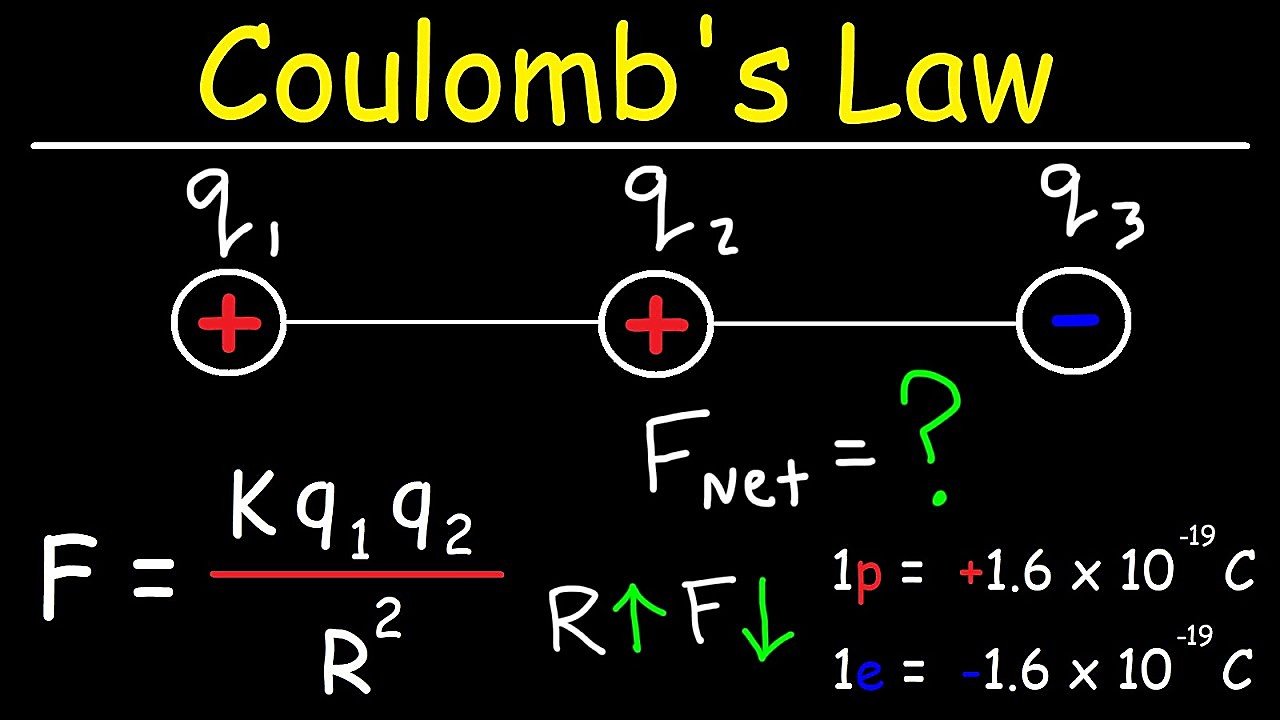
Electric force is the force of attraction or repulsion between electrically charged objects. The magnitude follows Coulomb's law: F = k|q1q2| / r². Electric force is measured in newtons (N). Like charges repel, and opposite charges attract.
For a reliable reference, consult OpenStax section on electric force and Coulomb’s law.
What Is Electric Force?
Electric force is the attractive or repulsive force that charged objects exert on each other. Experiments show that two objects with electric charge exert an electric force on each other. Electric force is also called Coulomb force or electrostatic force.
Examples of electric force include the attraction between an electron and a proton in a hydrogen atom, the repulsion between 2 like-charged rods, and the attraction of small paper pieces to a rubbed plastic comb.
What Is the Difference Between Electric Force and Electrostatic Force?
Electric force describes the force between charges in general, and electrostatic force describes the electric force between charges at rest.
What Are the Symbol and Units of Electric Force?
The symbol of electric force is F_E, or F. The SI unit of electric force is the newton (N). The SI unit of electric charge is the coulomb (C), and 1 microcoulomb (µC) equals 1 × 10⁻⁶ C.
What Is the Direction of Electric Force?
Electric force acts along the line connecting the 2 charges. The electric force acts along the line that connects the two charges. Unlike charges attract, and like charges repel.
Table 1 lists the force type and direction for 3 charge combinations.
| Charge combination | Force type | Direction on each charge |
|---|---|---|
| Positive and positive | Repulsive | Away from the other charge |
| Negative and negative | Repulsive | Away from the other charge |
| Positive and negative | Attractive | Toward the other charge |
What Is the Electric Force Formula?
The electric force formula is F = k|q1q2| / r². Coulomb's law calculates the magnitude of the force between 2 point charges, q1 and q2, separated by a distance r. The force is proportional to the magnitude of each charge and inversely proportional to the square of the distance between them.
Coulomb's law applies to point charges and to spherically symmetric charge distributions.
Table 2 defines the 4 variables in F = k|q1q2| / r².
| Symbol | Quantity | SI unit | Unit symbol |
|---|---|---|---|
| F | Magnitude of electric force | Newton | N |
| k | Coulomb's constant (8.99 × 10⁹) | Newton meter squared per coulomb squared | N·m²/C² |
| q1, q2 | Electric charges | Coulomb | C |
| r | Separation between the charges | Meter | m |
Coulomb's constant equals 1 / (4πε₀), where ε₀ is the permittivity of vacuum. The value of ε₀ is 8.85 × 10⁻¹² C²/(N·m²).
What Is Coulomb's Law?
Coulomb's law states that electric force is proportional to the product of the charges and inversely proportional to the square of their separation. Charles-Augustin de Coulomb measured the electrostatic force with a torsion balance in 1785. The SI unit of electric charge bears his name.
Modern experiments have verified Coulomb's law to great precision. The most sensitive tests of the inverse-square exponent use apparatus based on Gauss's law, such as concentric conducting spheres.
What Is the Vector Form of the Electric Force?
The vector form of the electric force on charge q2 from charge q1 is F = k q1 q2 / r² × r̂, where r̂ is the unit vector pointing from q1 to q2. A positive result means repulsion, and a negative result means attraction.
The net electric force on a charge from several charges equals the vector sum of the individual forces. Students confuse a single force with the net force when applying Coulomb's law.
How Does Newton's Third Law Apply to Electric Force?
The 2 charges exert forces of equal magnitude and opposite direction on each other. Newton's third law applies as usual, so the force on q1 equals in magnitude and opposes the force on q2. A 4 µC charge and a 1 µC charge exert the same force magnitude on each other.
What Are the 5 Steps to Calculate Electric Force?
Calculate electric force by identifying the charges and separation, substituting them into F = k|q1q2| / r², and determining the direction from the charge signs. The 5 steps are:
- Identify the charges q1 and q2 in coulombs.
- Identify the separation r in meters.
- Substitute the values into F = k|q1q2| / r².
- Calculate the magnitude in newtons.
- Determine the direction from the signs of the charges.
Two charges of 3 µC and 2 µC separated by 0.40 m exert a force of 0.34 N on each other. The calculation is F = (8.99 × 10⁹ × 3 × 10⁻⁶ × 2 × 10⁻⁶) / (0.40)² = 0.34 N, and the force is repulsive because both charges are positive.
How Does Electric Force Change With Charge and Distance?
Electric force increases in direct proportion to each charge and decreases with the square of the separation. Table 3 shows the effect of changing 1 variable at a time.
| Change | Effect on electric force | Relationship |
|---|---|---|
| One charge doubles | Force doubles | Direct proportion to q1 or q2 |
| Both charges double | Force becomes 4 times larger | Proportion to q1 × q2 |
| Separation doubles | Force becomes one quarter | Inverse proportion to r² |
| Separation halves | Force becomes 4 times larger | Inverse proportion to r² |
| Separation triples | Force becomes one ninth | Inverse proportion to r² |
What Are 6 Examples of Electric Force?
Six examples of electric force are 2 charged spheres, an electron and a proton, 2 elementary charges, 2 microcoulomb charges, 2 opposite charges, and 2 charges of 1 coulomb. Table 4 lists the charges, separation, force, and force type for each example.
| Example | Charges | Separation | Electric force | Force type |
|---|---|---|---|---|
| Two charged spheres | +3 µC and +2 µC | 0.40 m | 0.34 N | Repulsive |
| Electron and proton in hydrogen | −1.60 × 10⁻¹⁹ C and +1.60 × 10⁻¹⁹ C | 0.530 × 10⁻¹⁰ m | 8.19 × 10⁻⁸ N | Attractive |
| Two elementary charges of the same sign | +1.60 × 10⁻¹⁹ C each | 1 × 10⁻⁹ m | 2.3 × 10⁻¹⁰ N | Repulsive |
| Two microcoulomb charges | +1 µC each | 1 m | 8.99 × 10⁻³ N | Repulsive |
| Two opposite charges | +2 µC and −3 µC | 0.5 m | 0.216 N | Attractive |
| Two coulomb charges | +1 C each | 1 m | 8.99 × 10⁹ N | Repulsive |
OpenStax reports that the Coulomb force between an electron and a proton in hydrogen is 8.19 × 10⁻⁸ N and attractive.
How Does Electric Force Compare With Gravitational Force?
Electric force exceeds gravitational force between an electron and a proton by a factor of about 2.27 × 10³⁹. Gravity dominates interactions between large objects because gravity is always attractive, while Coulomb forces tend to cancel in nearly neutral objects.
Table 5 compares electric force and gravitational force across 5 attributes.
| Attribute | Electric force | Gravitational force |
|---|---|---|
| Source property | Electric charge | Mass |
| Direction | Attractive or repulsive | Attractive only |
| Formula | F = k | q1q2 |
| Constant | k = 8.99 × 10⁹ N·m²/C² | G = 6.674 × 10⁻¹¹ N·m²/kg² |
| Distance dependence | Inverse square | Inverse square |
Gravity follows a similar inverse-square law, but gravitation depends on the masses of objects rather than their charges.
What Is the Difference Between Electric Force and Electric Field?
Electric force is the force on a charge, and electric field is the force per unit charge. The relationship is F = qE, where E is the electric field in newtons per coulomb (N/C) and q is the charge in coulombs.
How Does Electric Force Relate to Everyday Forces?
Electric force underlies every everyday force except gravity. All forces experienced in daily life, except gravity, arise from the electric force. The forces include:
- Normal force: arises from repulsion between electrons at contact surfaces
- Tension: arises from bonds between atoms in a rope or cable
- Friction: arises from interactions between atoms on touching surfaces
- Chemical bonding: binds atoms into molecules, liquids, and solids
What Are 4 Common Misconceptions About Electric Force?
Physics education research identifies 4 common misconceptions about electric force. On a Conceptual Survey of Electricity and Magnetism item, about one-third of students answered that the force on the charge that increased from +Q to +4Q stays at F. A literature review reports the idea that a bigger charge exerts a stronger force, which shows that students fail to see the symmetry of Coulomb's law between unequal charges.
A study of algebra-based physics students found 2 contributors to inconsistent use of Coulomb's law: confusion between a single force and the net force, and the belief that additional charges or insulators alter the interaction of 2 charges.
Table 6 pairs each misconception with the correct physics.
| Misconception | Correct physics |
|---|---|
| The larger charge exerts a larger force on the smaller charge | Both charges exert forces of equal magnitude on each other |
| Electric force depends only on the charge that exerts the force | Electric force is proportional to the product of both charges |
| Additional charges change the force between 2 charges | The force between 2 charges stays the same, and additional charges add separate forces to the net force |
| Electric force is zero when the net charge is zero | A neutral object still experiences electric force, as the electric force is not zero just because the net charge is zero |
Where Is Electric Force Applied?
Electric force is applied in 4 fields. The fields and their uses are:
- Electronics: guiding electron motion in circuits
- Printing: attracting toner particles to a charged drum in laser printers
- Pollution control: collecting dust particles in electrostatic precipitators
- Atomic physics: binding electrons to nuclei in atoms
People Also Ask About Electric Force
What is electric force in simple terms?
Electric force is the push or pull between charged objects.
What is the SI unit of electric force?
The SI unit of electric force is the newton (N).
What is the value of Coulomb's constant?
Coulomb's constant is 8.99 × 10⁹ N·m²/C².
Is electric force attractive or repulsive?
Electric force is attractive between opposite charges and repulsive between like charges.
Is electric force a vector or a scalar?
Electric force is a vector quantity with magnitude and direction.
Is electric force stronger than gravity?
Electric force is stronger than gravity between charged particles, by a factor of about 2.27 × 10³⁹ for an electron and a proton.
What is the difference between electric force and magnetic force?
Electric force acts on any charge, and magnetic force acts only on moving charges.
What Is the Electric Force? Summary of 5 Key Facts
The 5 key facts about electric force are:
- Electric force is the attractive or repulsive force between charged objects.
- The electric force formula is F = k|q1q2| / r².
- Electric force is measured in newtons (N).
- Like charges repel, and opposite charges attract.
- Electric forces on 2 charges have equal magnitude and opposite direction.
Title tag: Newton's 2nd Law Definition: Formula, Units, and 6 Examples

The University of the West Indies
My passion as a teacher and leader in education is to contribute to students’ enhanced learning by creation of a positive teaching/learning environment, where they are motivated to develop strong critical thinking, analytical and problem-solving skills.
As acting Vice-Principal and head of Physics, I have amassed five years of experience in leading meetings, implementing strategies to maintain discipline and school ethos, liaise with stakeholders in planning for future development of the institution; successfully negotiated the implementation of various projects for student development as well as supervising effective execution of such. For the past 19 years, I have incorporated discovery learning within the classroom through practical activities, problem solving and cooperative learning and have realized that students retention in Physics and Mathematics have increased significantly.
I am always cognizant that students have different learning styles, and as such teaching strategies during planning and delivery must take this crucial factor into consideration and be tailored to meet such differences.