

Newton's Second Law: 3 Equation Forms and How Force, Mass, and Acceleration Relate
Meta title: Newton's Second Law: F = ma Formula, Units, and 2 Solved Examples
For a reliable reference, see OpenStax on Newton’s laws of motion.
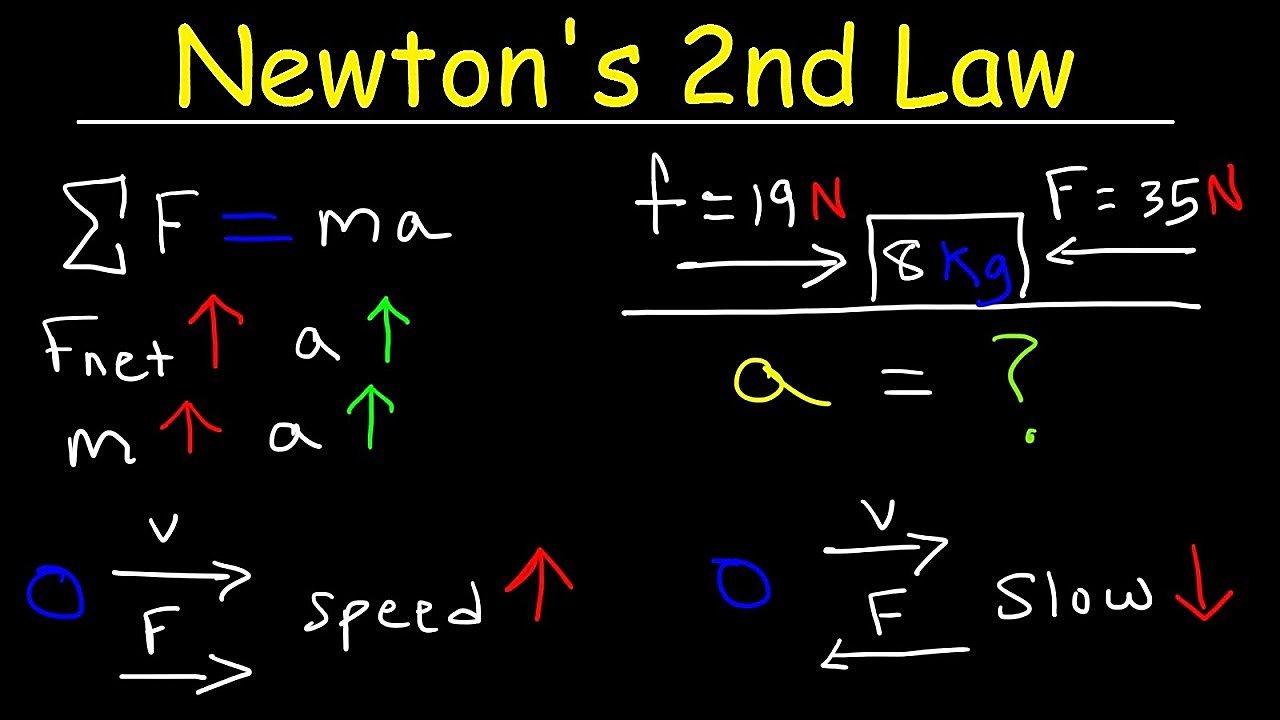
Newton's second law states that the net force on an object equals its mass multiplied by its acceleration (F = ma). Acceleration increases with greater net force, decreases with greater mass, and points in the direction of the net force.
What Is Newton's Second Law of Motion?
Newton's second law of motion states that the net force acting on an object equals the object's mass multiplied by its acceleration. The law links 3 quantities: force, mass, and acceleration.
Net force is the vector sum of all forces acting on an object. Forces are pushes or pulls. Examples include gravity, friction, tension, and air resistance.
Acceleration is the rate of change of velocity. Examples include speeding up, slowing down, and turning.
What Is the Statement of Newton's Second Law in Simple Words?
A larger net force produces a larger acceleration. A larger mass produces a smaller acceleration. A 2 kg object and a 4 kg object receive the same push, and the 2 kg object accelerates twice as much.
Who Discovered Newton's Second Law and When?
Isaac Newton published the second law in 1687 in Philosophiæ Naturalis Principia Mathematica. Newton stated the law in terms of the change of motion, which is momentum. The algebraic form F = ma developed in the 18th century through the work of mathematicians such as Leonhard Euler.
NASA Glenn Research Center describes the second law as the relationship between force, mass, and acceleration.
What Is the Formula for Newton's Second Law?
The formula for Newton's second law is F = ma, where F is net force, m is mass, and a is acceleration.
The table below defines each symbol in the formula. Rows list the quantities, and columns show the symbol, the SI unit, and an example value that satisfies F = ma.
| Quantity | Symbol | SI Unit | Example Value |
|---|---|---|---|
| Net force | F | newton (N) | 20 N |
| Mass | m | kilogram (kg) | 5 kg |
| Acceleration | a | meter per second squared (m/s²) | 4 m/s² |
What Are the 3 Forms of the Newton's Second Law Equation?
The 3 algebraic forms of the equation are F = ma, a = F/m, and m = F/a. Each form solves for a different unknown, if mass is constant.
The table below compares the 3 forms. Rows list each form, and columns show the equation and the quantity it calculates.
| Form | Equation | Quantity Calculated |
|---|---|---|
| Force form | F = ma | Net force |
| Acceleration form | a = F/m | Acceleration |
| Mass form | m = F/a | Mass |
What Is the Momentum Form of Newton's Second Law?
The momentum form of Newton's second law is F = dp/dt, where p is momentum and t is time. Net force equals the rate of change of momentum. This form applies to systems with changing mass, such as rockets.
What Are the Units of Force in Newton's Second Law?
The SI unit of force is the newton (N). One newton is the force that gives a 1 kg mass an acceleration of 1 m/s², so 1 N = 1 kg·m/s².
The table below lists 4 units of force. Rows show each unit, and columns show the symbol, the measurement system, and the equivalent value in newtons.
| Unit | Symbol | System | Equivalent in Newtons |
|---|---|---|---|
| Newton | N | SI | 1 N |
| Dyne | dyn | CGS | 0.00001 N |
| Pound-force | lbf | Imperial | 4.448 N |
| Kilogram-force | kgf | Metric technical | 9.807 N |
What Is the Dimensional Formula of Force?
The dimensional formula of force is M¹L¹T⁻², where M is mass, L is length, and T is time.
How Do Force, Mass, and Acceleration Relate in Newton's Second Law?
Acceleration is directly proportional to net force and inversely proportional to mass. The relationship is expressed as a = F/m.
How Does Net Force Affect Acceleration?
Acceleration increases in direct proportion to net force, if mass stays constant. Doubling the net force doubles the acceleration. A 2 kg object accelerates at 2 m/s² under 4 N and at 4 m/s² under 8 N.
How Does Mass Affect Acceleration?
Acceleration decreases in inverse proportion to mass, if net force stays constant. Doubling the mass halves the acceleration.
The table below shows 4 objects pushed by the same 12 N net force. Rows list the objects by mass, and columns show the calculation and the resulting acceleration.
| Mass | Calculation (a = F/m) | Acceleration |
|---|---|---|
| 1 kg | 12 N ÷ 1 kg | 12 m/s² |
| 2 kg | 12 N ÷ 2 kg | 6 m/s² |
| 3 kg | 12 N ÷ 3 kg | 4 m/s² |
| 6 kg | 12 N ÷ 6 kg | 2 m/s² |
Why Does Acceleration Point in the Direction of Net Force?
Force and acceleration are vector quantities, and acceleration has the same direction as net force. A braking car experiences a backward net force and a backward acceleration, which reduces its speed.
What Happens When Net Force Is Zero?
Acceleration equals zero when net force equals zero, and velocity stays constant. This case is Newton's first law.
How Is Newton's Second Law Derived From Momentum?
Newton's second law derives from the definition of force as the rate of change of momentum. The derivation has 5 steps:
- Define momentum as p = mv.
- Write force as F = dp/dt.
- Substitute p = mv to get F = d(mv)/dt.
- Hold mass constant to get F = m(dv/dt).
- Replace dv/dt with a to get F = ma.
How Do You Solve Newton's Second Law Problems?
Solve Newton's second law problems by finding the net force, identifying the mass, and applying a = F/m. The method has 6 steps:
- Draw a free-body diagram of the object.
- List all forces with their directions.
- Calculate the net force along the direction of motion.
- Convert all quantities to SI units.
- Apply F = ma or a = F/m.
- Check the direction and units of the result.
How Do You Calculate Acceleration With Friction?
Subtract friction from the applied force to get net force, then divide by mass.
A 10 kg box receives a 50 N push, and friction exerts 20 N in the opposite direction.
- Net force: 50 N − 20 N = 30 N
- Acceleration: a = F/m = 30 N ÷ 10 kg = 3 m/s²
How Do You Find Mass From Force and Acceleration?
Divide net force by acceleration to get mass.
A 150 N net force accelerates an object at 5 m/s².
- Mass: m = F/a = 150 N ÷ 5 m/s² = 30 kg
What Are Examples of Newton's Second Law in Daily Life?
Newton's second law appears whenever a net force changes the motion of an object. There are 6 common examples:
- Pushing a shopping cart: an empty cart accelerates faster than a full cart under the same push.
- Kicking a ball: a football accelerates more than a bowling ball under equal kicking force.
- Accelerating a car: a 1,000 kg car with a 3,000 N net force accelerates at 3 m/s², and a 2,000 kg SUV with the same force accelerates at 1.5 m/s².
- Braking a vehicle: the backward braking force produces a backward acceleration that reduces speed.
- Launching a rocket: thrust greater than weight produces an upward acceleration.
- Dropping an object: gravity produces a downward acceleration of about 9.81 m/s².
How Does Newton's Second Law Explain Free Fall?
Newton's second law shows that objects in free fall near Earth's surface accelerate at about 9.81 m/s², regardless of mass, if air resistance is absent.
Weight equals mass times gravitational acceleration (W = mg). Substituting W for F gives a = W/m = mg/m = g. Mass cancels, so a feather and a hammer accelerate equally in a vacuum. A 70 kg person has a weight of 686.7 N (70 kg × 9.81 m/s²).
What Is the Difference Between Newton's First, Second, and Third Laws?
The first law describes motion without net force, the second law quantifies motion under net force, and the third law describes force pairs between 2 objects.
The table below compares the 3 laws. Rows list each law, and columns show its common name, its statement, and its equation.
| Law | Common Name | Statement | Equation |
|---|---|---|---|
| First | Law of inertia | An object keeps constant velocity, if net force is zero | ΣF = 0, so a = 0 |
| Second | Law of acceleration | Net force equals mass times acceleration | F = ma |
| Third | Law of action and reaction | Two interacting objects exert equal and opposite forces | F(AB) = −F(BA) |
What Is the Difference Between Mass and Weight in Newton's Second Law?
Mass is the amount of matter in an object, and weight is the gravitational force on that object. Mass appears in F = ma as a measure of inertia, and weight is a force calculated as W = mg.
The table below compares mass and weight. Rows list the properties, and columns show the values for each quantity.
| Property | Mass | Weight |
|---|---|---|
| Definition | Measure of inertia | Gravitational force on an object |
| Symbol | m | W |
| SI unit | kilogram (kg) | newton (N) |
| Formula | Not applicable | W = mg |
| Change with location | Stays constant | Changes with gravitational field |
| Quantity type | Scalar | Vector |
A 70 kg person weighs 686.7 N on Earth (g = 9.81 m/s²) and 113.4 N on the Moon (g = 1.62 m/s²).
Where Is Newton's Second Law Used in Engineering and Science?
Newton's second law is used to calculate forces and accelerations in mechanical systems. There are 5 main applications:
- Vehicle safety design: crumple zones and airbags extend stopping time, which reduces the average force on occupants.
- Rocket propulsion: engine thrust and vehicle mass determine launch acceleration.
- Sports biomechanics: athlete mass and applied force determine sprint and jump performance.
- Structural engineering: load forces determine the acceleration of buildings and bridges during earthquakes.
- Orbital mechanics: gravitational force and spacecraft mass determine trajectory.
What Are the Limitations of Newton's Second Law?
Newton's second law holds in inertial reference frames at speeds much lower than the speed of light. There are 4 main limitations:
- Non-inertial frames require fictitious forces, such as the centrifugal force.
- Speeds near the speed of light require relativistic momentum, p = γmv.
- Atomic and subatomic scales require quantum mechanics.
- Systems with changing mass, such as rockets and conveyor belts, require the momentum form F = dp/dt.
What Are Common Misconceptions About Newton's Second Law?
Studies show that students hold persistent misconceptions about force and motion. Hestenes, Wells, and Swackhamer introduced the Force Concept Inventory in 1992 to measure understanding of Newtonian force concepts. Hake analyzed Force Concept Inventory data from 6,542 students in 62 introductory physics courses in 1998. Interactive-engagement courses produced average learning gains about 2 times higher than traditional lecture courses.
The table below lists 4 misconceptions. Rows show each misconception, and columns show the incorrect belief and the correct fact.
| Misconception | Incorrect Belief | Correct Fact |
|---|---|---|
| Force and motion | Constant motion requires a constant force | Constant velocity requires zero net force |
| Falling objects | Heavier objects fall faster | All masses share a = 9.81 m/s² in free fall without air resistance |
| Moving objects | A moving object stores force | A moving object has momentum and kinetic energy, and force is an interaction |
| Direction | Force points in the direction of velocity | Net force points in the direction of acceleration |
People Also Ask About Newton's Second Law
Is F = ma Always Correct?
F = ma is correct for constant mass, in inertial frames, at speeds far below the speed of light.
What Is the SI Unit of Force?
The SI unit of force is the newton (N), equal to 1 kg·m/s².
Why Do Heavier Objects Accelerate More Slowly?
Heavier objects have greater inertia, so the same net force produces a smaller acceleration.
What Is the Relationship Between the First Law and the Second Law?
The first law is the special case of the second law in which net force equals zero.
Is Newton's Second Law a Vector Equation?
Yes, the equation ΣF = ma holds separately for the x, y, and z components of force and acceleration.
What Is Newton's Second Law Used For?
Newton's second law is used to predict the acceleration of an object from known forces and mass.
What Is the Main Summary of Newton's Second Law of Motion?
Newton's second law of motion states that net force equals mass times acceleration (F = ma). There are 5 key facts:
- Force is measured in newtons, where 1 N = 1 kg·m/s².
- Acceleration is directly proportional to net force.
- Acceleration is inversely proportional to mass.
- Acceleration points in the direction of net force.
- The momentum form F = dp/dt covers systems with changing mass.
Sources:
- Isaac Newton, Philosophiæ Naturalis Principia Mathematica (1687)
- NASA Glenn Research Center, Newton's Laws of Motion educational pages
- Bureau International des Poids et Mesures (BIPM), The International System of Units (SI Brochure)
- Hestenes, D., Wells, M., and Swackhamer, G. (1992), "Force Concept Inventory," The Physics Teacher, volume 30
- Hake, R. R. (1998), "Interactive-engagement versus traditional methods," American Journal of Physics, volume 66

The University of the West Indies
My passion as a teacher and leader in education is to contribute to students’ enhanced learning by creation of a positive teaching/learning environment, where they are motivated to develop strong critical thinking, analytical and problem-solving skills.
As acting Vice-Principal and head of Physics, I have amassed five years of experience in leading meetings, implementing strategies to maintain discipline and school ethos, liaise with stakeholders in planning for future development of the institution; successfully negotiated the implementation of various projects for student development as well as supervising effective execution of such. For the past 19 years, I have incorporated discovery learning within the classroom through practical activities, problem solving and cooperative learning and have realized that students retention in Physics and Mathematics have increased significantly.
I am always cognizant that students have different learning styles, and as such teaching strategies during planning and delivery must take this crucial factor into consideration and be tailored to meet such differences.