

Examples of Newton's Third Law of Motion: 24 Action-Reaction Pairs, the Formula, and 3 Solved Problems
Meta title: Examples of Newton's Third Law of Motion: 24 Everyday, Sports, Space, and Animal Cases
For a reliable reference, see OpenStax on Newton’s laws of motion.
Newton's third law of motion states that when object A exerts a force on object B, object B exerts an equal and opposite force on object A. Examples include walking, swimming, rocket launches, and bird flight.
What Is Newton's Third Law of Motion?
Newton's third law of motion states that forces occur in pairs, and the 2 forces in a pair have equal magnitude, opposite direction, and act on different objects. Isaac Newton published the law in 1687 in Philosophiæ Naturalis Principia Mathematica. The common wording is "for every action, there is an equal and opposite reaction."
The law applies to any interaction between 2 objects. Examples of interactions include a foot pushing on the ground, a wing pushing on air, and the Earth pulling on the Moon.
What Is the Formula for Newton's Third Law?
The formula for Newton's third law is F_AB = −F_BA, where F_AB is the force on object A from object B, and F_BA is the force on object B from object A. The minus sign shows opposite directions, and the magnitudes are equal.
The table below defines each symbol. Rows list the quantities, and columns show the symbol, the meaning, and the SI unit.
| Quantity | Symbol | Meaning | SI Unit |
|---|---|---|---|
| Force on A | F_AB | Force exerted on object A by object B | newton (N) |
| Force on B | F_BA | Force exerted on object B by object A | newton (N) |
| Mass | m | Amount of matter in an object | kilogram (kg) |
| Acceleration | a | Rate of change of velocity | meter per second squared (m/s²) |
Combining the third law with Newton's second law gives m_A a_A = −m_B a_B. The object with the smaller mass has the larger acceleration.
What Are the 5 Characteristics of an Action-Reaction Pair?
An action-reaction pair has 5 characteristics:
- Equal magnitude: both forces have the same size in newtons.
- Opposite direction: the forces point in opposite directions along the same line.
- Different objects: each force acts on a different object.
- Same type: both forces are gravitational, both are contact forces, or both are of another matching type.
- Same timing: both forces begin and end at the same instant.
What Are Examples of Newton's Third Law in Daily Life?
Daily life examples of Newton's third law include walking, jumping, swimming, and rowing. The table below lists 8 examples. Rows list the examples, and columns show the action force and the reaction force.
| Example | Action Force | Reaction Force |
|---|---|---|
| Walking | Foot pushes the ground backward | Ground pushes the foot forward |
| Jumping | Legs push the ground downward | Ground pushes the person upward |
| Swimming | Hands and feet push water backward | Water pushes the swimmer forward |
| Rowing a boat | Oars push water backward | Water pushes the oars and boat forward |
| Releasing an inflated balloon | Balloon pushes air out backward | Air pushes the balloon forward |
| Hammering a nail | Hammer pushes the nail into the wood | Nail pushes the hammer backward |
| Leaning on a wall | Person pushes the wall horizontally | Wall pushes the person back |
| Pushing off a wall on roller skates | Skater pushes the wall | Wall pushes the skater away |
What Are Examples of Newton's Third Law in Sports?
Sports examples of Newton's third law include kicking, striking, sprinting, and diving. The table below lists 5 examples. Rows list the sports actions, and columns show the action force and the reaction force.
| Example | Action Force | Reaction Force |
|---|---|---|
| Kicking a soccer ball | Foot pushes the ball forward | Ball pushes the foot backward |
| Hitting a tennis ball | Racket pushes the ball | Ball pushes the racket back |
| Sprinting from starting blocks | Runner pushes the blocks backward | Blocks push the runner forward |
| Diving from a springboard | Diver pushes the board downward | Board pushes the diver upward |
| Punching a boxing bag | Fist pushes the bag | Bag pushes the fist back |
What Are Examples of Newton's Third Law in Transportation and Space?
Transportation and space examples of Newton's third law include rockets, jet engines, cars, helicopters, and propellers. The table below lists 6 examples. Rows list the vehicles, and columns show the action force and the reaction force.
| Example | Action Force | Reaction Force |
|---|---|---|
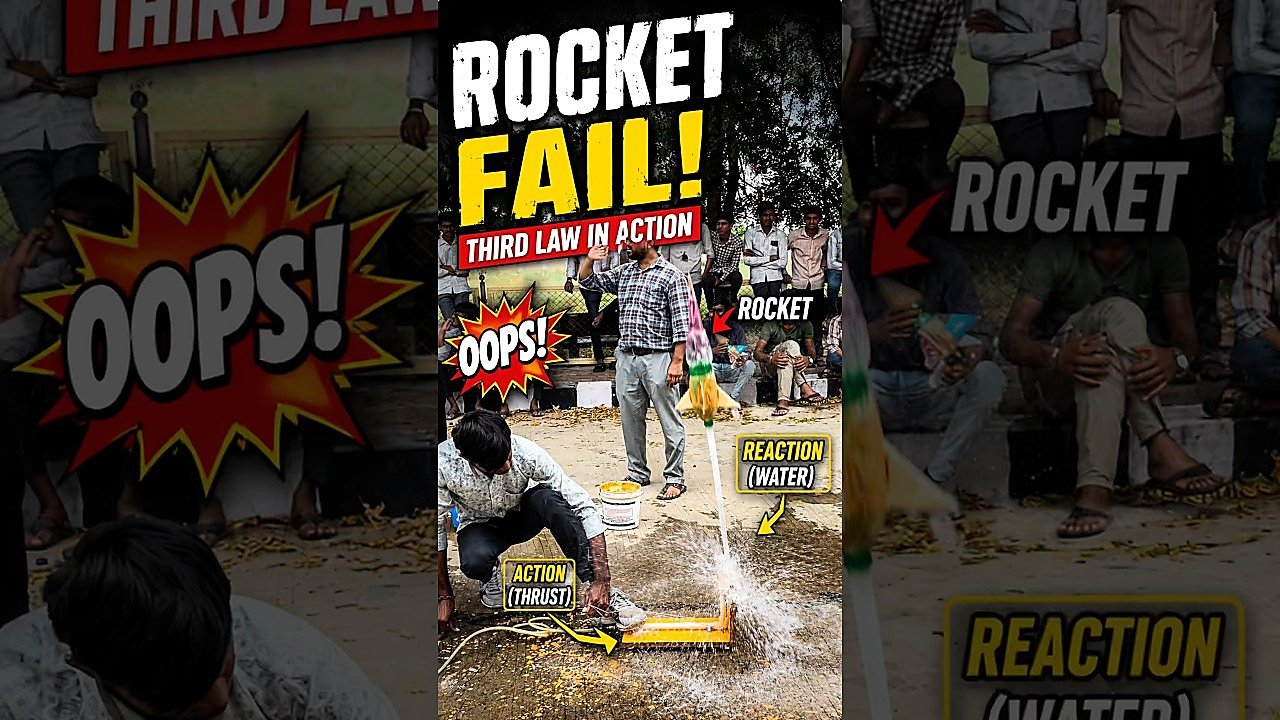
| Rocket launch | Engine pushes exhaust gas downward | Gas pushes the rocket upward |
| Jet engine | Engine pushes hot gas backward | Gas pushes the engine and aircraft forward |
| Car acceleration | Tires push the road backward | Road pushes the tires forward |
| Helicopter hover | Rotor blades push air downward | Air pushes the rotor upward |
| Boat propeller | Propeller pushes water backward | Water pushes the propeller forward |
| Astronaut throwing a tool | Astronaut pushes the tool away | Tool pushes the astronaut in the opposite direction |
What Are Examples of Newton's Third Law in Nature and Animals?
Animals use Newton's third law to move through air, water, and over land. The table below lists 5 examples. Rows list the animals, and columns show the action force and the reaction force.
| Example | Action Force | Reaction Force |
|---|---|---|
| Bird flight | Wings push air downward and backward | Air pushes the bird upward and forward |
| Fish swimming | Tail and fins push water backward | Water pushes the fish forward |
| Squid jet propulsion | Squid expels water backward | Water pushes the squid forward |
| Kangaroo hopping | Legs push the ground downward and backward | Ground pushes the kangaroo upward and forward |
| Woodpecker pecking | Beak pushes the tree | Tree pushes the beak back |
What Are Examples of Newton's Third Law in Gravity?
Gravity produces action-reaction pairs between any 2 masses. Each object pulls on the other with the same force, and the accelerations differ if the masses differ.
The table below compares 2 gravitational pairs. Rows list the pairs, and columns show the force on each object and the acceleration of each object.
| Pair | Force on Each Object | Acceleration of First Object | Acceleration of Second Object |
|---|---|---|---|
| Earth and Moon | about 2.0 × 10²⁰ N | Moon: about 2.7 × 10⁻³ m/s² | Earth: about 3.3 × 10⁻⁵ m/s² |
| Earth and a 0.100 kg apple | 0.981 N | Apple: 9.81 m/s² | Earth: about 1.6 × 10⁻²⁵ m/s² |
The Earth-Moon force uses G = 6.674 × 10⁻¹¹ N·m²/kg², an Earth mass of 5.97 × 10²⁴ kg, a Moon mass of 7.35 × 10²² kg, and a mean distance of 3.84 × 10⁸ m. The apple's acceleration equals the force divided by its mass. Earth's acceleration equals the same force divided by Earth's far larger mass.
What Are Examples of Newton's Third Law in Collisions?
In every collision, the 2 objects exert equal and opposite forces on each other. Examples include cars colliding, billiard balls striking, and bumper cars bumping.
How Do a Car and a Truck Experience Equal Collision Forces?
Problem 1: A 1,000 kg car and a 10,000 kg truck collide, and the collision force is 50,000 N on each vehicle.
| Vehicle | Mass | Force | Acceleration (a = F/m) |
|---|---|---|---|
| Car | 1,000 kg | 50,000 N | 50 m/s² |
| Truck | 10,000 kg | 50,000 N | 5 m/s² |
The forces are equal. The car's acceleration is 10 times the truck's acceleration, which equals the mass ratio of 10,000 ÷ 1,000.
How Do You Solve Newton's Third Law Problems?
Solve Newton's third law problems by writing the force on each object, equating the magnitudes, and applying the second law to each object separately. The method has 5 steps:
- Identify the 2 interacting objects.
- Write the force on each object from the other.
- Set the 2 force magnitudes equal.
- Apply a = F/m to each object separately.
- Check the direction of each acceleration.
How Do You Calculate Rifle Recoil?
Problem 2: A 4 kg rifle at rest fires a 0.02 kg bullet at 500 m/s. Internal forces act equally on the bullet and the rifle, so total momentum stays at zero.
- Equation: 0 = 0.02 × 500 + 4 × v
- Recoil velocity: v = −10 ÷ 4 = −2.5 m/s
- Bullet kinetic energy: ½ × 0.02 × 500² = 2,500 J
- Rifle kinetic energy: ½ × 4 × 2.5² = 12.5 J
The rifle recoils at 2.5 m/s opposite to the bullet. The forces are equal, and the lighter bullet gains far more speed and kinetic energy.
How Do You Calculate Rocket Thrust and Acceleration?
Problem 3: A rocket with a mass of 10,000 kg expels exhaust at 2,000 m/s at a rate of 100 kg/s. The calculation treats the mass as constant at launch.
- Force on the exhaust: F = 100 kg/s × 2,000 m/s = 200,000 N downward
- Thrust on the rocket by the third law: 200,000 N upward
- Weight: 10,000 kg × 9.81 m/s² = 98,100 N
- Net force: 200,000 N − 98,100 N = 101,900 N
- Acceleration: 101,900 N ÷ 10,000 kg = 10.19 m/s² upward
How Do You Identify Action-Reaction Pairs?
Identify an action-reaction pair by naming the force on object B from object A, then reversing the names to find the force on object A from object B. The method has 4 steps:
- Name the 2 interacting objects.
- Write the force as "force on B by A."
- Reverse the names to write "force on A by B."
- Confirm that both forces have the same type and opposite directions.
The table below separates true pairs from non-pairs for a book resting on a table. Rows list the force combinations, and columns show whether the combination is a third-law pair and the reason.
| Force Combination | Third-Law Pair | Reason |
|---|---|---|
| Earth pulls the book down, book pulls Earth up | Yes | Same type, different objects, opposite directions |
| Table pushes the book up, book pushes the table down | Yes | Same type, different objects, opposite directions |
| Earth pulls the book down, table pushes the book up | No | Both forces act on the book, and the types differ |
Why Do Action and Reaction Forces Not Cancel?
Action and reaction forces do not cancel because they act on different objects. Cancellation applies only to forces that act on the same object.
A person pushing a wall exerts a force on the wall. The wall exerts an equal force on the person. Motion of the person depends on all forces acting on the person, including friction from the floor.
In a tug of war, the rope exerts equal and opposite forces on the 2 teams. The team that pushes harder backward against the ground receives a larger forward friction force from the ground and moves the rope in its direction.
Does Newton's Third Law Always Hold?
Newton's third law holds for contact forces and gravity in classical mechanics. The law fails in its simple form for forces between moving charged particles, where momentum is also carried by the electromagnetic field. Total momentum, including the field, remains constant.
How Is Newton's Third Law Used in Engineering and Technology?
Newton's third law is used to design systems that move by pushing mass in one direction. There are 5 main applications:
- Rocket propulsion: exhaust gas thrust accelerates the vehicle.
- Jet engines: accelerated air and combustion gas produce forward thrust.
- Propellers and rotors: airplanes, helicopters, and boats move fluid to gain thrust or lift.
- Recoil management: recoil pads and buffers absorb the reaction force on a user.
- Structural supports: foundations and bridge piers push upward with forces equal to the loads they carry.
What Is the Difference Between the Third Law and the First and Second Laws?
The first and second laws describe the motion of 1 object, and the third law describes the forces between 2 objects. The table below compares the 3 laws. Rows list the laws, and columns show the statement, the number of objects, and the equation.
| Law | Statement | Objects Involved | Equation |
|---|---|---|---|
| First | An object keeps constant velocity, if net force is zero | 1 | ΣF = 0 |
| Second | Net force equals mass times acceleration | 1 | F = ma |
| Third | Two interacting objects exert equal and opposite forces | 2 | F_AB = −F_BA |
What Are Common Misconceptions About Newton's Third Law?
Physics education research documents misconceptions about force pairs. The Force Concept Inventory, published in 1992 by Hestenes, Wells, and Swackhamer, includes questions on collision forces between objects of different mass. Many students select the answer that the heavier object exerts the larger force.
The table below lists 5 misconceptions. Rows show each misconception, and columns show the incorrect belief and the correct fact.
| Misconception | Incorrect Belief | Correct Fact |
|---|---|---|
| Force size | The action force is larger than the reaction force | Both forces have equal magnitude |
| Cancellation | The pair cancels, so nothing moves | The forces act on different objects, so they do not cancel |
| Weight and normal force | Weight and the normal force form a third-law pair | Both act on the same object, and the weight's partner is the object's pull on Earth |
| Timing | The reaction occurs after the action | Both forces occur at the same instant |
| Mass | The larger object exerts the larger force | Both objects exert equal forces, and the accelerations differ |
People Also Ask About Examples of Newton's Third Law
What Is a Simple Example of Newton's Third Law?
Walking is a simple example, because the foot pushes the ground backward and the ground pushes the foot forward.
What Is an Example of Newton's Third Law in a Rocket?
A rocket pushes exhaust gas downward, and the gas pushes the rocket upward with an equal force.
Why Does a Gun Recoil When Fired?
A gun recoils because the gun pushes the bullet forward and the bullet pushes the gun backward with an equal force.
Are Action and Reaction Forces Always Equal?
Yes, the 2 forces in a third-law pair always have equal magnitude.
Why Do Action and Reaction Not Cancel Each Other?
They act on different objects, and cancellation requires forces on the same object.
Is Weight and the Normal Force an Action-Reaction Pair?
No, weight and the normal force both act on the same object, so they are not a third-law pair.
How Do Birds Fly Using Newton's Third Law?
Birds push air downward with their wings, and the air pushes the birds upward.
What Is the Main Summary of Examples of Newton's Third Law of Motion?
Newton's third law of motion states that 2 interacting objects exert equal and opposite forces on each other. There are 6 key facts:
- The formula is F_AB = −F_BA.
- The 2 forces act on different objects, so they do not cancel.
- Examples include walking, swimming, rocket launches, bird flight, and collisions.
- Equal forces produce unequal accelerations, if the masses differ.
- Weight and the normal force are not a third-law pair.
- The law supports rocket propulsion, jet engines, propellers, and structural supports.
Sources:
- Isaac Newton, Philosophiæ Naturalis Principia Mathematica (1687)
- Hestenes, D., Wells, M., and Swackhamer, G. (1992), "Force Concept Inventory," The Physics Teacher, volume 30
- NASA Glenn Research Center, Newton's Laws of Motion educational pages

The University of the West Indies
My passion as a teacher and leader in education is to contribute to students’ enhanced learning by creation of a positive teaching/learning environment, where they are motivated to develop strong critical thinking, analytical and problem-solving skills.
As acting Vice-Principal and head of Physics, I have amassed five years of experience in leading meetings, implementing strategies to maintain discipline and school ethos, liaise with stakeholders in planning for future development of the institution; successfully negotiated the implementation of various projects for student development as well as supervising effective execution of such. For the past 19 years, I have incorporated discovery learning within the classroom through practical activities, problem solving and cooperative learning and have realized that students retention in Physics and Mathematics have increased significantly.
I am always cognizant that students have different learning styles, and as such teaching strategies during planning and delivery must take this crucial factor into consideration and be tailored to meet such differences.