

What Are the Circular Motion Equations?
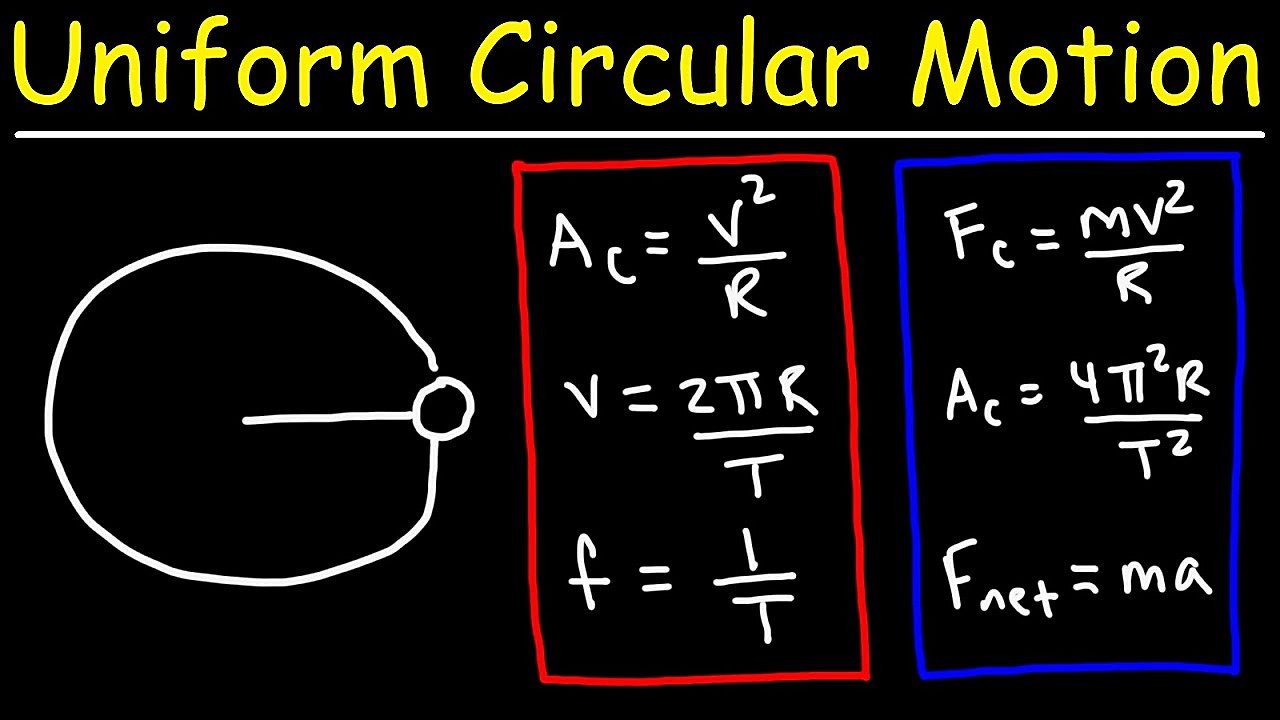
The circular motion equations relate angular displacement, angular velocity, period, tangential speed, centripetal acceleration, and centripetal force. The core equations are v = rω, a_c = v² / r, and F_c = mv² / r.
For a reliable reference, consult OpenStax section on uniform circular motion.
The 4 core relationships are:
- Angular velocity: ω = Δθ / Δt
- Tangential speed: v = rω
- Centripetal acceleration: a_c = v² / r = rω²
- Centripetal force: F_c = mv² / r = mrω²
What Is Circular Motion?
Circular motion is the movement of an object along a circular path. Examples include a car on a roundabout, a satellite in orbit, a ball on a string, and a Ferris wheel. In uniform circular motion, an object moves on a circle at constant speed. In non-uniform circular motion, the speed changes, which adds an acceleration tangent to the circle.
What Is the Difference Between Uniform and Non-Uniform Circular Motion?
Uniform circular motion has constant speed, while non-uniform circular motion has changing speed. Uniform circular motion still involves acceleration, because the direction of the velocity changes continuously. Table 1 compares the two types.
Table 1: Uniform and Non-Uniform Circular Motion Compared
| Feature | Uniform Circular Motion | Non-Uniform Circular Motion |
|---|---|---|
| Speed | Constant | Changing |
| Tangential acceleration | Zero | Nonzero |
| Angular acceleration | Zero | Nonzero |
| Direction of total acceleration | Toward the center | At an angle between the inward and tangent directions |
| Example | Ferris wheel at a steady rate | Spinning top that is slowing down |
A spinning top that slows after being spun and an accelerating rotor are examples of non-uniform circular motion.
What Are the Symbols and Units in Circular Motion Equations?
Circular motion equations use SI units: meters, radians, seconds, kilograms, and newtons. Angular velocity is measured in radians per second, and centripetal acceleration is measured in meters per second squared. Table 2 defines every symbol used in this article.
Table 2: Symbols and SI Units
| Quantity | Symbol | SI Unit |
|---|---|---|
| Arc length | s | meter (m) |
| Radius | r | meter (m) |
| Angle of rotation | θ | radian (rad) |
| Angular velocity | ω | radian per second (rad/s) |
| Angular acceleration | α | radian per second squared (rad/s²) |
| Period | T | second (s) |
| Frequency | f | hertz (Hz) |
| Tangential speed | v | meter per second (m/s) |
| Centripetal acceleration | a_c | meter per second squared (m/s²) |
| Tangential acceleration | a_T | meter per second squared (m/s²) |
| Mass | m | kilogram (kg) |
| Centripetal force | F_c | newton (N) |
| Gravitational acceleration | g | 9.8 m/s² |
| Static friction coefficient | μ_s | Dimensionless |
The conversion factors are:
- 1 revolution = 2π rad = 360°
- 1 rad ≈ 57.3°
- 1 rpm = 2π / 60 rad/s ≈ 0.1047 rad/s
- 1 Hz = 1 revolution per second = 2π rad/s
The conversion between radians and degrees is 1 rad = 57.3°.
What Are the Equations for Uniform Circular Motion?
Uniform circular motion has 12 core equations, which Table 3 lists with the unit of each result. OpenStax lists the angle of rotation, angular speed, tangential speed, centripetal acceleration, and centripetal force equations in its key equations summary.
Table 3: Equations for Uniform Circular Motion
| Quantity | Equation | Unit of Result |
|---|---|---|
| Angle of rotation | Δθ = Δs / r |
rad |
| Angular velocity | ω = Δθ / Δt |
rad/s |
| Period from speed | T = 2πr / v |
s |
| Period from angular velocity | T = 2π / ω |
s |
| Frequency | f = 1 / T |
Hz |
| Angular velocity from frequency | ω = 2πf |
rad/s |
| Tangential speed | v = rω |
m/s |
| Tangential speed from period | v = 2πr / T |
m/s |
| Centripetal acceleration | a_c = v² / r |
m/s² |
| Centripetal acceleration (angular form) | a_c = rω² |
m/s² |
| Centripetal force | F_c = mv² / r |
N |
| Centripetal force (angular form) | F_c = mrω² |
N |
What Is the Equation for Angular Velocity?
The equation for angular velocity is ω = Δθ / Δt. Angular velocity is the rate of change of an angle, measured in radians per second. For uniform circular motion, ω = 2π / T and ω = 2πf.
What Is the Equation for Tangential Speed?
The equation for tangential speed is v = rω. In terms of the period, the speed equals 2πr / T. The velocity vector is tangent to the circular path.
What Is the Equation for Period and Frequency?
The period equals the time for 1 revolution, T = 2πr / v = 2π / ω. Frequency is the reciprocal of the period, f = 1 / T. A frequency of 5 Hz equals 5 revolutions per second.
What Is the Equation for Centripetal Acceleration?
The equation for centripetal acceleration is a_c = v² / r = rω². A third form is a_c = 4π²r / T². The acceleration vector is perpendicular to the velocity and points toward the center of the circle.
What Is the Equation for Centripetal Force?
The equation for centripetal force is F_c = ma_c = mv² / r = mrω². Centripetal force is any force that causes uniform circular motion. Examples include string tension, friction, gravity, and the normal force.
What Are the Equations for Non-Uniform Circular Motion?
Non-uniform circular motion adds angular acceleration, α = Δω / Δt, and tangential acceleration, a_T = rα, to the uniform equations. Tangential acceleration equals the rate of change of speed, and it is perpendicular to the centripetal acceleration. The magnitude of the total acceleration is therefore a = √(a_c² + a_T²). Table 4 lists 6 equations.
Table 4: Equations for Non-Uniform Circular Motion
| Quantity | Equation | Unit of Result |
|---|---|---|
| Angular acceleration | α = Δω / Δt |
rad/s² |
| Tangential acceleration | a_T = rα |
m/s² |
| Magnitude of total acceleration | a = √(a_c² + a_T²) |
m/s² |
| Final angular velocity | ω = ω₀ + αt |
rad/s |
| Angular displacement | θ = ω₀t + ½αt² |
rad |
| Final angular velocity without time | ω² = ω₀² + 2αθ |
rad²/s² |
OpenStax lists the rotational kinematic equations ω = ω₀ + αt, θ = ω₀t + ½αt², and ω² = ω₀² + 2αθ for constant angular acceleration.
What Are the Circular Motion Equations for Curves and Vertical Circles?
Curves and vertical circles apply the centripetal force equation to specific situations. Table 5 lists 7 equations.
Table 5: Circular Motion Equations for Curves and Vertical Circles
| Situation | Equation | Result |
|---|---|---|
| Flat curve, friction only | μ_s = v² / (rg) |
Minimum static friction coefficient |
| Ideal banked curve | tanθ = v² / (rg) |
Banking angle |
| Ideal banked curve | v = √(rg tanθ) |
Ideal speed |
| Vertical circle, top | v_top = √(gr) |
Minimum speed with zero tension |
| Vertical circle, top | T_top = mv² / r − mg |
Tension at the top |
| Vertical circle, bottom | T_bottom = mv² / r + mg |
Tension at the bottom |
| Vertical circle, bottom | v_bottom = √(5gr) |
Minimum speed at the bottom for a full circle |
What Is the Equation for a Car on a Flat Curve?
The equation for a car on a flat curve is μ_s = v² / (rg). Friction is the only horizontal force on the car, so friction supplies the centripetal force. A 900 kg car at 25.0 m/s on a 500 m radius curve has F_c = 900(25.0)² / 500 = 1,125 N and μ_s = 25.0² / (500 × 9.8) ≈ 0.13.
What Is the Equation for a Banked Curve?
The equation for an ideally banked curve is tanθ = v² / (rg). An ideal angle lets a car negotiate the curve at a certain speed without friction. Rearranging gives v = √(rg tanθ). A 100 m radius curve banked at 20° has an ideal speed of 18.9 m/s.
What Are the Equations for a Vertical Circle?
The minimum speed at the top of a vertical circle is v = √(gr). This minimum speed does not depend on mass. Tension is greatest at the bottom, T = mv² / r + mg, and smallest at the top, T = mv² / r − mg. The minimum speed at the bottom for a full circle is √(5gR).
How Are the Circular Motion Equations Used in Worked Examples?
The equations are applied by listing the known quantities and selecting the equation that contains them. The 3 examples below use equations from Tables 3, 4, and 5.
Example 1: What Are the Speed and Force on a Ball Swung in a Horizontal Circle?
A 0.50 kg ball moves in a circle of radius r = 0.80 m with a period T = 0.50 s.
- Angular velocity: ω = 2π / T = 2π / 0.50 s = 12.57 rad/s.
- Tangential speed: v = rω = (0.80 m)(12.57 rad/s) ≈ 10.1 m/s.
- Centripetal acceleration: a_c = rω² = (0.80 m)(12.57 rad/s)² ≈ 126.3 m/s².
- Centripetal force: F_c = ma_c = (0.50 kg)(126.3 m/s²) ≈ 63.2 N.
Example 2: What Is the Total Acceleration of a Speeding-Up Flywheel?
A flywheel of radius r = 0.25 m starts at ω₀ = 10 rad/s with α = 4.0 rad/s² for t = 3.0 s.
- Final angular velocity: ω = 10 + (4.0)(3.0) = 22 rad/s.
- Angular displacement: θ = (10)(3.0) + ½(4.0)(3.0)² = 48 rad.
- Tangential acceleration: a_T = rα = (0.25)(4.0) = 1.0 m/s².
- Centripetal acceleration: a_c = rω² = (0.25)(22)² = 121 m/s².
- Total acceleration: a = √(121² + 1.0²) ≈ 121.0 m/s².
Example 3: What Are the Tensions in a Vertical Circle?
A 0.20 kg ball moves on a 0.50 m string in a vertical circle, with a speed of 3.0 m/s at the top.
- Minimum top speed: v = √(gr) = √(9.8 × 0.50) ≈ 2.21 m/s, so 3.0 m/s keeps the string taut.
- Tension at the top: T_top = mv² / r − mg = (0.20)(9.0) / 0.50 − (0.20)(9.8) ≈ 1.64 N.
- Speed at the bottom: v² = v_top² + 4gr = 9.0 + 4(9.8)(0.50) = 28.6 m²/s².
- Tension at the bottom: T_bottom = mv² / r + mg = (0.20)(28.6) / 0.50 + (0.20)(9.8) ≈ 13.4 N.
Energy conservation gives v_bottom² = v_top² + 4gr, which relates the top and bottom speeds.
What Are Real Circular Motion Values in Astronomy?
Earth completes 2 circular motions that follow the same equations. Table 6 lists measured values for each. The values come from ω = 2π / T, v = rω, and a_c = rω².
Table 6: Circular Motion Values for Earth
| Motion | Radius (m) | Period (s) | Angular Velocity (rad/s) | Speed (m/s) | Centripetal Acceleration (m/s²) |
|---|---|---|---|---|---|
| Rotation, point on the equator | 6.37 × 10⁶ | 8.64 × 10⁴ | 7.27 × 10⁻⁵ | 4.63 × 10² | 3.37 × 10⁻² |
| Orbit around the Sun | 1.50 × 10¹¹ | 3.16 × 10⁷ | 1.99 × 10⁻⁷ | 2.98 × 10⁴ | 5.93 × 10⁻³ |
The equatorial centripetal acceleration equals 0.343% of g. Using the sidereal day of 23 hours, 56 minutes, and 4.09 seconds, the angular velocity of Earth's rotation is 7.2921159 × 10⁻⁵ rad/s.
What Is the Difference Between Centripetal and Centrifugal Force?
Centripetal force is a real inward force, while centrifugal force is a fictitious outward force. Centrifugal force appears only in rotating, non-inertial reference frames. Table 7 compares the two.
Table 7: Centripetal and Centrifugal Force Compared
| Feature | Centripetal Force | Centrifugal Force |
|---|---|---|
| Direction | Toward the center | Away from the center |
| Type | Real net force | Fictitious (pseudo) force |
| Reference frame | Inertial frame | Rotating (non-inertial) frame |
| Equation | F_c = mv² / r |
F = mω²r |
The centrifugal force in a uniformly rotating frame has the magnitude mω²r.
What Are People Also Asking About Circular Motion Equations?
What is the formula for centripetal acceleration?
The formula is a_c = v² / r = rω², directed toward the center of the circle.
What is the formula for centripetal force?
The formula is F_c = mv² / r = mrω².
What is the formula for angular velocity in circular motion?
The formula is ω = Δθ / Δt = 2π / T.
What is the relationship between linear speed and angular velocity?
Linear speed and angular velocity are related by v = rω, or ω = v / r.
How do you find the period of circular motion?
The period equals T = 2πr / v, or T = 2π / ω.
What is the SI unit of angular velocity?
The SI unit of angular velocity is the radian per second (rad/s).
Is an object in uniform circular motion accelerating?
Yes, the object accelerates because the direction of its velocity changes continuously, even though its speed is constant.
Does centripetal force do work?
No, centripetal force acts perpendicular to the velocity, so it changes the direction of motion and not the speed.
How do you convert rpm to rad/s?
Multiply the value in rpm by 2π / 60, which is about 0.1047, so 3,000 rpm equals 314.2 rad/s.
Which Circular Motion Equation Applies to Each Situation?
The applicable circular motion equation depends on the known quantities. Table 8 maps 10 situations to an equation.
Table 8: Circular Motion Equation by Known Quantities
| Known Quantities | Equation | Result |
|---|---|---|
| Arc length and radius | Δθ = Δs / r |
Angle of rotation |
| Angle and time | ω = Δθ / Δt |
Angular velocity |
| Period | ω = 2π / T |
Angular velocity |
| Radius and angular velocity | v = rω |
Tangential speed |
| Speed and radius | a_c = v² / r |
Centripetal acceleration |
| Mass, speed, and radius | F_c = mv² / r |
Centripetal force |
| Angular acceleration and time | ω = ω₀ + αt |
Final angular velocity |
| Radius and angular acceleration | a_T = rα |
Tangential acceleration |
| Speed, radius, and gravity | tanθ = v² / (rg) |
Ideal banking angle |
| Radius and gravity | v = √(gr) |
Minimum speed at the top of a vertical circle |
The circular motion equations connect angle, angular velocity, period, speed, acceleration, and force, and Tables 3, 4, and 5 contain the 25 formulas for uniform motion, non-uniform motion, and applied situations.
Title: Boltzmann Constant in eV: Value, Conversions, and 5 Examples

The University of the West Indies
My passion as a teacher and leader in education is to contribute to students’ enhanced learning by creation of a positive teaching/learning environment, where they are motivated to develop strong critical thinking, analytical and problem-solving skills.
As acting Vice-Principal and head of Physics, I have amassed five years of experience in leading meetings, implementing strategies to maintain discipline and school ethos, liaise with stakeholders in planning for future development of the institution; successfully negotiated the implementation of various projects for student development as well as supervising effective execution of such. For the past 19 years, I have incorporated discovery learning within the classroom through practical activities, problem solving and cooperative learning and have realized that students retention in Physics and Mathematics have increased significantly.
I am always cognizant that students have different learning styles, and as such teaching strategies during planning and delivery must take this crucial factor into consideration and be tailored to meet such differences.