

What Is the Formula for Velocity?
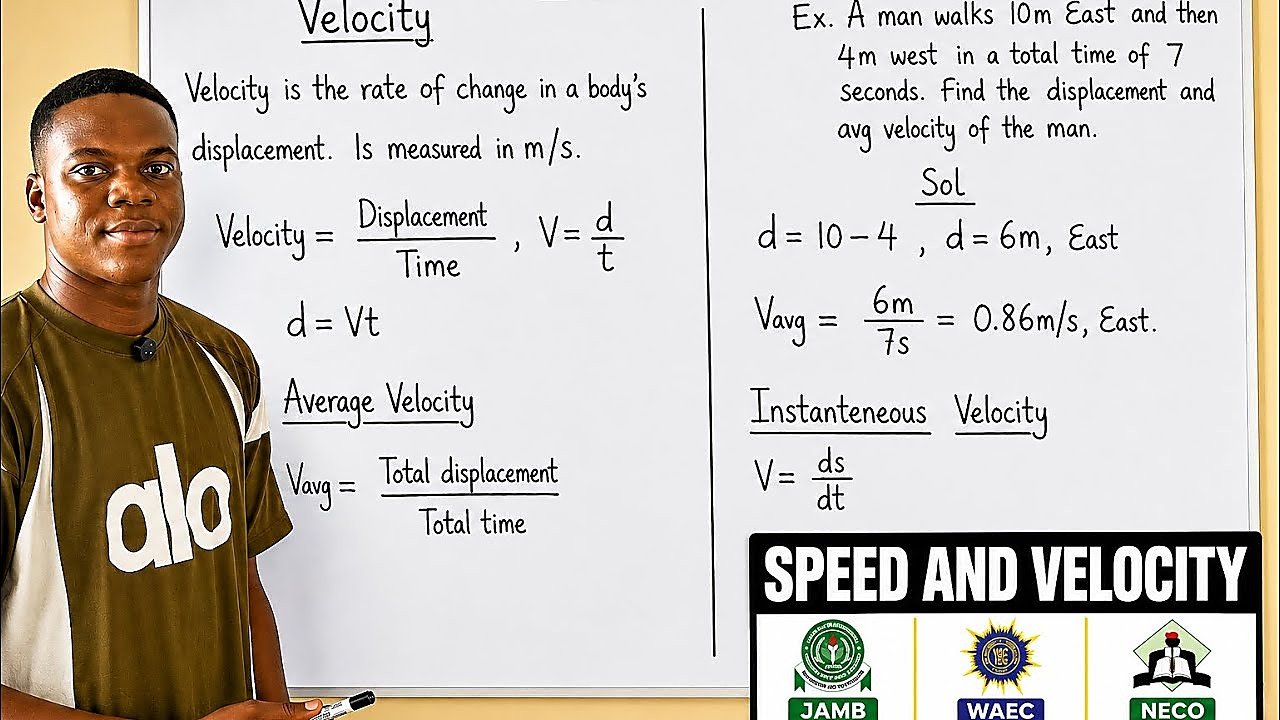
The formula for velocity is v = Δx / Δt, which divides displacement by elapsed time. The result is a vector quantity that includes direction. The SI unit is meters per second (m/s).
For a reliable reference, consult OpenStax section on velocity and speed.
Velocity formulas cover 4 core situations:
- Average velocity: v = Δx / Δt
- Instantaneous velocity: v = dx / dt
- Final velocity with constant acceleration: v = v₀ + at
- Final velocity from displacement: v² = v₀² + 2aΔx
What Is Velocity in Physics?
Velocity in physics is the rate of change of position with respect to time, and it includes direction. Velocity is a vector because displacement is a vector. Examples include 10 m/s east, 25 km/h north, and −5 m/s. In one dimension, a positive value indicates motion in the positive coordinate direction, and a negative value indicates motion in the negative direction.
What Is the Difference Between Velocity and Speed?
Velocity includes direction and uses displacement, while speed excludes direction and uses distance. Average speed equals total distance traveled divided by elapsed time. Table 1 compares the two quantities.
Table 1: Velocity and Speed Compared
| Property | Velocity | Speed |
|---|---|---|
| Quantity type | Vector | Scalar |
| Calculated from | Displacement (change in position) | Distance traveled |
| Formula | v = Δx / Δt |
speed = distance / Δt |
| Direction | Included | Not included |
| Possible values | Positive, negative, or zero | Zero or positive |
| Result for a round trip | Zero | Greater than zero |
A round trip has zero displacement, so its average velocity is zero while its average speed is not.
What Is the Formula for Average Velocity?
The formula for average velocity is v_avg = Δx / Δt = (x₂ − x₁) / (t₂ − t₁). The expression divides the displacement between two points by the elapsed time. The symbols are:
- v_avg: average velocity (m/s)
- Δx: displacement, equal to final position minus initial position (m)
- Δt: elapsed time, equal to final time minus initial time (s)
- x₁, x₂: initial and final positions (m)
- t₁, t₂: initial and final times (s)
The calculation requires a nonzero elapsed time.
What Is the Formula for Instantaneous Velocity?
The formula for instantaneous velocity is v = dx / dt, the derivative of position with respect to time. OpenStax writes it as v(t) = dx(t)/dt. The formula equals the limit of Δx / Δt as Δt approaches 0.
How Is Velocity Found From a Graph?
Velocity equals the slope of a position-versus-time graph. The slope at a specific time gives the instantaneous velocity at that time, and the slope of a velocity-versus-time graph gives acceleration.
What Are the Velocity Formulas for Constant Acceleration?
The velocity formulas for constant acceleration are v = v₀ + at, v² = v₀² + 2aΔx, and v_avg = (v₀ + v) / 2. These equations assume that acceleration is constant. Motion with changing acceleration can be split into parts, and each part has its own constant acceleration.
Table 2 lists 4 constant-acceleration equations and the quantity each one solves for.
Table 2: Constant-Acceleration Equations
| Equation | Solves For | Known Variables |
|---|---|---|
v = v₀ + at |
Final velocity | v₀, a, t |
v² = v₀² + 2aΔx |
Final velocity (squared) | v₀, a, Δx |
v_avg = (v₀ + v) / 2 |
Average velocity | v₀, v |
Δx = v₀t + ½at² |
Displacement | v₀, a, t |
The symbols in Table 2 are:
- v: final velocity (m/s)
- v₀: initial velocity (m/s)
- a: constant acceleration (m/s²)
- t: elapsed time (s)
- Δx: displacement (m)
What Is the Formula for Final Velocity?
The formula for final velocity is v = v₀ + at, if acceleration is constant and time is known. Use v = √(v₀² + 2aΔx), if time is unknown. The square root takes a positive or negative sign, depending on the direction of motion.
What Is the Formula for Initial Velocity?
The formula for initial velocity is v₀ = v − at. Rearranging the other equations in Table 2 gives 2 more forms:
- v₀ = √(v² − 2aΔx)
- v₀ = Δx / t − ½at
How Is Velocity Calculated in Practice?
Velocity is calculated by matching the known variables to one equation and substituting values with consistent units. The 4 examples below use equations from Tables 1 and 2.
Example 1: What Is the Average Velocity of a Runner?
A runner moves from x₁ = 20 m to x₂ = 140 m in 15 s.
- Calculate displacement: Δx = 140 m − 20 m = 120 m.
- Identify elapsed time: Δt = 15 s.
- Divide: v = 120 m / 15 s = 8 m/s in the positive direction.
Example 2: What Is the Final Velocity of an Accelerating Car?
A car starts from rest (v₀ = 0 m/s) with a = 3 m/s² for t = 8 s.
- Select the equation: v = v₀ + at.
- Substitute: v = 0 + (3 m/s²)(8 s).
- Solve: v = 24 m/s, which equals 86.4 km/h.
Example 3: What Is the Initial Velocity of a Cyclist?
A cyclist reaches v = 25 m/s after accelerating at a = 2.5 m/s² for t = 6 s.
- Select the equation: v₀ = v − at.
- Substitute: v₀ = 25 m/s − (2.5 m/s²)(6 s).
- Solve: v₀ = 10 m/s.
Example 4: What Is the Final Velocity Without a Time Value?
An object has v₀ = 10 m/s and a = 2 m/s² over Δx = 100 m.
- Select the equation: v² = v₀² + 2aΔx.
- Substitute: v² = 10² + 2(2)(100) = 500.
- Solve: v = √500 ≈ 22.4 m/s.
What Are the Units of Velocity?
Velocity is measured in units of length per time, and the SI unit is meters per second (m/s). The dimensional formula is [L T⁻¹]. Other common units include miles per hour and kilometers per hour. Table 3 gives each unit as a multiple of 1 m/s.
Table 3: Velocity Units and Their Values in Meters Per Second
| Unit | Symbol | Value in m/s |
|---|---|---|
| Meter per second | m/s | 1 |
| Kilometer per hour | km/h | 0.27778 (1 / 3.6) |
| Mile per hour | mph | 0.44704 |
| Foot per second | ft/s | 0.3048 |
| Knot | kn | 0.51444 |
The conversion rules are:
- Multiply m/s by 3.6 to get km/h.
- Divide km/h by 3.6 to get m/s.
- Multiply mph by 0.44704 to get m/s.
- Multiply mph by 1.609344 to get km/h.
The factor 0.44704 comes from dividing the international mile, exactly 1,609.344 meters, by 3,600 seconds.
What Is the Formula for Velocity in Circular Motion?
The formula for tangential velocity in circular motion is v = rω. Angular velocity ω equals Δθ / Δt, measured in radians per second. The symbol r is the radius in meters. A point 0.1 m from the axis of a flywheel spinning at 45.0 rad/s has a tangential speed of 4.5 m/s.
What Is the Formula for Orbital Velocity?
The formula for orbital velocity in a circular orbit is v = √(GM / r). The same source gives the escape velocity as √2 times the orbital velocity at any radius. The symbols are:
- G: gravitational constant, 6.674 × 10⁻¹¹ N·m²/kg²
- M: mass of the central body (kg)
- r: distance from the center of the central body (m)
A satellite 400 km above Earth has r = 6.771 × 10⁶ m. With GM = 3.986 × 10¹⁴ m³/s² for Earth, v = √[(3.986 × 10¹⁴) / (6.771 × 10⁶)] ≈ 7,673 m/s. The International Space Station travels at roughly 17,150 miles per hour, about 5 miles per second, and completes an orbit every 92 minutes.
What Is the Formula for Escape Velocity?
The formula for escape velocity is v = √(2GM / r). Escape velocity is the minimum initial velocity needed to move from a point to infinity in a gravitational field, and the escaping object's mass does not appear in the formula. The value for Earth's surface is about 11.2 km/s. The value for the Moon is about 2.4 km/s.
For Earth, G = 6.674 × 10⁻¹¹ N·m²/kg², M = 5.972 × 10²⁴ kg, and r = 6.371 × 10⁶ m. The calculation is v = √[2(6.674 × 10⁻¹¹)(5.972 × 10²⁴) / (6.371 × 10⁶)] ≈ 11,186 m/s.
What Is the Formula for Terminal Velocity?
The formula for terminal velocity is vₜ = √(2mg / (ρ A Cd)). Terminal velocity is the constant falling speed reached when drag balances gravity. The symbols are:
- m: mass of the falling object (kg)
- g: gravitational acceleration, 9.8 m/s²
- ρ: density of the fluid (kg/m³)
- A: cross-sectional area (m²)
- Cd: drag coefficient (dimensionless)
A skydiver in a spread-eagle position reaches about 120 miles per hour (193 kilometers per hour). Terminal velocity is inversely proportional to the square root of fluid density.
A 75 kg skydiver with ρ = 1.2 kg/m³, A = 0.5 m², and Cd = 0.8 has vₜ = √[2(75)(9.8) / (1.2 × 0.5 × 0.8)] ≈ 55.3 m/s, or about 124 mph.
What Is the Formula for Wave Velocity?
The formula for wave velocity is v = fλ. The symbol v is wave speed, f is frequency, and λ is wavelength. Sound in air travels at 331 m/s at 0°C and 343 m/s at 20.0°C. A 440 Hz tone in air at 343 m/s has a wavelength of about 0.78 m.
What Are the Formulas for Velocity From Momentum and Kinetic Energy?
The formulas for velocity from momentum and kinetic energy are v = p / m and v = √(2KE / m). They come from rearranging p = mv and KE = ½mv². Examples include:
- p = 12 kg·m/s and m = 3 kg give v = 4 m/s.
- KE = 50 J and m = 4 kg give v = √(2 × 50 / 4) = 5 m/s.
What Is the Formula for Relative Velocity?
The formula for relative velocity in one dimension is v_AB = v_A − v_B, where both velocities are measured in the same reference frame. The result is the velocity of object A relative to object B. A car moving at 30 m/s east relative to the road, passing a car moving at 20 m/s east, has a relative velocity of +10 m/s.
What Are Common Velocity Values and the Formulas Behind Them?
Table 4 lists 5 reference values and the formula that applies to each. NIST lists the speed of light in vacuum as exactly 299,792,458 m/s.
Table 4: Reference Velocities and Related Formulas
| Phenomenon | Approximate Value | Related Formula |
|---|---|---|
| Sound in air at 20.0°C | 343 m/s | v = fλ |
| Skydiver, spread-eagle position | 120 mph (193 km/h) | vₜ = √(2mg / (ρ A Cd)) |
| International Space Station | 17,150 mph (about 5 miles per second) | v = √(GM / r) |
| Escape from Earth's surface | 11.2 km/s | v = √(2GM / r) |
| Light in vacuum | 299,792,458 m/s (exact) | Defined constant, c |
What Are People Also Asking About the Formula for Velocity?
What is the formula for velocity with acceleration and time?
The formula is v = v₀ + at, where v₀ is initial velocity, a is constant acceleration, and t is elapsed time.
What is the formula for velocity without time?
The formula is v = √(v₀² + 2aΔx), where Δx is displacement.
What is the SI unit of velocity?
The SI unit of velocity is meters per second (m/s).
Is velocity the same as speed?
No, velocity is a vector that includes direction, while speed is a scalar that does not.
Can velocity be negative?
Yes, a negative velocity indicates displacement in the negative coordinate direction.
What is the formula for velocity from distance and time?
The formula is speed = distance / time, which gives average speed, and velocity replaces distance with displacement.
How do you convert m/s to km/h?
Multiply the value in m/s by 3.6 to get km/h.
What is the formula for angular velocity?
The formula is ω = Δθ / Δt, and tangential speed relates to it by v = rω.
What is the dimensional formula of velocity?
The dimensional formula of velocity is [L T⁻¹].
Which Formula for Velocity Applies to Each Situation?
The applicable formula for velocity depends on the known quantities. Table 5 maps each set of known quantities to 1 of the 13 equations in this article.
Table 5: Formula for Velocity by Known Quantities
| Known Quantities | Formula | Velocity Calculated |
|---|---|---|
| Displacement and elapsed time | v_avg = Δx / Δt |
Average velocity |
| Position as a function of time | v = dx / dt |
Instantaneous velocity |
| Initial velocity, acceleration, and time | v = v₀ + at |
Final velocity |
| Initial velocity, acceleration, and displacement | v² = v₀² + 2aΔx |
Final velocity |
| Initial velocity and final velocity | v_avg = (v₀ + v) / 2 |
Average velocity, constant acceleration |
| Radius and angular velocity | v = rω |
Tangential velocity |
| Central mass and orbital radius | v = √(GM / r) |
Orbital velocity |
| Central mass and radius | v = √(2GM / r) |
Escape velocity |
| Mass, fluid density, area, and drag coefficient | vₜ = √(2mg / (ρ A Cd)) |
Terminal velocity |
| Frequency and wavelength | v = fλ |
Wave velocity |
| Momentum and mass | v = p / m |
Velocity from momentum |
| Kinetic energy and mass | v = √(2KE / m) |
Velocity from kinetic energy |
| Two velocities in the same reference frame | v_AB = v_A − v_B |
Relative velocity |
The formula for velocity is v = Δx / Δt, and each of the other 12 equations applies to a specific set of known quantities.
Title: Formula for Chemical Compounds: 3 Types, Writing Rules, and 13 Examples

The University of the West Indies
My passion as a teacher and leader in education is to contribute to students’ enhanced learning by creation of a positive teaching/learning environment, where they are motivated to develop strong critical thinking, analytical and problem-solving skills.
As acting Vice-Principal and head of Physics, I have amassed five years of experience in leading meetings, implementing strategies to maintain discipline and school ethos, liaise with stakeholders in planning for future development of the institution; successfully negotiated the implementation of various projects for student development as well as supervising effective execution of such. For the past 19 years, I have incorporated discovery learning within the classroom through practical activities, problem solving and cooperative learning and have realized that students retention in Physics and Mathematics have increased significantly.
I am always cognizant that students have different learning styles, and as such teaching strategies during planning and delivery must take this crucial factor into consideration and be tailored to meet such differences.