

What Is the Difference Between Centripetal Force and Centrifugal Force?
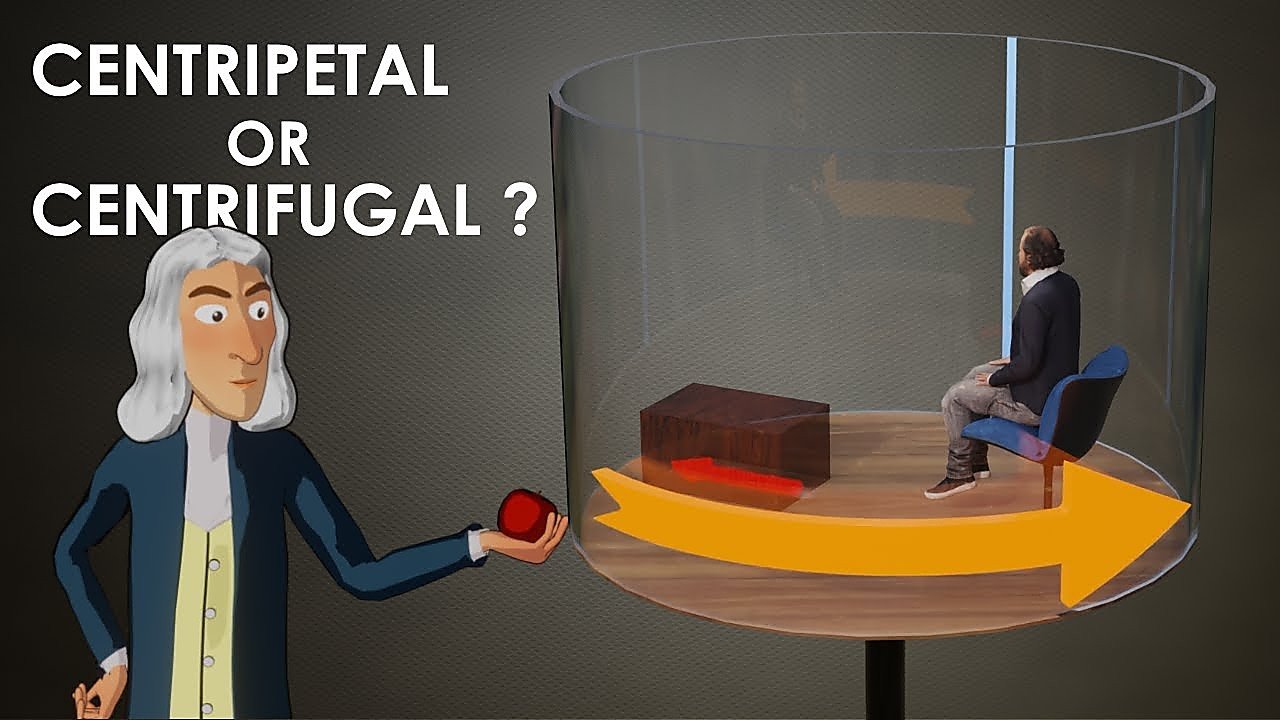
Centripetal force is the real inward net force that keeps an object on a circular path, while centrifugal force is the apparent outward force that exists only in a rotating frame of reference. Centrifugal force is considered fictitious and is observed only in rotating, non-inertial frames. The table below compares the 2 forces.
For a reliable reference, consult OpenStax section on uniform circular motion.
| Feature | Centripetal Force | Centrifugal Force |
|---|---|---|
| Direction | Toward the center of the circle | Away from the center of the circle |
| Force type | Real net force | Fictitious (inertial) force |
| Reference frame | Inertial frame | Rotating, non-inertial frame |
| Origin | Tension, friction, gravity, or normal force | Inertia of the object, seen from a rotating frame |
| Formula | F_c = mv²/r = mω²r | F_cf = mv²/r = mω²r (outward) |
| Newton's third law | Has a real reaction partner on another object | Has no reaction partner |
| Meaning of the name | Center-seeking | Center-fleeing |
What Is Centripetal Force?
Centripetal force is any net force that causes uniform circular motion, directed toward the center of curvature. The force is always perpendicular to the path of the object. Centripetal force is not a new kind of force. The name describes the force or combination of forces that point toward the center.
The term centripetal means center-seeking. Sources of centripetal force include tension, friction, gravity, and the normal force.
What Is the Formula for Centripetal Force?
The formula for centripetal force is F_c = mv²/r, which also equals mω²r. The formula comes from Newton's second law, F = ma, with centripetal acceleration a = v²/r. The table below defines each symbol with its SI unit.
| Symbol | Quantity | SI Unit |
|---|---|---|
| F_c | Centripetal force | N |
| m | Mass of the object | kg |
| v | Speed along the circle | m/s |
| r | Radius of the circle | m |
| ω | Angular speed | rad/s |
The AP Physics 1 formula sheet lists a_c = v²/r alongside the connected mechanics relationships.
What Is Centrifugal Force?
Centrifugal force is a pseudo force that appears only in rotating, non-inertial reference frames. The force points radially outward from the axis of rotation. Its formula mirrors the centripetal force calculation but points outward.
An example is the outward push that a passenger feels in a car turning left.
Is Centrifugal Force Real?
No, centrifugal force is a fictitious force because it is observed only in rotating, non-inertial frames and has no physical interaction behind it. The force acts as a correction that an observer in the rotating frame adds to account for the acceleration of that frame.
Centrifugal force does not obey Newton's third law, and centripetal and centrifugal forces are not an action-reaction pair.
Why Do Objects Appear to Move Outward in Circular Motion?
Objects appear to move outward because of inertia, which keeps an object moving in a straight line unless a net force acts on it. When the string of a spinning ball breaks, the ball continues in a straight line. An observer outside the circle sees only the tension pulling the ball inward and no outward force.
How Do Inertial and Rotating Frames Describe the Same Motion?
An inertial frame describes circular motion with one real inward force, while a rotating frame adds a fictitious outward force that balances it. In the rotating frame, the object remains stationary relative to the frame because the centrifugal force balances the centripetal force. The table below compares both descriptions for a ball on a string.
| Reference Frame | Observer Position | Forces Described | Net Force on the Ball |
|---|---|---|---|
| Inertial frame | Standing outside the circle | Tension (centripetal force) | Inward, equal to mv²/r |
| Rotating frame | Moving with the ball | Tension and centrifugal force | Zero, so the ball appears stationary |
What Are Examples of Centripetal Force?
Centripetal force appears in 5 common situations, and each has a different physical source:
- Car on a curve: friction between the tires and the road.
- Ball on a string: tension in the string.
- Moon orbiting Earth: gravity between the Moon and Earth.
- Roller coaster loop: the normal force from the track combined with gravity.
- Washing machine drum: the normal force from the drum wall on the clothes.
What Are Examples of Centrifugal Force?
Centrifugal force appears in 5 common situations, and each is an apparent outward effect seen from a rotating frame:
- Turning car: passengers feel pushed toward the outer door.
- Spin cycle: water leaves through the drum holes.
- Laboratory centrifuge: denser particles move toward the bottom of the tube.
- Amusement park rotor: riders feel pressed against the wall.
- Rotating space station: occupants feel an outward pull that resembles gravity.
How Do You Calculate Centripetal Force for a Car on a Curve?
Calculate centripetal force by substituting mass, speed, and radius into F_c = mv²/r. The steps for a 1,000 kg car moving at 15 m/s on a curve with a 50 m radius are:
- Write the formula: F_c = mv²/r.
- Substitute the values: F_c = (1,000 kg × (15 m/s)²) / 50 m.
- Compute the result: F_c = 4,500 N.
- Compare with friction: the minimum coefficient of friction is 4,500 N / (1,000 kg × 9.8 m/s²) ≈ 0.46.
In the car's rotating frame, the centrifugal force on the car has the same magnitude of 4,500 N and points outward.
Does Centripetal Force Change the Speed of an Object?
No, centripetal force changes the direction of velocity but not the speed in uniform circular motion, because the force is perpendicular to the path. A force that has a component along the motion changes the speed.
What Is the Summary of Centripetal Force vs Centrifugal Force?
Centripetal force is a real inward force with the formula F_c = mv²/r, and centrifugal force is a fictitious outward force seen in rotating frames. The 2 forces differ in direction, type, reference frame, origin, formula context, reaction partner, and name.
People Also Ask: What Do Students Ask About Centripetal Force vs Centrifugal Force?
What is the main difference between centripetal and centrifugal force?
Centripetal force is a real inward force, while centrifugal force is a fictitious outward force seen only in rotating frames.
Is centrifugal force real or fake?
Centrifugal force is a fictitious force that appears only in rotating, non-inertial frames.
What is the formula for centripetal force?
The formula is F_c = mv²/r, which equals mω²r.
Are centripetal and centrifugal forces equal and opposite?
They have equal magnitudes in a rotating frame, but they are not an action-reaction pair, because the 2 forces do not act in the same reference frame as a Newton's third law pair.
What provides the centripetal force for a planet orbiting the Sun?
Gravity between the planet and the Sun provides the centripetal force.
What is the SI unit of centripetal force?
The SI unit of centripetal force is the newton (N).
Does a washing machine use centripetal or centrifugal force?
The drum wall provides the centripetal force on the clothes, and the water exits through the holes because no wall force acts on it there.
What is reactive centrifugal force?
In some textbooks, reactive centrifugal force names the outward pull that the object exerts on the string or track, which is a real force acting on the string or track and not on the object.

The University of the West Indies
My passion as a teacher and leader in education is to contribute to students’ enhanced learning by creation of a positive teaching/learning environment, where they are motivated to develop strong critical thinking, analytical and problem-solving skills.
As acting Vice-Principal and head of Physics, I have amassed five years of experience in leading meetings, implementing strategies to maintain discipline and school ethos, liaise with stakeholders in planning for future development of the institution; successfully negotiated the implementation of various projects for student development as well as supervising effective execution of such. For the past 19 years, I have incorporated discovery learning within the classroom through practical activities, problem solving and cooperative learning and have realized that students retention in Physics and Mathematics have increased significantly.
I am always cognizant that students have different learning styles, and as such teaching strategies during planning and delivery must take this crucial factor into consideration and be tailored to meet such differences.