

What Is Centripetal Force? Definition, Formula, 6 Examples, and Calculations
For a reliable reference, consult OpenStax section on uniform circular motion.
Centripetal force is the net force that acts toward the center of a circular path and keeps an object moving along that path. The formula is F = mv²/r, and the SI unit is the newton (N). This article covers the definition, formula, direction, sources, examples, calculations, and the difference from centrifugal force.
What Is Centripetal Force?
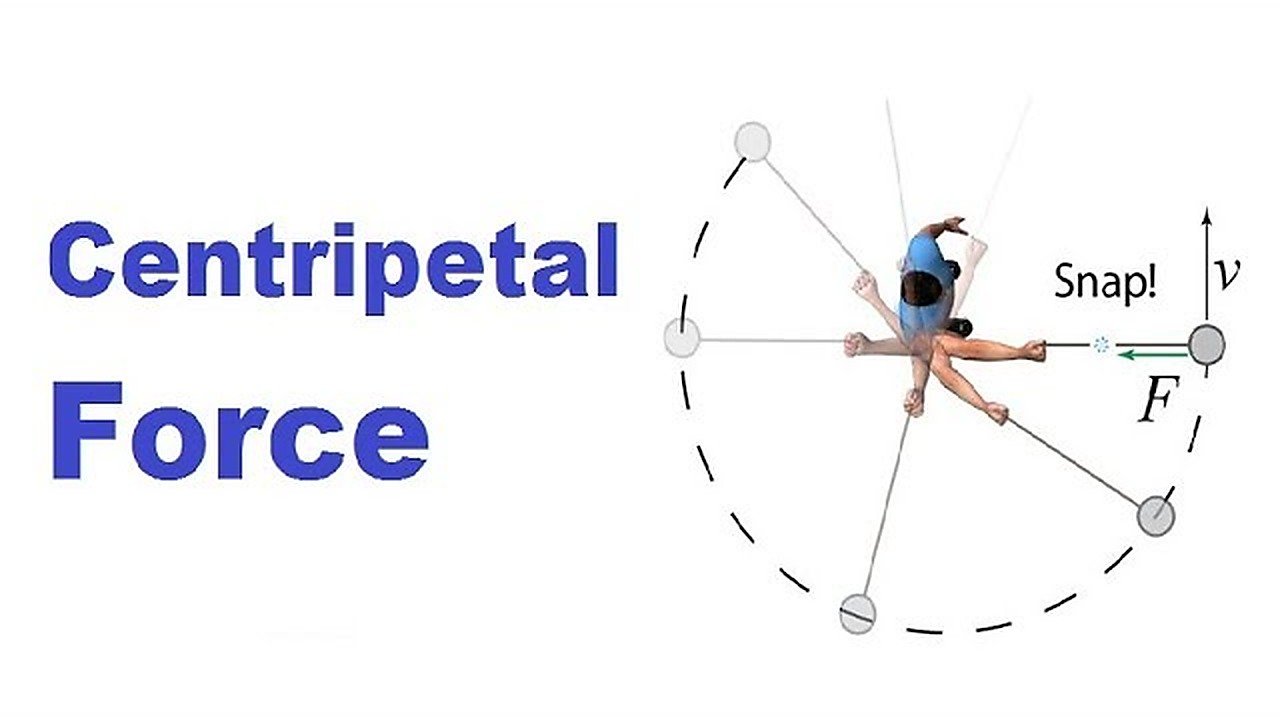
Centripetal force is the net force that acts on an object toward the center of its circular path, which changes the direction of the velocity and keeps the object moving in a circle.
The word centripetal comes from the Latin words centrum, meaning center, and petere, meaning to seek. The term means center-seeking force. According to OpenStax University Physics Volume 1, centripetal force is any net force that causes uniform circular motion.
Centripetal force is not a separate type of force. It is the name for the net inward force that tension, gravity, friction, a normal force, or a magnetic force supplies. Examples include the tension in a string, Earth’s gravity on the Moon, and friction between tires and a road.
What Is the Direction of Centripetal Force?
Centripetal force points toward the center of the circular path and is perpendicular to the velocity of the object. The centripetal acceleration points in the same direction. Because the force is perpendicular to the motion, it changes the direction of the velocity but not the speed in uniform circular motion. The force does zero work, so the kinetic energy stays constant.
What Is the Unit of Centripetal Force?
The SI unit of centripetal force is the newton (N), where 1 N = 1 kg·m/s². The SI unit of centripetal acceleration is meters per second squared (m/s²).
What Is the Formula for Centripetal Force?
The centripetal force formula is F = mv²/r, where m is the mass of the object, v is its speed, and r is the radius of the circular path. Table 1 lists 7 centripetal force formulas by known quantity or situation.
Table 1: Centripetal force formulas
| Known quantities or situation | Formula | Variables and units |
|---|---|---|
| Mass, speed, radius | F = mv²/r | m in kg, v in m/s, r in m |
| Mass, angular velocity, radius | F = mω²r | ω in rad/s |
| Mass, period, radius | F = 4π²mr/T² | T in s |
| Mass, frequency, radius | F = 4π²mrf² | f in Hz |
| Mass, centripetal acceleration | F = m × ac | ac in m/s² |
| Charged particle in a magnetic field | F = qvB | q in C, B in T, v perpendicular to B |
| Orbit under gravity | F = GMm/r² | G = 6.674 × 10⁻¹¹ N·m²/kg², M in kg |
What Is the Centripetal Acceleration Formula?
Centripetal acceleration is a = v²/r, directed toward the center of the circle. The equivalent forms are a = ω²r and a = 4π²r/T². Newton’s second law, F = ma, converts the acceleration into the force F = mv²/r. Christiaan Huygens derived the mathematical description of this acceleration in 1659.
How Is the Centripetal Force Formula Derived?
The formula follows from the change in the velocity vector during circular motion. The 4 derivation steps are:
- An object with speed v moves through a small angle Δθ = vΔt/r in a short time Δt.
- The velocity vector rotates by the same angle, so the change in velocity has magnitude Δv = vΔθ.
- The acceleration is a = Δv/Δt = v × (v/r) = v²/r.
- Newton’s second law gives F = ma = mv²/r.
What Provides the Centripetal Force?
Tension, gravity, friction, the normal force, and the magnetic force provide centripetal force, depending on the situation. Table 2 lists 7 situations with the force that supplies the centripetal force.
Table 2: Sources of centripetal force
| Situation | Force that supplies the centripetal force | Example |
|---|---|---|
| Object whirled on a string | Tension | Hammer throw |
| Body in orbit | Gravity | Moon around Earth |
| Vehicle on a flat curve | Static friction | Car turning a corner |
| Vehicle on a banked curve | Horizontal component of the normal force | Highway ramp |
| Object pressed against a rotating wall | Normal force | Washing machine drum |
| Charged particle in a magnetic field | Magnetic force | Cyclotron |
| Vertical loop | Gravity and normal force combined | Roller coaster at the top of a loop |
Free-body diagrams show tension, gravity, friction, and the normal force. The net inward component of those forces equals the centripetal force.
What Are 6 Examples of Centripetal Force?
The 6 examples of centripetal force are a car turning, a planet or moon orbiting, a ball on a string, a washing machine spin cycle, a roller coaster loop, and a charged particle in a magnetic field.
What Is an Example of Centripetal Force in a Car Turning?
Static friction between the tires and the road supplies the centripetal force when a car turns on a flat road. The maximum speed is v = √(μgr). For a friction coefficient of 0.7, which is typical for dry asphalt, and a radius of 50 m, v = √(0.7 × 9.8 × 50) = 18.5 m/s, or about 67 km/h. If the friction is too small, the car continues in a straight line along the tangent.
What Is an Example of Centripetal Force in an Orbit?
Gravity supplies the centripetal force for a moon, a planet, or a satellite in orbit. The Moon orbits at a radius of 3.84 × 10⁸ m with a period of 27.3 days, or 2.36 × 10⁶ s. Its speed is v = 2πr/T = 1.02 × 10³ m/s, and its centripetal acceleration is a = v²/r = 2.7 × 10⁻³ m/s². This value equals the surface gravity g = 9.81 m/s² divided by about 3,600, which matches the inverse-square law because the Moon is about 60 Earth radii away.
What Is an Example of Centripetal Force in a Ball on a String?
Tension in the string supplies the centripetal force for a ball whirled in a horizontal circle. A 0.50 kg ball moving at 6.0 m/s on a 1.2 m string needs a tension of 15 N. If the string breaks, the ball moves in a straight line along the tangent, according to Newton’s first law.
What Is an Example of Centripetal Force in a Washing Machine?
The normal force from the drum wall supplies the centripetal force on the clothes during the spin cycle. Water leaves through the holes in the drum and moves along straight tangent lines, because no wall force acts on it. A drum with a radius of 0.25 m at 1,200 rpm (125.7 rad/s) produces a = ω²r = 3.95 × 10³ m/s², or about 400 g.
What Is an Example of Centripetal Force in a Roller Coaster Loop?
Gravity and the normal force from the track together supply the centripetal force at the top of a vertical loop, according to N + mg = mv²/r. The minimum speed at the top occurs when N = 0, which gives v = √(gr). For a loop radius of 10 m, the minimum speed is √(9.8 × 10) = 9.9 m/s.
What Is an Example of Centripetal Force on a Charged Particle?
The magnetic force supplies the centripetal force on a charged particle that moves perpendicular to a magnetic field. Setting qvB = mv²/r gives the radius r = mv/(qB). An electron with a speed of 1.0 × 10⁷ m/s in a 1.0 mT field follows a circle with a radius of 5.7 cm.
How Do You Calculate Centripetal Force?
To calculate centripetal force, identify the known quantities, convert to SI units, select the matching formula, and compute the result in newtons. The 5 steps are:
- Identify the mass m, the speed v (or ω or T), and the radius r.
- Convert all values to SI units: kilograms, meters, and seconds.
- Select the formula from Table 1 that matches the known quantities.
- Substitute the values and compute F in newtons.
- Identify the real forces that supply the result, such as tension, friction, or gravity.
What Are 4 Worked Examples of Centripetal Force?
The 4 worked examples below calculate the centripetal force for a car, a ball on a string, a laboratory centrifuge, and an astronaut in orbit.
How Do You Find the Centripetal Force on a 1,200 kg Car Turning at 15 m/s on a 50 m Radius?
- Given: m = 1,200 kg, v = 15 m/s, and r = 50 m.
- Formula: F = mv²/r.
- Calculation: F = 1,200 × 15² / 50 = 1,200 × 225 / 50.
- Answer: F = 5,400 N toward the center of the curve. The minimum friction coefficient is μ = v²/(rg) = 225/(50 × 9.8) = 0.46.
How Do You Find the Tension in a String for a 0.50 kg Ball at 6.0 m/s and 1.2 m?
- Given: m = 0.50 kg, v = 6.0 m/s, and r = 1.2 m.
- Formula: F = mv²/r.
- Calculation: F = 0.50 × 6.0² / 1.2 = 0.50 × 36 / 1.2.
- Answer: F = 15 N, which equals the tension in the string.
How Do You Find the Centripetal Force on a 10 g Sample in a Centrifuge at 3,000 rpm?
- Given: m = 0.010 kg, r = 0.10 m, and ω = 3,000 × 2π / 60 = 314.2 rad/s.
- Formula: F = mω²r.
- Calculation: F = 0.010 × (314.2)² × 0.10 = 0.010 × 98,700 × 0.10.
- Answer: F = 98.7 N. The centripetal acceleration is ω²r = 9,870 m/s², or about 1,000 g.
How Do You Find the Centripetal Force on a 70 kg Astronaut in Orbit?
- Given: m = 70 kg, v = 7.66 × 10³ m/s, and r = 6.77 × 10⁶ m, which is Earth’s radius plus an altitude of about 400 km.
- Formula: F = mv²/r.
- Calculation: F = 70 × (7.66 × 10³)² / (6.77 × 10⁶) = 70 × 8.67.
- Answer: F = 6.1 × 10² N, supplied by Earth’s gravity. The centripetal acceleration is 8.67 m/s², which is about 88% of the surface value of g. The astronaut feels weightless because the astronaut and the station fall together.
What Is the Difference Between Centripetal Force and Centrifugal Force?
Centripetal force is a real inward force, and centrifugal force is a fictitious outward force that appears in a rotating frame of reference. Table 3 compares 6 properties of the 2 forces.
Table 3: Centripetal force compared with centrifugal force
| Property | Centripetal force | Centrifugal force |
|---|---|---|
| Direction | Toward the center of the circle | Away from the center of the circle |
| Type | Real force from a physical interaction | Inertial (fictitious) force |
| Frame of reference | Inertial frame | Rotating frame |
| Formula | F = mv²/r | F = mω²r |
| Origin of the term | Isaac Newton, Principia (1687) | Christiaan Huygens, De Vi Centrifuga (1659) |
| Example | Tension in a whirled string | The sensation of being pushed outward in a turning car |
Is Centrifugal Force Real?
Centrifugal force is not a real force in an inertial frame. It is an inertial force with magnitude mω²r that arises when an observer uses a rotating frame of reference. Centripetal and centrifugal forces are not an action and reaction pair under Newton’s third law, because the 2 forces belong to different frames of reference.
What Happens if Centripetal Force Stops?
An object moves in a straight line along the tangent to the circle, if the centripetal force stops. The motion follows Newton’s first law, which states that an object keeps its velocity without a net force. Examples include a ball from a broken string and mud thrown from a spinning tire.
Who Discovered Centripetal Force?
Christiaan Huygens derived the mathematical description of circular motion in 1659, and Isaac Newton defined centripetal force in 1687. The key events are:
- 1659: Christiaan Huygens derived the acceleration in circular motion and introduced the term centrifugal force in De Vi Centrifuga.
- 1687: Isaac Newton defined centripetal force in the Principia and applied it to planetary orbits.
- Moon comparison: Newton compared the centripetal acceleration of the Moon with surface gravity, which supported the inverse-square law of gravitation.
How Does Centripetal Force Change With Mass, Speed, and Radius?
Centripetal force is directly proportional to mass and to the square of the speed, and inversely proportional to the radius. Table 4 lists the effect of changing 1 variable while the others stay constant.
Table 4: Effect of changing one variable on centripetal force
| Change | Effect on centripetal force |
|---|---|
| Mass doubles | Force doubles (× 2) |
| Speed doubles | Force quadruples (× 4) |
| Speed triples | Force increases 9 times (× 9) |
| Radius doubles at constant speed | Force halves (× 1/2) |
| Angular velocity doubles at constant radius | Force quadruples (× 4) |
| Radius doubles at constant angular velocity | Force doubles (× 2) |
How Can You Demonstrate Centripetal Force in an Experiment?
To demonstrate centripetal force, whirl a rubber stopper on a string through a glass tube and compare the calculated force with the hanging weight. The 5 steps are:
- Tie a rubber stopper of known mass m to a string.
- Pass the string through a glass tube and attach a hanging weight of known mass M to the lower end.
- Whirl the stopper in a horizontal circle at a constant radius r.
- Time 20 revolutions and divide by 20 to find the period T.
- Calculate F = 4π²mr/T² and compare it with the weight Mg.
The 2 values agree within experimental error, because the string tension equals Mg and supplies the centripetal force.
What Are the Applications of Centripetal Force?
Centripetal force applies to 5 technologies: centrifuges, banked roads, satellites, particle accelerators, and amusement rides.
- Centrifuges: Rotating tubes separate mixtures by density. Laboratory ultracentrifuges exceed accelerations of 100,000 g.
- Banked roads: The horizontal component of the normal force supplies the centripetal force. The ideal banking angle follows tan θ = v²/(rg), which gives θ = 17.7° for v = 25 m/s and r = 200 m.
- Satellites: Gravity supplies the centripetal force, and the orbital speed is v = √(GM/r). For Earth, GM = 3.986 × 10¹⁴ m³/s², and r = 6.77 × 10⁶ m gives v = 7.67 km/s.
- Particle accelerators: Magnetic fields bend charged particles into circles of radius r = mv/(qB). Cyclotrons and mass spectrometers use this effect.
- Amusement rides: Walls, tracks, and seats supply the centripetal force in rotors, loops, and spinning rides.
What Mistakes Occur Most Often With Centripetal Force?
5 mistakes occur most often with centripetal force:
- Treating centripetal force as a separate force on a free-body diagram.
- Confusing centripetal force with centrifugal force.
- Using the diameter instead of the radius in F = mv²/r.
- Forgetting to square the speed.
- Using rpm or degrees without conversion to radians per second.
What Do People Also Ask About Centripetal Force?
What Is Centripetal Force in Simple Words?
Centripetal force is the inward force that keeps an object moving in a circle.
What Is the Formula for Centripetal Force?
The formula is F = mv²/r.
What Is the Direction of Centripetal Force?
Centripetal force points toward the center of the circle.
What Is the SI Unit of Centripetal Force?
The SI unit is the newton (N).
Is Centripetal Force a Real Force?
Centripetal force is real, because physical interactions such as tension, gravity, friction, and the normal force supply it.
What Causes Centripetal Force?
Tension, gravity, friction, the normal force, and the magnetic force cause centripetal force.
Does Centripetal Force Do Work?
Centripetal force does zero work in uniform circular motion, because the force is perpendicular to the displacement.
What Happens When Centripetal Force Is Removed?
The object moves in a straight line along the tangent to the circle.
Is Centripetal Force the Same as Gravity?
Centripetal force is not the same as gravity, because gravity supplies the centripetal force only for orbiting bodies.
What Is Centripetal Acceleration?
Centripetal acceleration is a = v²/r, directed toward the center of the circle.
What Are the Key Takeaways About Centripetal Force?
Centripetal force is the net inward force that keeps an object moving in a circle, and its formula is F = mv²/r. The 6 key takeaways are:
- Definition: The net force toward the center of a circular path.
- Formula: F = mv²/r = mω²r = 4π²mr/T².
- Direction: Toward the center, perpendicular to the velocity.
- Sources: Tension, gravity, friction, normal force, and magnetic force.
- Difference: Centrifugal force is a fictitious outward force in a rotating frame.
- Calculation: Convert to SI units, select the formula, and compute F in newtons.

The University of the West Indies
My passion as a teacher and leader in education is to contribute to students’ enhanced learning by creation of a positive teaching/learning environment, where they are motivated to develop strong critical thinking, analytical and problem-solving skills.
As acting Vice-Principal and head of Physics, I have amassed five years of experience in leading meetings, implementing strategies to maintain discipline and school ethos, liaise with stakeholders in planning for future development of the institution; successfully negotiated the implementation of various projects for student development as well as supervising effective execution of such. For the past 19 years, I have incorporated discovery learning within the classroom through practical activities, problem solving and cooperative learning and have realized that students retention in Physics and Mathematics have increased significantly.
I am always cognizant that students have different learning styles, and as such teaching strategies during planning and delivery must take this crucial factor into consideration and be tailored to meet such differences.