

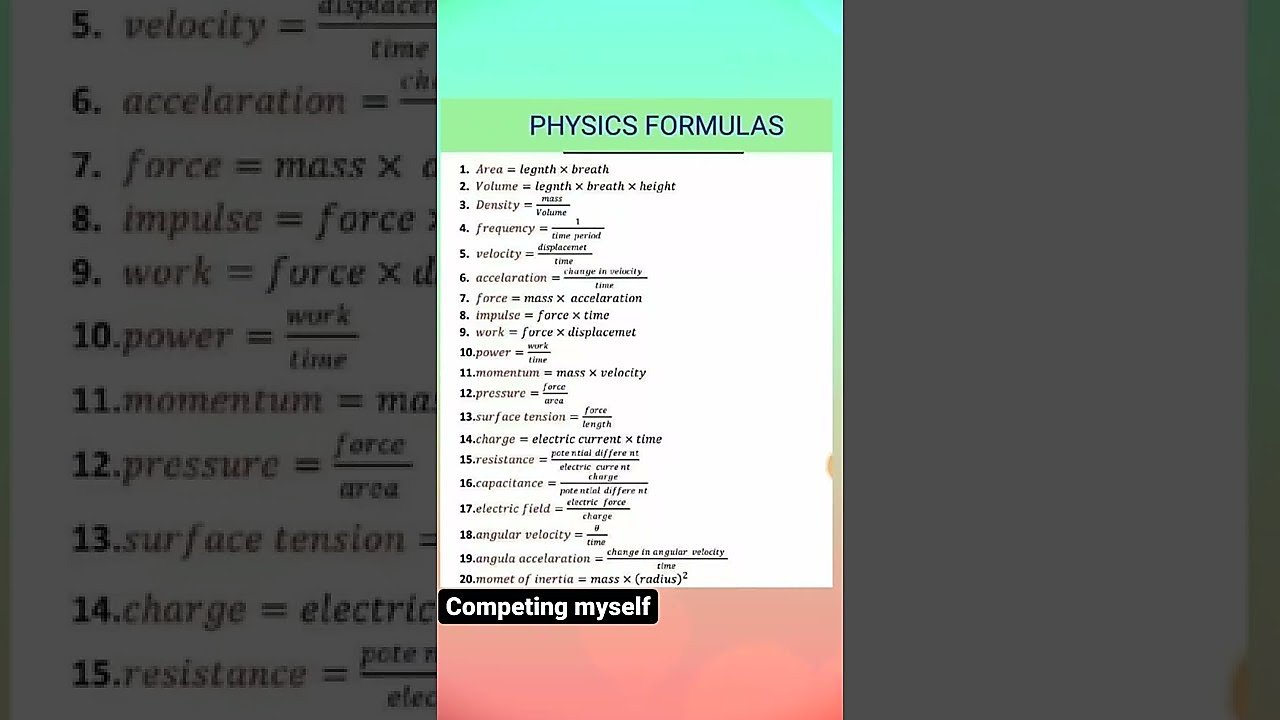
What Is the Physics C Formula Sheet, and Which Mechanics and E&M Equations Does It Cover?
The Physics C formula sheet is the College Board reference list of equations and constants for the AP Physics C: Mechanics and AP Physics C: Electricity and Magnetism exams. Mechanics equations cover 7 groups: kinematics, dynamics, work and energy, momentum, rotation, oscillations, and gravitation. E&M equations cover 5 groups: electrostatics, capacitors, circuits, magnetism, and induction. Both exams are hybrid digital and permit calculators.
For a reliable reference, consult College Board AP Physics C Mechanics course information.
What Is the Physics C Formula Sheet?
The Physics C formula sheet is a reference document of equations and constants for AP Physics C: Mechanics and AP Physics C: Electricity and Magnetism. Each exam has its own set of equations.
Equations on the sheets include Newton's second law, Coulomb's law, and Faraday's law. The Mechanics exam tests the ability to use calculus in problems on kinematics, linear momentum, and other topics. The sheets therefore contain derivative and integral forms of physical relationships.
This article lists standard formulas for each topic group. The official College Board sheet defines the exact equations and notation available on exam day.
Is the Physics C Formula Sheet Provided on Exam Day?
Yes, the College Board provides reference sheets for the AP Physics C exams. The College Board directs students to a reference information page for exam day materials, and a table of equations is supplied at the exam site.
Calculators are permitted on both exams.
Where Can Students Find the Official Physics C Formula Sheet?
The official sheets are published on the College Board AP pages under Reference Information for Specific AP Exams. Both the AP Central exam pages and the AP Students course pages link to the reference sheets and exam day details.
Third-party formula sheets differ in content and notation. Only the College Board version defines the equations available during the exam.
What Is the Current Format of the AP Physics C Exams?
Both AP Physics C exams are hybrid digital, with multiple-choice questions in the Bluebook app and handwritten free-response answers in paper booklets. Students view free-response questions in Bluebook and write answers in paper exam booklets that are returned for scoring.
The list gives the section formats on the College Board exam pages.
- Mechanics Section I: 40 multiple-choice questions, 80 minutes, 50% of the score
- Mechanics Section II: 4 free-response questions, 100 minutes, 50% of the score
- E&M Section I: 42 multiple-choice questions, 85 minutes, 50% of the score, effective from the May 2027 exam
- E&M Section II: 4 free-response questions, 95 minutes, 50% of the score, effective from the May 2027 exam
The earlier format had 35 multiple-choice questions in 45 minutes and 3 free-response questions in 45 minutes. Prep books and websites that list this format are outdated. The Mechanics figures above come from College Board exam pages for the 2025-26 school year.
What Are the Mechanics Formulas in AP Physics C?
Mechanics formulas fall into 7 groups: kinematics, dynamics, work and energy, momentum, rotation, oscillations, and gravitation. Each group uses derivatives and integrals of position, force, or energy.
What Are the Kinematics Formulas?
Kinematics formulas relate position, velocity, acceleration, and time. Constant-acceleration equations apply only when acceleration does not change.
| Quantity | Formula | Variables |
|---|---|---|
| Velocity | v = dx/dt | Position x (m), time t (s) |
| Acceleration | a = dv/dt = d²x/dt² | Velocity v (m/s) |
| Displacement from velocity | Δx = ∫v dt | Velocity v (m/s) |
| Velocity, constant acceleration | v = v₀ + at | Initial velocity v₀ (m/s), acceleration a (m/s²) |
| Position, constant acceleration | x = x₀ + v₀t + ½at² | Initial position x₀ (m) |
| Velocity and position, constant acceleration | v² = v₀² + 2a(x − x₀) | Initial and final positions x₀ and x (m) |
| Projectile range on level ground | R = v₀² sin 2θ / g | Launch speed v₀ (m/s), launch angle θ, gravitational acceleration g (m/s²) |
What Are the Dynamics Formulas?
Dynamics formulas relate force to motion through Newton's second law, ΣF = ma = dp/dt.
| Quantity | Formula | Variables |
|---|---|---|
| Newton's second law | ΣF = ma = dp/dt | Net force ΣF (N), mass m (kg), momentum p (kg·m/s) |
| Weight | W = mg | Gravitational acceleration g (m/s²) |
| Kinetic friction | f_k = μ_k N | Coefficient μ_k, normal force N (N) |
| Maximum static friction | f_s ≤ μ_s N | Coefficient μ_s, normal force N (N) |
| Spring force | F = −kx | Spring constant k (N/m), displacement x (m) |
| Linear drag | F = −bv | Drag coefficient b (kg/s), velocity v (m/s) |
| Terminal velocity with linear drag | v_t = mg/b | Mass m (kg), drag coefficient b (kg/s) |
| Centripetal acceleration | a_c = v²/r | Speed v (m/s), radius r (m) |
What Are the Work, Energy, and Power Formulas?
Work, energy, and power formulas relate force and displacement to changes in kinetic and potential energy.
| Quantity | Formula | Variables |
|---|---|---|
| Work, variable force | W = ∫F dx | Force F (N), displacement x (m) |
| Work, constant force | W = Fd cos θ | Force F (N), distance d (m), angle θ between F and d |
| Kinetic energy | K = ½mv² | Mass m (kg), speed v (m/s) |
| Work-energy theorem | W_net = ΔK | Net work W_net (J), kinetic energy change ΔK (J) |
| Gravitational potential energy near Earth | U_g = mgh | Height h (m) |
| Spring potential energy | U_s = ½kx² | Spring constant k (N/m), displacement x (m) |
| Force from potential energy | F = −dU/dx | Potential energy U (J) |
| Power | P = dW/dt = F·v | Work W (J), force F (N), velocity v (m/s) |
What Are the Linear Momentum Formulas?
Linear momentum formulas relate mass, velocity, and impulse, and conservation of momentum applies to isolated systems.
| Quantity | Formula | Variables |
|---|---|---|
| Momentum | p = mv | Mass m (kg), velocity v (m/s) |
| Impulse | J = ∫F dt = Δp | Force F (N), time t (s), momentum change Δp (kg·m/s) |
| Conservation of momentum | Σp_before = Σp_after | Total momentum of an isolated system (kg·m/s) |
| Center of mass | x_cm = Σmᵢxᵢ / Σmᵢ = (1/M)∫x dm | Masses mᵢ (kg), positions xᵢ (m), total mass M (kg) |
| Elastic collision, one dimension | v₁ − v₂ = −(v₁′ − v₂′) | Velocities before (v₁, v₂) and after (v₁′, v₂′) in m/s |
What Are the Rotation Formulas?
Rotation formulas relate torque, moment of inertia, angular acceleration, and angular momentum.
| Quantity | Formula | Variables |
|---|---|---|
| Angular velocity | ω = dθ/dt | Angle θ (rad), time t (s) |
| Angular acceleration | α = dω/dt | Angular velocity ω (rad/s) |
| Constant angular acceleration | ω = ω₀ + αt and θ = θ₀ + ω₀t + ½αt² | Initial values ω₀ and θ₀ |
| Torque | τ = r × F, with magnitude τ = rF sin θ | Lever arm r (m), force F (N) |
| Rotational second law | Στ = Iα | Net torque Στ (N·m), moment of inertia I (kg·m²) |
| Moment of inertia | I = ∫r² dm = Σmr² | Mass element dm (kg), distance r from the axis (m) |
| Parallel axis theorem | I = I_cm + Md² | Center-of-mass inertia I_cm, mass M (kg), axis offset d (m) |
| Angular momentum | L = r × p = Iω | Linear momentum p (kg·m/s) |
| Torque and angular momentum | τ = dL/dt | Angular momentum L (kg·m²/s) |
| Rotational kinetic energy | K = ½Iω² | Angular velocity ω (rad/s) |
| Rolling without slipping | v = ωR and K = ½Mv² + ½Iω² | Radius R (m), mass M (kg) |
The table lists moments of inertia for 5 shapes.
| Shape | Axis | Moment of Inertia |
|---|---|---|
| Hoop | Through center, perpendicular to plane | MR² |
| Solid cylinder or disk | Through center, perpendicular to face | ½MR² |
| Solid sphere | Through center | ⅖MR² |
| Thin rod | Through center, perpendicular to length | (1/12)ML² |
| Thin rod | Through one end, perpendicular to length | ⅓ML² |
What Are the Oscillation Formulas?
Oscillation formulas describe simple harmonic motion through displacement, angular frequency, and period.
| Quantity | Formula | Variables |
|---|---|---|
| Displacement | x = A cos(ωt + φ) | Amplitude A (m), angular frequency ω (rad/s), phase constant φ (rad) |
| Period and frequency | T = 2π/ω = 1/f | Period T (s), frequency f (Hz) |
| Angular frequency of a spring | ω = √(k/m) | Spring constant k (N/m), mass m (kg) |
| Period of a spring | T = 2π√(m/k) | Mass m (kg), spring constant k (N/m) |
| Simple pendulum, small angles | T = 2π√(ℓ/g) | Length ℓ (m), gravitational acceleration g (m/s²) |
| Physical pendulum | T = 2π√(I/(mgd)) | Moment of inertia I (kg·m²), pivot-to-center distance d (m) |
| Torsional pendulum | T = 2π√(I/κ) | Torsion constant κ (N·m/rad) |
| Total energy | E = ½kA² | Spring constant k (N/m), amplitude A (m) |
What Are the Gravitation Formulas?
Gravitation formulas relate mass and distance to gravitational force, potential energy, and orbital motion.
| Quantity | Formula | Variables |
|---|---|---|
| Gravitational force | F_g = Gm₁m₂/r² | Gravitational constant G, masses m₁ and m₂ (kg), separation r (m) |
| Gravitational field | g = GM/r² | Central mass M (kg), distance r (m) |
| Gravitational potential energy | U_g = −Gm₁m₂/r | Zero reference at infinite separation |
| Circular orbital speed | v = √(GM/r) | Central mass M (kg), orbital radius r (m) |
| Escape speed | v_esc = √(2GM/r) | Central mass M (kg), distance r (m) |
| Total orbital energy, circular orbit | E = −GMm/(2r) | Orbiting mass m (kg) |
| Kepler's third law | T² = (4π²/GM) r³ | Orbital period T (s), orbital radius r (m) |
What Are the Electricity and Magnetism Formulas in AP Physics C?
E&M formulas fall into 5 groups: electrostatics, capacitors, circuits, magnetism, and induction. Integrals over charge distributions and flux appear throughout the groups.
What Are the Electrostatics Formulas?
Electrostatics formulas relate charge to electric force, field, potential, and potential energy.
| Quantity | Formula | Variables |
|---|---|---|
| Coulomb's law | F = kq₁q₂/r², with k = 1/(4πε₀) | Charges q₁ and q₂ (C), separation r (m) |
| Electric field | E = F/q | Force F (N), test charge q (C) |
| Point charge field | E = kq/r² | Charge q (C), distance r (m) |
| Field of a continuous distribution | E = ∫k dq/r² (r̂ direction) | Charge element dq (C) |
| Electric flux | Φ_E = ∫E·dA | Area element dA (m²) |
| Gauss's law | ∮E·dA = Q_enc/ε₀ | Enclosed charge Q_enc (C) |
| Potential difference | ΔV = −∫E·dl | Path element dl (m) |
| Point charge potential | V = kq/r | Charge q (C), distance r (m) |
| Field from potential | E = −dV/dr | Potential V (V) |
| Potential energy of a charge | U = qV | Charge q (C), potential V (V) |
What Are the Capacitor Formulas?
Capacitor formulas relate charge, voltage, geometry, and stored energy.
| Quantity | Formula | Variables |
|---|---|---|
| Capacitance | C = Q/V | Charge Q (C), voltage V (V) |
| Parallel plate capacitor | C = κε₀A/d | Dielectric constant κ, plate area A (m²), separation d (m) |
| Stored energy | U = ½CV² = ½QV | Capacitance C (F) |
| Capacitors in series | 1/C_eq = Σ1/Cᵢ | Capacitances Cᵢ (F) |
| Capacitors in parallel | C_eq = ΣCᵢ | Capacitances Cᵢ (F) |
| Electric energy density in vacuum | u = ½ε₀E² | Electric field E (V/m) |
What Are the Circuit Formulas?
Circuit formulas relate current, voltage, resistance, and power, and RC circuits use the time constant τ = RC.
| Quantity | Formula | Variables |
|---|---|---|
| Current | I = dQ/dt | Charge Q (C), time t (s) |
| Ohm's law | V = IR | Voltage V (V), resistance R (Ω) |
| Resistance of a wire | R = ρℓ/A | Resistivity ρ (Ω·m), length ℓ (m), cross-sectional area A (m²) |
| Power | P = IV = I²R = V²/R | Power P (W) |
| Resistors in series | R_eq = ΣRᵢ | Resistances Rᵢ (Ω) |
| Resistors in parallel | 1/R_eq = Σ1/Rᵢ | Resistances Rᵢ (Ω) |
| Kirchhoff's junction rule | ΣI_in = ΣI_out | Currents at a junction (A) |
| Kirchhoff's loop rule | ΣΔV = 0 | Potential changes around a closed loop (V) |
| RC time constant | τ = RC | Resistance R (Ω), capacitance C (F) |
| Capacitor charging | q(t) = Q_max(1 − e^(−t/RC)) | Maximum charge Q_max (C) |
| Capacitor discharging | q(t) = Q₀e^(−t/RC) | Initial charge Q₀ (C) |
What Are the Magnetism Formulas?
Magnetism formulas relate moving charges and currents to magnetic force and magnetic field.
| Quantity | Formula | Variables |
|---|---|---|
| Magnetic force on a charge | F = qv × B | Charge q (C), velocity v (m/s), field B (T) |
| Radius of a charged particle path | r = mv/(qB) | Mass m (kg), speed v (m/s) |
| Magnetic force on a wire | F = Iℓ × B | Current I (A), length vector ℓ (m) |
| Biot-Savart law | dB = (μ₀/4π)(I dℓ × r̂)/r² | Permeability μ₀, current element I dℓ |
| Ampère's law | ∮B·dℓ = μ₀I_enc | Enclosed current I_enc (A) |
| Long straight wire | B = μ₀I/(2πr) | Distance r (m) |
| Center of a circular loop | B = μ₀I/(2R) | Loop radius R (m) |
| Solenoid | B = μ₀nI | Turns per meter n (1/m) |
| Force between parallel wires | F/ℓ = μ₀I₁I₂/(2πd) | Currents I₁ and I₂ (A), separation d (m) |
| Magnetic flux | Φ_B = ∫B·dA | Area element dA (m²) |
What Are the Induction and Inductance Formulas?
Induction formulas relate changing magnetic flux to induced emf, and inductors store energy in magnetic fields.
| Quantity | Formula | Variables |
|---|---|---|
| Faraday's law | ε = −dΦ_B/dt | Magnetic flux Φ_B (Wb) |
| Motional emf | ε = Bℓv | Field B (T), length ℓ (m), speed v (m/s) |
| Inductor emf | ε = −L dI/dt | Inductance L (H), current I (A) |
| Inductor energy | U = ½LI² | Inductance L (H) |
| Solenoid inductance | L = μ₀n²Aℓ | Turns per meter n (1/m), area A (m²), length ℓ (m) |
| RL time constant | τ = L/R | Inductance L (H), resistance R (Ω) |
| Current growth in an RL circuit | I(t) = (ε/R)(1 − e^(−t/τ)) | Source emf ε (V) |
| LC angular frequency | ω = 1/√(LC) | Inductance L (H), capacitance C (F) |
| Magnetic energy density | u_B = B²/(2μ₀) | Field B (T) |
What Are Maxwell's Equations in Integral Form?
Maxwell's equations consist of 4 laws that describe electric and magnetic fields.
- Gauss's law for electricity: ∮E·dA = Q_enc/ε₀
- Gauss's law for magnetism: ∮B·dA = 0
- Faraday's law: ∮E·dl = −dΦ_B/dt
- Ampère-Maxwell law: ∮B·dl = μ₀I_enc + μ₀ε₀ dΦ_E/dt
What Constants Appear on the Physics C Formula Sheet?
The constants include the electron charge, particle masses, the speed of light, the Coulomb constant, and the permittivity and permeability of free space. The table lists 9 common constants rounded to 3 significant figures or fewer.
| Constant | Symbol | Value |
|---|---|---|
| Electron charge | e | 1.60 × 10⁻¹⁹ C |
| Electron mass | mₑ | 9.11 × 10⁻³¹ kg |
| Proton mass | m_p | 1.67 × 10⁻²⁷ kg |
| Speed of light | c | 3.00 × 10⁸ m/s |
| Coulomb constant | k | 9.0 × 10⁹ N·m²/C² |
| Permittivity of free space | ε₀ | 8.85 × 10⁻¹² C²/(N·m²) |
| Permeability of free space | μ₀ | 4π × 10⁻⁷ T·m/A |
| Gravitational constant | G | 6.67 × 10⁻¹¹ N·m²/kg² |
| Gravitational acceleration at Earth's surface | g | 9.8 m/s² |
The official sheet defines the constant values used for exam scoring.
What Are the SI Units of Physics C Quantities?
SI units express every formula result in base units of meters, kilograms, seconds, and amperes. The table lists 14 quantities, their symbols, and their units.
| Quantity | Symbol | SI Unit | Base Units |
|---|---|---|---|
| Force | F | newton (N) | kg·m/s² |
| Energy and work | E, W | joule (J) | kg·m²/s² |
| Power | P | watt (W) | kg·m²/s³ |
| Momentum | p | kilogram meter per second | kg·m/s |
| Torque | τ | newton meter (N·m) | kg·m²/s² |
| Moment of inertia | I | kilogram square meter | kg·m² |
| Angular momentum | L | kilogram square meter per second | kg·m²/s |
| Charge | q | coulomb (C) | A·s |
| Electric potential | V | volt (V) | kg·m²/(A·s³) |
| Capacitance | C | farad (F) | A²·s⁴/(kg·m²) |
| Resistance | R | ohm (Ω) | kg·m²/(A²·s³) |
| Magnetic field | B | tesla (T) | kg/(A·s²) |
| Magnetic flux | Φ_B | weber (Wb) | kg·m²/(A·s²) |
| Inductance | L | henry (H) | kg·m²/(A²·s²) |
How Do Calculus Definitions Connect the Physics C Formulas?
Many Physics C formulas are derivatives or integrals of other formulas. Derivative forms define a quantity as a rate of change. Integral forms accumulate that quantity over time, distance, or area.
| Quantity | Derivative Form | Integral Form |
|---|---|---|
| Position and velocity | v = dx/dt | Δx = ∫v dt |
| Velocity and acceleration | a = dv/dt | Δv = ∫a dt |
| Momentum and force | F = dp/dt | J = ∫F dt = Δp |
| Work and power | P = dW/dt | W = ∫P dt |
| Angular momentum and torque | τ = dL/dt | ΔL = ∫τ dt |
| Current and charge | I = dQ/dt | Q = ∫I dt |
| Field and potential | E = −dV/dr | ΔV = −∫E·dl |
| Flux and emf | ε = −dΦ_B/dt | Φ_B = ∫B·dA |
Calculus rules such as d/dx(xⁿ) = nxⁿ⁻¹ and ∫xⁿ dx = xⁿ⁺¹/(n + 1) support these relationships.
What Is the Difference Between the Mechanics and E&M Formula Sheets?
The Mechanics sheet covers motion, force, energy, rotation, and gravitation, while the E&M sheet covers electric fields, circuits, magnetic fields, and induction.
| Attribute | AP Physics C: Mechanics | AP Physics C: Electricity and Magnetism |
|---|---|---|
| Subject area | Motion, forces, energy, momentum, rotation, oscillations, gravitation | Electric fields, potential, capacitors, circuits, magnetic fields, induction |
| Central law | Newton's second law, ΣF = ma | Maxwell's equations |
| Vector products | τ = r × F and L = r × p | F = qv × B and the Biot-Savart law |
| Typical integrals | W = ∫F dx and I = ∫r² dm | E = ∫k dq/r² and Φ_B = ∫B·dA |
| Time constants | Not applicable | τ = RC and τ = L/R |
| Constants used | G, g | k, ε₀, μ₀, e |
How Does the Physics C Sheet Differ From the Physics 1 and Physics 2 Sheets?
Physics C sheets contain calculus-based relationships, while Physics 1 and Physics 2 sheets contain algebra-based relationships.
| Course | Mathematics Level | Topic Coverage |
|---|---|---|
| AP Physics 1 | Algebra and trigonometry | Kinematics, dynamics, energy, momentum, rotation, simple harmonic motion, introductory circuits |
| AP Physics 2 | Algebra and trigonometry | Fluids, thermodynamics, electromagnetism, optics, modern physics |
| AP Physics C: Mechanics | Calculus | Mechanics |
| AP Physics C: Electricity and Magnetism | Calculus | Electricity and magnetism |
How to Use the Physics C Formula Sheet?
Using the sheet takes 6 steps: list, locate, check, convert, solve, and verify.
- List the given quantities and the unknown quantity.
- Locate the topic group that contains the relationship.
- Check the conditions of the formula, such as constant acceleration, small angles, or vacuum.
- Convert all values to SI units.
- Solve for the unknown quantity with the correct sign convention.
- Verify the units and the magnitude of the result.
Practice with the official sheet from the first unit builds familiarity with its layout and notation.
What Are Common Mistakes With Physics C Formulas?
Common mistakes involve applying a formula outside its conditions, mixing units, and dropping signs.
| Mistake | Correction |
|---|---|
| Applying constant-acceleration equations to varying acceleration | Integrate a(t) to find velocity and position |
| Applying T = 2π√(ℓ/g) at large angles | The formula holds for small angles, up to about 15 degrees |
| Using I = ½MR² for a hoop | A hoop has I = MR² |
| Using only ½Mv² for a rolling object | Add ½Iω² for rotational kinetic energy |
| Dropping the negative sign in Faraday's law | The sign expresses the direction of the induced emf (Lenz's law) |
| Using ε₀ inside a dielectric | Replace ε₀ with κε₀ |
| Entering degrees in a radian-based calculation | Set the calculator to radians for ωt + φ |
People Also Ask About the Physics C Formula Sheet
Does AP Physics C provide a formula sheet?
Yes, the College Board provides reference sheets for the AP Physics C exams.
Is the formula sheet the same for Mechanics and E&M?
No, each exam has its own equations for its topics.
Where can I find the official AP Physics C formula sheet?
The official sheets are on the College Board AP pages under Reference Information for Specific AP Exams.
Is there a PDF of the AP Physics C formula sheet?
The College Board hosts the official reference materials, and third-party PDFs vary in accuracy.
Are calculators permitted on AP Physics C?
Yes, calculators are permitted on both exams.
How many multiple-choice questions are on AP Physics C: Mechanics?
The 2025-26 exam page lists 40 multiple-choice questions in 80 minutes.
How many multiple-choice questions are on AP Physics C: E&M?
The College Board lists 42 questions in 85 minutes, effective from the May 2027 exam.
Is the AP Physics C exam digital?
The exams are hybrid digital, with multiple-choice questions in Bluebook and handwritten free-response answers.
Is AP Physics C calculus-based?
Yes, both exams require derivatives and integrals in problem solving.
What is Newton's second law in Physics C form?
Newton's second law is ΣF = ma = dp/dt.
What is Faraday's law of induction?
Faraday's law is ε = −dΦ_B/dt.
Can students bring a personal formula sheet to the exam?
The College Board supplies the reference sheet, and AP exam rules restrict outside notes.
What is the Physics C formula sheet in one sentence?
The Physics C formula sheet is the College Board list of equations and constants for the AP Physics C: Mechanics and Electricity and Magnetism exams.

The University of the West Indies
My passion as a teacher and leader in education is to contribute to students’ enhanced learning by creation of a positive teaching/learning environment, where they are motivated to develop strong critical thinking, analytical and problem-solving skills.
As acting Vice-Principal and head of Physics, I have amassed five years of experience in leading meetings, implementing strategies to maintain discipline and school ethos, liaise with stakeholders in planning for future development of the institution; successfully negotiated the implementation of various projects for student development as well as supervising effective execution of such. For the past 19 years, I have incorporated discovery learning within the classroom through practical activities, problem solving and cooperative learning and have realized that students retention in Physics and Mathematics have increased significantly.
I am always cognizant that students have different learning styles, and as such teaching strategies during planning and delivery must take this crucial factor into consideration and be tailored to meet such differences.