

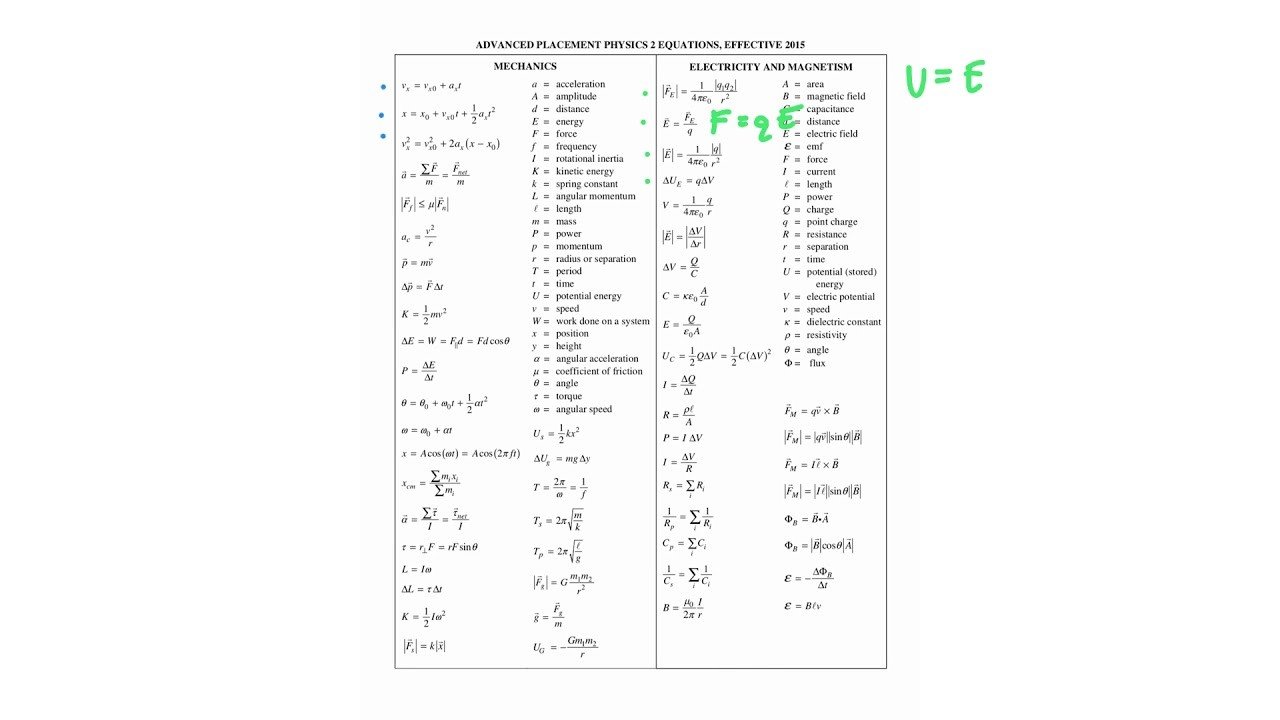
AP Physics 2 Equation Sheet: 7 Equation Sections, 20 Constants and Conversion Factors, and 9 Exam Conventions Provided by the College Board
What Is the AP Physics 2 Equation Sheet?
The AP Physics 2 equation sheet is a College Board reference document that lists equations, constants, unit symbols, prefixes, trigonometric values, and exam conventions. The College Board titles it Exam Reference Information.
For a reliable reference, see The College Board provides official reference information for AP Physics 2 exams.
The sheet groups its equations under 7 headings:
- Electricity
- Magnetism
- Thermal Physics
- Waves, Sound, and Optics
- Modern Physics
- Geometry and Trigonometry
- Mechanics and Fluids
Does the AP Physics 2 Exam Provide an Equation Sheet?
Yes, the College Board provides the reference information during the exam. The printed note allows scratch work in blank space and states that proctors collect the sheet at the end.
College Board guidance for AP Physics 1 and 2 states that students cannot bring their own copies of the tables to the exam room.
Where Can Students Find the Official AP Physics 2 Equation Sheet PDF?
The official PDF is hosted on the College Board’s AP Central website. The file sits at apcentral.collegeboard.org/media/pdf/ap-physics-2-equations-sheet.pdf. The current edition carries a 2026 College Board copyright.
The College Board notes that tables can be revised and directs students to AP Central for the latest versions.
What Constants Does the AP Physics 2 Equation Sheet Include?
The sheet includes 20 constants and conversion factors, from Avogadro’s number to the gravitational field strength at Earth’s surface. The table below shows each entry with its symbol and value.
| Constant or Conversion Factor | Symbol | Value |
|---|---|---|
| Avogadro’s number | N₀ | 6.02 × 10²³ mol⁻¹ |
| Universal gas constant | R | 8.31 J/(mol·K) |
| Boltzmann’s constant | k_B | 1.38 × 10⁻²³ J/K |
| 1 atmosphere of pressure | 1 atm | 1.0 × 10⁵ Pa |
| Coulomb constant | k | 9.0 × 10⁹ N·m²/C² |
| Proton mass | m_p | 1.67 × 10⁻²⁷ kg |
| Neutron mass | m_n | 1.67 × 10⁻²⁷ kg |
| Electron mass | m_e | 9.11 × 10⁻³¹ kg |
| Elementary charge | e | 1.60 × 10⁻¹⁹ C |
| Vacuum permittivity | ε₀ | 8.85 × 10⁻¹² C²/(N·m²) |
| Vacuum permeability | μ₀ | 4π × 10⁻⁷ (T·m)/A |
| 1 electron volt | 1 eV | 1.60 × 10⁻¹⁹ J |
| Planck’s constant | h | 6.63 × 10⁻³⁴ J·s = 4.14 × 10⁻¹⁵ eV·s |
| Speed of light | c | 3.00 × 10⁸ m/s |
| Wien’s constant | b | 2.90 × 10⁻³ m·K |
| Stefan-Boltzmann constant | σ | 5.67 × 10⁻⁸ W/(m²·K⁴) |
| 1 unified atomic mass unit | 1 u | 1.66 × 10⁻²⁷ kg = 931 MeV/c² |
| Universal gravitational constant | G | 6.67 × 10⁻¹¹ m³/(kg·s²) |
| Acceleration due to gravity at Earth’s surface | g | 9.8 m/s² |
| Gravitational field strength at Earth’s surface | g | 9.8 N/kg |
Which Prefixes Does the Equation Sheet List?
The sheet lists 9 metric prefixes: tera (T, 10¹²), giga (G, 10⁹), mega (M, 10⁶), kilo (k, 10³), centi (c, 10⁻²), milli (m, 10⁻³), micro (μ, 10⁻⁶), nano (n, 10⁻⁹), and pico (p, 10⁻¹²).
Which Unit Symbols Does the Equation Sheet List?
The sheet lists 18 unit symbols: ampere (A), coulomb (C), degree Celsius (°C), electron volt (eV), farad (F), hertz (Hz), joule (J), kelvin (K), kilogram (kg), meter (m), mole (mol), newton (N), ohm (Ω), pascal (Pa), second (s), tesla (T), volt (V), and watt (W).
Which Trigonometric Values Does the Equation Sheet List?
The sheet lists sine, cosine, and tangent values for 7 angles: 0°, 30°, 37°, 45°, 53°, 60°, and 90°.
What Exam Conventions Does the AP Physics 2 Equation Sheet State?
The sheet states 9 conventions that apply unless a problem says otherwise:
- The frame of reference is inertial.
- Frictional forces are negligible.
- Strings, springs, batteries, wires, and meters are ideal.
- Resistors and lightbulbs are ohmic.
- Ideal gases are monatomic.
- Electric potential is zero at an infinite distance from an isolated point charge.
- Current is conventional current.
- Capacitors are air-filled.
- The small angle approximation is valid for single-slit and double-slit diffraction.
What Equations Are on the AP Physics 2 Equation Sheet?
The sheet lists equations across 7 sections, and the tables below follow the printed headings. The Electricity section appears as 2 tables for readability. Symbols follow the sheet’s variable keys.
Which Equations Describe Electric Force, Field, and Potential?
| Equation | Relationship Described |
|---|---|
| |F_E| = (1/4πε₀)|q₁q₂|/r² = k|q₁q₂|/r² | Coulomb’s law for electric force |
| E = F_E/q | Electric field from the force on a charge |
| |E| = (1/4πε₀)|q|/r² = k|q|/r² | Electric field of a point charge |
| U_E = (1/4πε₀)q₁q₂/r = kq₁q₂/r | Electric potential energy of two point charges |
| ΔU_E = qΔV | Change in potential energy across a potential difference |
| V = (1/4πε₀)Σq_i/r_i | Electric potential from point charges |
| |E| = |ΔV/Δr| | Electric field from potential change over distance |
Symbols: F = force, E = electric field, q = charge, r = distance, U = potential energy, V = electric potential.
Which Equations Describe Circuits and Capacitors?
| Equation | Relationship Described |
|---|---|
| C = Q/ΔV | Capacitance |
| C = κε₀A/d | Parallel-plate capacitance |
| E_C = Q/(κε₀A) | Electric field between capacitor plates |
| U_C = ½QΔV | Energy stored in a capacitor |
| I = Δq/Δt | Electric current |
| R = ρℓ/A | Resistance of a wire |
| P = IΔV | Electric power |
| I = ΔV/R | Ohm’s law |
| R_eq,s = ΣR_i | Resistors in series |
| 1/R_eq,p = Σ(1/R_i) | Resistors in parallel |
| 1/C_eq,s = Σ(1/C_i) | Capacitors in series |
| C_eq,p = ΣC_i | Capacitors in parallel |
| τ = R_eq C_eq | RC time constant |
Symbols: C = capacitance, κ = dielectric constant, A = area, d = distance, I = current, R = resistance, ρ = resistivity, ℓ = length, P = power, τ = time constant.
Which Magnetism Equations Are on the Sheet?
| Equation | Relationship Described |
|---|---|
| F_B = qvB sin θ | Magnetic force on a moving charge |
| B = μ₀I/(2πr) | Magnetic field of a long straight wire |
| F_B = IℓB sin θ | Magnetic force on a current-carrying wire |
| Φ_B = B · A = |B| cos θ |A| | Magnetic flux |
| |ε| = |ΔΦ_B/Δt| | Induced emf (Faraday’s law) |
| ε = Bℓv | Motional emf |
Symbols: B = magnetic field, v = speed, θ = angle, Φ = flux, ε = emf.
Which Thermal Physics Equations Are on the Sheet?
| Equation | Relationship Described |
|---|---|
| P = F⊥/A | Pressure |
| K_avg = (3/2)k_BT = ½mv_rms² | Average kinetic energy of gas particles |
| Q/Δt = kAΔT/L | Rate of thermal conduction |
| PV = nRT = Nk_BT | Ideal gas law |
| U = (3/2)nRT = (3/2)Nk_BT | Internal energy of a monatomic ideal gas |
| W = -PΔV | Work done on a gas |
| ΔU = Q + W | First law of thermodynamics |
| Q = mcΔT | Energy transferred by heating |
Symbols: n = number of moles, N = number of atoms, T = temperature, Q = energy transferred by heating, W = work done on a system, c = specific heat, k = thermal conductivity, L = length.
Which Waves and Sound Equations Are on the Sheet?
| Equation | Relationship Described |
|---|---|
| λ = v/f | Wavelength, speed, and frequency |
| T = 1/f | Period and frequency |
| x(t) = A cos(ωt) = A cos(2πft) | Position of an oscillating point |
| y(x) = A cos(2πx/λ) | Position along a wave |
| v_string = √(F_T/(m/ℓ)) | Wave speed on a string |
| |f_beat| = |f₁ – f₂| | Beat frequency |
Symbols: λ = wavelength, v = speed, f = frequency, T = period, A = amplitude, ω = angular frequency, F_T = tension force, m/ℓ = mass per unit length.
Which Optics Equations Are on the Sheet?
| Equation | Relationship Described |
|---|---|
| n = c/v | Index of refraction |
| n₁ sin θ₁ = n₂ sin θ₂ | Snell’s law |
| 1/s_i + 1/s_o = 1/f | Thin lens and mirror equation |
| |M| = |h_i/h_o| = |s_i/s_o| | Magnification |
| ΔD = mλ | Path length difference for order m |
| ΔD = a sin θ | Path length difference for a single slit |
| a y_min/L ≈ mλ | Single-slit minima positions |
| ΔD = d sin θ | Path length difference for a double slit |
| d y_max/L ≈ mλ | Double-slit maxima positions |
Symbols: n = index of refraction, s_i = image position, s_o = object position, f = focal length, M = magnification, h = height, D = path length, a = slit width, d = slit separation, L = distance to the screen, m = order.
Which Modern Physics Equations Are on the Sheet?
| Equation | Relationship Described |
|---|---|
| E = hf | Photon energy |
| λ = h/p | de Broglie wavelength |
| λ = c/f | Wavelength and frequency of light |
| λ_max = b/T | Wien’s displacement law |
| P = AσT⁴ | Power radiated by a blackbody |
| K_max = hf – φ | Photoelectric effect |
| Δλ = (h/m_e c)(1 – cos θ) | Compton scattering wavelength shift |
| E = mc² | Mass-energy equivalence |
| N = N₀e^(-λt) | Radioactive decay |
| λ = ln 2/t_1/2 | Decay constant and half-life |
Symbols: E = energy, p = momentum, T = absolute temperature, φ = work function, N = number of particles, λ = wavelength or decay constant.
Which Mechanics and Fluids Equations Are on the Sheet?
The Mechanics and Fluids section covers kinematics, forces, energy, power, momentum, rotation, oscillations, and fluids. The AP Physics 2 course framework moved fluids out of the curriculum, and the sheet retains the fluids equations below.
| Equation | Relationship Described |
|---|---|
| ρ = m/V | Density |
| P = F⊥/A | Pressure |
| P = P₀ + ρgh | Pressure at depth |
| P_gauge = ρgh | Gauge pressure |
| F_b = ρVg | Buoyant force |
| A₁v₁ = A₂v₂ | Continuity equation |
| P₁ + ρgy₁ + ½ρv₁² = P₂ + ρgy₂ + ½ρv₂² | Bernoulli’s equation |
Symbols: ρ = density, m = mass, V = volume, h = depth, y = vertical position, A = area, v = fluid speed.
Which Geometry and Trigonometry Formulas Does the Sheet Provide?
The Geometry and Trigonometry section provides formulas for areas, circumferences, volumes, and surface areas, plus right triangle relationships. Its variable key covers area, base, circumference, height, length, radius, arc length, surface area, volume, width, and angle.
How Does the AP Physics 2 Equation Sheet Compare With the AP Physics 1 Sheet?
The AP Physics 2 sheet lists 20 constants and 9 conventions, while the AP Physics 1 sheet lists 4 constants and 4 conventions. The table below compares the two sheets.
| Feature | AP Physics 1 Sheet | AP Physics 2 Sheet |
|---|---|---|
| Constants and conversion factors | 4 | 20 |
| Unit symbols | 8 | 18 |
| Exam conventions | 4 | 9 |
| Prefixes | 9 | 9 |
| Trigonometric angles | 7 | 7 |
| Equation sections, including geometry | 2 | 7 |
Physics 1 Formula Sheet: Equations, Constants, and Exam Rules for 8 Units
How Can Students Use the AP Physics 2 Equation Sheet Effectively?
Students use the sheet effectively by matching the topic and known quantities to the correct section. The steps below apply to practice problems and exam questions.
- Identify the topic, such as circuits, optics, or thermal physics.
- List the known values and the quantity to find.
- Match the variables to an equation in the matching section.
- Check units against the unit symbols and prefixes on the sheet.
- Compare the setup with the 9 conventions, such as ideal batteries and conventional current.
Do Students Need to Memorize AP Physics 2 Equations?
Memorizing every equation is not required because the College Board provides the sheet. The sheet lists equations without stating when each one applies. Students recall conditions of use, such as the small angle approximation for the slit equations, and the meaning of each symbol.
What Is the Summary of the AP Physics 2 Equation Sheet?
The AP Physics 2 equation sheet is a College Board reference with 7 equation sections. It lists 20 constants and conversion factors, 18 unit symbols, 9 prefixes, 7 trigonometric angles, and 9 exam conventions.
People Also Ask: What Do Students Ask About the AP Physics 2 Equation Sheet?
Is an equation sheet provided for AP Physics 2?
Yes, the College Board provides reference information with equations, constants, and tables during the exam.
Can students bring a personal equation sheet to the AP Physics 2 exam?
College Board guidance states that students cannot bring their own copies of the tables to the exam room.
How many constants are on the AP Physics 2 equation sheet?
The 2026 sheet lists 20 constants and conversion factors.
Does the AP Physics 2 equation sheet include fluids equations?
Yes, the sheet includes a Mechanics and Fluids section.
Does the AP Physics 2 equation sheet include Snell’s law and the lens equation?
Yes, the Waves, Sound, and Optics section lists n₁ sin θ₁ = n₂ sin θ₂ and 1/s_i + 1/s_o = 1/f.
What value of Planck’s constant appears on the sheet?
The sheet lists Planck’s constant as 6.63 × 10⁻³⁴ J·s, which equals 4.14 × 10⁻¹⁵ eV·s.
Where is the official AP Physics 2 equation sheet PDF?
The official PDF is on the College Board’s AP Central website under the AP Physics 2 resources.

The University of the West Indies
My passion as a teacher and leader in education is to contribute to students’ enhanced learning by creation of a positive teaching/learning environment, where they are motivated to develop strong critical thinking, analytical and problem-solving skills.
As acting Vice-Principal and head of Physics, I have amassed five years of experience in leading meetings, implementing strategies to maintain discipline and school ethos, liaise with stakeholders in planning for future development of the institution; successfully negotiated the implementation of various projects for student development as well as supervising effective execution of such. For the past 19 years, I have incorporated discovery learning within the classroom through practical activities, problem solving and cooperative learning and have realized that students retention in Physics and Mathematics have increased significantly.
I am always cognizant that students have different learning styles, and as such teaching strategies during planning and delivery must take this crucial factor into consideration and be tailored to meet such differences.
2 Comments
Pingback: AP Physics C Mechanics Equation Sheet: Units and Exam Rules
Pingback: Boltzmann Constant in eV: Value and Conversion