

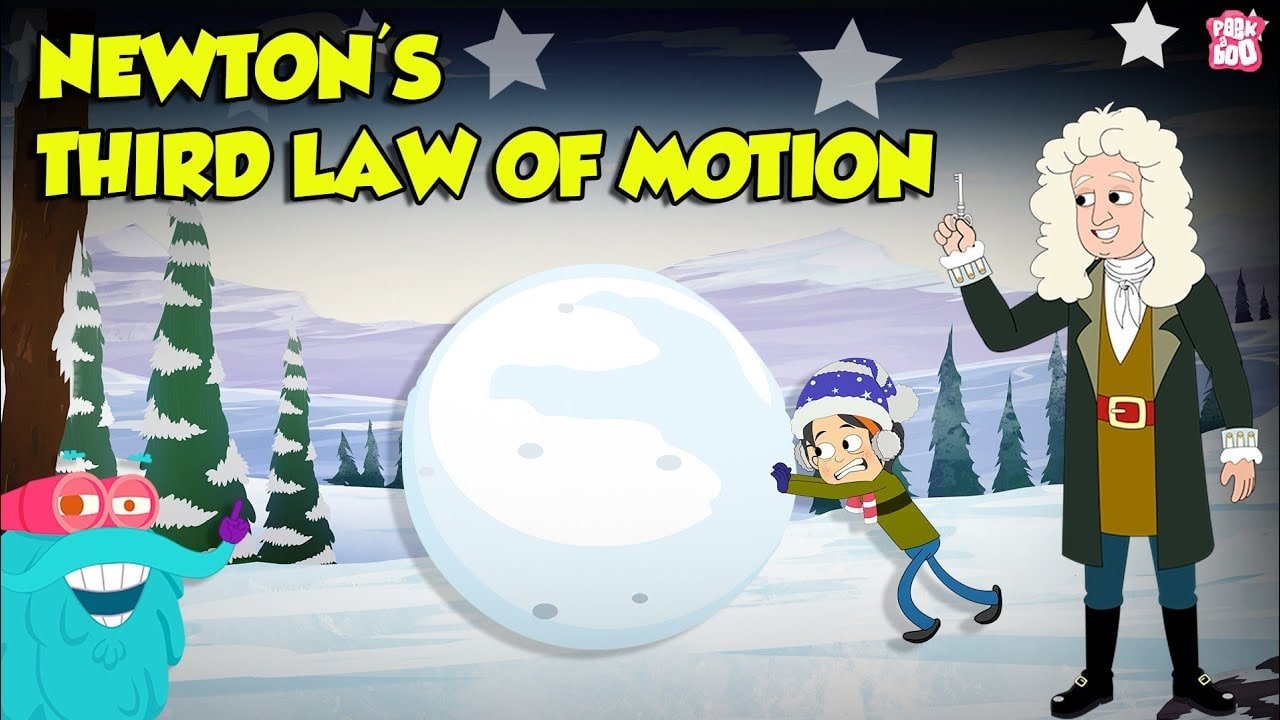
Newton's Third Law States That Two Interacting Objects Exert Equal and Opposite Forces on Each Other
Newton's third law is the law of action and reaction in classical mechanics. It describes every force as an interaction between 2 objects.
For a standard reference, see the relevant OpenStax or College Board explanation.
What Is Newton's Third Law of Motion?
Two interacting objects exert forces on each other that have the same magnitude and point in opposite directions. The law is also called the law of action and reaction or the third law of motion. Action-reaction pairs appear in many systems. Examples include a swimmer and a pool wall, a rocket and its exhaust gas, and a walker pushing backward on the ground.
What Is the Formula for Newton's Third Law?
The formula for Newton's third law is F(A on B) = -F(B on A).
F(A on B)is the force that object A exerts on object B, measured in newtons (N).F(B on A)is the force that object B exerts on object A, measured in newtons (N).- The negative sign marks the opposite direction.
Who Formulated Newton's Third Law, and When?
Isaac Newton formulated the third law. The Principia, published in 1687, lays out the 3 laws of motion. The Principia words the third law as a statement about the mutual actions of 2 bodies, which are equal and directed to contrary parts.
What Are the 3 Key Features of Newton's Third Law?
Newton's third law has 3 key features.
- Equal magnitude: both forces have the same size.
- Opposite direction: the forces point in contrary directions.
- Different objects: each force is exerted on a different object.
What Are 5 Examples of Newton's Third Law in Everyday Life?
Walking, swimming, rocket launches, jet engine operation, and airplane flight are 5 examples of Newton's third law. The table below lists 5 action-reaction pairs. The first column names the situation. The second column names the action force. The third column names the reaction force.
| Situation | Action Force | Reaction Force |
|---|---|---|
| Walking | Foot pushes backward on the ground | Ground pushes forward on the foot |
| Swimming | Swimmer pushes on the pool wall | Pool wall pushes on the swimmer |
| Rocket launch | Rocket pushes exhaust gas backward | Exhaust gas pushes the rocket forward (thrust) |
| Jet engine | Engine pushes hot exhaust gases out the back | Exhaust gases push the engine forward (thrust) |
| Airplane wing | Wing deflects air downward | Air pushes the wing upward (lift) |
How Does Newton's Third Law Explain Rocket and Jet Propulsion?
Rockets and jet engines move forward because they push exhaust gas backward. OpenStax describes the forward force on a rocket from the expelled gas as thrust. NASA Glenn identifies the air leaving a bottle rocket nozzle as the action and the forward motion of the bottle as the reaction. The bottle's momentum equals the momentum of the escaping air in magnitude and opposes it in direction.
How Does Newton's Third Law Explain Lift on an Aircraft Wing?
An aircraft wing generates lift because it deflects air downward and the air pushes the wing upward. NASA Glenn applies the same pattern to a spinning ball, which deflects air to one side and moves in the opposite direction.
Why Do Action and Reaction Forces Not Cancel Each Other?
Action and reaction forces do not cancel because they act on 2 different systems. Only external forces change the motion of a system. When a swimmer pushes off a wall, the force of her feet on the wall acts on the wall and does not cancel the force of the wall on her.
How Does Newton's Third Law Differ From the First and Second Laws?
The first law describes inertia, the second law relates force to change in motion, and the third law describes forces as paired interactions. Britannica summarizes the 3 laws of motion as a body remaining at rest unless a force acts, change of motion being proportional to force, and an equal and opposite reaction for every action. The table below compares the 3 laws. Rows list each law. Columns list the topic and the core statement.
| Law | Topic | Core Statement |
|---|---|---|
| First law | Inertia | A body stays at rest or in uniform straight-line motion unless a force changes that state |
| Second law | Force and acceleration | The change of motion is proportional to the applied force, written F = ma |
| Third law | Interaction pairs | Two interacting objects exert equal and opposite forces on each other |
How Does the Third Law Work With the Second Law (F = ma)?
The third law fixes the size of the 2 forces, and the second law converts each force into an acceleration. The forces are the same, but the accelerations differ when the 2 masses differ.
How Does Newton's Third Law Relate to Conservation of Momentum?
Newton's third law leads to conservation of momentum because internal forces between interacting objects cancel in the total. The proof of momentum conservation rests on this cancellation of internal forces. NASA Glenn applies the principle to a bottle rocket, where the bottle and the escaping air carry equal and opposite momentum.
Does Newton's Third Law Have Limits?
Newton's third law does not hold exactly for moving charged particles, because the electromagnetic field carries momentum. A paper in Applied Sciences reports that the law fails to hold perfectly in all cases. Lecture notes on electrodynamics state that the law holds in electrostatics and magnetostatics.
Richard Feynman described 2 charges moving at right angles whose induced forces do not cancel. The momentum gained by the charges is balanced by momentum lost to the field. Add the field momentum to the total, if the interacting bodies are moving charges.
What Are the 3 Most Common Difficulties With Newton's Third Law?
Research identifies 3 recurring difficulties with the third law.
- Cancellation of action and reaction forces, which OpenStax identifies as a common assumption
- Larger force assigned to the heavier object in collisions
- Lower accuracy on questions about moving or accelerating objects
A Georgia State University analysis found that students overcame misconceptions about stationary systems but scored lower on questions about objects in constant motion or accelerating.
Does a Heavier Object Exert a Larger Force in a Collision?
No. Both objects exert forces of equal magnitude on each other in a collision. A University of Maryland physics education tutorial reports that nearly every student predicts a larger force from the truck. In its cart experiment, one cart has about twice the mass of the other, and the force graphs match. The lighter object accelerates more because acceleration equals force divided by mass.
What Do Large Studies Show About Newton's Third Law Understanding?
Large studies show that third law misconceptions persist after instruction. A study across 5 U.S. institutions found that third law misconceptions ranked among the 3 most frequently applied misconceptions, and many students still applied them after instruction at all but the highest-performing institution.
- A 2021 analysis in Physical Review Physics Education Research examined 3 samples of calculus-based physics students (N = 9,606, 4,360, and 1,439) and found a response dimension linked most strongly to third law misconceptions.
- A study of 97 Jordanian physics student-teachers reported that 20% answered the third law questions correctly.
- A graduate engineering study of 34 students described the third law as the most elusive of the 3 laws.
- A study of 255 Philippine Military Academy cadets recorded a significant improvement in third law understanding after instruction.
How Do You Apply Newton's Third Law to Solve a Problem?
Apply Newton's third law in 5 steps.
- Identify the 2 interacting objects.
- Write the force that object A exerts on object B.
- Write the force that object B exerts on object A, with equal magnitude and opposite direction.
- Draw a separate free-body diagram for each object, since free-body diagrams vary with the chosen system.
- Apply Newton's second law to each object, using only the external forces on that object.
What Is a Worked Example of Newton's Third Law?
Two skaters who push apart with 120 N each accelerate at 2 m/s² (60 kg skater) and 3 m/s² (40 kg skater).
- Force on each skater: 120 N, equal in magnitude and opposite in direction.
- Acceleration of the 60 kg skater: 120 N ÷ 60 kg = 2 m/s².
- Acceleration of the 40 kg skater: 120 N ÷ 40 kg = 3 m/s².
What Do People Also Ask About Newton's Third Law?
Why Is Newton's Third Law Important?
Newton's third law is important because it identifies forces as paired interactions, which explains propulsion in rockets, jet engines, and swimming.
What Is Newton's Third Law in Simple Words?
Newton's third law means that an object pushing on another object receives a push of equal size in the opposite direction.
What Is the Unit of Force in Newton's Third Law?
Force in Newton's third law is measured in newtons (N).
Does Newton's Third Law Apply to Gravity?
Yes, because Earth pulls an object downward and the object pulls Earth upward with a force of equal magnitude.
Is Newton's Third Law Always True?
Newton's third law holds for contact forces and static fields, but moving charges require field momentum for an exact balance.
When Did Newton Publish the Third Law?
Newton published the third law in the Principia in 1687.
What Are the Main Takeaways About Newton's Third Law?
Newton's third law states that interacting objects exert equal and opposite forces on each other. There are 5 key facts.
- Forces occur in pairs, and each force acts on a different object.
- The 2 forces have equal magnitude and opposite direction.
- Equal forces produce different accelerations when the masses differ.
- Rockets, jet engines, and swimmers move through action-reaction pairs.
- Moving charges require field momentum for exact momentum conservation.

The University of the West Indies
My passion as a teacher and leader in education is to contribute to students’ enhanced learning by creation of a positive teaching/learning environment, where they are motivated to develop strong critical thinking, analytical and problem-solving skills.
As acting Vice-Principal and head of Physics, I have amassed five years of experience in leading meetings, implementing strategies to maintain discipline and school ethos, liaise with stakeholders in planning for future development of the institution; successfully negotiated the implementation of various projects for student development as well as supervising effective execution of such. For the past 19 years, I have incorporated discovery learning within the classroom through practical activities, problem solving and cooperative learning and have realized that students retention in Physics and Mathematics have increased significantly.
I am always cognizant that students have different learning styles, and as such teaching strategies during planning and delivery must take this crucial factor into consideration and be tailored to meet such differences.