

Geometry Formulas: 50 Formulas for Area, Perimeter, Volume, and Surface Area
Geometry formulas are 50 equations that calculate area, perimeter, volume, and surface area for 12 2D shapes and 8 3D shapes. Examples include squares, rectangles, triangles, circles, cubes, spheres, and cylinders. Each formula uses sides, radii, heights, and pi (pi = 3.14159).
What Is a Geometry Formula, and What Is an Example?
A geometry formula is an equation that gives 1 measurement of a shape from other measurements of the same shape. Variables are letters. Examples include s for side, r for radius, h for height, and b for base.
Length measures distance in linear units. Examples include inches, feet, and centimeters. Area measures surface cover in square units. Examples include in squared, ft squared, and cm squared. Volume measures space inside a solid in cubic units. Examples include in cubed, ft cubed, and cm cubed.
Pi is the ratio of a circle circumference to its diameter, equal to 3.14159. Pi appears in 6 core formulas. Examples include circle area, circumference, sphere volume, and cylinder volume. According to the Common Core State Standards for Mathematics, students in grades 6 to 8 apply area, surface area, and volume formulas to real-world problems.
Geometry Formulas: 12 Formulas for 2D Area and Perimeter
Geometry formulas for 12 flat shapes are in Table 1. Perimeter is total distance around a shape. Circumference is perimeter of a circle.
Table 1: Area and perimeter formulas for 2D shapes, with variables defined.
| Shape | Area formula | Perimeter formula | Variables |
|---|---|---|---|
| Square | A = s squared | P = 4s | s = side |
| Rectangle | A = l x w | P = 2(l + w) | l = length, w = width |
| Triangle | A = 1/2 x b x h | P = a + b + c | b = base, h = height |
| Parallelogram | A = b x h | P = 2(a + b) | |
| Trapezoid | A = 1/2 x (a + b) x h | P = a + b + c + d | |
| Circle | A = pi r squared | C = 2 pi r | r = radius |
| Semicircle | A = 1/2 pi r squared | P = pi r + 2r | |
| Rhombus | A = 1/2 x d1 x d2 | P = 4s | |
| Kite | A = 1/2 x d1 x d2 | P = 2(a + b) | |
| Regular polygon | A = 1/2 x P x a | P = n x s | |
| Ellipse | A = pi x a x b | ||
| Sector | A = (theta/360) x pi r squared |
What Is the Area and Perimeter of a Rectangle?
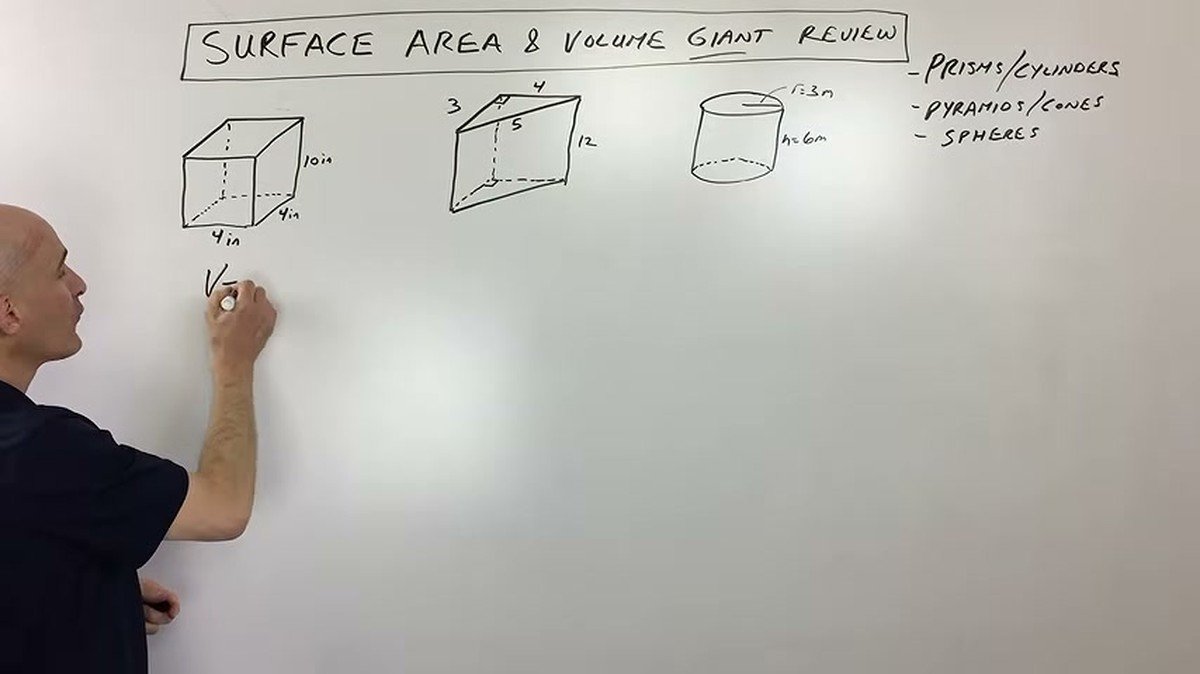
Rectangle area is length multiplied by width. Rectangle perimeter is 2 multiplied by length plus width. Example 1. A rectangle has length 8 in and width 5 in. Area is 8 x 5. Perimeter is 2 x (8 + 5). The area is 40 in squared. The perimeter is 26 in.
What Is the Area and Circumference of a Circle?
Circle area is pi multiplied by radius squared. Circumference is 2 multiplied by pi and radius. Diameter equals 2 radii. Example 2. A circle has radius 7 cm. Pi equals 3.14159. Area is pi x 7 squared. Circumference is 2 x pi x 7. The area is 153.94 cm squared. The circumference is 43.98 cm.
Geometry Formulas: 3 Triangle Formulas and 1 Pythagorean Theorem
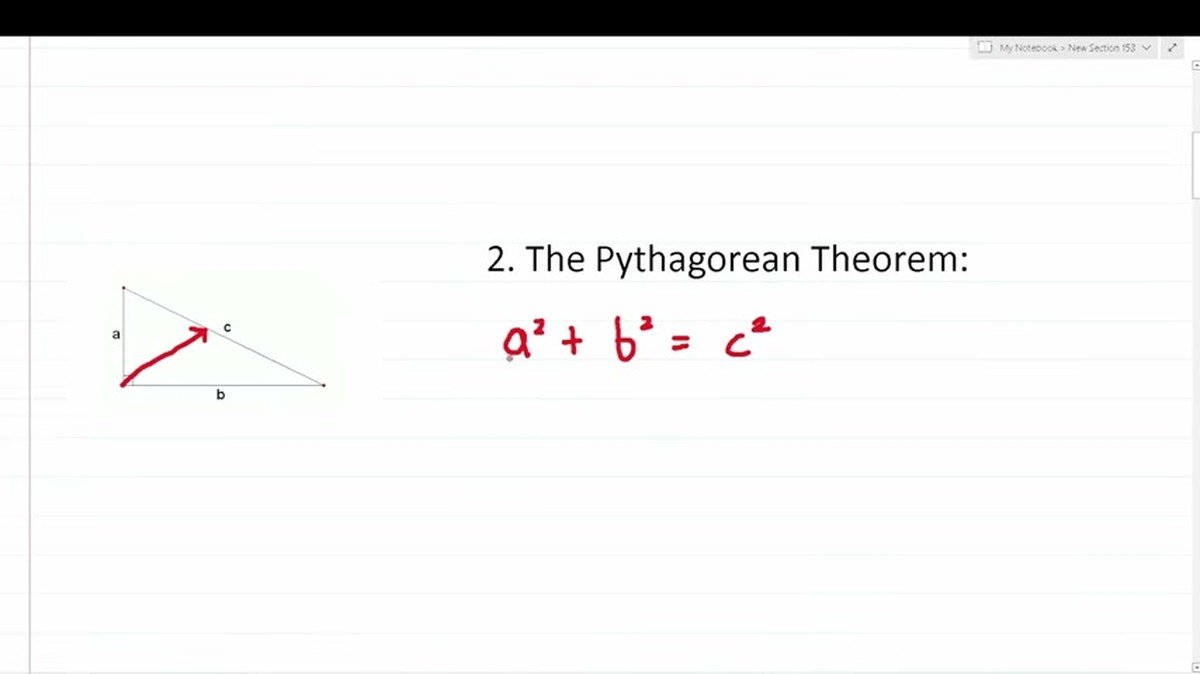
Geometry formulas for triangles are 3 area forms and 1 Pythagorean theorem. The theorem states a squared + b squared = c squared in a right triangle. The letter c is the hypotenuse. The letters a and b are the 2 legs.
The 3 area forms are:
- Base-height form: A = 1/2 b h, from 1 base and 1 height.
- Heron form: A = sqrt(s(s-a)(s-b)(s-c)), and s = (a+b+c) / 2, from 3 sides.
- Trigonometric form: A = 1/2 a b sin C, from 2 sides and 1 included angle.
Example 3. A right triangle has legs 3 ft and 4 ft. Hypotenuse is sqrt(3 squared + 4 squared). Hypotenuse is sqrt(25). The hypotenuse is 5 ft. The 3 interior angles of every triangle sum to 180 degrees.
Geometry Formulas: 8 Formulas for 3D Volume and Surface Area
Geometry formulas for 8 solid shapes are in Table 2. Volume measures space inside a solid. Surface area measures total area of all faces.
Table 2: Volume and surface area formulas for 3D shapes.
| Shape | Volume formula | Surface area formula |
|---|---|---|
| Cube | V = s cubed | SA = 6s squared |
| Rectangular prism | V = l x w x h | SA = 2(lw + lh + wh) |
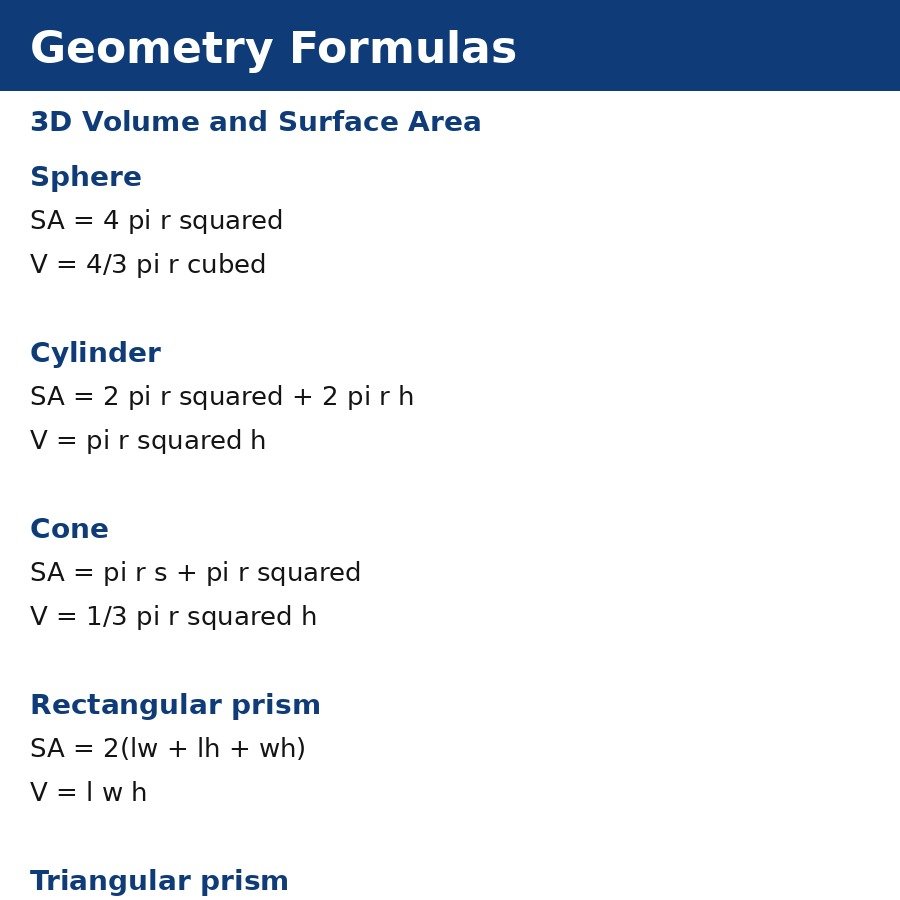
| Sphere | V = 4/3 pi r cubed | SA = 4 pi r squared |
| Cylinder | V = pi r squared h | SA = 2 pi r (r + h) |
| Cone | V = 1/3 pi r squared h | SA = pi r (r + l) |
| Square pyramid | V = 1/3 x b squared x h | SA = b squared + 2 b l |
| Triangular prism | V = 1/2 x b x h x L | SA = b h + L(a + b + c) |
| Hemisphere | V = 2/3 pi r cubed | SA = 3 pi r squared |
What Is the Volume and Surface Area of a Cylinder?
Cylinder volume is pi multiplied by radius squared and height. Example 4. A cylinder has radius 3 in and height 10 in. Volume is pi x 3 squared x 10. Surface area is 2 x pi x 3 x (3 + 10). The volume is 282.74 in cubed. The surface area is 245.04 in squared. Convert all lengths to 1 unit system before calculation. Mixed units produce incorrect values.
Geometry Formulas: 5 Formulas for Coordinates, Angles, and Trigonometry
Geometry formulas for coordinates are 5 formulas for distance, midpoint, slope, lines, and circles from (x, y) points. Distance: d = sqrt((x2-x1) squared + (y2-y1) squared). Midpoint: M = ((x1+x2)/2, (y1+y2)/2). Slope: m = (y2-y1) / (x2-x1). Line: y = m x + b, with m = slope and b = y-intercept. Circle: (x-h) squared + (y-k) squared = r squared, with center (h, k) and radius r.
Geometry formulas for angles are 3 facts. Complementary angles sum to 90 degrees. Supplementary angles sum to 180 degrees. Interior angles of an n-sided polygon sum to (n – 2) x 180 degrees.
Sine is sin theta = opposite / hypotenuse. Cosine is cos theta = adjacent / hypotenuse. Tangent is tan theta = opposite / adjacent. Law of sines is a / sin A = b / sin B = c / sin C. Law of cosines is c squared = a squared + b squared – 2 a b cos C.
Geometry Formulas: 5 Steps to Use 1 Formula Correctly
Geometry formulas give a correct result in 5 steps.
- Identify the shape and the required measurement.
- Write the formula for that shape and measurement.
- Substitute the given values for the variables.
- Calculate the result with correct order of operations.
- Label the result with linear, square, or cubic units.
3 common errors are diameter in place of radius, slant height in place of vertical height, and mixed units in 1 calculation. Perimeter measures boundary length in linear units. Area measures surface cover in square units. Volume measures interior space in cubic units.
What Do People Also Ask About Geometry Formulas?
What is the formula for the area of a triangle?
The area of a triangle is 1/2 multiplied by base and height.
What is the formula for the circumference of a circle?
The circumference of a circle is 2 multiplied by pi and radius.
What is the Pythagorean theorem formula?
The Pythagorean theorem formula is a squared + b squared = c squared for a right triangle.
What is the formula for the volume of a cylinder?
The volume of a cylinder is pi multiplied by radius squared and height.
Geometry Formulas: 50 Formulas in 3 Groups for Grades 6 to 12
Geometry formulas are 50 formulas in 3 groups. Group 1 is 2D area and perimeter. Group 2 is 3D volume and surface area. Group 3 is coordinates, angles, and triangles. Tables 1 and 2 give the complete reference for grades 6 to 12.
Sources: National Council of Teachers of Mathematics (NCTM), Principles and Standards for School Mathematics; Common Core State Standards for Mathematics, Geometry domain, grades 6 to 12; Khan Academy, Geometry course: area, perimeter, volume, and surface area units.

The University of the West Indies
My passion as a teacher and leader in education is to contribute to students’ enhanced learning by creation of a positive teaching/learning environment, where they are motivated to develop strong critical thinking, analytical and problem-solving skills.
As acting Vice-Principal and head of Physics, I have amassed five years of experience in leading meetings, implementing strategies to maintain discipline and school ethos, liaise with stakeholders in planning for future development of the institution; successfully negotiated the implementation of various projects for student development as well as supervising effective execution of such. For the past 19 years, I have incorporated discovery learning within the classroom through practical activities, problem solving and cooperative learning and have realized that students retention in Physics and Mathematics have increased significantly.
I am always cognizant that students have different learning styles, and as such teaching strategies during planning and delivery must take this crucial factor into consideration and be tailored to meet such differences.