

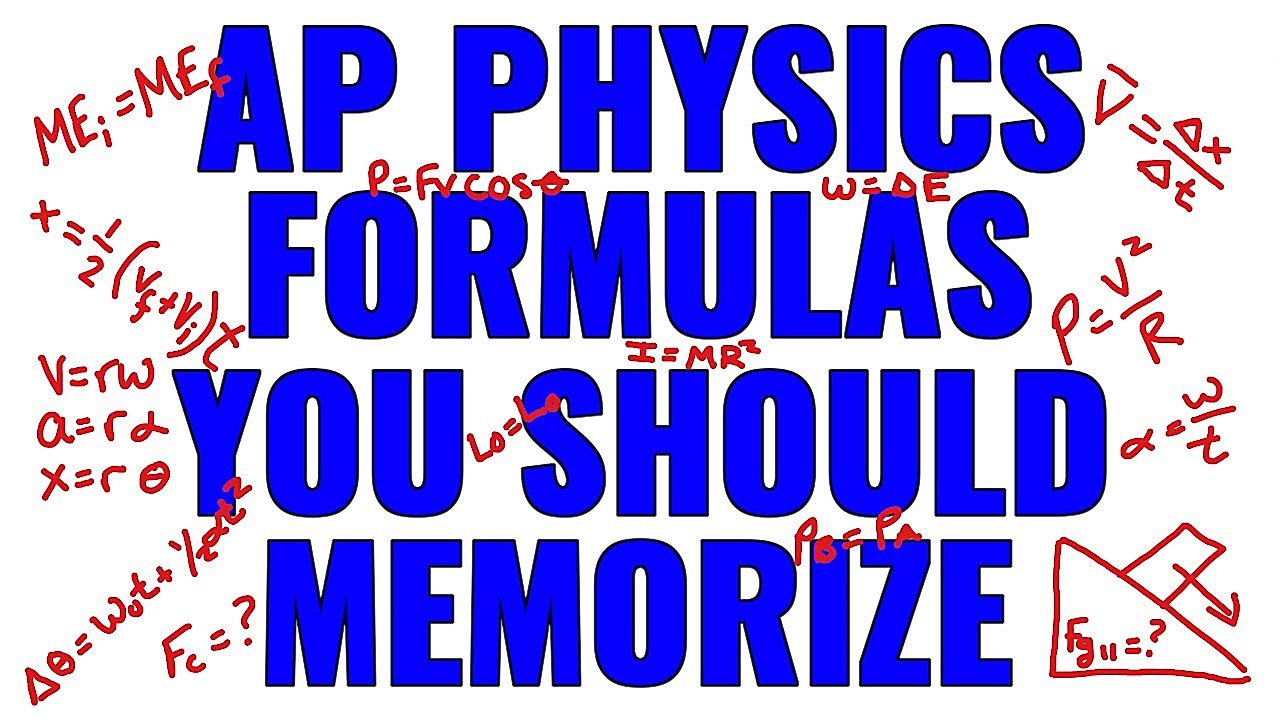
AP Physics Exam Formula Sheet: 4 Official Reference Sheets, Physics 1 Contents, 2027 Exam Formats, Calculator Rules, and 8 Study Steps
What Is the AP Physics Exam Formula Sheet?
The AP Physics exam formula sheet is the College Board reference document of constants, units, and equations that students use during an AP Physics exam. Synonyms include equation sheet, table of information, and exam reference information. Examples include the AP Physics 1 Exam Reference Information booklet and the AP Physics C: Mechanics reference sheet.
For a reliable reference, consult OpenStax University Physics Volume 1.
What Does the College Board Call the AP Physics Formula Sheet?
The Physics 1 booklet carries the cover title Exam Reference Information, and its first reference page is a Table of Information. Students and teachers also say formula sheet, equation sheet, and reference sheet.
Is the Formula Sheet Provided on the AP Physics Exam?
Yes, the College Board provides reference information for each AP Physics exam. Printed reference materials are mailed to schools, and the same materials are available in Bluebook during test preview and on exam day.
Can Students Bring Their Own AP Physics Formula Sheet?
No, only reference information provided by the College Board is allowed during AP Exam administration. Students may write on the printed booklets, and proctors collect every booklet after the exam. The AP coordinator keeps the booklets in secure storage for 30 days.
How Many AP Physics Formula Sheets Exist?
Each of the 4 AP Physics exams has its own reference information. The table below lists the 4 exams. Rows represent exams. Columns show the math level, the course focus, and the 2027 exam date.
| Exam | Math Level | Course Focus | 2027 Exam Date |
|---|---|---|---|
| AP Physics 1: Algebra-Based | Algebra | Mechanics and fluids | Wednesday, May 5 |
| AP Physics 2: Algebra-Based | Algebra | Thermodynamics, electricity, magnetism, optics, and modern physics | Thursday, May 6 |
| AP Physics C: Mechanics | Calculus | Calculus-based mechanics | Monday, May 3 |
| AP Physics C: Electricity and Magnetism | Calculus | Calculus-based electricity and magnetism | Wednesday, May 5 |
The College Board exam calendar places these exams in the May 3 to 7 week of the 2027 schedule. AP Physics 1 is a Session 2 exam. For most schools, including all schools in the lower 48 United States, exams begin at 8 a.m. and 12 p.m. local time. Start times changed in some locations in 2027. Students outside the lower 48 states confirm the start time with the AP coordinator.
What Is on the AP Physics 1 Formula Sheet?
The 2025 AP Physics 1 formula sheet has 7 sections: constants, prefixes, unit symbols, trigonometric values, conventions, geometry and trigonometry, and mechanics and fluids equations. The College Board marks the current sheet with a 2025 copyright date.
Which Constants Are on the AP Physics 1 Formula Sheet?
The sheet lists 4 constants: the universal gravitational constant, the acceleration due to gravity, the gravitational field strength at Earth's surface, and the pressure of 1 atmosphere. The table below shows each value. Rows represent constants. Columns show the symbol, the value, and the unit.
| Constant | Symbol | Value | Unit |
|---|---|---|---|
| Universal gravitational constant | G | 6.67 × 10⁻¹¹ | m³/(kg·s²), equal to N·m²/kg² |
| Acceleration due to gravity at Earth's surface | g | 9.8 | m/s² |
| Gravitational field strength at Earth's surface | g | 9.8 | N/kg |
| 1 atmosphere of pressure | atm | 1.0 × 10⁵ | N/m², equal to Pa |
Which Prefixes and Unit Symbols Are on the Sheet?
The sheet lists 9 prefixes from tera to pico. The table below shows each prefix. Rows represent prefixes. Columns show the factor and the symbol.
| Prefix | Symbol | Factor |
|---|---|---|
| tera | T | 10¹² |
| giga | G | 10⁹ |
| mega | M | 10⁶ |
| kilo | k | 10³ |
| centi | c | 10⁻² |
| milli | m | 10⁻³ |
| micro | μ | 10⁻⁶ |
| nano | n | 10⁻⁹ |
| pico | p | 10⁻¹² |
The sheet lists 8 unit symbols:
- hertz (Hz)
- joule (J)
- kilogram (kg)
- meter (m)
- newton (N)
- pascal (Pa)
- second (s)
- watt (W)
Which Trigonometric Values Are on the Sheet?
The sheet lists sine, cosine, and tangent for 7 common angles. The table below shows the values. Rows represent angles. Columns show sine, cosine, and tangent.
| Angle | sin θ | cos θ | tan θ |
|---|---|---|---|
| 0° | 0 | 1 | 0 |
| 30° | 1/2 | √3/2 | √3/3 |
| 37° | 3/5 | 4/5 | 3/4 |
| 45° | √2/2 | √2/2 | 1 |
| 53° | 4/5 | 3/5 | 4/3 |
| 60° | √3/2 | 1/2 | √3 |
| 90° | 1 | 0 | undefined |
Which Conventions Apply to AP Physics 1 Problems?
The sheet states 4 conventions for exam problems:
- The frame of reference is inertial unless a problem states otherwise.
- Air resistance is negligible unless a problem states otherwise.
- Springs and strings are ideal unless a problem states otherwise.
- Fluids are ideal, and pipes are completely filled by fluid, unless a problem states otherwise.
What Equations Are on the AP Physics 1 Formula Sheet?
The sheet groups its equations under the heading Mechanics and Fluids and defines every symbol in a key. The table below lists the standard relationships by topic. Rows represent equations. Columns show the topic, the equation, and the meaning. Check the official PDF for exact notation.
| Topic | Equation | Meaning |
|---|---|---|
| Kinematics | v_x = v_x0 + a_x t | Velocity under constant acceleration |
| Kinematics | x = x₀ + v_x0 t + ½a_x t² | Position under constant acceleration |
| Kinematics | v_x² = v_x0² + 2a_x(x − x₀) | Velocity from change in position |
| Dynamics | a = ΣF/m | Acceleration from net force |
| Dynamics | |F_f| ≤ μ|F_n| | Maximum friction force |
| Dynamics | a_c = v²/r | Centripetal acceleration |
| Dynamics | |F_s| = k|x| | Spring force |
| Gravitation | |F_g| = Gm₁m₂/r² | Gravitational force between 2 masses |
| Gravitation | g = Gm/r² | Gravitational field strength |
| Momentum | p = mv | Linear momentum |
| Momentum | J = FΔt = Δp | Impulse |
| Energy | K = ½mv² | Kinetic energy |
| Energy | ΔE = W = Fd cos θ | Work and energy change |
| Energy | P = ΔE/Δt | Power |
| Energy | ΔU_g = mgΔy | Change in gravitational potential energy |
| Energy | U_s = ½kx² | Spring potential energy |
| Rotation | ω = ω₀ + αt | Angular speed under constant angular acceleration |
| Rotation | θ = θ₀ + ω₀t + ½αt² | Angular position under constant angular acceleration |
| Rotation | τ = rF sin θ | Torque |
| Rotation | α = τ_net/I | Angular acceleration from net torque |
| Rotation | L = Iω | Angular momentum |
| Rotation | ΔL = τΔt | Angular impulse |
| Rotation | K = ½Iω² | Rotational kinetic energy |
| Oscillations | T = 1/f | Period and frequency |
| Oscillations | T_s = 2π√(m/k) | Period of a mass on a spring |
| Oscillations | T_p = 2π√(ℓ/g) | Period of a simple pendulum |
| Oscillations | x = A cos(2πft) | Position in simple harmonic motion |
| Fluids | ρ = m/V | Density |
| Fluids | P = F/A | Pressure |
| Fluids | P = P₀ + ρgh | Pressure at depth h |
| Fluids | F_b = ρVg | Buoyant force |
| Fluids | A₁v₁ = A₂v₂ | Continuity equation |
| Fluids | P + ρgy + ½ρv² = constant | Bernoulli's equation |
What Changed on the AP Physics 1 Formula Sheet in 2025?
The 2025 sheet combines equations into 1 section titled Mechanics and Fluids and lists 4 constants, compared with 8 constants on the 2020 sheet. The College Board revised all 4 AP Physics courses and exams for the 2024-25 school year. The 2020 sheet included equations for mechanics, electricity, waves, geometry, and trigonometry. The table below compares the 2 versions. Rows represent features. Columns show the 2020 sheet and the 2025 sheet.
| Feature | 2020 Sheet | 2025 Sheet |
|---|---|---|
| Equation sections | Mechanics, electricity, waves | Mechanics and fluids |
| Number of constants | 8 | 4 |
| Electric constants (Coulomb constant, electron charge) | Listed | Not listed |
| Particle masses and speed of light | Listed | Not listed |
| Pressure of 1 atmosphere | Not listed | Listed |
| Number of unit symbols | 13 | 8 |
| Number of prefixes | 9 | 9 |
| Trigonometric angles | 7 | 7 |
Older PDFs list electricity equations that the current Physics 1 sheet excludes.
What Is the AP Physics Exam Format for 2027?
AP Physics 1 has 42 multiple-choice questions in 85 minutes and 4 free-response questions in 95 minutes starting with the May 2027 exam. The College Board changed the question count from 40 to 42, the multiple-choice time from 80 to 85 minutes, and the free-response time from 100 to 95 minutes. AP Physics 2 has the same updated format. The College Board lists a 2027 update to question count and timing for AP Physics C: Mechanics. The table below compares the 2026 and 2027 formats for AP Physics 1 and AP Physics 2. Rows represent sections. Columns show the 2026 and 2027 values.
| Section | 2026 Format | 2027 Format | Score Weight |
|---|---|---|---|
| Section I: Multiple Choice | 40 questions, 80 minutes | 42 questions, 85 minutes | 50% |
| Section II: Free Response | 4 questions, 100 minutes | 4 questions, 95 minutes | 50% |
Section II contains 1 question of each of 4 types:
- Mathematical routines
- Translation between representations
- Experimental design and analysis
- Qualitative/quantitative translation
What Is a Hybrid Digital AP Physics Exam?
A hybrid digital exam delivers multiple-choice questions in Bluebook and collects handwritten free-response answers in paper booklets. Students view the free-response questions in Bluebook. The College Board scores the returned booklets.
Which Calculators Are Allowed on AP Physics Exams?
Calculators are permitted on the AP Physics 1 and AP Physics C: Mechanics exams. The AP Physics 2 exam also permits calculators. Approved models include four-function, scientific, and graphing calculators. The College Board calculator policy page lists approved calculators.
What Is Not on the AP Physics Formula Sheet?
The sheet omits derived equations, special cases, and the conditions for using each equation. The College Board states that the Physics 1 and Physics 2 tables do not include every equation, equations derived by combining others, or special cases. For Physics C, students are responsible for the principles behind each equation and the conditions where each applies.
The 2025 Physics 1 sheet also omits the speed of light, the electron charge, and the Coulomb constant. Problems that need such values supply them in the question.
How Do Students Use the AP Physics Formula Sheet in 8 Steps?
Match the known variables to an equation, rearrange for the unknown, and check the unit, in 8 steps:
- Download the current official sheet for the exam.
- Print the sheet and keep it beside every practice problem.
- List the known variables and the unknown with units.
- Select the equation whose symbols match the list.
- Check the conditions of the equation, such as constant acceleration for kinematics.
- Rearrange the equation and substitute the values.
- Verify the unit and the sign of the answer.
- Compare the work with released scoring guidelines for similar problems.
Dunlosky and colleagues reviewed 10 study techniques in a 2013 paper in Psychological Science in the Public Interest. Practice testing and distributed practice received the highest utility ratings. Solve problems without the sheet first, then check each equation against the sheet.
Where Can Students Practice With the Formula Sheet?
The College Board offers 4 practice resources for AP Physics 1:
- Bluebook test previews for digital AP exams
- Released free-response questions with scoring information
- A sample free-response booklet for the hybrid digital format
- The course and exam description PDF
Where Can Students Download the Official AP Physics Formula Sheets?
The official sheets are on the AP Central page titled Reference Information for Specific AP Exams. The posted reference information matches the information in the course and exam description for each subject. The AP Physics 1 PDF is at apcentral.collegeboard.org/media/pdf/ap-physics-1-equations-sheet.pdf.
What Happens to the Formula Sheet on Exam Day?
The reference booklet follows 5 steps on exam day:
- The school receives printed booklets with the spring exam shipment.
- Proctors give each student the booklet for the matching exam.
- Students use the printed booklet or the same information in Bluebook.
- Students write on the booklet if they choose.
- Proctors collect the booklets and return them to the AP coordinator.
Proctors check that each student receives the correct booklet, because each AP Physics exam has different reference information.
What Are Common Mistakes When Using the AP Physics Formula Sheet?
Six mistakes cause most errors:
- Using a pre-2025 Physics 1 sheet
- Applying constant-acceleration equations to changing acceleration
- Substituting g = 10 m/s² when the sheet gives 9.8 m/s²
- Using the wrong angle in W = Fd cos θ
- Skipping prefix conversions, such as centimeters to meters
- Reading a symbol with the wrong meaning
Six symbols carry 2 or more meanings on the Physics 1 sheet. The table below lists them. Rows represent symbols. Columns show each meaning and where it appears.
| Symbol | Meaning 1 | Meaning 2 | Meaning 3 |
|---|---|---|---|
| P | Power (mechanics key) | Pressure (fluids key) | None |
| A | Amplitude | Area | None |
| θ | Angle | Angular position | None |
| μ | Coefficient of friction | Micro prefix (10⁻⁶) | None |
| k | Spring constant | Kilo prefix (10³) | None |
| m | Mass | Meter (unit) | Milli prefix (10⁻³) |
What Does the AP Physics Exam Formula Sheet Include in Summary?
The AP Physics exam formula sheet is the College Board reference document for each of 4 AP Physics exams. The 2025 Physics 1 sheet has 7 sections, 4 constants, 9 prefixes, 8 unit symbols, and a combined Mechanics and Fluids equation section. The 2027 Physics 1 and Physics 2 exams have 42 multiple-choice questions in 85 minutes and 4 free-response questions in 95 minutes. Calculators are permitted. Students use only College Board reference information.
People Also Ask About the AP Physics Exam Formula Sheet
Is there a formula sheet on the AP Physics exam?
Yes, each of the 4 AP Physics exams has its own printed reference information.
Can I bring my own formula sheet to the AP Physics exam?
No, only reference information provided by the College Board is allowed.
Can I write on the AP Physics formula sheet?
Yes, students may write on the printed reference booklets.
Where can I download the AP Physics 1 formula sheet?
The AP Physics 1 formula sheet is on the College Board AP Central page titled Reference Information for Specific AP Exams.
What is on the AP Physics 1 formula sheet?
The sheet lists constants, prefixes, unit symbols, trigonometric values, geometry formulas, and mechanics and fluids equations.
Does the AP Physics 1 formula sheet include fluids?
Yes, the 2025 sheet has a section titled Mechanics and Fluids.
Does the AP Physics 1 formula sheet include electricity equations?
No, the 2025 sheet has no electricity section and does not list the Coulomb constant.
Are calculators allowed on the AP Physics exam?
Yes, calculators are permitted on the AP Physics 1 exam.
When is the AP Physics 1 exam in 2027?
The AP Physics 1 exam is on Wednesday, May 5, 2027, in Session 2.
How many questions are on the AP Physics 1 exam in 2027?
The exam has 42 multiple-choice questions and 4 free-response questions.
Is the formula sheet the same for all AP Physics exams?
No, each AP Physics exam has its own reference information.

The University of the West Indies
My passion as a teacher and leader in education is to contribute to students’ enhanced learning by creation of a positive teaching/learning environment, where they are motivated to develop strong critical thinking, analytical and problem-solving skills.
As acting Vice-Principal and head of Physics, I have amassed five years of experience in leading meetings, implementing strategies to maintain discipline and school ethos, liaise with stakeholders in planning for future development of the institution; successfully negotiated the implementation of various projects for student development as well as supervising effective execution of such. For the past 19 years, I have incorporated discovery learning within the classroom through practical activities, problem solving and cooperative learning and have realized that students retention in Physics and Mathematics have increased significantly.
I am always cognizant that students have different learning styles, and as such teaching strategies during planning and delivery must take this crucial factor into consideration and be tailored to meet such differences.