

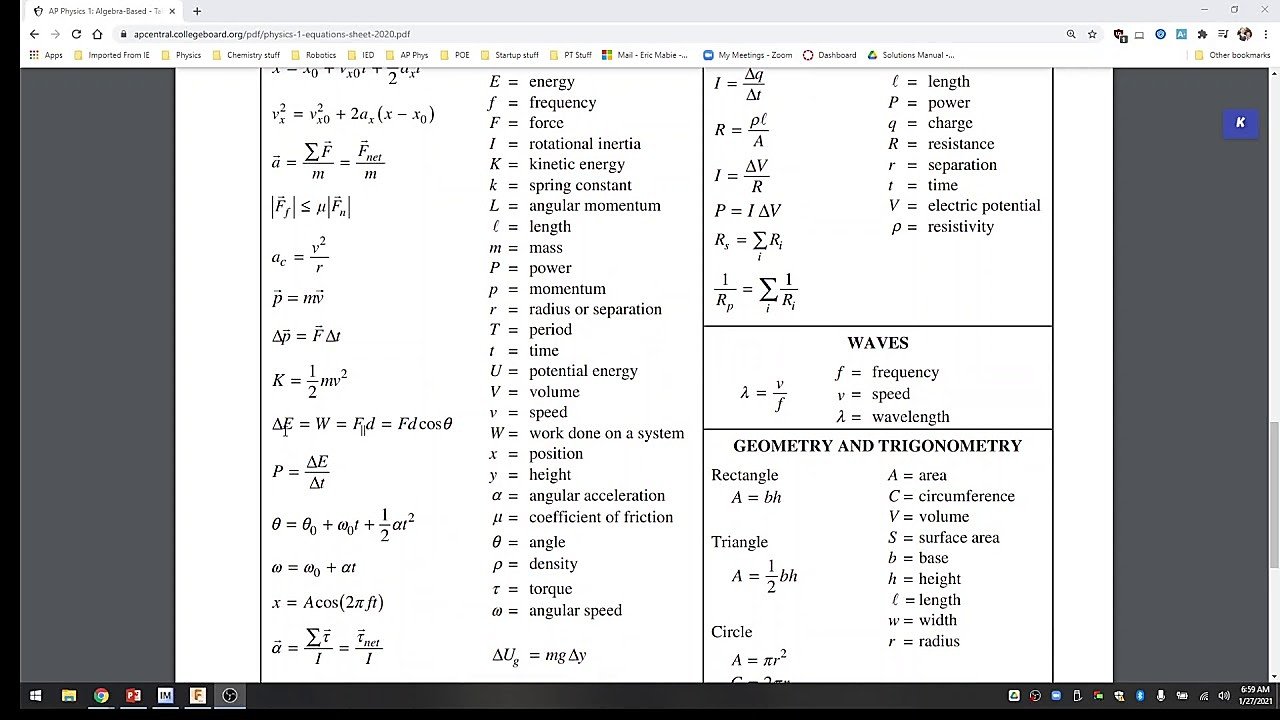
AP Physics Formula Sheet: 4 Sheets, Constants, and Equations
The AP Physics formula sheet is official reference information that College Board provides on all 4 AP Physics exams. Each exam has its own sheet with constants, units, prefixes, trigonometric values, and equations. This guide covers the contents of each sheet, the 2027 exam changes, access rules, worked examples, and research on formula sheets.
Do AP Physics Exams Provide a Formula Sheet?
Yes. College Board provides reference information on AP Physics 1, AP Physics 2, AP Physics C: Mechanics, and AP Physics C: Electricity and Magnetism. The reference information is printed for students and is also available in Bluebook in the test preview and on exam day.
College Board sets 5 rules for the sheets:
- Each of the 4 AP Physics exams has its own reference information
- Only reference information from College Board can be used during the exam
- Students may write on the printed booklet
- Students may not take the booklet from the exam room during the break or after the exam
- Proctors collect all booklets at the end of the exam
What Is on the AP Physics Formula Sheet?
Each AP Physics sheet has 2 parts: a Table of Information and equation sections with symbol keys. The Table of Information lists constants, unit symbols, prefixes, trigonometric values, and exam conventions. The symbol keys define the variables used in the equations.
The table below compares the equation sections on 3 sheets.
| Course | Math level | Equation sections on the sheet |
|---|---|---|
| AP Physics 1 | Algebra-based | Mechanics and Fluids; Geometry and Trigonometry |
| AP Physics 2 | Algebra-based | Mechanics and Fluids; Electricity; Magnetism; Thermal Physics; Waves, Sound, and Optics; Modern Physics; Geometry and Trigonometry |
| AP Physics C: Electricity and Magnetism | Calculus-based | Electricity and Magnetism; Mechanics; Vectors, Calculus, and Identities; Geometry and Trigonometry |
The AP Physics C: Mechanics exam has its own reference information, which is available on AP Central.
Which Equations Are on the AP Physics 1 Formula Sheet?
The AP Physics 1 sheet lists equations for kinematics, forces, momentum, energy, rotation, oscillations, gravitation, and fluids. The current sheet has 2 equation sections: Mechanics and Fluids, and Geometry and Trigonometry. Electricity and waves equations from the 2020 version are no longer on the sheet.
The table below lists the equation groups with their key equations. The kinematic, force, momentum, energy, rotation, oscillation, and gravitation equations match the 2020 College Board sheet. The fluid equations use the quantities defined in the current symbol key.
| Topic | Key equations | Calculates |
|---|---|---|
| Kinematics | vx = vx0 + ax·t; x = x0 + vx0·t + ½ax·t²; vx² = vx0² + 2ax(x − x0) | Velocity and position under constant acceleration |
| Forces | a = ΣF / m; |Ff| ≤ μ|Fn| | Acceleration and maximum friction |
| Circular motion | ac = v² / r | Centripetal acceleration |
| Momentum and impulse | p = mv; Δp = FΔt | Momentum and change in momentum |
| Energy and power | K = ½mv²; ΔE = W = Fd cosθ; P = ΔE / Δt; ΔUg = mgΔy | Kinetic energy, work, power, and gravitational potential energy |
| Rotation | ω = ω0 + αt; θ = θ0 + ω0·t + ½αt²; τ = rF sinθ; α = Στ / I; L = Iω; ΔL = τΔt; K = ½Iω² | Angular motion, torque, and angular momentum |
| Springs and oscillations | |Fs| = k|x|; Us = ½kx²; Ts = 2π√(m / k); Tp = 2π√(ℓ / g); T = 1 / f | Spring force, spring energy, and periods |
| Gravitation | Fg = Gm1m2 / r²; g = Gm / r²; UG = −Gm1m2 / r | Gravitational force, field strength, and potential energy |
| Fluids | ρ = m / V; P = F / A; P = P0 + ρgh; Fb = ρVg; A1v1 = A2v2; P + ρgy + ½ρv² = constant | Density, pressure, buoyancy, and flow |
What Is on the AP Physics 2 Formula Sheet?
The AP Physics 2 sheet has 7 sections and the longest Table of Information of the 3 sheets. The Table of Information lists 18 constants and 18 unit symbols.
The table below lists the quantities defined in the symbol key of each section.
| Section | Quantities defined in the symbol key |
|---|---|
| Mechanics and Fluids | Acceleration, impulse, momentum, power, rotational inertia, torque, angular momentum, density, pressure |
| Electricity | Capacitance, electric field, current, resistance, resistivity, electric potential, dielectric constant, time constant |
| Magnetism | Magnetic field, force, current, charge, velocity, emf, flux |
| Thermal Physics | Specific heat, thermal conductivity, number of moles, pressure, energy transferred by heating, temperature, internal energy, work done on a system |
| Waves, Sound, and Optics | Slit width, separation, path length, focal length, magnification, index of refraction, wavelength, angular frequency |
| Modern Physics | Energy, frequency, kinetic energy, momentum, number of particles, absolute temperature, work function, decay constant |
| Geometry and Trigonometry | Area, circumference, volume, surface area, angle |
What Is on the AP Physics C Formula Sheet?
The AP Physics C: Electricity and Magnetism sheet has 4 pages. The sheet includes calculus-based symbols, such as current density, inductance, and flux, and a section on vectors, calculus, and identities.
The table below lists the contents of each page.
| Page | Content |
|---|---|
| 1 | Table of Information: 11 constants, 2 gravity values, 15 unit symbols, 9 prefixes, trigonometric values, and 7 conventions |
| 2 | Electricity and Magnetism equations and symbols, including current density, inductance, permittivity, permeability, and flux |
| 3 | Mechanics equations and symbols, including linear mass density, rotational inertia, torque, phase angle, and angular frequency |
| 4 | Vectors, calculus, and identities, plus geometry and trigonometry |
College Board states that its Physics C tables do not include all equations. The tables exclude many equations that can be derived by combining listed equations, and they exclude special cases of listed equations.
Which Constants Do AP Physics Formula Sheets List?
The AP Physics 1 sheet lists 4 constant entries, the AP Physics 2 sheet lists 20, and the AP Physics C: Electricity and Magnetism sheet lists 13. The table below shows each constant with its value and the sheets that list it.
| Constant | Symbol | Value | Physics 1 | Physics 2 | Physics C: E&M |
|---|---|---|---|---|---|
| Universal gravitational constant | G | 6.67 × 10⁻¹¹ m³/(kg·s²) | Yes | Yes | Yes |
| Acceleration due to gravity at Earth’s surface | g | 9.8 m/s² | Yes | Yes | Yes |
| Gravitational field strength at Earth’s surface | g | 9.8 N/kg | Yes | Yes | Yes |
| 1 atmosphere of pressure | atm | 1.0 × 10⁵ Pa | Yes | Yes | No |
| Coulomb constant | k | 9.0 × 10⁹ N·m²/C² | No | Yes | Yes |
| Vacuum permittivity | ε0 | 8.85 × 10⁻¹² C²/(N·m²) | No | Yes | Yes |
| Vacuum permeability | μ0 | 4π × 10⁻⁷ (T·m)/A | No | Yes | Yes |
| Elementary charge | e | 1.60 × 10⁻¹⁹ C | No | Yes | Yes |
| Electron mass | me | 9.11 × 10⁻³¹ kg | No | Yes | Yes |
| Proton mass | mp | 1.67 × 10⁻²⁷ kg | No | Yes | Yes |
| Neutron mass | mn | 1.67 × 10⁻²⁷ kg | No | Yes | Yes |
| Speed of light | c | 3.00 × 10⁸ m/s | No | Yes | Yes |
| 1 electron volt | eV | 1.60 × 10⁻¹⁹ J | No | Yes | Yes |
| 1 unified atomic mass unit | u | 1.66 × 10⁻²⁷ kg = 931 MeV/c² | No | Yes | Yes |
| Planck’s constant | h | 6.63 × 10⁻³⁴ J·s = 4.14 × 10⁻¹⁵ eV·s | No | Yes | No |
| Avogadro’s number | NA | 6.02 × 10²³ mol⁻¹ | No | Yes | No |
| Universal gas constant | R | 8.31 J/(mol·K) | No | Yes | No |
| Boltzmann’s constant | kB | 1.38 × 10⁻²³ J/K | No | Yes | No |
| Wien’s constant | b | 2.90 × 10⁻³ m·K | No | Yes | No |
| Stefan-Boltzmann constant | σ | 5.67 × 10⁻⁸ W/(m²·K⁴) | No | Yes | No |
The values follow College Board rounding to 3 significant figures. Check the current PDF before the exam, because College Board revises the sheets.
Which Prefixes, Units, and Trigonometric Values Do the Sheets List?
All 3 sheets list the same 9 prefixes, from tera (10¹²) to pico (10⁻¹²). The sheets omit deci and the prefixes above tera.
| Factor | Prefix | Symbol |
|---|---|---|
| 10¹² | tera | T |
| 10⁹ | giga | G |
| 10⁶ | mega | M |
| 10³ | kilo | k |
| 10⁻² | centi | c |
| 10⁻³ | milli | m |
| 10⁻⁶ | micro | μ |
| 10⁻⁹ | nano | n |
| 10⁻¹² | pico | p |
The number of unit symbols differs by sheet:
- AP Physics 1: 8 unit symbols (Hz, J, kg, m, N, Pa, s, W)
- AP Physics C: Electricity and Magnetism: 15 unit symbols (A, C, eV, F, H, Hz, J, kg, m, N, Ω, s, T, V, W)
- AP Physics 2: 18 unit symbols (A, C, °C, eV, F, Hz, J, K, kg, m, mol, N, Ω, Pa, s, T, V, W)
The AP Physics 1 and AP Physics 2 sheets list trigonometric values for 7 angles. The 37° and 53° columns use the 3-4-5 triangle.
| Function | 0° | 30° | 37° | 45° | 53° | 60° | 90° |
|---|---|---|---|---|---|---|---|
| sinθ | 0 | 1/2 | 3/5 | √2/2 | 4/5 | √3/2 | 1 |
| cosθ | 1 | √3/2 | 4/5 | √2/2 | 3/5 | 1/2 | 0 |
| tanθ | 0 | √3/3 | 3/4 | 1 | 4/3 | √3 | ∞ |
Which Conventions Do AP Physics Formula Sheets Assume?
Each sheet states conventions that students apply unless a problem says otherwise. AP Physics 1 lists 4 conventions, AP Physics C: Electricity and Magnetism lists 7, and AP Physics 2 lists 9.
| Convention | Physics 1 | Physics 2 | Physics C: E&M |
|---|---|---|---|
| The frame of reference is inertial | Yes | Yes | Yes |
| Air resistance is negligible | Yes | No | Yes |
| Frictional forces are negligible | No | Yes | Yes |
| Springs and strings are ideal | Yes | Yes | Yes |
| Fluids are ideal and pipes are completely filled | Yes | No | No |
| Batteries, wires, and meters are ideal | No | Yes | Yes |
| Resistors and lightbulbs are ohmic | No | Yes | Yes |
| Capacitors are air-filled | No | Yes | Yes |
| Electric potential is zero at infinite distance from an isolated point charge | No | Yes | Yes |
| Current is conventional current | No | Yes | Yes |
| Ideal gases are monatomic | No | Yes | No |
| The small angle approximation is valid for single-slit and double-slit diffraction | No | Yes | No |
What Changed on the AP Physics Exams for 2027?
The AP Physics 1 exam changes to 42 multiple-choice questions in 85 minutes and 4 free-response questions in 95 minutes, starting in May 2027. The AP Physics C: Electricity and Magnetism exam lists the same format. College Board also announced updated question counts and timing for AP Physics 2 and AP Physics C: Mechanics.
The table below compares 5 features of the AP Physics 1 exam.
| Feature | Through May 2024 | May 2025 and May 2026 | From May 2027 |
|---|---|---|---|
| Multiple-choice questions | 50 | 40 | 42 |
| Multiple-choice time | Not listed | 80 minutes | 85 minutes |
| Free-response questions | 5 | 4 | 4 |
| Free-response time | Not listed | 100 minutes | 95 minutes |
| Multi-select questions | Included | Removed | Removed |
The AP Physics 1 exam is a hybrid digital exam. Students answer multiple-choice questions in Bluebook, view free-response questions in Bluebook, and handwrite free-response answers in paper booklets. The exam date is Wednesday, May 5, 2027, in Session 2. Calculators are permitted.
College Board also moved AP Physics C: Mechanics and AP Physics C: Electricity and Magnetism into separate full exam sessions in the 2025 revision.
How Do You Access the AP Physics Formula Sheet?
Access the AP Physics formula sheet in 3 ways:
- Download the PDF from College Board AP Central, where each exam has its own file
- Open the reference information in Bluebook during the test preview
- Use the printed booklet that proctors distribute on exam day
College Board states that the posted reference information is the same information printed in the course and exam description for each subject.
How Do You Use the AP Physics Formula Sheet?
Use the AP Physics formula sheet in 6 steps: open the correct sheet, locate the section, read the symbol key, select the equation, take constants from the Table of Information, and check the conventions.
- Open the reference information for the correct exam.
- Locate the section that matches the topic.
- Read the symbol key to match each variable.
- Select the equation that contains the unknown and the given values.
- Take constants and trigonometric values from the Table of Information.
- Check the conventions before substituting values.
Worked Example 1: Centripetal Acceleration (Physics 1)
A car moves at v = 12 m/s on a curve with r = 30 m. ac = v² / r = 12² / 30 = 4.8 m/s².
Worked Example 2: Spring Period (Physics 1)
A 0.50 kg block oscillates on a spring with k = 200 N/m. Ts = 2π√(m / k) = 2π√(0.50 / 200) = 2π × 0.05 = 0.31 s.
Worked Example 3: Incline With the 37° Value (Physics 1)
A 10 kg block rests on a frictionless incline at 37°. The sheet gives sin37° = 3/5.
- Force along the incline = mg sinθ = 10 × 9.8 × 3/5 = 58.8 N.
- Acceleration = g sinθ = 9.8 × 3/5 = 5.88 m/s².
Worked Example 4: Gravitational Force (Physics 1)
Two masses of 1,000 kg and 500 kg sit 2.0 m apart. Fg = Gm1m2 / r² = (6.67 × 10⁻¹¹)(1,000)(500) / 2.0² = 8.3 × 10⁻⁶ N.
Worked Example 5: Ideal Gas Pressure (Physics 2)
A gas has n = 2.0 mol, T = 300 K, and V = 0.050 m³. The sheet gives R = 8.31 J/(mol·K). P = nRT / V = (2.0)(8.31)(300) / 0.050 = 9.97 × 10⁴ Pa, which is close to the 1.0 × 10⁵ Pa listed for 1 atmosphere.
What Is Not on the AP Physics Formula Sheet?
The AP Physics formula sheets do not list every equation. College Board states that its Physics C tables exclude many equations that students can derive by combining listed equations, and they exclude special cases of listed equations.
Students supply 4 types of information:
- Derived equations, such as the projectile range formula R = v0² sin2θ / g, which follows from the kinematic equations
- Special cases of listed equations
- The conditions that make each equation valid, such as constant acceleration for kinematics
- The meaning of each variable beyond the symbol key
An earlier College Board document states that students are responsible for knowing the principles behind each equation and the conditions under which the equation applies.
Do Formula Sheets Improve Physics Exam Performance?
Studies of formula sheets in physics courses report modest gains and positive attitudes, and the broader research is mixed. Most studies involve university courses, not AP exams.
- A University of Ghana study in Africa Education Review compared 2 first-year physics courses over 3 academic years. Formula sheet access raised the item difficulty index from 0.60 ± 0.16 to 0.64 ± 0.20. A higher index indicates a larger share of correct responses.
- Chang (2012) surveyed 216 students in 4 introductory physics classes at Feng Chia University in Taiwan. Over 80% agreed with the formula sheet policy, and about 2% disagreed.
- An American Association of Physics Teachers meeting abstract compared student-prepared and instructor-prepared equation sheets over 4 semesters of an introductory physics course. Instructor-prepared sheets had a more positive influence on performance. The AP sheets are prepared by College Board, not by students.
- A 2024 American Society for Engineering Education paper on 210 students over 2 semesters describes research on equation sheets as mixed.
The sheets do not decide results alone. The table below shows the percentage of students scoring 3 or higher in 2024 and 2025, the first year of the redesigned exams, with the percentage scoring 5 in 2025.
| Exam | Scoring 3 or higher, 2024 | Scoring 3 or higher, 2025 | Scoring 5, 2025 |
|---|---|---|---|
| AP Physics 1 | 47.3% | 67.3% | 19.8% |
| AP Physics 2 | 70.5% | 72.6% | 21.8% |
| AP Physics C: Electricity and Magnetism | 71.6% | 72.9% | 25.2% |
| AP Physics C: Mechanics | 76.3% | 73.2% | 21.7% |
Where Can You Download the AP Physics Formula Sheets?
Download the AP Physics formula sheets from College Board AP Central. 4 official resources are available:
- AP Physics 1: Algebra-Based Exam Reference Information (PDF)
- AP Physics 2: Algebra-Based Exam Reference Information (PDF)
- AP Physics C: Electricity and Magnetism Exam Reference Information (PDF)
- AP Physics C: Mechanics reference information, listed on the AP Central page for each exam
People Also Ask About the AP Physics Formula Sheet
Do AP Physics Exams Give You a Formula Sheet?
Yes, College Board provides a printed reference booklet, and the reference information is also available in Bluebook.
Can You Bring Your Own Formula Sheet to AP Physics?
No, only the reference information provided by College Board can be used during the exam.
Can You Write on the AP Physics Formula Sheet?
Yes, students may write on the printed booklet, but they may not take it from the exam room.
Is the AP Physics Formula Sheet the Same for Every Course?
No, each of the 4 AP Physics exams has its own reference information.
Does AP Physics 1 Give the Kinematic Equations?
Yes, the AP Physics 1 sheet lists the 3 kinematic equations for constant acceleration.
Which AP Physics Sheet Has the Most Constants?
The AP Physics 2 sheet has the most constants, with 18 constants and 2 gravity values.
Are Calculators Allowed on AP Physics Exams?
Yes, College Board permits calculators on the AP Physics 1 exam and lists calculator policy details for each course.
How Many Multiple-Choice Questions Are on AP Physics 1 in 2027?
The May 2027 AP Physics 1 exam has 42 multiple-choice questions in 85 minutes.
Is the AP Physics C Formula Sheet Calculus-Based?
Yes, the AP Physics C sheet includes calculus-based symbols and a section on vectors, calculus, and identities.
Which AP Physics Formula Sheet Matches Each Course?
Match the course to the sheet in the table below. The table compares 3 sheets by math level, sections, constants, and unit symbols.
| Course | Math level | Sheet sections | Constant entries | Unit symbols |
|---|---|---|---|---|
| AP Physics 1 | Algebra-based | Mechanics and Fluids; Geometry and Trigonometry | 4 | 8 |
| AP Physics 2 | Algebra-based | 7 sections, from Mechanics and Fluids to Modern Physics | 20 | 18 |
| AP Physics C: Electricity and Magnetism | Calculus-based | 4 pages, including Vectors, Calculus, and Identities | 13 | 15 |
The AP Physics C: Mechanics exam uses its own reference information. The AP Physics formula sheet lists constants, units, prefixes, trigonometric values, and equations for each exam, and the 2027 revision changes the question counts and timing.
Sources cited in this article:
- College Board AP Central, AP Physics 1 Exam page: https://apcentral.collegeboard.org/courses/ap-physics-1/exam
- College Board AP Central, AP Physics 1 Course and Exam Description Clarifications and Corrections: https://apcentral.collegeboard.org/media/pdf/ap-physics-1-course-and-exam-description-clarifications.pdf
- College Board AP Central, AP Physics 1 Exam Reference Information: https://apcentral.collegeboard.org/media/pdf/ap-physics-1-equations-sheet.pdf
- College Board AP Central, AP Physics 1 Table of Information (2020 version): https://apcentral.collegeboard.org/media/pdf/physics-1-equations-sheet-2020_1.pdf
- College Board AP Central, AP Physics 2 Exam Reference Information: https://apcentral.collegeboard.org/media/pdf/ap-physics-2-equations-sheet.pdf
- College Board AP Central, AP Physics C: Electricity and Magnetism Exam Reference Information: https://apcentral.collegeboard.org/media/pdf/ap-physics-c-electricity-and-magnetism-equations-sheet.pdf
- College Board AP Central, AP Physics C: Mechanics Table of Information (2020 version): https://apcentral.collegeboard.org/media/pdf/physics-cm-equations-sheet-2020.pdf
- College Board AP Central, Reference Information for Specific AP Exams: https://apcentral.collegeboard.org/exam-administration-ordering-scores/administering-exams/subject-specific/reference-information
- College Board AP Central, Printed Reference Information: https://apcentral.collegeboard.org/courses/printed-reference-information-exams
- College Board AP Central, AP Physics C: Electricity and Magnetism Exam page: https://apcentral.collegeboard.org/courses/ap-physics-c-electricity-and-magnetism/exam
- College Board AP Central, AP Physics Revisions for 2024-25: https://apcentral.collegeboard.org/courses/ap-physics/revisions-2024-25
- College Board, Table of Information and Equation Tables for AP Physics C Exams: https://secure-media.collegeboard.org/digitalServices/pdf/ap/ap-physics-c-equation-tables.pdf
- College Board, 2025 AP Score Distributions: https://apstudents.collegeboard.org/about-ap-scores/score-distributions/2025
- College Board, 2024 AP Score Distributions: https://apstudents.collegeboard.org/about-ap-scores/score-distributions/2024
- University of Ghana, Improving the Achievement of Learning Outcomes in Early Undergraduate Physics: https://pure.ug.edu.gh/en/publications/improving-the-achievement-of-learning-outcomes-in-early-undergrad/
- Chang (2012), The Impact of Using Formula Sheets for Physics Examinations: https://conference.pixel-online.net/conferences/edu_future2012/common/download/Abstract_pdf/169-ITL30-ABS-Chang-FOE2012.pdf
- American Association of Physics Teachers, Winter Meeting 2014 program, Types of Equation Sheets on Problem Solving: https://www.aapt.org/Conferences/wm2014/Program/files/assets/basic-html/page88.html
- American Society for Engineering Education (2024), Equation Sheets: Are We Helping or Hurting Our Students?: https://peer.asee.org/47326

The University of the West Indies
My passion as a teacher and leader in education is to contribute to students’ enhanced learning by creation of a positive teaching/learning environment, where they are motivated to develop strong critical thinking, analytical and problem-solving skills.
As acting Vice-Principal and head of Physics, I have amassed five years of experience in leading meetings, implementing strategies to maintain discipline and school ethos, liaise with stakeholders in planning for future development of the institution; successfully negotiated the implementation of various projects for student development as well as supervising effective execution of such. For the past 19 years, I have incorporated discovery learning within the classroom through practical activities, problem solving and cooperative learning and have realized that students retention in Physics and Mathematics have increased significantly.
I am always cognizant that students have different learning styles, and as such teaching strategies during planning and delivery must take this crucial factor into consideration and be tailored to meet such differences.