

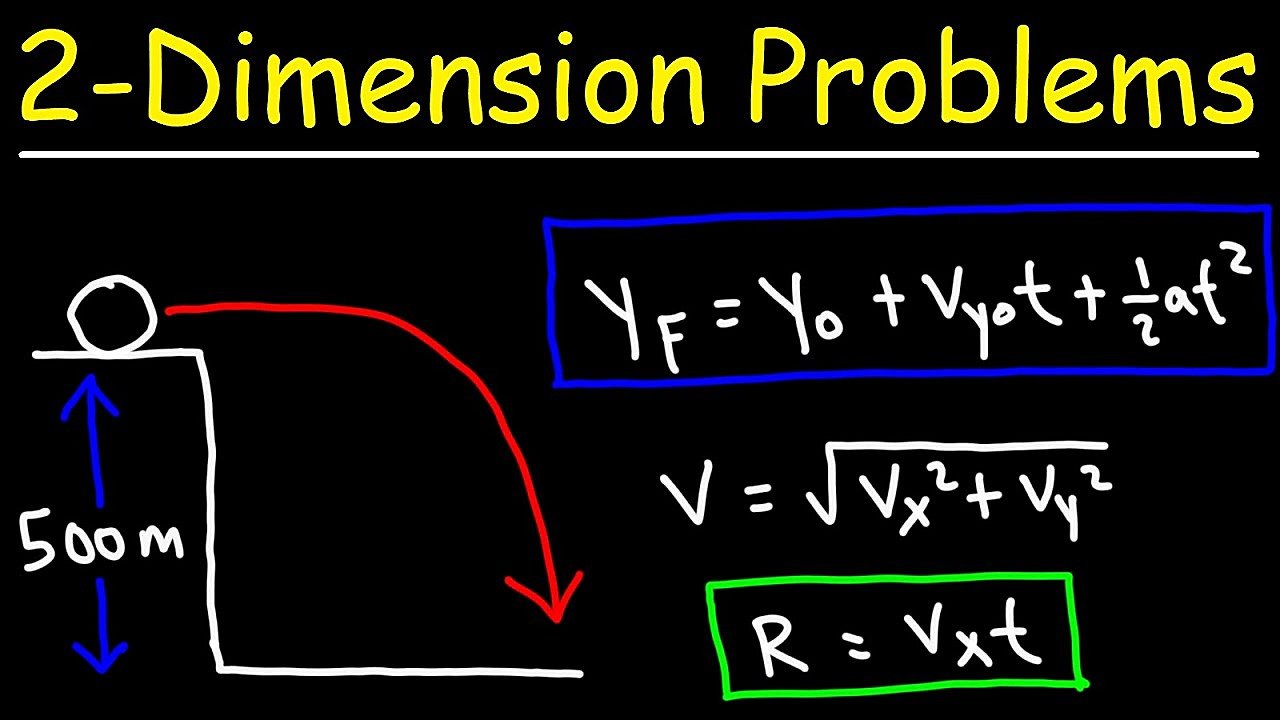
Two-dimensional motion is movement in a plane, and vectors are quantities with magnitude and direction that describe it. The horizontal and vertical components of a vector are independent of one another.
For a reliable reference, consult OpenStax University Physics Volume 1.
What Is Two-Dimensional Motion?
Two-dimensional motion is motion along a path on a flat surface or plane. Examples include a ball on a pool table, a skater on an ice rink, and a thrown football. Motion not confined to a plane, such as a car on a winding mountain road, is three-dimensional. Both types extend the one-dimensional kinematics of straight-line motion.
What Are the Types of Two-Dimensional Motion?
There are 3 common types: projectile motion, uniform circular motion, and relative motion. The table below compares them.
| Motion Type | Description | Key Quantity | Example |
|---|---|---|---|
| Projectile motion | Motion through the air under gravity alone | ay = −g = −9.80 m/s² | Thrown football |
| Uniform circular motion | Motion on a circle at constant speed | ac = v²/r, toward the center | Point on a spinning propeller |
| Relative motion | Velocity observed from a reference frame | v = √(vx² + vy²) | Boat crossing a river |
Sources: OpenStax College Physics 2e, OpenStax University Physics Volume 1, and OpenStax-based course material.
What Are Vectors?
A vector is a quantity with both magnitude and direction. In two dimensions, a vector is drawn as an arrow with a length proportional to its magnitude, pointing in its direction relative to a reference frame. A scalar has magnitude only. The table below lists examples of each quantity type.
| Quantity Type | Defining Property | Examples |
|---|---|---|
| Scalar | Magnitude only | Distance, speed, time, mass, energy |
| Vector | Magnitude and direction | Displacement, velocity, acceleration, force, momentum |
How Do You Find Vector Components?
Find vector components with Ax = A cos θ and Ay = A sin θ, where θ is the angle from the x-axis. The Pythagorean theorem and an inverse tangent then recombine the components into a magnitude and a direction. The table below lists the 4 formulas.
| Quantity | Formula | Use |
|---|---|---|
| x-component | Ax = A cos θ | Horizontal part of the vector |
| y-component | Ay = A sin θ | Vertical part of the vector |
| Magnitude | A = √(Ax² + Ay²) | Length from components |
| Direction | θ = tan⁻¹(Ay/Ax) | Angle from components |
Calculators return tan⁻¹ values between −90° and 90°, so add 180° when Ax is negative.
How Are Components Calculated in a Worked Example?
A velocity of 50 m/s at 30° above the horizontal has these components:
- Horizontal component: vx = 50 cos 30° = 43.3 m/s
- Vertical component: vy = 50 sin 30° = 25.0 m/s
- Check: √(43.3² + 25.0²) = 50.0 m/s
How Do You Add and Subtract Vectors?
Add vectors graphically with the head-to-tail method or analytically by adding components. Subtraction works as addition of the opposite vector, so A − B = A + (−B), and addition is commutative, so A + B = B + A.
How Does the Head-to-Tail Method Work?
Draw the first vector, place the tail of each later vector at the head of the previous one, and draw the resultant from the tail of the first vector to the head of the last. A ruler measures the magnitude, and a protractor measures the direction.
How Does the Component Method Work?
The component method uses 4 steps:
- Resolve each vector into x-components and y-components.
- Add the components: Rx = Ax + Bx and Ry = Ay + By.
- Calculate the magnitude: R = √(Rx² + Ry²).
- Calculate the direction: θ = tan⁻¹(Ry/Rx).
How Is Vector Addition Calculated in a Worked Example?
A person walks 30 m east and then 40 m north. The resultant displacement follows from the components:
- Rx = 30 m and Ry = 40 m
- Magnitude: R = √(30² + 40²) = 50 m
- Direction: θ = tan⁻¹(40/30) = 53.1° north of east
What Equations Describe Two-Dimensional Motion?
Two-dimensional motion with constant acceleration uses separate kinematic equations for the x-direction and the y-direction. Horizontal motion does not affect vertical motion, and vertical motion does not affect horizontal motion. The table below shows the projectile equations, with up as the positive y-direction and g = 9.80 m/s².
| Quantity | Horizontal (x) | Vertical (y) |
|---|---|---|
| Acceleration | ax = 0 | ay = −g = −9.80 m/s² |
| Velocity | vx = v0x (constant) | vy = v0y − gt |
| Position | x = x0 + vx·t | y = y0 + v0y·t − ½gt² |
| Velocity and position | Not applicable | vy² = v0y² − 2g(y − y0) |
Recombine the components with s = √(x² + y²), v = √(vx² + vy²), and θv = tan⁻¹(vy/vx).
What Is Projectile Motion?
Projectile motion is the motion of an object through the air under the influence of gravity alone. Models of this motion treat air resistance as negligible. The path of an ideal projectile is a parabola.
What Are the Key Projectile Motion Formulas?
The key formulas give the launch components, the maximum height, and the range on level ground. The table below lists 5 formulas, where v0 is the launch speed and θ0 is the launch angle.
| Quantity | Formula | Meaning |
|---|---|---|
| Horizontal velocity | vx = v0 cos θ0 | Constant during flight |
| Initial vertical velocity | v0y = v0 sin θ0 | Starting upward speed |
| Maximum height | h = v0y² / (2g) | Highest point above the launch level |
| Range (level ground) | R = v0² sin 2θ0 / g | Horizontal distance traveled |
| Time of flight (level ground) | T = 2v0y / g | Time in the air |
What Launch Angle Gives the Maximum Range?
A launch angle of 45° gives the maximum range on level ground, because sin 2θ0 reaches its maximum value of 1 at 45°. Complementary angles give equal ranges. For example, 30° and 60° both give sin 2θ0 = 0.866. These results assume negligible air resistance.
How Is a Projectile Problem Solved in a Worked Example?
A ball launches at 20 m/s and 30° above the horizontal from level ground, with g = 9.80 m/s²:
- Components: vx = 20 cos 30° = 17.3 m/s and v0y = 20 sin 30° = 10.0 m/s
- Time of flight: T = 2(10.0)/9.80 = 2.04 s
- Maximum height: h = (10.0)²/(2 × 9.80) = 5.10 m
- Range: R = 17.3 × 2.04 = 35.3 m
- Check: R = 20² × sin 60° / 9.80 = 35.3 m
What Is Relative Velocity in Two Dimensions?
Relative velocity is the velocity of an object as observed from a particular reference frame. Velocities in two dimensions add with the same component method as other vectors. Classical relativity applies when speeds stay below about 1% of the speed of light.
How Is Relative Velocity Calculated in a Worked Example?
A boat heads north at 4.0 m/s relative to the water, in a river that flows east at 3.0 m/s. The velocity relative to the ground follows from the components:
- Components: vx = 3.0 m/s and vy = 4.0 m/s
- Speed: v = √(3.0² + 4.0²) = 5.0 m/s
- Direction: θ = tan⁻¹(4.0/3.0) = 53° north of east
What Is Uniform Circular Motion?
Uniform circular motion is motion on a circle at constant speed, as in a spinning propeller or a watch hand. The object accelerates because its velocity direction changes, and the acceleration points toward the center of the circle. This acceleration is called centripetal acceleration, and its magnitude is ac = v²/r. A point moving at 10 m/s on a circle of radius 5.0 m has ac = 10²/5.0 = 20 m/s².
What Mistakes Do Students Make With Two-Dimensional Motion and Vectors?
Students struggle most with vector direction and the separation of components. A 2023 physics education paper summarizes 3 earlier findings on vector skills, and notes that students handle magnitude better than direction. A descriptive study of 67 grade 11 students found that 74.63% struggled with projectile motion problems, mainly with velocity components and position at a given time. The table below lists the findings.
| Study | Sample | Finding |
|---|---|---|
| Knight, 1995 | Calculus-based first-semester physics students | 50% demonstrated vector addition |
| Nguyen and Meltzer, 2003 | Algebra-based second-semester physics students | 73% correct on one-dimensional addition, 44% on two-dimensional addition, 35% on two-dimensional subtraction |
| Indonesian descriptive study | 67 grade 11 students | 74.63% struggled with projectile motion problems |
Studies of grade 11 students also report 3 recurring projectile misconceptions:
| Misconception | Correct Concept |
|---|---|
| A horizontally launched object falls more slowly than a dropped object | Fall time is unaffected by horizontal motion |
| A larger launch angle always gives a larger range | Range follows sin 2θ0, so it peaks at 45° |
| Acceleration points along the direction of motion | Projectile acceleration points downward at 9.80 m/s² throughout the flight |
People Also Ask
What Is the Difference Between Scalars and Vectors?
A scalar has magnitude only, and a vector has magnitude and direction.
Are Horizontal and Vertical Motion Independent in Projectile Motion?
Yes, horizontal motion does not affect vertical motion, and vertical motion does not affect horizontal motion.
What Is the Acceleration of a Projectile at Its Highest Point?
The acceleration stays at −9.80 m/s² downward, and only the vertical velocity equals zero.
How Do You Find the Resultant of Two Vectors?
Add the x-components and the y-components, then use R = √(Rx² + Ry²) and θ = tan⁻¹(Ry/Rx).
Does Uniform Circular Motion Have Acceleration?
Yes, the velocity direction changes, so a centripetal acceleration of ac = v²/r points toward the center.
What Is the Summary of Two-Dimensional Motion and Vectors?
Two-dimensional motion is movement in a plane, described by independent horizontal and vertical vector components. Here are 6 key facts:
- Resolves vectors with Ax = A cos θ and Ay = A sin θ
- Adds vectors by summing x-components and y-components
- Treats horizontal and vertical motion as independent
- Sets ax = 0 and ay = −9.80 m/s² for projectiles
- Maximizes range at 45° on level ground
- Applies ac = v²/r toward the center in uniform circular motion

The University of the West Indies
My passion as a teacher and leader in education is to contribute to students’ enhanced learning by creation of a positive teaching/learning environment, where they are motivated to develop strong critical thinking, analytical and problem-solving skills.
As acting Vice-Principal and head of Physics, I have amassed five years of experience in leading meetings, implementing strategies to maintain discipline and school ethos, liaise with stakeholders in planning for future development of the institution; successfully negotiated the implementation of various projects for student development as well as supervising effective execution of such. For the past 19 years, I have incorporated discovery learning within the classroom through practical activities, problem solving and cooperative learning and have realized that students retention in Physics and Mathematics have increased significantly.
I am always cognizant that students have different learning styles, and as such teaching strategies during planning and delivery must take this crucial factor into consideration and be tailored to meet such differences.