

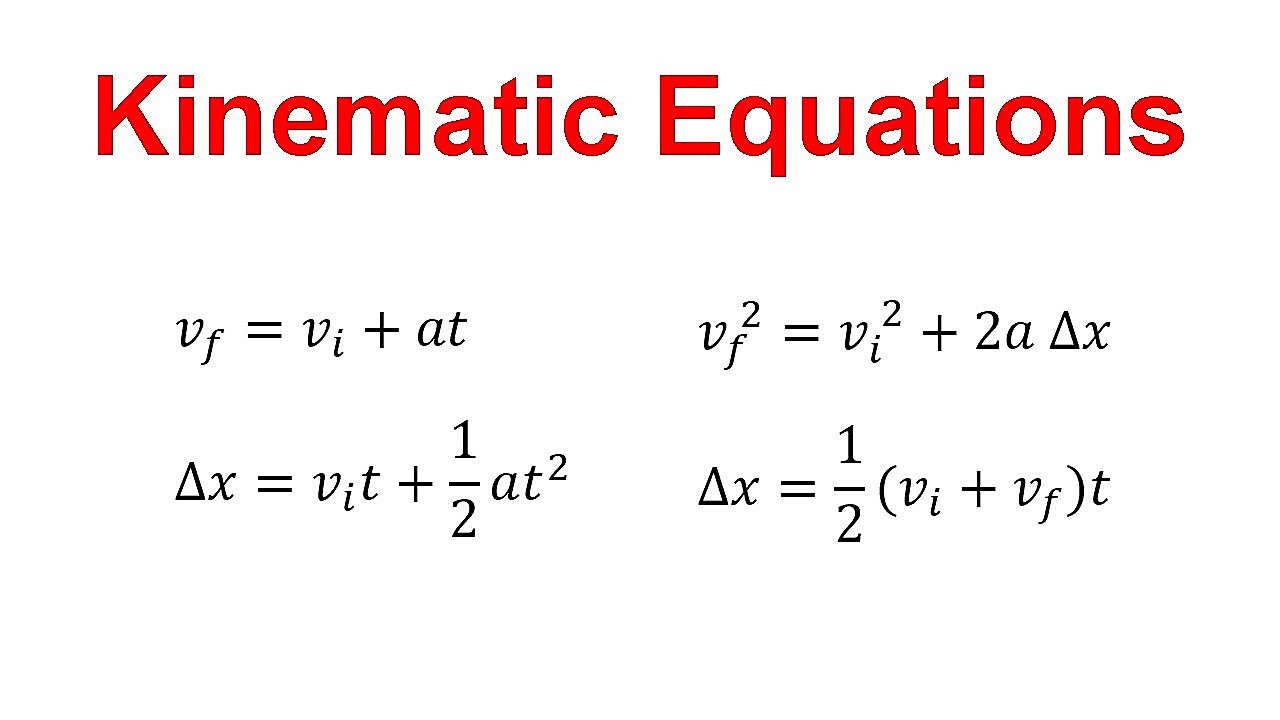
The physics kinematics equations are 5 formulas that relate displacement, initial velocity, final velocity, acceleration, and time. They apply only when acceleration is constant.
For a reliable reference, consult OpenStax University Physics Volume 1.
What Are the Kinematic Equations in Physics?
The kinematic equations are algebraic formulas that describe motion with constant acceleration. Kinematics describes how objects move, without considering what causes the motion. Each equation connects 4 of the 5 quantities, so any 3 known quantities give a fourth.
What Are the 5 Kinematic Equations?
There are 5 kinematic equations, and each one omits 1 variable. The table below lists each equation with its missing variable and its use case.
| No. | Equation | Missing Variable | Use When |
|---|---|---|---|
| 1 | v = v₀ + at | Δx | Displacement is not involved |
| 2 | Δx = v₀t + ½at² | v | Final velocity is not involved |
| 3 | v² = v₀² + 2aΔx | t | Time is not involved |
| 4 | Δx = ½(v₀ + v)t | a | Acceleration is not involved |
| 5 | Δx = vt − ½at² | v₀ | Initial velocity is not involved |
What Do the Symbols in the Kinematic Equations Mean?
The 5 symbols stand for displacement, initial velocity, final velocity, acceleration, and time. Physics textbooks write displacement as Δx = x − x₀, and UK courses use the SUVAT letters s, u, v, a, t. All quantities except time are vectors, so they take negative values.
| Physics Symbol | SUVAT Symbol | Quantity | SI Unit | Type |
|---|---|---|---|---|
| Δx | s | Displacement | m | Vector |
| v₀ | u | Initial velocity | m/s | Vector |
| v | v | Final velocity | m/s | Vector |
| a | a | Constant acceleration | m/s² | Vector |
| t | t | Elapsed time | s | Scalar |
When Do the Kinematic Equations Apply?
The equations apply only when acceleration is constant. Constant acceleration makes the average and instantaneous accelerations equal. Motion with changing acceleration, such as a car that accelerates and then brakes, splits into parts with constant acceleration each. Variable acceleration requires calculus.
How Do You Choose the Right Kinematic Equation?
List the 3 known quantities, name the unknown, and select the equation that omits the fifth quantity. Each equation links 4 quantities, so the omitted quantity is the one the problem does not mention. Follow these 5 steps:
- Define the positive direction.
- List the 3 known quantities.
- Identify the unknown quantity.
- Select the equation that contains those 4 quantities.
- Solve for the unknown and check the units.
A problem with 2 unknowns requires 2 independent equations, solved together. The table below converts common problem phrases into known values.
| Problem Phrase | Known Value |
|---|---|
| Starts from rest | v₀ = 0 |
| Comes to a stop | v = 0 |
| Moves at constant velocity | a = 0 |
| Is dropped | v₀ = 0 and a = −g (up positive) |
| Reaches the highest point | v = 0 and a = −g (up positive) |
How Are the Kinematic Equations Derived?
The equations follow from the definitions of average velocity and acceleration for constant acceleration. The derivation has 4 steps:
- Define average velocity as v̄ = Δx/t, which equals (v₀ + v)/2 for constant acceleration, giving equation 4.
- Define acceleration as a = (v − v₀)/t, giving equation 1.
- Substitute equation 1 into equation 4, giving equation 2.
- Eliminate t between equations 1 and 4, giving equation 3.
The 4 equations that contain time follow from a velocity-time graph, and 2 of the equations also follow from calculus, by integrating acceleration to get velocity and integrating velocity to get displacement.
What Is the Graphical Meaning of the Kinematic Equations?
The slope of a velocity-time graph gives acceleration, and the area under it gives displacement. The area under an acceleration-time graph equals the change in velocity. Constant acceleration produces a straight line on a velocity-time graph.
| Graph Type | Slope Gives | Area Under the Curve Gives |
|---|---|---|
| Position-time | Velocity | Not used |
| Velocity-time | Acceleration | Displacement |
| Acceleration-time | Rate of change of acceleration (jerk) | Change in velocity |
What Are the Kinematic Equations for Free Fall?
Free-fall equations replace a with −g, with up as the positive direction. The 3 free-fall forms use y for vertical position.
| Standard Equation | Free-Fall Form |
|---|---|
| v = v₀ + at | v = v₀ − gt |
| Δy = v₀t + ½at² | y = y₀ + v₀t − ½gt² |
| v² = v₀² + 2aΔy | v² = v₀² − 2g(y − y₀) |
Three facts apply to free fall:
- The value of g averages 9.81 m/s² and ranges from 9.78 to 9.83 m/s² across Earth's surface.
- The acceleration stays at g throughout the motion, even at the top of a thrown object's path, where the velocity is zero.
- An object thrown upward returns to its launch point with its launch speed.
What Are Worked Examples of the Kinematic Equations?
There are 4 worked examples, 1 for each of equations 1, 2, and 3 and 1 for free fall. The examples use g = 9.80 m/s².
How Is Final Velocity Calculated With v = v₀ + at?
A train accelerates from 12.0 m/s at 0.800 m/s² for 15.0 s.
- Knowns: v₀ = 12.0 m/s, a = 0.800 m/s², t = 15.0 s
- Unknown: v
- Equation: v = v₀ + at
- Result: v = 12.0 + 0.800 × 15.0 = 24.0 m/s
How Is Displacement Calculated With Δx = v₀t + ½at²?
A sprinter starts from rest and accelerates at 4.00 m/s² for 2.50 s.
- Knowns: v₀ = 0, a = 4.00 m/s², t = 2.50 s
- Unknown: Δx
- Equation: Δx = v₀t + ½at²
- Result: Δx = ½ × 4.00 × 2.50² = 12.5 m
How Is Stopping Distance Calculated With v² = v₀² + 2aΔx?
A car travels at 25.0 m/s and brakes at −6.00 m/s² until it stops.
- Knowns: v₀ = 25.0 m/s, v = 0, a = −6.00 m/s²
- Unknown: Δx
- Equation: Δx = (v² − v₀²) / (2a)
- Result: Δx = (0 − 625) / (−12.0) = 52.1 m
A car that travels twice as fast needs a much longer distance to stop. At 50.0 m/s, the distance is 2500 / 12.0 = 208 m, which is 4 times the distance at 25.0 m/s.
How Is Free Fall Calculated With the Kinematic Equations?
A ball drops from rest from a height of 45.0 m. Up is positive.
- Knowns: v₀ = 0, a = −9.80 m/s², Δy = −45.0 m
- Unknowns: t and v
- Time: t = √(2 × 45.0 / 9.80) = 3.03 s
- Final velocity: v = −9.80 × 3.03 = −29.7 m/s, and v² = 2 × 9.80 × 45.0 = 882 confirms the result
How Do the Kinematic Equations Extend to Two Dimensions and Rotation?
Apply the equations separately to the x and y components when acceleration is constant. The equations also generalize to rotational motion, when the angular acceleration is constant. The article What Are Two-Dimensional Motion and Vectors? Key Formulas and 4 Worked Examples covers projectile motion in detail. The table below pairs each linear equation with its rotational form.
| Linear Equation | Rotational Equation | Rotational Symbols |
|---|---|---|
| v = v₀ + at | ω = ω₀ + αt | ω = angular velocity, α = angular acceleration |
| Δx = v₀t + ½at² | Δθ = ω₀t + ½αt² | θ = angular position |
| v² = v₀² + 2aΔx | ω² = ω₀² + 2αΔθ | Δθ = angular displacement |
What Is the Difference Between SUVAT and Physics Kinematic Equations?
SUVAT is the UK notation for the same 5 equations, using the letters s, u, v, a, and t. The letters stand for displacement, initial velocity, final velocity, acceleration, and time. UK problems set a = g = 9.81 m/s² for objects falling under gravity.
Exam boards differ on whether they provide the equations. The table below shows 4 cases.
| Exam | Equations Listed | Provided in the Exam? |
|---|---|---|
| AP Physics 1 (College Board) | 3 core equations plus the average velocity relation | Yes, on the equation sheet |
| AQA AS Maths Mechanics | 5 SUVAT equations | Yes |
| CIE AS Maths Mechanics (9709) | First 4 of the 5 equations | Yes |
| Edexcel International AS Maths Mechanics | 5 SUVAT equations | No |
What Mistakes Do Students Make With the Kinematic Equations?
Students make the most errors with graph interpretation and sign conventions. Beichner's 1994 TUG-K study reported percent correct by objective: 51% for velocity from a position-time graph, 40% for acceleration from a velocity-time graph, and 23% for change in velocity from an acceleration-time graph. The table below lists 3 studies.
| Study | Sample | Finding |
|---|---|---|
| Beichner, 1994 | TUG-K development study | 51% correct on velocity from position-time graphs, 40% on acceleration from velocity-time graphs, 23% on change in velocity from acceleration-time graphs |
| TUG-K teaching assistant study | Introductory physics students | 37% correct on constant acceleration graphs, against 63% on constant velocity graphs |
| Yustiandi and Saepuzaman, 2017 | 21 grade 10 students in Banten, Indonesia | 14% correct on the position graph of an accelerating object |
The table below lists 5 common errors and their corrections.
| Error | Correct Practice |
|---|---|
| Applying the equations to non-constant acceleration | Split the motion into parts with constant acceleration |
| Mixing sign conventions | Keep 1 positive direction for all vector quantities |
| Setting a = 0 at the top of a throw | Keep a = −g throughout the flight |
| Keeping a negative time root | Reject any root with t < 0 |
| Doubling stopping distance when speed doubles | Scale stopping distance with v², which gives 4 times the distance |
People Also Ask
How Many Kinematic Equations Are There?
There are 5 SUVAT equations, and the AP Physics 1 sheet lists 3 core ones.
Do the Kinematic Equations Work for Non-Constant Acceleration?
No, they require constant acceleration, so split the motion into constant-acceleration parts or use calculus.
Which Kinematic Equation Does Not Contain Time?
The equation v² = v₀² + 2aΔx contains no time variable.
Which Kinematic Equation Does Not Contain Acceleration?
The equation Δx = ½(v₀ + v)t contains no acceleration term, so it suits problems with unknown acceleration.
What Is the Acceleration at the Top of a Thrown Object's Path?
The acceleration equals −g, which is 9.8 m/s² downward, while the velocity is momentarily zero.
What Is the Summary of the Physics Kinematics Equations?
The physics kinematics equations are 5 formulas that link displacement, initial velocity, final velocity, acceleration, and time at constant acceleration. Here are 6 key facts:
- Connects 4 of the 5 quantities in each equation
- Requires constant acceleration
- Selects the equation that omits the missing quantity
- Derives from average velocity, acceleration, and velocity-time graphs
- Replaces a with −g for free fall
- Extends to x and y components and to rotation

The University of the West Indies
My passion as a teacher and leader in education is to contribute to students’ enhanced learning by creation of a positive teaching/learning environment, where they are motivated to develop strong critical thinking, analytical and problem-solving skills.
As acting Vice-Principal and head of Physics, I have amassed five years of experience in leading meetings, implementing strategies to maintain discipline and school ethos, liaise with stakeholders in planning for future development of the institution; successfully negotiated the implementation of various projects for student development as well as supervising effective execution of such. For the past 19 years, I have incorporated discovery learning within the classroom through practical activities, problem solving and cooperative learning and have realized that students retention in Physics and Mathematics have increased significantly.
I am always cognizant that students have different learning styles, and as such teaching strategies during planning and delivery must take this crucial factor into consideration and be tailored to meet such differences.