

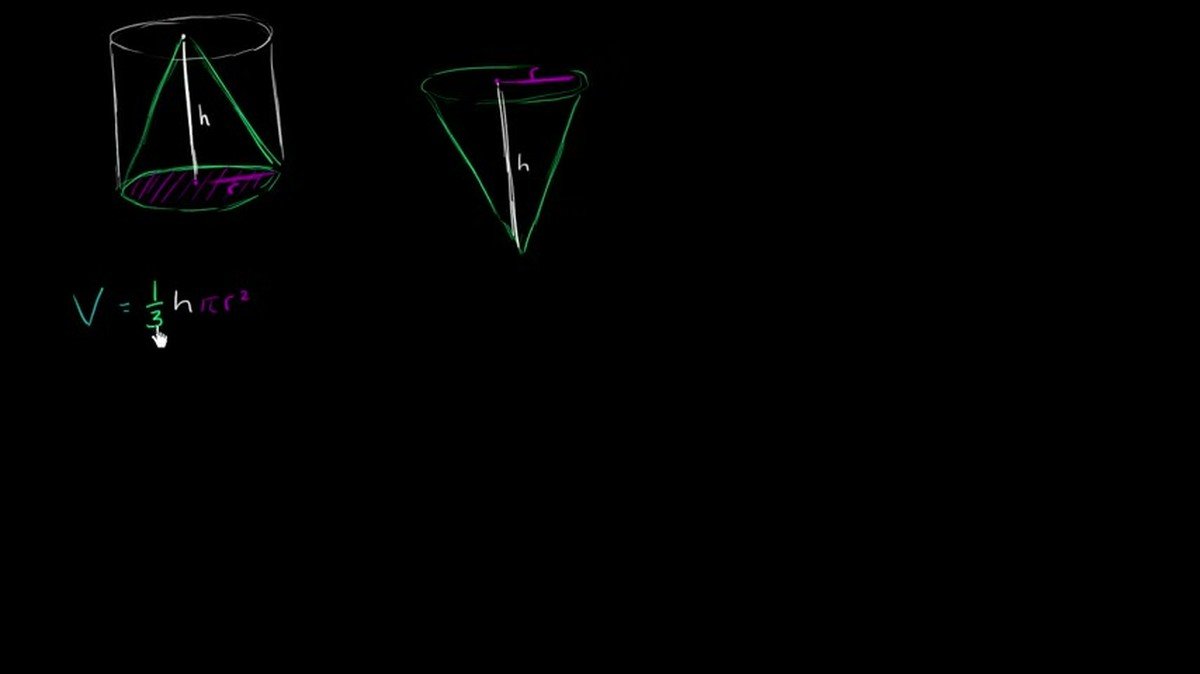
Cone volume formula is V = 1/3 πr²h, where V is volume, r is base radius, and h is perpendicular height. This article gives 7 cone formulas, 4 worked examples, and 3 steps. It covers radius, height, slant height, base area, volume, and surface area.
What Is the Cone Volume Formula?
Cone volume formula is V = 1/3 πr²h. V is volume in cubic units. Pi equals 3.14159. Radius r is distance from center of circular base to its edge. Height h is perpendicular distance from base center to apex. A cone is a solid with 1 circular base and 1 apex. Examples include ice cream cones, traffic cones, and funnels. A right circular cone has its apex directly above the center of its base. An oblique cone has its apex offset. The formula uses the same form for right and oblique cones, if h is perpendicular height. According to Khan Academy, volume of a cone is 1/3 of volume of a cylinder with same base and height. Cylinder volume πr²h, cone volume 1/3 πr²h.
What Are the 7 Cone Volume Formulas?
| Formula | Equation |
|---|---|
| Cone volume | V = 1/3 πr²h |
| Volume from base area | V = 1/3 × B × h |
| Volume from diameter | V = 1/12 πd²h |
| Base area | B = πr² |
| Slant height | l = √(r² + h²) |
| Lateral surface area | CSA = πrl |
| Total surface area | SA = πr(r + l) |
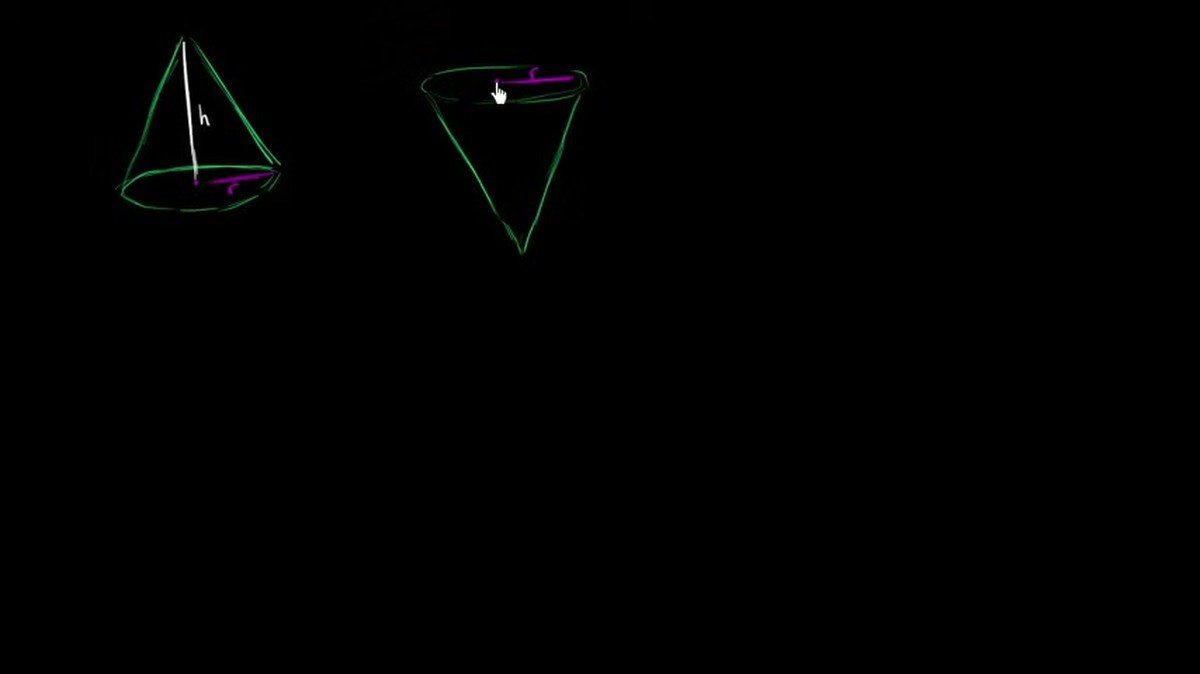
A frustum is a cone with its top cut off. Its volume is V = 1/3 πh(R² + Rr + r²), where R is base radius and r is top radius. Use diameter formula, if radius is unknown.
Why Is the Cone Volume Formula 1/3 of a Cylinder?
Cone volume is 1/3 of cylinder volume, because 3 cones fill 1 cylinder with same base and height. Cylinder volume πr²h, cone 1/3 πr²h. Studies of volume use water pouring to show the 1/3 ratio. Three cone volumes fill one cylinder volume. Ratio is 1:3.
How Do You Calculate Cone Volume in 3 Steps?
- Measure radius and height in same unit.
- Substitute values into V = 1/3 πr²h.
- Calculate result and add cubic units.
What Are 4 Worked Examples of the Cone Volume Formula?
Radius 3 cm height 7 cm: V = 1/3 × π × 9 × 7 = 21π, volume is 65.97 cm³.
Radius 3 cm height 4 cm: slant height l = √(3² + 4²) = 5 cm, volume 37.70 cm³, total surface area 75.40 cm².
Radius 5 cm height 12 cm: slant height 13 cm, volume 314.16 cm³, lateral surface area 204.20 cm², total surface area 282.74 cm².
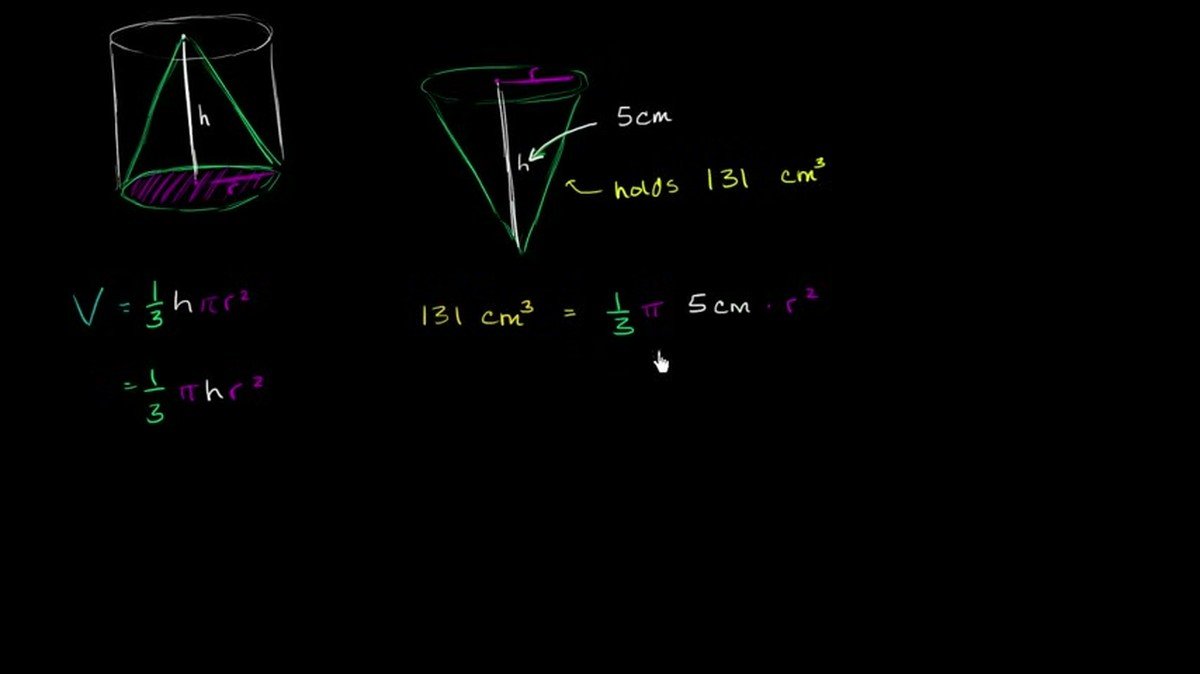
Volume 131 cm³ height 5 cm: r² = 393 / (5π) = 25.02, radius is 5 cm. This example follows Khan Academy.
What Are 5 Common Mistakes With the Cone Volume Formula?
Using slant height in place of perpendicular height. Omitting 1/3 factor. Using diameter in place of radius. Mixing centimetres and metres. Using square units for volume and cubic units for area. Practice improves accuracy.
What Do People Also Ask About the Cone Volume Formula?
What is the cone volume formula? V = 1/3 πr²h, r base radius, h perpendicular height.
What is volume of a cone with radius 3 and height 7? 65.97 cm³.
Why is cone volume 1/3 of a cylinder? A cone holds 1/3 volume of a cylinder with same base and height.
What is slant height formula? l = √(r² + h²).
What Are the Sources for the Cone Volume Formula?
Khan Academy, Wikipedia, GeeksforGeeks. Khan Academy gives V = 1/3 πr²h and shows cone with volume 131 cm³ and height 5 cm.
How Does the Cone Volume Formula Connect Radius, Height, and Volume?
Cone volume connects radius, height, volume in 1 equation. Radius enters as r². Height enters as h. Pi enters as constant. Volume increases with radius squared and with height. Cone volume formula is V = 1/3 πr²h.

The University of the West Indies
My passion as a teacher and leader in education is to contribute to students’ enhanced learning by creation of a positive teaching/learning environment, where they are motivated to develop strong critical thinking, analytical and problem-solving skills.
As acting Vice-Principal and head of Physics, I have amassed five years of experience in leading meetings, implementing strategies to maintain discipline and school ethos, liaise with stakeholders in planning for future development of the institution; successfully negotiated the implementation of various projects for student development as well as supervising effective execution of such. For the past 19 years, I have incorporated discovery learning within the classroom through practical activities, problem solving and cooperative learning and have realized that students retention in Physics and Mathematics have increased significantly.
I am always cognizant that students have different learning styles, and as such teaching strategies during planning and delivery must take this crucial factor into consideration and be tailored to meet such differences.