

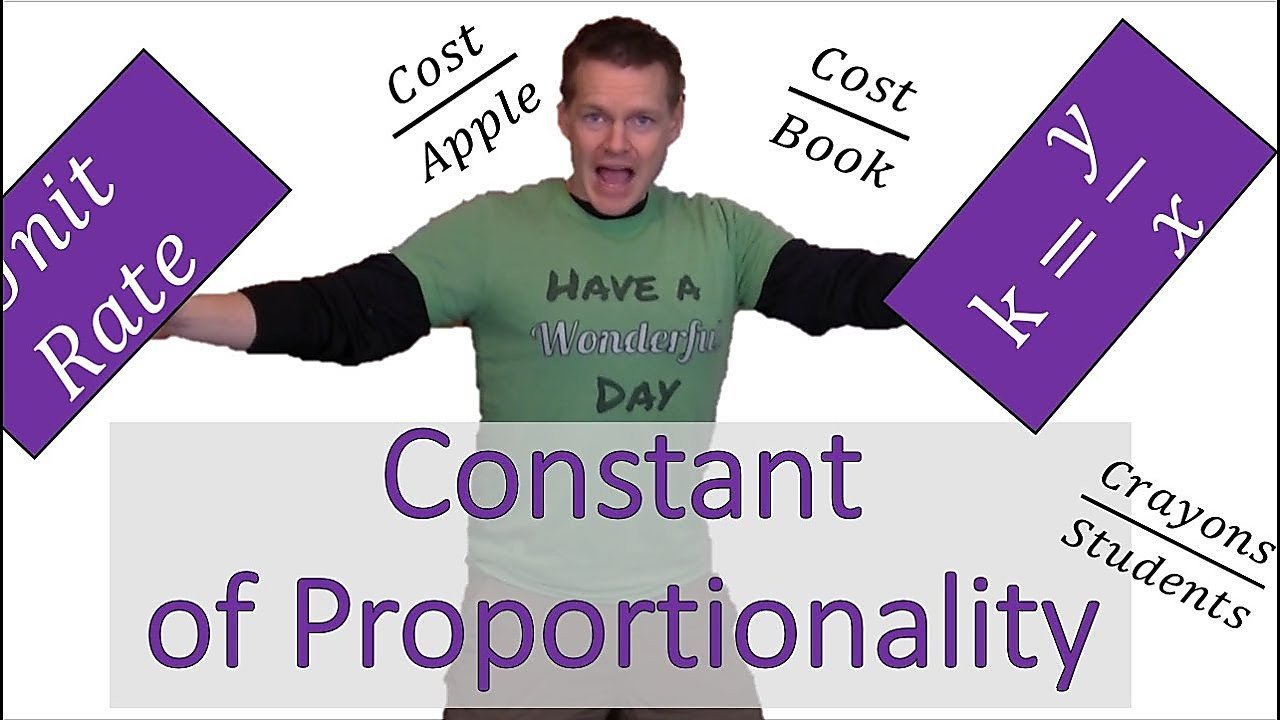
What Is the Constant of Proportionality? Definition, 5 Methods, and Examples
The constant of proportionality is the fixed ratio between 2 proportional quantities, written as k in the equation y = kx. It is found by dividing y by x (k = y / x). The 5 methods use a table, a graph, an equation, a diagram, or a verbal description. The constant also appears in direct proportion, inverse proportion, physics laws, geometry, and calculus.
For a reliable reference, consult OpenStax College Algebra section on proportional relationships.
What Is the Constant of Proportionality and What Are Examples of It?
The constant of proportionality is the number that multiplies x to produce y in a proportional relationship. The notation y ∝ x means y = kx. Other names for k include constant of variation, proportionality constant, coefficient of proportionality, and unit rate.
Proportional quantities keep the same ratio for every pair of values. Examples include hours worked and pay earned, items bought and total cost, and distance and time at constant speed.
Example: 1 notebook costs $3, so 4 notebooks cost $12. The ratio 12 / 4 equals 3, so k = 3 and the equation is y = 3x.
The Common Core State Standards place the identification of the constant of proportionality in grade 7, under standard 7.RP.A.2.b. The 2006 NCTM Curriculum Focal Points also list proportionality as a grade 7 focus.
What Is the Formula for the Constant of Proportionality?
The formula is k = y / x, which comes from the direct proportion equation y = kx. The formula applies when x is not zero.
3 forms of the formula exist:
- Direct proportion: y = kx, so k = y / x
- Inverse proportion: y = k / x, so k = xy
- Joint variation: z = kxy, so k = z / (xy)
In the formulas, y is the dependent variable, x is the independent variable, and k is the constant.
What Are the 5 Methods to Find the Constant of Proportionality?
The 5 methods find k from a table, graph, equation, diagram, or verbal description. The table below lists where k appears in each representation, how to find it, and an example result.
| Method | Where k Appears | How to Find k | Example Result |
|---|---|---|---|
| Table | Pairs of x and y values | Divide y by x in any row | y = 12 and x = 4 give k = 3 |
| Graph | Straight line through the origin (0, 0) | Divide y by x at any point on the line | Point (4, 10) gives k = 2.5 |
| Equation | y = kx | Read the coefficient of x | y = 7x gives k = 7 |
| Diagram | Double number line or ratio diagram | Divide a value on one line by the aligned value on the other | 90 km over 2 h gives k = 45 |
| Verbal description | Sentence with 2 quantities and a rate | Divide the second quantity by the first | $96 for 8 h gives k = 12 |
How Do You Find the Constant of Proportionality From a Table?
The constant of proportionality is found by dividing each y-value by its matching x-value, if the quotients are equal. The table below shows the cost of notebooks at a fixed price. The last row gives the ratio y / x for each column.
| Column 1 | Column 2 | Column 3 | Column 4 | |
|---|---|---|---|---|
| Notebooks (x) | 2 | 4 | 6 | 8 |
| Cost in dollars (y) | 6 | 12 | 18 | 24 |
| Ratio y / x | 3 | 3 | 3 | 3 |
Every ratio equals 3, so k = 3 dollars per notebook.
How Do You Find the Constant of Proportionality From a Graph?
The constant of proportionality is found by dividing the y-coordinate by the x-coordinate of any point on a straight line through the origin. The value of k also equals the y-value at x = 1, and it equals the slope of the line.
- Confirm the line is straight and passes through (0, 0).
- Select a point on the line, such as (4, 10).
- Divide the y-coordinate by the x-coordinate.
- Record the result: 10 / 4 = 2.5.
How Do You Find the Constant of Proportionality From an Equation?
The constant of proportionality is the coefficient of x in an equation written as y = kx. Equations in other arrangements are rewritten first.
- y = 7x gives k = 7.
- y = x / 4 gives k = 1/4, or 0.25.
- 3y = 12x becomes y = 4x, so k = 4.
- y = 2x + 3 has no constant of proportionality, because the added constant 3 breaks proportionality.
How Do You Find the Constant of Proportionality From a Diagram?
The constant of proportionality is found by dividing a value on one number line by the aligned value on the other number line of a double number line. A double number line is a diagram with 2 aligned number lines that show matching values of 2 quantities.
Example: A double number line aligns 0, 2, 4, and 6 hours with 0, 90, 180, and 270 kilometers. The ratio 90 / 2 equals 45, and the ratios 180 / 4 and 270 / 6 also equal 45. The constant is 45 km/h.
How Do You Find the Constant of Proportionality From a Word Problem?
The constant of proportionality is found by dividing the quantity that depends on the other by the quantity it depends on. The quantity after the word "per" is the x-value.
- Identify the 2 quantities in the sentence.
- Assign x to the quantity after "per" or "for each".
- Divide y by x.
- Attach the unit of y per unit of x.
Example: A worker earns $96 for 8 hours. The constant is 96 / 8 = $12 per hour. Pay for 15 hours is 12 × 15 = $180.
How Do You Use the Constant of Proportionality to Solve for a Missing Value?
A missing value is found by calculating k from a known pair and substituting it into y = kx. The method works for a missing y or a missing x.
- Find k from the known pair of values.
- Write the equation y = kx with the value of k.
- Substitute the known value of x or y.
- Solve for the missing variable.
Example: y = 18 when x = 6, so k = 18 / 6 = 3. When x = 10, y = 3 × 10 = 30. When y = 45, x = 45 / 3 = 15.
How Do You Know if a Relationship Is Proportional?
A relationship is proportional when the ratio y / x is the same for every pair of values and the graph is a straight line through the origin. 3 checks confirm proportionality:
- Ratio check: y / x gives the same number for every pair.
- Graph check: the points form a straight line through (0, 0).
- Equation check: the equation has the form y = kx with no added constant.
The table below shows a relationship that fails the ratio check. The last row gives the ratio y / x for each column.
| Column 1 | Column 2 | Column 3 | |
|---|---|---|---|
| x | 1 | 2 | 3 |
| y | 5 | 7 | 9 |
| Ratio y / x | 5 | 3.5 | 3 |
The 3 ratios differ, so the relationship is not proportional. The equation is y = 2x + 3, and the line crosses the y-axis at 3 instead of 0.
What Is the Difference Between Direct and Inverse Proportionality?
In direct proportion, y increases as x increases and the ratio y / x stays constant. In inverse proportion, y decreases as x increases and the product xy stays constant. The table below compares the 2 types by 6 features.
| Feature | Direct Proportion | Inverse Proportion |
|---|---|---|
| Equation | y = kx | y = k / x |
| Formula for k | k = y / x | k = xy |
| Graph shape | Straight line through the origin | Curve (hyperbola) approaching both axes |
| Effect of doubling x | y doubles | y halves |
| Example relationship | Number of items and total cost | Speed and travel time over a fixed distance |
| Numeric example | 3 items cost $9 and 6 items cost $18, so k = 3 | 120 km takes 2 h at 60 km/h and 1 h at 120 km/h, so k = 120 km |
What Is the Difference Between the Constant of Proportionality, Unit Rate, and Slope?
In a proportional relationship, the constant of proportionality, unit rate, and slope have the same numeric value. The table below defines each term and states whether it equals k.
| Term | Definition | Where It Is Used | Equals k? |
|---|---|---|---|
| Constant of proportionality | Ratio y / x in y = kx | Proportional relationships | Yes |
| Unit rate | Quantity per 1 unit of another quantity | Rates and word problems | Yes, in proportional relationships |
| Slope | Rise divided by run of a line | Graphs of lines | Yes, for lines through the origin |
| Constant of variation | Another name for k | Algebra textbooks | Yes |
| Rate of change | Change in y per change in x | Functions in general | Yes, if the relationship is proportional |
Slope (m) in y = mx + b equals k only when b = 0. The line y = 2x + 3 has a slope of 2 but no constant of proportionality.
What Are Examples of the Constant of Proportionality in Real Life?
Real-life examples include price per item, speed, hourly wage, recipe yield, exchange rate, and density. The table below lists 6 situations with the quantities x and y, the value of k, and the meaning of k.
| Situation | x | y | Value of k | Meaning of k |
|---|---|---|---|---|
| Shopping | Items | Total cost in dollars | $3 per item | Price per item |
| Driving at constant speed | Hours | Kilometers | 60 km/h | Speed |
| Hourly wage | Hours | Pay in dollars | $12 per hour | Hourly rate |
| Baking | Cups of flour | Cookies | 8 cookies per cup | Yield per cup |
| Currency exchange | Units of currency A | Units of currency B | 1.25 (example rate) | Exchange rate |
| Density of aluminum | Volume in cm³ | Mass in g | 2.70 g/cm³ | Density |
Example: A car travels 150 km in 2.5 hours. The constant is 150 / 2.5 = 60 km/h.
What Are Examples of the Constant of Proportionality in Physics?
Physics laws use constants of proportionality to link measured quantities. Examples include the spring constant, electrical resistance, mass, the gravitational constant, and the Coulomb constant. The table below lists 6 laws with the related quantities, equation, constant, unit of the constant, and type of proportion.
| Law | Quantities Related | Equation | Constant of Proportionality | Unit of Constant | Type of Proportion |
|---|---|---|---|---|---|
| Hooke's law | Spring force and stretch | F = kx | Spring constant (k) | N/m | Direct |
| Ohm's law | Voltage and current | V = IR | Resistance (R) | Ω (ohm) | Direct |
| Newton's second law | Force and acceleration | F = ma | Mass (m) | kg | Direct |
| Boyle's law | Gas pressure and volume at constant temperature | PV = k | Constant (k) | Pa·m³ | Inverse |
| Newton's law of universal gravitation | Gravitational force, masses, and distance | F = Gm₁m₂ / r² | Gravitational constant (G) | N·m²/kg² | Direct with m₁m₂, inverse with r² |
| Coulomb's law | Electric force, charges, and distance | F = kq₁q₂ / r² | Coulomb constant (k) | N·m²/C² | Direct with q₁q₂, inverse with r² |
Robert Boyle published his law in 1662, and Robert Hooke published his in 1678. Isaac Newton published the law of gravitation in 1687, and Charles-Augustin de Coulomb presented his law in 1785. Georg Ohm published his law in 1827.
NIST lists the CODATA recommended value of G as 6.67430 × 10⁻¹¹ N·m²/kg². The Boyle's law constant depends on the temperature and the amount of gas.
Example: A 10 N force stretches a spring by 0.05 m. The spring constant is 10 / 0.05 = 200 N/m.
Johannes Kepler published the third law of planetary motion in 1619. The law states T² = ka³, where T is the orbital period and a is the orbital distance. The constant k equals 1 when T is measured in years and a in astronomical units, for objects orbiting the Sun.
What Is the Constant of Proportionality in Geometry?
In geometry, pi is the constant of proportionality between the circumference and the diameter of a circle (C = πd). The value of pi is approximately 3.14159.
Example: A circle with a diameter of 10 cm has a circumference of 10 × 3.14159 ≈ 31.42 cm.
The scale factor is the constant of proportionality between corresponding lengths of similar figures. A triangle with sides 3, 4, and 5 and a triangle with sides 6, 8, and 10 have a scale factor of 2. Areas scale by k², so the area ratio is 4.
What Is the Constant of Proportionality in Calculus and Differential Equations?
In differential equations, the constant of proportionality links the rate of change of a quantity to the quantity itself in the equation dy/dt = ky. The solution is y = y₀e^(kt), where y₀ is the starting value.
A positive k models growth, and a negative k models decay. Examples include population growth, radioactive decay, and Newton's law of cooling.
Example: Carbon-14 has a half-life of about 5,730 years. The decay constant is k = −ln 2 / 5,730 ≈ −0.000121 per year.
Can the Constant of Proportionality Be Negative, Zero, or a Fraction?
The constant of proportionality can be positive, negative, a fraction, a decimal, or an irrational number. The value zero gives y = 0 for every x, which is a degenerate case.
- Positive k: the line rises through the origin, as in y = 3x.
- Negative k: the line falls through the origin, as in y = −2x.
- Fractional k: the line has a gentle slope, as in y = x / 4, where k = 0.25.
- Irrational k: the constant is a non-repeating decimal, as in C = πd.
- Zero k: the line lies along the x-axis, as in y = 0.
What Are the Units of the Constant of Proportionality?
The unit of k is the unit of y divided by the unit of x in direct proportion. Examples include dollars per item ($/item), kilometers per hour (km/h), newtons per meter (N/m), and grams per cubic centimeter (g/cm³).
In inverse proportion, the unit of k is the unit of y multiplied by the unit of x. The constant has no unit when both quantities share the same unit, as with a scale factor of 2.
What Are the Common Mistakes When Finding the Constant of Proportionality?
5 common mistakes produce incorrect values of k. Research by Wim Van Dooren and colleagues, published in Cognition and Instruction in 2005, documented that students apply proportional reasoning to problems that are not proportional.
- Dividing x by y instead of y by x, which gives the reciprocal 1/k.
- Using 1 pair of values without checking that other pairs give the same ratio.
- Treating y = mx + b with b ≠ 0 as a proportional relationship.
- Ignoring units, which changes the meaning of k.
- Applying proportional reasoning to non-proportional situations.
Example of the last mistake: A square with a side of 4 cm has an area of 16 cm². A square with a side of 8 cm has an area of 64 cm², not 32 cm². Area is not proportional to side length.
What Do People Also Ask About the Constant of Proportionality?
What is the constant of proportionality in simple terms?
The constant of proportionality is the number that multiplies x to give y in the equation y = kx.
What is the symbol for the constant of proportionality?
The symbol for the constant of proportionality is k.
What is the formula for the constant of proportionality?
The formula is k = y / x, for a direct proportion.
Is the constant of proportionality the same as slope?
The constant of proportionality equals the slope of a line that passes through the origin.
Is the constant of proportionality the same as the unit rate?
The constant of proportionality equals the unit rate in a proportional relationship.
How do you find the constant of proportionality from a graph?
Divide the y-coordinate by the x-coordinate of any point on the line, or read the y-value at x = 1.
How do you find the constant of proportionality from a table?
Divide y by x in any row, if all rows give the same quotient.
What is the constant of proportionality in an inverse relationship?
The constant in an inverse relationship is the product k = xy.
Which grade level teaches the constant of proportionality?
The Common Core State Standards teach the constant of proportionality in grade 7.
What is the constant of proportionality of y = 5x?
The constant of proportionality of y = 5x is 5.
What are examples of the constant of proportionality in physics?
Examples include the spring constant in Hooke's law, resistance in Ohm's law, and the gravitational constant G.
What Is the Constant of Proportionality and How Is It Found?
The constant of proportionality is the fixed ratio k between 2 proportional quantities, found with k = y / x. The 5 methods use a table, graph, equation, diagram, or verbal description. A relationship is proportional when every ratio y / x matches and the graph passes through (0, 0). Direct proportion uses y = kx, and inverse proportion uses xy = k. The constant carries the unit of y per unit of x. Examples include price per item, speed, spring constant, pi, scale factor, and the decay constant.
Title: Average Acceleration Formula: Definition, 6 Methods, and Examples

The University of the West Indies
My passion as a teacher and leader in education is to contribute to students’ enhanced learning by creation of a positive teaching/learning environment, where they are motivated to develop strong critical thinking, analytical and problem-solving skills.
As acting Vice-Principal and head of Physics, I have amassed five years of experience in leading meetings, implementing strategies to maintain discipline and school ethos, liaise with stakeholders in planning for future development of the institution; successfully negotiated the implementation of various projects for student development as well as supervising effective execution of such. For the past 19 years, I have incorporated discovery learning within the classroom through practical activities, problem solving and cooperative learning and have realized that students retention in Physics and Mathematics have increased significantly.
I am always cognizant that students have different learning styles, and as such teaching strategies during planning and delivery must take this crucial factor into consideration and be tailored to meet such differences.