

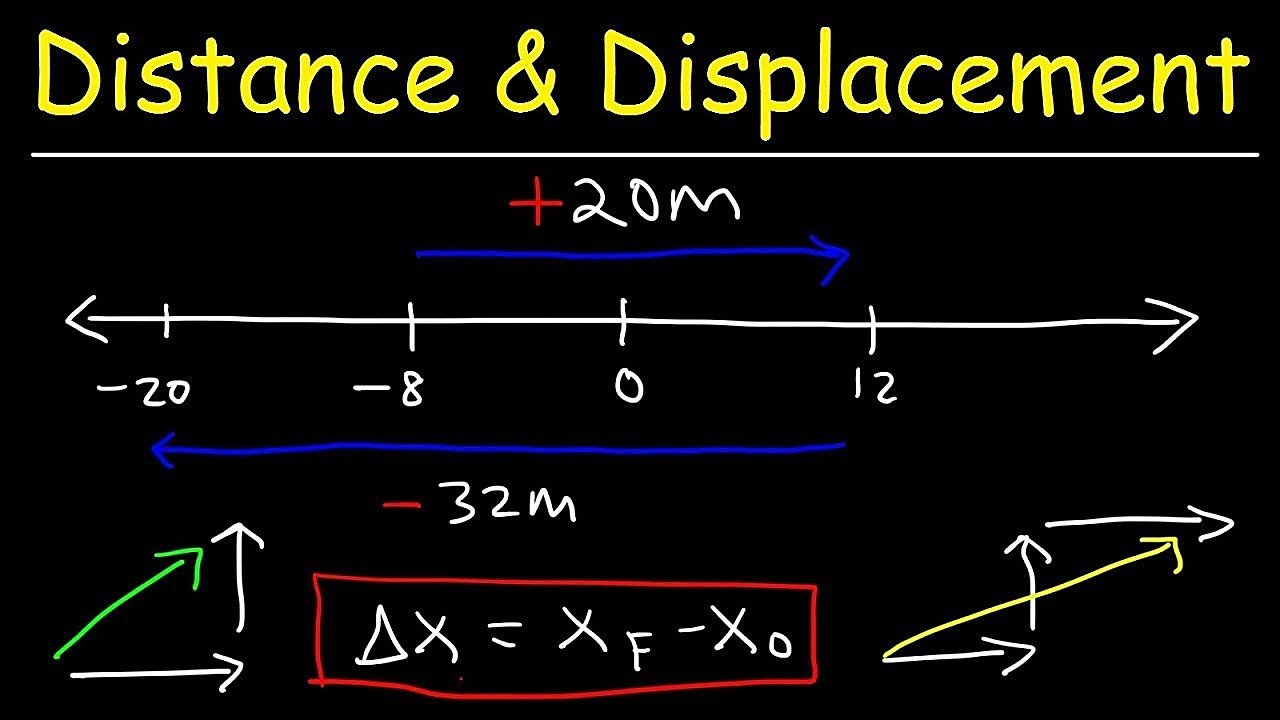
Distance to Displacement: Difference, Conversion Formulas, and 5 Worked Examples
For a reliable reference, consult OpenStax section on position and displacement.
Distance is the total length of the path traveled, and displacement is the straight-line change in position from the start point to the end point. Displacement equals the final position minus the initial position. Distance converts to displacement only when the start point, the end point, and the direction of each path segment are known. This article covers the definitions, formulas for 1D and 2D motion, 5 worked examples, and the link to speed and velocity. Here, distance means distance traveled along the path.
What Is the Difference Between Distance and Displacement?
Distance is the total length of the path an object travels, and displacement is the straight-line change in position from the start point to the end point.
Distance is a scalar quantity with magnitude only. Displacement is a vector quantity with magnitude and direction. Table 1 compares 8 properties of the 2 quantities.
Table 1: Distance compared with displacement
| Property | Distance | Displacement |
|---|---|---|
| Definition | Total length of the path traveled | Change in position from the start point to the end point |
| Quantity type | Scalar | Vector |
| Direction | None | Included |
| Possible values | Zero or positive | Positive, negative, or zero |
| Depends on the path | Yes | No, only on the start and end points |
| SI unit | Meter (m) | Meter (m) |
| Typical symbol | d | Δx or Δr |
| Common measuring device | Odometer | Position difference between 2 points |
OpenStax College Physics 2e separates 2 terms. Distance traveled is the total length of the path, and distance is the magnitude of the displacement between 2 positions. Everyday usage treats distance as the path length.
Can You Convert Distance to Displacement?
Distance cannot convert directly to displacement, because displacement also depends on the start position, the end position, and the direction. A distance traveled of 10 km can produce any displacement magnitude from 0 km to 10 km. The distance sets an upper limit: the magnitude of the displacement is less than or equal to the distance traveled.
Displacement requires 1 of 2 sets of information:
- The start position and the end position.
- The length and direction of each path segment.
When Does Distance Equal Displacement?
Distance traveled equals the magnitude of displacement when an object moves along a straight line in 1 direction without reversing. A car that drives 5 km east on a straight road has d = 5 km and Δx = +5 km east. Any turn or reversal makes the distance traveled greater than the magnitude of the displacement.
Can Displacement Be Greater Than Distance?
The magnitude of displacement is never greater than the distance traveled, because a straight line is the shortest path between 2 points.
What Is the Displacement Formula?
The displacement formula is Δx = xf − xi, where Δx is the displacement, xf is the final position, and xi is the initial position. A positive result points in the positive direction, and a negative result points in the negative direction. The SI unit is the meter (m). The vector form is Δr = rf − ri.
Table 2 lists 7 formulas for displacement and distance by situation.
Table 2: Displacement and distance formulas
| Situation | Formula | Variables |
|---|---|---|
| Straight line (1D) | Δx = xf − xi | xf = final position, xi = initial position, in m |
| Vector form | Δr = rf − ri | rf and ri = position vectors, in m |
| Plane (2D) from components | |Δr| = √(Δx² + Δy²) | Δx = x2 − x1 and Δy = y2 − y1, in m |
| Space (3D) | |Δr| = √(Δx² + Δy² + Δz²) | Δz = z2 − z1, in m |
| Constant velocity | Δx = vt | v = velocity in m/s, t = time in s |
| Constant acceleration | Δx = v0t + ½at² | v0 = initial velocity in m/s, a = acceleration in m/s² |
| Total path length | d = d1 + d2 + … + dn | d1 to dn = lengths of the path segments, in m |
What Is the Distance Formula?
Distance traveled is the sum of the lengths of all path segments, d = d1 + d2 + … + dn. For constant speed, the formula is d = st, where s is the speed and t is the time. The straight-line distance between 2 points in a plane is √((x2 − x1)² + (y2 − y1)²), which equals the magnitude of the displacement.
What Is the Formula for Displacement From Perpendicular Distances?
For 2 perpendicular legs a and b, the displacement magnitude is √(a² + b²) by the Pythagorean theorem, and the direction is θ = tan⁻¹(b/a). A path of 3 km east and 4 km north has a displacement of √(3² + 4²) = 5 km at 53.1° north of east.
How Do You Calculate Displacement From Distance Traveled?
To calculate displacement from distance traveled, list each leg with its direction, resolve the legs into components, add the components, and find the resultant. The 6 steps are:
- List each leg of the path with its distance and direction.
- Choose a coordinate system, such as east and north as the positive directions.
- Resolve each leg into components: x = d cos θ and y = d sin θ.
- Add all x components and all y components to find Δx and Δy.
- Calculate the displacement magnitude: |Δr| = √(Δx² + Δy²).
- Calculate the direction: θ = tan⁻¹(Δy/Δx), adjusted for the quadrant.
What Are 5 Worked Examples of Distance to Displacement?
The 5 worked examples below convert path information into displacement for a straight track, a closed lap, perpendicular legs, a 3-leg walk, and a semicircle.
How Do You Find Displacement for a Runner Who Goes 100 m East and Then 40 m West?
- Given: Leg 1 is 100 m east, and leg 2 is 40 m west. East is positive.
- Distance: d = 100 m + 40 m = 140 m.
- Displacement: Δx = +100 m − 40 m = +60 m.
- Answer: Distance = 140 m, and displacement = 60 m east.
How Do You Find Displacement for One Lap of a 400 m Track?
- Given: The start point and the end point are the same, and the path length is 400 m.
- Distance: d = 400 m.
- Displacement: Δx = xf − xi = 0 m.
- Answer: Distance = 400 m, and displacement = 0 m.
How Do You Find Displacement for 3 km East and Then 4 km North?
- Given: Leg 1 is 3 km east, and leg 2 is 4 km north.
- Distance: d = 3 km + 4 km = 7 km.
- Displacement: |Δr| = √(3² + 4²) = √25 = 5 km, and θ = tan⁻¹(4/3) = 53.1°.
- Answer: Distance = 7 km, and displacement = 5 km at 53.1° north of east.
How Do You Find Displacement for a Walk of 6.0 km East, 8.0 km North, and 2.0 km West?
- Given: Leg 1 is 6.0 km east, leg 2 is 8.0 km north, and leg 3 is 2.0 km west.
- Distance: d = 6.0 + 8.0 + 2.0 = 16.0 km.
- Components: Δx = +6.0 − 2.0 = +4.0 km, and Δy = +8.0 km.
- Displacement: |Δr| = √(4.0² + 8.0²) = √80 = 8.9 km, and θ = tan⁻¹(8.0/4.0) = 63.4°.
- Answer: Distance = 16.0 km, and displacement = 8.9 km at 63.4° north of east.
How Do You Find Displacement for Half a Lap Around a Circle With a 50 m Radius?
- Given: The path is a semicircle with radius r = 50 m.
- Distance: d = πr = 3.1416 × 50 = 157.1 m.
- Displacement: |Δr| = 2r = 100 m, which equals the diameter.
- Answer: Distance = 157.1 m, and displacement = 100 m from the start point to the opposite point on the circle.
How Do Distance and Displacement Relate to Speed and Velocity?
Average speed equals distance traveled divided by time, and average velocity equals displacement divided by time. Speed is a scalar quantity, and velocity is a vector quantity. Table 3 compares the 2 quantities.
Table 3: Average speed compared with average velocity
| Quantity | Formula | Type | Based on |
|---|---|---|---|
| Average speed | d / t | Scalar | Distance traveled |
| Average velocity | Δx / t | Vector | Displacement |
A runner who completes 1 lap of a 400 m track in 80 s has an average speed of 400 m / 80 s = 5.0 m/s. The average velocity is 0 m / 80 s = 0 m/s, because the displacement is 0 m.
How Do Distance and Displacement Appear on Graphs?
A distance-time graph never decreases, and a displacement-time graph can decrease or fall below zero. The slope of a distance-time graph is the speed. The slope of a displacement-time graph is the velocity. A displacement-time graph returns to zero when the object returns to its start point, while a distance-time graph keeps rising.
What Are Real-World Examples of Distance and Displacement?
Distance and displacement appear in navigation, aviation, sports, and biology.
- Navigation: A map app reports the route length as the distance traveled. The straight-line gap between the origin and the destination is the magnitude of the displacement.
- Aviation: A flight path curves around weather and restricted airspace, so the distance traveled exceeds the displacement magnitude.
- Sports: A 42.195 km marathon that starts and finishes at different points has a displacement magnitude below 42.195 km.
- Biology: A bacterium travels a large total distance relative to its size, while its displacement stays small, according to OpenStax College Physics.
A car odometer records distance traveled, not displacement.
What Mistakes Occur Most Often When Converting Distance to Displacement?
5 mistakes occur most often when converting distance to displacement:
- Adding the lengths of the legs to find the displacement instead of adding the vectors.
- Ignoring the direction signs in 1D motion.
- Using the total distance in Δx = xf − xi.
- Reporting the displacement without a direction.
- Mixing units, such as kilometers and meters, within 1 calculation.
What Do People Also Ask About Distance and Displacement?
Is Displacement the Same as Distance?
Displacement is not the same as distance, because displacement is a vector based on the start and end points, and distance is a scalar based on the path length.
What Is the Formula to Convert Distance to Displacement?
No direct formula exists, so use Δx = xf − xi for 1D motion or |Δr| = √(Δx² + Δy²) for 2D motion.
Can Displacement Be Negative?
Displacement is negative when the final position lies in the negative direction from the initial position.
Can Displacement Be Zero When Distance Is Not Zero?
Displacement is zero when the object returns to its start point, such as after 1 lap of a track.
Is Distance a Scalar or a Vector?
Distance is a scalar quantity.
Is Displacement a Scalar or a Vector?
Displacement is a vector quantity.
What Is the SI Unit of Displacement?
The SI unit of displacement is the meter (m).
Can Distance Be Negative?
Distance is never negative, because it measures path length.
Which Is Larger, Distance or Displacement?
Distance traveled is greater than or equal to the magnitude of displacement.
What Is the Shortest Distance Between 2 Points?
The shortest distance is the straight line between the points, and its length equals the magnitude of the displacement.
What Are the Key Takeaways About Distance to Displacement?
Distance to displacement conversion requires the start position, the end position, and the direction of each path segment. The 6 key takeaways are:
- Distance: The total path length, a scalar quantity.
- Displacement: The straight-line change in position, a vector quantity.
- Formula: Δx = xf − xi for 1D motion.
- 2D calculation: |Δr| = √(Δx² + Δy²) after adding components.
- Relationship: Distance traveled is greater than or equal to the magnitude of displacement.
- Motion link: Average speed uses distance, and average velocity uses displacement.

The University of the West Indies
My passion as a teacher and leader in education is to contribute to students’ enhanced learning by creation of a positive teaching/learning environment, where they are motivated to develop strong critical thinking, analytical and problem-solving skills.
As acting Vice-Principal and head of Physics, I have amassed five years of experience in leading meetings, implementing strategies to maintain discipline and school ethos, liaise with stakeholders in planning for future development of the institution; successfully negotiated the implementation of various projects for student development as well as supervising effective execution of such. For the past 19 years, I have incorporated discovery learning within the classroom through practical activities, problem solving and cooperative learning and have realized that students retention in Physics and Mathematics have increased significantly.
I am always cognizant that students have different learning styles, and as such teaching strategies during planning and delivery must take this crucial factor into consideration and be tailored to meet such differences.