

Electric Potential Energy Formula: Equations, Units, Sign Rules, and Worked Examples
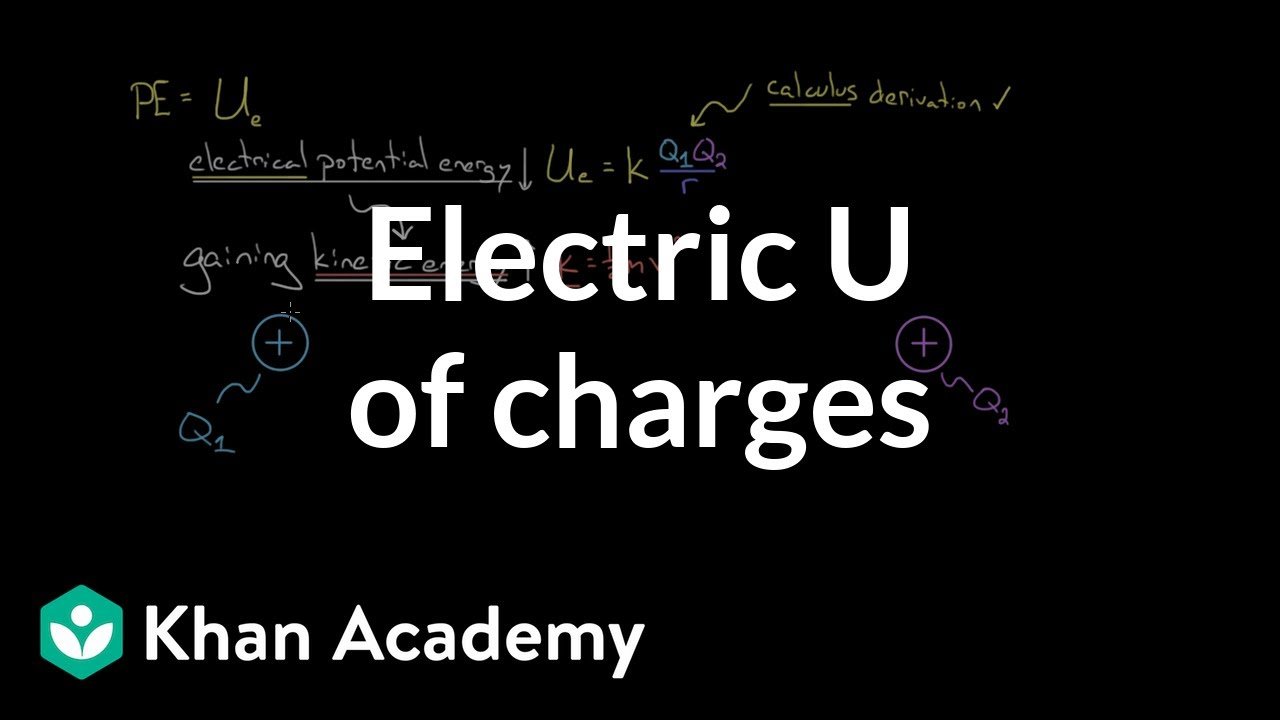
The electric potential energy formula for 2 point charges is U = kq₁q₂/r, where k = 8.99 × 10⁹ N·m²/C². The SI unit is the joule. Other formulas cover uniform fields, charge systems, electric potential, and capacitors. This guide lists 5 equations, the sign rules, the units, and 5 worked examples.
For a related explanation, see Physics 1 Formula Sheet.
What Is Electric Potential Energy?
Electric potential energy is the energy stored in a system of electric charges because of the positions of the charges. The SI unit is the joule (J). Examples include 2 charges held 0.100 m apart, a charge between charged parallel plates, and the charge stored on capacitor plates. According to OpenStax, the work done by a conservative force, such as the electric force, equals the negative change in potential energy: W = −ΔU.
What Does Electric Potential Energy Depend On?
Electric potential energy depends on 3 factors: the magnitude of each charge, the sign of each charge, and the separation distance. Doubling either charge doubles the magnitude of U. Doubling the separation halves the magnitude of U.
What Is the Electric Potential Energy Formula?
The electric potential energy formula for 2 point charges is U = kq₁q₂/r. The same formula is written U = q₁q₂/(4πε₀r). OpenStax sets U = 0 when the charges are infinitely far apart. The table below defines each symbol with its quantity, SI unit, and value.
| Symbol | Quantity | SI Unit | Value or Note |
|---|---|---|---|
| U | Electric potential energy | joule (J) | Zero at infinite separation |
| k | Coulomb constant | N·m²/C² | 8.99 × 10⁹ |
| q₁, q₂ | Point charges | coulomb (C) | Signed values |
| r | Separation between the charges | meter (m) | Positive distance |
| ε₀ | Vacuum electric permittivity | F/m | 8.854 187 8188 × 10⁻¹² |
According to the 2022 CODATA values from NIST, the elementary charge is exactly 1.602 176 634 × 10⁻¹⁹ C, and ε₀ is 8.854 187 8188(14) × 10⁻¹² F/m.
Which Electric Potential Energy Formula Applies to Each Situation?
Five formulas cover point charges, charge systems, uniform fields, electric potential, and capacitors. The table below lists each situation with its formula and symbol definitions.
| Situation | Formula | Symbol Definitions |
|---|---|---|
| Two point charges | U = kq₁q₂/r | k = Coulomb constant, q₁ and q₂ = charges, r = separation |
| System of point charges | U = kΣ(qᵢqⱼ/rᵢⱼ) | Sum over each pair of charges once, rᵢⱼ = separation of charges i and j |
| Uniform electric field | ΔU = −qEd | q = charge, E = field strength, d = distance moved along the field direction |
| Charge at a potential | ΔU = qΔV | q = charge, ΔV = potential difference |
| Capacitor | U = ½CV² | C = capacitance, V = potential difference across the plates |
The capacitor formula has 2 equivalent forms: U = Q²/2C and U = ½QV, where Q is the charge on the plates.
How Do Signs Affect Electric Potential Energy?
The sign of electric potential energy matches the sign of the product q₁q₂. Like charges give positive U, and opposite charges give negative U. The table below lists the 3 charge combinations with the force type and the change in U as the separation increases.
| Charge Combination | Sign of q₁q₂ | Sign of U | Force Type | Change in U as Separation Increases |
|---|---|---|---|---|
| Both positive | Positive | Positive | Repulsive | U decreases toward zero |
| Both negative | Positive | Positive | Repulsive | U decreases toward zero |
| Opposite signs | Negative | Negative | Attractive | U increases toward zero |
A negative U means the charges form a bound system. Separating the charges to infinite distance requires external work equal to |U|.
How Do You Calculate Electric Potential Energy?
Calculate electric potential energy by selecting the formula for the situation and substituting signed values in SI units. The calculation takes 6 steps:
- Identify the situation, such as 2 point charges or a charge in a uniform field.
- Convert charges to coulombs (1 nC = 10⁻⁹ C, 1 μC = 10⁻⁶ C) and distances to meters.
- Select the matching formula from the table above.
- Substitute each charge with its sign.
- Calculate each pair once, if the system has 3 or more charges.
- Report the result in joules with its sign.
What Are Worked Examples of the Electric Potential Energy Formula?
Five worked examples apply the formulas to like charges, opposite charges, 3 charges, a uniform field, and an accelerated electron. The table below lists the given values, the formula, and the result of each example.
| Example | Given | Formula and Substitution | Result |
|---|---|---|---|
| 1. Like charges | q₁ = +5.00 nC, q₂ = +3.00 nC, r = 0.100 m | U = (8.99 × 10⁹)(5.00 × 10⁻⁹)(3.00 × 10⁻⁹)/0.100 | U = +1.35 × 10⁻⁶ J |
| 2. Opposite charges | q₁ = +2.00 μC, q₂ = −3.00 μC, r = 0.500 m | U = (8.99 × 10⁹)(2.00 × 10⁻⁶)(−3.00 × 10⁻⁶)/0.500 | U = −0.108 J |
| 3. Three charges | +2.00 nC, +2.00 nC, and −2.00 nC at the corners of a triangle with 0.100 m sides | Each pair gives kq²/r = 3.60 × 10⁻⁷ J, with signs +, −, − | U = −3.60 × 10⁻⁷ J |
| 4. Uniform field | q = +0.500 μC, E = 6.25 × 10⁵ V/m, d = 0.0400 m along the field | ΔU = −(0.500 × 10⁻⁶)(6.25 × 10⁵)(0.0400) | ΔU = −1.25 × 10⁻² J |
| 5. Electron through 100 V | q = −1.60 × 10⁻¹⁹ C, ΔV = +100 V | ΔU = (−1.60 × 10⁻¹⁹)(100) | ΔU = −1.60 × 10⁻¹⁷ J, v = 5.93 × 10⁶ m/s |
In example 1, increasing the separation to 0.150 m lowers U to 8.99 × 10⁻⁷ J. The change is ΔU = −4.5 × 10⁻⁷ J. OpenStax reports the same change for this setup, and the charges gain 4.5 × 10⁻⁷ J of kinetic energy.
How Is Electric Potential Energy Related to Electric Potential?
Electric potential energy equals charge times electric potential: U = qV. OpenStax defines electric potential as potential energy per unit charge, V = U/q. The table below compares the 2 quantities across 4 features.
| Feature | Electric Potential Energy (U) | Electric Potential (V) |
|---|---|---|
| Definition | Energy of a charge in a field or charge system | Potential energy per unit charge |
| Formula | U = qV | V = U/q |
| SI unit | joule (J) | volt (V), where 1 V = 1 J/C |
| Dependence on test charge | Depends on the charge | Independent of the charge |
OpenStax states that voltage is energy per unit charge, so voltage is not the same as energy.
What Is the Unit of Electric Potential Energy?
The SI unit of electric potential energy is the joule (J), where 1 J = 1 N·m. Atomic and particle physics use the electron-volt (eV). One electron-volt is the energy gained by an elementary charge through 1 V. The table below converts 3 energy units to joules.
| Unit | Symbol | Value in Joules |
|---|---|---|
| Electron-volt | eV | 1.602 176 634 × 10⁻¹⁹ J |
| Kiloelectron-volt | keV | 1.602 176 634 × 10⁻¹⁶ J |
| Megaelectron-volt | MeV | 1.602 176 634 × 10⁻¹³ J |
The electron-volt equals the elementary charge times 1 V, so its value is exact in the 2022 CODATA values.
How Does Electric Potential Energy Relate to Work and Kinetic Energy?
The work done by the electric force equals the negative change in electric potential energy: W = −ΔU. A system with only electric forces conserves energy, so ΔK + ΔU = 0. Repelled like charges lose potential energy and gain kinetic energy by the same amount.
What Mistakes Do Students Make With Electric Potential Energy?
Five mistakes lose points in electric potential energy problems:
- Using centimeters or nanocoulombs without converting to meters or coulombs
- Dropping the sign of a charge in U = kq₁q₂/r
- Confusing electric potential energy U with electric potential V
- Counting the same pair of charges twice in a system of 3 or more charges
- Assuming electric potential is zero wherever the electric field is zero
Physics education research documents errors in this topic. A review of electricity and magnetism misconceptions cites Bagno and Eylon (1997), who found that 62% of students answered incorrectly when asked whether the potential is zero where the field is zero. The review also cites Galili (1995), who found that fewer than one third of students correctly identified the source of a charge's kinetic energy gain in an electric field.
What Are People Also Asking About the Electric Potential Energy Formula?
What is the formula for electric potential energy?
The formula for electric potential energy of 2 point charges is U = kq₁q₂/r.
What is the formula for electric potential energy in terms of voltage?
The formula in terms of voltage is U = qV, where q is the charge and V is the electric potential.
What is the value of k in the electric potential energy formula?
The Coulomb constant is k = 8.99 × 10⁹ N·m²/C².
Can electric potential energy be negative?
Yes, electric potential energy is negative for opposite charges, when U = 0 at infinite separation.
Is electric potential energy a scalar or a vector?
Electric potential energy is a scalar quantity with a sign and no direction.
What is the difference between electric potential energy and electric potential?
Electric potential energy is the energy of a charge, and electric potential is the energy per unit charge.
Why Does the Electric Potential Energy Formula Matter in Physics?
The electric potential energy formula matters because it gives the energy of charge arrangements, the work done by electric forces, and the speed gained by charged particles. The point-charge formula U = kq₁q₂/r, the uniform-field formula ΔU = −qEd, and the relation U = qV cover point charges, uniform fields, and potentials in introductory electrostatics. Sign rules and SI units determine the correct result.
Title tag: Units of Momentum: 4 Unit Systems and Conversions
Meta description: Units of momentum: the SI unit is kg·m/s, equal to N·s. See 4 unit systems, conversion factors, dimensions, and 6 worked examples.
For the official reference, consult OpenStax University Physics Electric Potential Energy.

The University of the West Indies
My passion as a teacher and leader in education is to contribute to students’ enhanced learning by creation of a positive teaching/learning environment, where they are motivated to develop strong critical thinking, analytical and problem-solving skills.
As acting Vice-Principal and head of Physics, I have amassed five years of experience in leading meetings, implementing strategies to maintain discipline and school ethos, liaise with stakeholders in planning for future development of the institution; successfully negotiated the implementation of various projects for student development as well as supervising effective execution of such. For the past 19 years, I have incorporated discovery learning within the classroom through practical activities, problem solving and cooperative learning and have realized that students retention in Physics and Mathematics have increased significantly.
I am always cognizant that students have different learning styles, and as such teaching strategies during planning and delivery must take this crucial factor into consideration and be tailored to meet such differences.
1 Comment
Pingback: SI Unit for Electric Potential: The Volt, Its Definition, Equivalent Forms, and Worked Examples