

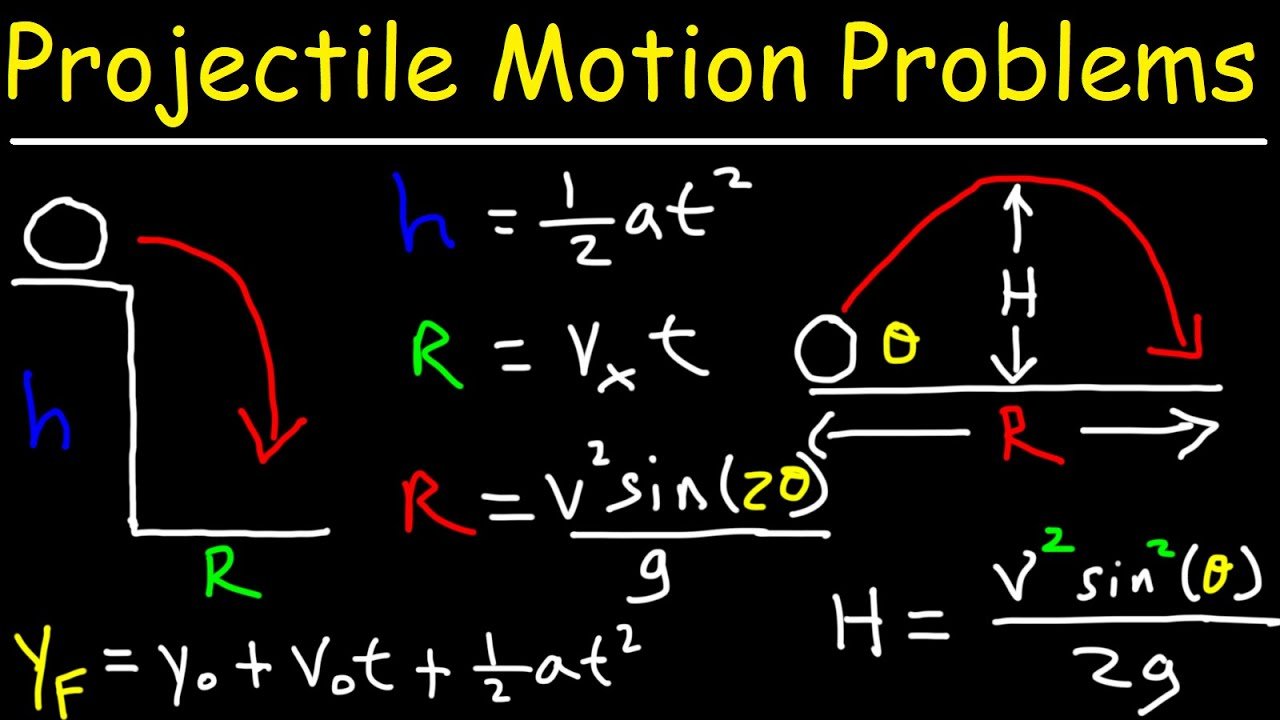
Projectile Motion: 6 Equations, 2 Types, and 3 Solved Problems
Projectile motion is a core topic in kinematics, and its vertical calculations use the same SUVAT equations explained in the main guide. This article covers the definition, 6 equations, horizontal and vertical formulas, launch angle effects, 3 solved practice problems, and real-world applications, solving all major user intents from definition through calculation.
What Is Projectile Motion?
Projectile motion is the curved, parabolic path an object follows when launched into the air and acted on only by gravity. Examples include a thrown baseball, a kicked football, a fired cannonball, and a ball rolling off a tabletop.
The launched object is called a projectile. The curved path it follows is called a trajectory. Galileo Galilei first described projectile motion mathematically in the early 17th century, establishing that horizontal and vertical motion are independent of each other.
What Are the 4 Key Characteristics of Projectile Motion?
Projectile motion has 4 defining characteristics: a parabolic trajectory, constant horizontal velocity, downward-accelerating vertical velocity, and gravity as the only acting force.
- Parabolic trajectory: The path forms a symmetric parabola that rises and falls at equal rates on both sides of the peak.
- Constant horizontal velocity: No horizontal force acts on the projectile, so horizontal speed stays constant throughout flight.
- Changing vertical velocity: Vertical speed decreases at 9.8 m/s² on the way up and increases at 9.8 m/s² on the way down.
- Single force: Gravity is the only force in basic projectile motion. Air resistance and wind are excluded from the standard model.
What Are the 2 Components of Projectile Motion?
Projectile motion has 2 independent components: horizontal and vertical. These 2 components are analyzed separately using different equations.
The horizontal component has zero acceleration. Horizontal velocity (vx = v0cosθ) remains constant for the entire flight. The vertical component has a downward acceleration of 9.8 m/s² due to gravity. Vertical velocity changes throughout the motion. This 2-component model is the foundation for solving all projectile motion problems.
What Are the Projectile Motion Equations?
The 6 core projectile motion equations calculate horizontal position, vertical position, horizontal velocity, vertical velocity, maximum height, and total range.
The 6 equations are:
- x = v0cosθ × t
- y = v0sinθ × t − (1/2)gt²
- vx = v0cosθ
- vy = v0sinθ − gt
- H = (v0sinθ)² / (2g)
- R = v0²sin(2θ) / g
The table below defines each equation, the quantity it calculates, and the key variables.
| Equation | Quantity Calculated | Key Variables |
|---|---|---|
| x = v0cosθ × t | Horizontal position (m) | v0 = initial velocity, θ = launch angle, t = time |
| y = v0sinθ × t − (1/2)gt² | Vertical position (m) | g = 9.8 m/s² gravitational acceleration |
| vx = v0cosθ | Horizontal velocity (m/s) | Constant; does not change during flight |
| vy = v0sinθ − gt | Vertical velocity at time t (m/s) | Decreases due to gravity |
| H = (v0sinθ)² / (2g) | Maximum height (m) | Applies when vy = 0 at the peak |
| R = v0²sin(2θ) / g | Total horizontal range (m) | Applies when launch and landing heights are equal |
| T = 2v0sinθ / g | Total time of flight (s) | Derived from the vertical position equation |
The standard value g = 9.8 m/s² applies at Earth’s surface. Some textbooks use g = 9.81 m/s² for greater precision.
What Is the Horizontal Projectile Motion Formula?
The horizontal position formula is x = v0cosθ × t. For a purely horizontal launch where θ = 0°, this simplifies to x = v0t because cos(0°) = 1.
Variables in the horizontal formula:
- x = horizontal distance in meters
- v0 = initial speed in m/s
- θ = launch angle in degrees
- t = elapsed time in seconds
Horizontal velocity does not change during flight. Air resistance is excluded from this formula.
What Is the Vertical Projectile Motion Formula?
The vertical position formula is y = v0sinθ × t − (1/2)gt². The negative term accounts for the downward acceleration of gravity.
At t = 0, the projectile is at the launch position (y = 0). Vertical position increases until vertical velocity reaches 0 at the peak, then decreases as gravity accelerates the object downward toward the ground.
What Is the Range Formula in Projectile Motion?
The range formula is R = v0²sin(2θ) / g. Range is the total horizontal distance from launch point to landing point.
This formula applies only when the projectile lands at the same height from which it was launched. A 45° launch angle produces the maximum range for any fixed initial speed.
What Is the Time of Flight Formula?
Time of flight is T = 2v0sinθ / g. It represents the total airborne time from launch to landing.
At v0 = 20 m/s and θ = 45°, time of flight equals T = 2 × 20 × sin45° / 9.8 = 2 × 20 × 0.707 / 9.8 = 2.89 seconds. Time of flight doubles when initial vertical velocity doubles, all else equal.
What Is the Maximum Height Formula?
Maximum height is H = (v0sinθ)² / (2g). A projectile reaches maximum height when vertical velocity equals 0 m/s.
The time to reach maximum height is t = v0sinθ / g. This time is exactly half the total time of flight. At maximum height, only horizontal velocity remains active. Vertical velocity is zero at that exact point.
What Is the Difference Between Horizontal and Vertical Projectile Motion?
Horizontal projectile motion uses a 0° launch angle. Vertical projectile motion uses a 90° launch angle. Real problems typically involve angles between 0° and 90°, combining both components.
The table below compares the 2 types across 6 features.
| Feature | Horizontal Projectile Motion | Vertical Projectile Motion |
|---|---|---|
| Launch angle (θ) | 0° | 90° |
| Initial horizontal velocity | Equal to v0 | 0 m/s |
| Initial vertical velocity | 0 m/s | Equal to v0 |
| Trajectory shape | Curved arc downward | Straight line up, then down |
| Horizontal range | Depends on launch height | 0 m (lands at same horizontal point) |
| Example | Ball rolled off a 1.2 m table | Ball thrown straight upward |
In horizontal projectile motion, the object has no initial upward velocity. Gravity pulls it downward from the instant of launch. In vertical projectile motion, the object travels straight up, decelerates at 9.8 m/s², stops at maximum height, and falls straight back down.
How Does Launch Angle Affect Projectile Motion?
A 45° launch angle produces the maximum range in projectile motion for any fixed initial speed. Angles above 45° increase maximum height but reduce range. Angles below 45° reduce both height and range.
Complementary angles such as 30° and 60° produce identical ranges but different maximum heights. The table below shows range and height at 5 launch angles for v0 = 20 m/s.
| Launch Angle (θ) | Range (R) | Maximum Height (H) |
|---|---|---|
| 15° | 20.4 m | 1.37 m |
| 30° | 35.4 m | 5.10 m |
| 45° | 40.8 m (maximum range) | 10.2 m |
| 60° | 35.4 m | 15.3 m |
| 75° | 20.4 m | 19.0 m |
The data confirms 2 patterns. First, complementary angles (15° and 75°, 30° and 60°) produce equal ranges. Second, the 45° angle delivers the highest range at any fixed initial velocity.
How Does a Projectile Motion Calculator Work?
A projectile motion calculator computes range, maximum height, and time of flight from 2 inputs: initial velocity (v0) and launch angle (θ). The calculator applies all 6 equations simultaneously and returns all output values.
Manual calculation steps:
- Enter v0 in m/s and θ in degrees.
- Compute horizontal velocity: vx = v0cosθ.
- Compute vertical velocity: vy = v0sinθ.
- Apply the relevant formula for range, height, or time.
The <a href="https://phet.colorado.edu/en/simulations/projectile-motion" target="_blank" rel="noopener">PhET Projectile Motion simulation</a> from the University of Colorado Boulder is a free browser-based tool. It allows testing with real objects including a basketball, cannonball, and golf ball. It includes adjustable air resistance, which shows the difference between ideal and real-world trajectories.
How to Solve Projectile Motion Problems
Solve projectile motion problems by separating horizontal and vertical components, listing known variables, selecting the correct equation, and solving step by step.
The 4-step method:
- Write known values: v0, θ, height (y), time (t), or range (x).
- Calculate vx = v0cosθ and vy = v0sinθ.
- Select the formula matching the unknown variable.
- Substitute values and compute.
Solved Problem 1: Range at a 30° Angle
Problem: A ball is launched at 20 m/s at 30°. Calculate the horizontal range.
Given: v0 = 20 m/s, θ = 30°, g = 9.8 m/s²
Solution:
R = v0²sin(2θ) / g
R = (20)² × sin(60°) / 9.8
R = 400 × 0.866 / 9.8
R = 346.4 / 9.8
R = 35.35 meters
Solved Problem 2: Maximum Height at 45°
Problem: A ball is launched at 15 m/s at 45°. Find the maximum height reached.
Given: v0 = 15 m/s, θ = 45°, g = 9.8 m/s²
Solution:
H = (v0sinθ)² / (2g)
H = (15 × sin45°)² / (2 × 9.8)
H = (15 × 0.7071)² / 19.6
H = (10.607)² / 19.6
H = 112.5 / 19.6
H = 5.74 meters
Solved Problem 3: Horizontal Launch from a Height
Problem: A ball rolls off a 1.2 m high table at 5 m/s horizontally. Find the time to hit the ground and the horizontal distance traveled.
Given: y = 1.2 m, v0 = 5 m/s, θ = 0°, g = 9.8 m/s²
Step 1: Find time using y = (1/2)gt²
1.2 = (1/2) × 9.8 × t²
1.2 = 4.9t²
t² = 0.245
t = 0.495 seconds
Step 2: Find horizontal distance
x = v0 × t = 5 × 0.495
x = 2.47 meters
What Are Real-World Examples of Projectile Motion?
Projectile motion appears in 5 real-world domains: sports, ballistics, engineering, automotive safety, and space physics.
- Sports: A basketball released toward the hoop follows a parabolic arc. A soccer ball kicked at 45° covers the maximum ground distance before landing.
- Ballistics: A bullet exits a rifle barrel and immediately follows projectile motion. Short-range ballistics use the 6 standard equations. Long-range ballistics (above 1 km) add air drag and Coriolis corrections.
- Engineering: A water fountain nozzle directs water at a calculated angle to achieve a specific arc and range. Engineers apply the range formula to set nozzle pressure and angle.
- Automotive safety: Crash testing uses projectile motion equations to predict the flight path of objects inside a vehicle during a collision.
- Space physics: Objects released from moving spacecraft in low-gravity environments follow projectile-like paths, governed by the local gravitational acceleration rather than 9.8 m/s².
What Are the 3 Assumptions in Projectile Motion?
The 3 standard assumptions in basic projectile motion are no air resistance, constant gravitational acceleration of 9.8 m/s², and a flat Earth surface.
These 3 assumptions hold for small-scale problems such as a ball thrown across a field or a projectile fired within 1 kilometer. For long-range applications, engineers apply extended models that include:
- Air drag proportional to the square of velocity
- The Coriolis effect from Earth’s rotation
- Variation in g at different altitudes above sea level
People Also Ask About Projectile Motion
What is the time of flight formula in projectile motion? Time of flight is T = 2v0sinθ / g, representing the total time a projectile spends in the air from launch to landing.
Does mass affect projectile motion? Mass does not affect projectile motion when air resistance is ignored. All objects fall at 9.8 m/s² regardless of mass, a principle established by Galileo Galilei in the early 17th century.
Is projectile motion 1D or 2D? Projectile motion is 2-dimensional. It combines horizontal (1D) and vertical (1D) motion into a single parabolic trajectory.
What is the velocity at maximum height in projectile motion? At maximum height, vertical velocity equals 0 m/s. Horizontal velocity remains constant at vx = v0cosθ throughout the entire flight.
What angle gives the maximum range? A 45° launch angle gives the maximum range in projectile motion for any fixed initial speed and constant gravitational acceleration.
What is a projectile in physics? A projectile is any object launched into the air that moves under gravity alone, with no active propulsion after the initial launch. Examples include balls, bullets, and cannonballs.

The University of the West Indies
My passion as a teacher and leader in education is to contribute to students’ enhanced learning by creation of a positive teaching/learning environment, where they are motivated to develop strong critical thinking, analytical and problem-solving skills.
As acting Vice-Principal and head of Physics, I have amassed five years of experience in leading meetings, implementing strategies to maintain discipline and school ethos, liaise with stakeholders in planning for future development of the institution; successfully negotiated the implementation of various projects for student development as well as supervising effective execution of such. For the past 19 years, I have incorporated discovery learning within the classroom through practical activities, problem solving and cooperative learning and have realized that students retention in Physics and Mathematics have increased significantly.
I am always cognizant that students have different learning styles, and as such teaching strategies during planning and delivery must take this crucial factor into consideration and be tailored to meet such differences.
1 Comment
Pingback: Pythagorean Identities: 3 Formulas, Proofs, and Examples