

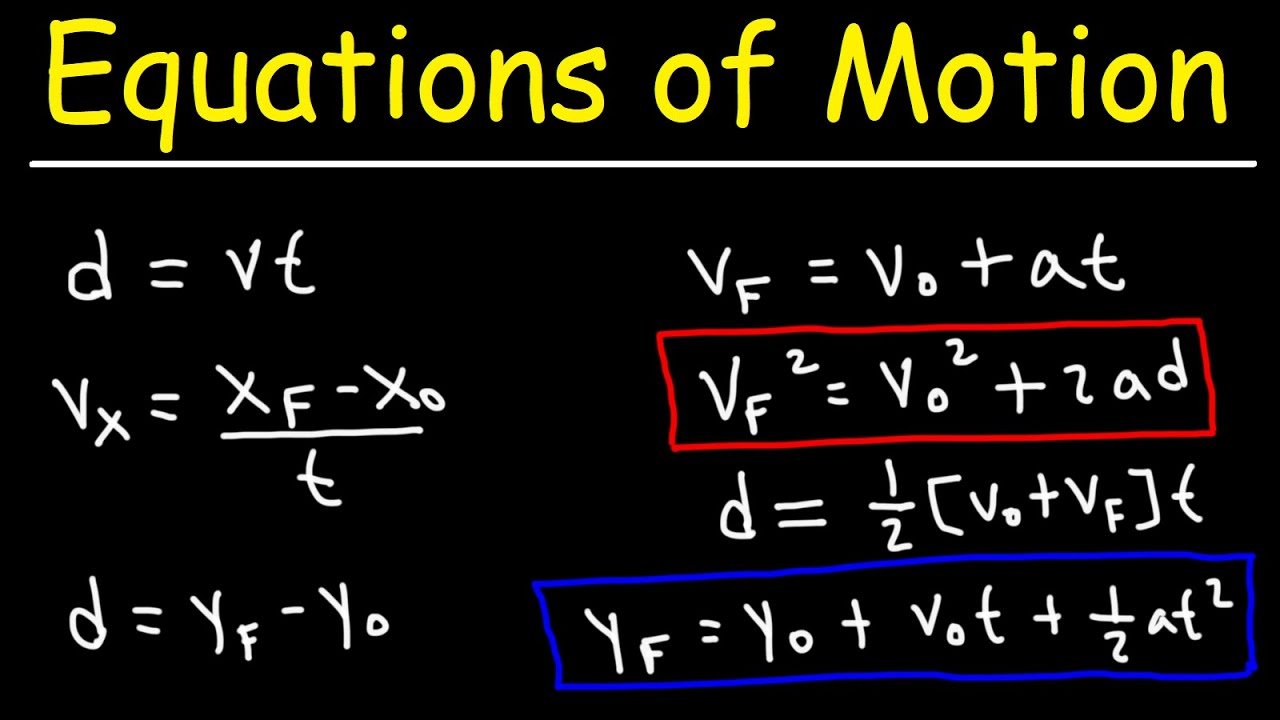
Equations of Motion: 4 SUVAT Formulas, Variables, and Worked Examples
The equations of motion are 4 kinematic formulas that calculate displacement, velocity, acceleration, and time for objects moving with constant acceleration in a straight line. They are called the SUVAT equations after the 5 variables they use: s, u, v, a, and t.
For a textbook reference, OpenStax’s motion equations for constant acceleration section develops the kinematic relationships from displacement, velocity, and acceleration.
What Are the Equations of Motion?
The equations of motion are 4 formulas that connect displacement, initial velocity, final velocity, acceleration, and time for an object moving under constant acceleration. Each equation contains 4 of the 5 SUVAT variables and omits the 5th.
The physics behind these equations was established by Galileo Galilei in the 16th century through experiments with objects in freefall and on inclined planes.
What Do the SUVAT Variables Mean?
SUVAT stands for the 5 variables used across the equations of motion. Each has a defined SI unit and a specific physical meaning.
| Variable | Meaning | SI Unit |
|---|---|---|
| s | Displacement | metres (m) |
| u | Initial velocity | metres per second (m/s) |
| v | Final velocity | metres per second (m/s) |
| a | Acceleration | metres per second squared (m/s²) |
| t | Time | seconds (s) |
Displacement (s) is a vector quantity. It measures how far an object has moved from its starting point in a specified direction. Distance measures total path length regardless of direction.
What Are the 4 Equations of Motion?
The 4 equations of motion are v = u + at, s = ut + ½at², v² = u² + 2as, and s = ½(u + v)t. Each equation omits 1 of the 5 SUVAT variables.
| Equation | Formula | Variable Omitted |
|---|---|---|
| Equation 1 | v = u + at | s |
| Equation 2 | s = ut + ½at² | v |
| Equation 3 | v² = u² + 2as | t |
| Equation 4 | s = ½(u + v)t | a |
All 4 equations assume acceleration is constant throughout the motion. They produce incorrect results when acceleration varies.
Which Equation of Motion Should You Use?
Select the equation that contains the 3 known variables and the 1 unknown variable. The variable the equation omits is the one not needed for that problem.
Follow this 4-step process:
- Write down every variable given in the question with its value and unit.
- Identify the variable the question asks you to find.
- Select the equation whose omitted variable is the one not mentioned in the question.
- Rearrange the equation to make the unknown the subject, then substitute values.
Example: Known variables are u, a, and t. Unknown is v. The equation that omits s is v = u + at. Use Equation 1.
How to Use the Equations of Motion
List the known variables, identify the unknown, select the matching equation, and substitute values. Assign a positive direction before substituting any numbers.
Before calculating:
- Define which direction is positive (upward, rightward, or the direction of initial motion)
- Apply negative signs to any quantity acting against the positive direction
- Convert all values into SI units before substituting
Worked Example 1: Finding Final Velocity
A car accelerates from rest at 3 m/s² for 8 seconds. Find its final velocity.
Known: u = 0 m/s, a = 3 m/s², t = 8 s. Unknown: v. Displacement not needed, so omit s.
Use Equation 1: v = u + at
v = 0 + (3)(8)
v = 24 m/s
The car starts from rest, which means u = 0. Equation 1 is correct because s is not needed and not given.
Worked Example 2: Finding Displacement
A ball is thrown upward at 15 m/s. Find its displacement after 2 seconds. Take upward as positive. Use g = 9.8 m/s².
Known: u = 15 m/s, a = -9.8 m/s², t = 2 s. Unknown: s. Final velocity not needed.
Use Equation 2: s = ut + ½at²
s = (15)(2) + ½(-9.8)(2²)
s = 30 + (-19.6)
s = 10.4 m
The ball is 10.4 m above its starting point after 2 seconds. Acceleration is negative because gravity acts downward, opposing the defined positive direction.
Worked Example 3: When Time Is Unknown
A cyclist traveling at 12 m/s decelerates at 4 m/s² and comes to rest. Find the distance traveled before stopping.
Known: u = 12 m/s, v = 0 m/s, a = -4 m/s². Unknown: s. Time is neither given nor needed.
Use Equation 3: v² = u² + 2as
0² = 12² + 2(-4)(s)
0 = 144 – 8s
8s = 144
s = 18 m
Equation 3 is the only equation that excludes time, which makes it the correct choice when t is missing from both the given values and the question.
Where Do the Equations of Motion Come From?
The equations of motion are derived from 2 definitions: acceleration equals change in velocity divided by time, and displacement equals average velocity multiplied by time.
Equation 1 comes directly from the definition of acceleration:
a = (v – u) / t, rearranged: v = u + at
Equation 4 comes from the definition of average velocity under constant acceleration. Average velocity equals ½(u + v). Multiplying by time gives:
s = ½(u + v)t
Equation 2 is derived by substituting Equation 1 into Equation 4, replacing v with (u + at):
s = ½(u + u + at)t, which simplifies to s = ut + ½at²
Equation 3 is derived by eliminating t between Equations 1 and 4, producing:
v² = u² + 2as
The same 4 equations are derived geometrically from the area under a velocity-time graph, where the total area equals displacement.
What Are the Conditions for Using the Equations of Motion?
The equations of motion apply only when acceleration is constant and motion occurs in a straight line. 3 conditions must be met:
- Acceleration is uniform throughout the entire motion.
- Motion is in one direction along a straight line.
- A reference point and positive direction are defined before calculating.
The equations do not apply to these 3 motion types:
- Variable acceleration (requires calculus: v = ∫a dt, s = ∫v dt)
- Circular motion
- Simple harmonic motion, such as springs and pendulums, where acceleration varies with position
Do the Equations of Motion Apply to Projectile Motion?
Yes. Projectile motion uses the equations of motion by applying them separately to the horizontal and vertical components.
| Direction | Acceleration | Applicable Equations |
|---|---|---|
| Horizontal | 0 m/s² (no air resistance) | s = ut only (Equation 2 simplified) |
| Vertical | 9.8 m/s² downward | All 4 equations apply |
Time (t) is the shared variable between horizontal and vertical motion. Finding t from the vertical component allows horizontal displacement to be calculated, and vice versa.
What Value of g Is Used in the Equations of Motion?
The standard gravitational acceleration used in the equations of motion is g = 9.8 m/s². The exact value depends on the exam board.
| Curriculum | Value of g |
|---|---|
| GCSE Physics (UK) | 9.8 m/s² or 10 m/s² |
| A-Level Physics (UK) | 9.81 m/s² |
| AP Physics (US) | 9.8 m/s² |
| IB Physics | 9.81 m/s² |
Always use the value given on the exam data sheet. When upward is the positive direction, substitute a = -9.8 m/s² in all vertical calculations.
What Are the Most Common Mistakes When Using the Equations of Motion?
4 errors account for the majority of incorrect answers in SUVAT problems.
- No positive direction defined. Signs on velocity and acceleration become inconsistent when no direction is set at the start. Define it in the first line of working.
- Wrong value for u. At the highest point of a thrown object, v = 0 m/s. This becomes the new u for the downward journey, not the original throwing speed.
- Positive sign on g. In freefall problems with upward as positive, a = -9.8 m/s², not +9.8 m/s².
- Choosing an equation that requires the missing variable. If t is unknown and not needed, Equation 3 is correct. Using Equation 1 or Equation 2 requires t and will not solve.
Checking that the final answer makes physical sense eliminates most of these errors before submitting.
Equations of Motion Practice Questions
These 3 questions test the 3 most frequently examined SUVAT applications in GCSE and A-Level physics.
- A stone is dropped from a cliff and takes 4 seconds to reach the base. Find its final velocity and the height of the cliff. (u = 0, a = 9.8 m/s², t = 4 s)
- A train decelerates uniformly from 30 m/s to rest over 450 m. Find the deceleration and the time taken to stop.
- A ball is launched horizontally at 8 m/s from a platform 5 m above the ground. Find the time to reach the ground and the horizontal distance traveled.

The University of the West Indies
My passion as a teacher and leader in education is to contribute to students’ enhanced learning by creation of a positive teaching/learning environment, where they are motivated to develop strong critical thinking, analytical and problem-solving skills.
As acting Vice-Principal and head of Physics, I have amassed five years of experience in leading meetings, implementing strategies to maintain discipline and school ethos, liaise with stakeholders in planning for future development of the institution; successfully negotiated the implementation of various projects for student development as well as supervising effective execution of such. For the past 19 years, I have incorporated discovery learning within the classroom through practical activities, problem solving and cooperative learning and have realized that students retention in Physics and Mathematics have increased significantly.
I am always cognizant that students have different learning styles, and as such teaching strategies during planning and delivery must take this crucial factor into consideration and be tailored to meet such differences.