

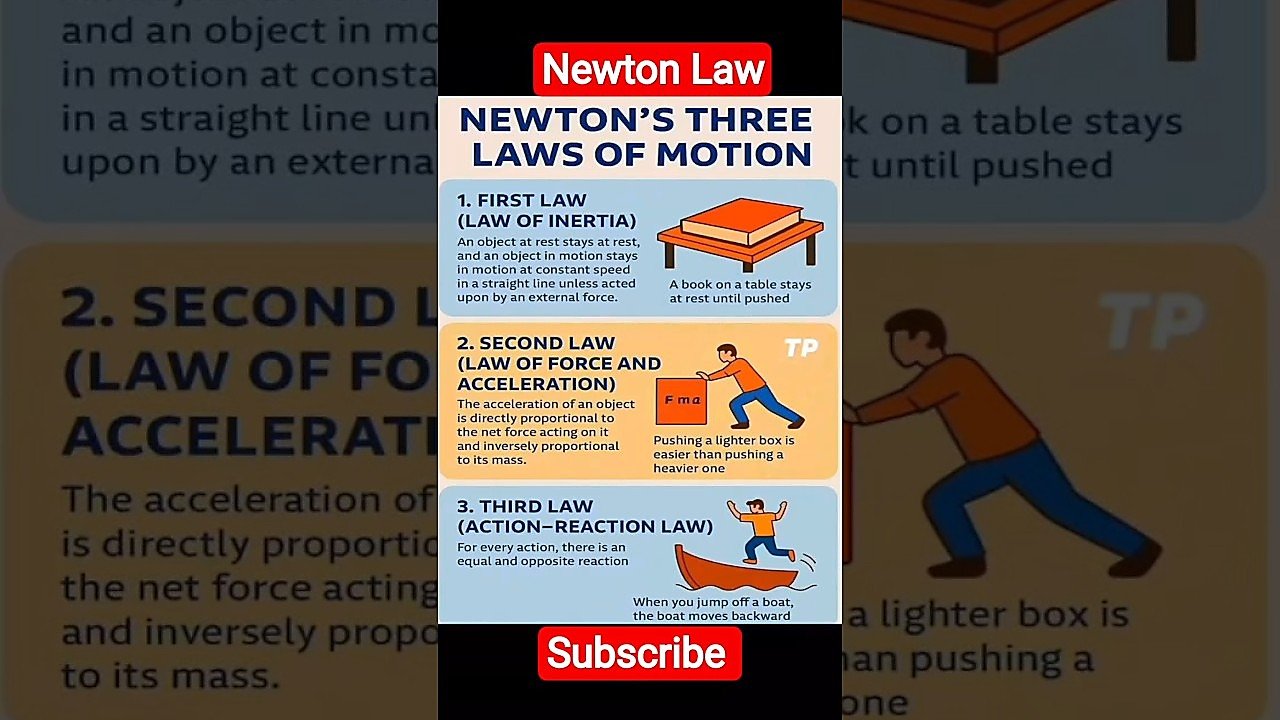
Newton's First Law of Motion: Definition, Formula, 10 Examples, and 5 Misconceptions
Newton's first law of motion states that an object stays at rest or keeps moving at constant velocity in a straight line unless a net external force acts on it. Isaac Newton published the law in 1687. The law is also known as the law of inertia, and its formula is ΣF = 0.
What Is Newton's First Law of Motion?
Newton's first law of motion states that an object remains at rest or moves at constant velocity in a straight line unless a net external force changes its state.
NASA Glenn Research Center describes the first law as a rule for every object: rest or uniform straight-line motion continues until an external force acts.
Objects include books, cars, planets, and spacecraft. The law covers 2 states of motion:
- Rest: the velocity of the object equals zero.
- Uniform motion: the object moves at constant speed in a straight line.
A net external force is the vector sum of all outside forces on an object. External forces include gravity, friction, tension, and air resistance. Newton first published the 3 laws of motion on July 5, 1687, in Philosophiæ Naturalis Principia Mathematica.
What Is the Formula for Newton's First Law?
The formula for Newton's first law is ΣF = 0, which means the net force on an object equals zero when the object stays at rest or keeps a constant velocity.
Zero net force produces zero acceleration, so the velocity of the object stays constant. The forms below express the same law:
- ΣF = 0: net force equals zero
- a = 0: acceleration equals zero
- Δv = 0: change in velocity equals zero
- Δp = 0: change in momentum equals zero (for constant mass)
The table below defines each symbol in the formula and states the value of each quantity under Newton's first law.
| Symbol | Quantity | SI Unit | Meaning | Value Under the First Law |
|---|---|---|---|---|
| ΣF | Net force | newton (N) | Vector sum of all external forces on an object | 0 N |
| a | Acceleration | meter per second squared (m/s²) | Rate of change of velocity | 0 m/s² |
| v | Velocity | meter per second (m/s) | Speed with direction | Constant |
| Δp | Change in momentum | kilogram meter per second (kg·m/s) | Change in the product of mass and velocity | 0 kg·m/s |
A 2 kg book resting on a table has a gravitational force of 19.6 N downward, using g = 9.8 m/s². The table pushes upward with 19.6 N. The net force equals 0 N, so the book stays at rest.
The arXiv paper On Foundations of Newtonian Mechanics states the same result: no force produces no acceleration, so a body maintains its velocity.
What Is Inertia in Newton's First Law?
Inertia is the property of matter that resists changes in the state of motion of an object. A body at rest stays at rest, and a body in motion keeps its velocity, until a force acts.
Why Is Newton's First Law Called the Law of Inertia?
Newton's first law is called the law of inertia because modern physics treats inertia and the first law as the same phenomenon.
The term inertia derives from a Latin word meaning sluggishness. According to Universe Today, Johannes Kepler first used the term in Epitome Astronomiae Copernicanae, published from 1618 to 1621. Synonyms for the law include the principle of inertia and the first law of motion.
What Are the 3 Types of Inertia?
Textbooks classify inertia into 3 types: inertia of rest, inertia of motion, and inertia of direction.
The table below lists the 3 types of inertia with a definition and an everyday example for each type.
| Type of Inertia | Definition | Example |
|---|---|---|
| Inertia of rest | Resistance of a resting object to starting motion | Passengers lean backward when a bus starts moving |
| Inertia of motion | Resistance of a moving object to changes in speed | Passengers lean forward when a bus brakes |
| Inertia of direction | Resistance of a moving object to changes in direction | Passengers lean outward when a bus turns |
How Does Mass Relate to Inertia?
Mass measures inertia, so a larger mass has greater inertia. Mass is measured in kilograms (kg).
Using ΣF = ma, a net force of 2,000 N accelerates a 1,000 kg car at 2 m/s², while a net force of 2 N accelerates a 1 kg ball at 2 m/s². Inertia does not depend on gravity, so a 1 kg object has the same inertia on Earth and on the Moon.
Who Discovered Newton's First Law of Motion?
Isaac Newton formulated Newton's first law and published it in 1687, building on earlier inertia work by Galileo Galilei and René Descartes.
The arXiv paper On Foundations of Newtonian Mechanics reports that Galileo published the law of inertia in a less accurate form, and Newton gave credit to Galileo.
The table below lists 6 contributors to the concept of inertia by approximate start date, with the period and the contribution of each.
| Contributor | Period | Contribution |
|---|---|---|
| Mozi (Chinese text) | Warring States period, 475 to 221 BCE | Professor John H. Lienhard credits the text with the first description of inertia |
| Aristotle | 384 to 322 BCE | Held that motion requires a continuing cause, a view that Newton's laws replaced |
| Johannes Kepler | 1618 to 1621 | First used the term inertia in Epitome Astronomiae Copernicanae |
| Galileo Galilei | Early 1600s | Rolled balls on polished planes and observed longer travel on smoother surfaces |
| René Descartes | 1644 | Stated rectilinear inertia in Principles of Philosophy |
| Isaac Newton | 1687 | Codified inertia as the first of 3 laws of motion in the Principia |
The arXiv paper also notes a difference between Aristotle and Newton: Aristotle linked the speed of a body to the motive force, while Newton linked the force to acceleration.
What Are 10 Examples of Newton's First Law?
Examples of Newton's first law include a book resting on a table, a passenger lurching forward in a braking car, and a hockey puck sliding across ice. The 10 examples below are grouped by 3 settings: rest, motion, and space.
What Are 3 Examples of Objects at Rest?
- A book on a table stays at rest because gravity and the normal force from the table balance.
- A parked car stays at rest until the engine applies a net force.
- Dishes on a tablecloth stay in place when the cloth is pulled quickly, because friction acts on them for a short time.
What Are 4 Examples of Objects in Motion?
- A passenger moves forward when a car brakes, because the body keeps the previous velocity of the car.
- A hockey puck slides across ice with little change in speed, because ice produces low friction.
- A soccer ball stops rolling on grass, because friction and air resistance apply a net force.
- A runner who trips falls forward, because the upper body keeps its forward velocity while the feet stop.
What Are 3 Examples of Newton's First Law in Space?
- A spacecraft far from large masses keeps a nearly constant velocity after engine shutdown, because almost no net force acts on it.
- A satellite in orbit keeps moving until a force changes its motion, such as a rocket motor or slight air resistance, according to NASA.
- A tool released during a spacewalk drifts away at nearly constant velocity relative to the spacecraft, because no friction acts in a vacuum.
How Do Balanced and Unbalanced Forces Relate to Newton's First Law?
Balanced forces produce zero net force and leave motion unchanged, while unbalanced forces produce a nonzero net force and change velocity.
Balanced forces are forces that cancel each other. Unbalanced forces are forces that do not cancel each other. The table below compares the 2 conditions by net force, effect on motion, and example.
| Force Condition | Net Force | Effect on Motion | Example |
|---|---|---|---|
| Balanced forces | 0 N | Velocity stays constant | A book resting on a table |
| Unbalanced forces | Greater than 0 N | Velocity changes in speed, direction, or both | A soccer ball slowed by friction |
How Does Friction Affect Newton's First Law?
Friction acts as an external force that opposes motion, so moving objects on Earth slow down and stop.
Forces that change motion include friction, air resistance, gravity, tension, and applied pushes. Galileo observed that a ball rolled farther on smoother surfaces, and a ball on a frictionless surface never stops. NASA states that the first law is valid on Earth and in orbit. NASA reports that satellites in orbit face little friction, and residual air molecules slow them only over many years.
How Can 3 Experiments Demonstrate Newton's First Law?
The coin and card test, the tablecloth pull, and the ball on 3 surfaces demonstrate Newton's first law with household materials.
How Does the Coin and Card Experiment Work?
The coin and card experiment shows that a coin at rest stays in place when the card beneath it is flicked away.
Materials include 1 glass, 1 index card, and 1 coin.
- Place the index card on top of the glass.
- Place the coin at the center of the card.
- Flick the card horizontally with a fast fingertip strike.
- Observe the coin drop into the glass.
The coin drops straight down because friction from the card acts for a short time, and gravity pulls the coin into the glass.
How Does the Tablecloth Pull Experiment Work?
The tablecloth experiment shows that dishes at rest stay in place when a smooth cloth is pulled out fast.
Materials include 1 smooth cloth without hems, 3 plastic dishes, and 1 table.
- Place the cloth on the table with one edge at the table border.
- Set the plastic dishes on the cloth.
- Grip the cloth edge with both hands.
- Pull the cloth down and away in one fast motion.
- Observe the dishes remain on the table.
The dishes stay at rest because friction from the cloth acts for a short time, and this force is too small to produce a large change in velocity.
How Does the 3-Surface Ball Experiment Work?
The 3-surface experiment shows that a rolling ball travels farther as friction decreases.
Materials include 1 ball, 1 ramp, 1 measuring tape, and 3 surfaces: carpet, wood, and tile.
- Release the ball from the top of the ramp onto the carpet.
- Measure the distance traveled by the ball.
- Repeat the release on the wood and tile surfaces.
- Compare the 3 distances.
Distance increases as friction decreases. The pattern supports the finding of Galileo that smoother surfaces produce longer travel.
How Does Newton's First Law Differ From the Second and Third Laws?
Newton's first law describes motion under zero net force, the second law relates net force to acceleration, and the third law describes paired forces between 2 objects.
The table below compares the 3 laws of motion by common name, statement, equation, and key concept.
| Law | Common Name | Statement | Equation | Key Concept |
|---|---|---|---|---|
| First law | Law of inertia | An object keeps its rest or constant velocity unless a net force acts | ΣF = 0 | Inertia: resistance to changes in motion |
| Second law | Law of acceleration | Net force equals mass times acceleration | ΣF = ma | Force and acceleration: net force produces acceleration |
| Third law | Law of action and reaction | Every force on an object has an equal and opposite force on another object | F₁₂ = −F₂₁ | Force pairs: forces act between 2 objects |
According to NASA Glenn Research Center, the second law defines force as the change in momentum per unit of time. NASA also states that the third law explains the lift of a wing and the thrust of a jet engine.
The second law gives the same result as the first law when ΣF = 0, because a = 0.
In Which Reference Frames Does Newton's First Law Hold?
Newton's first law holds in inertial reference frames, which are frames at rest or moving at constant velocity.
Inertial frames include a parked car, a train moving at constant velocity, and a spacecraft coasting at constant velocity. Non-inertial frames include a braking car, a turning car, and a rotating platform. The surface of Earth approximates an inertial frame for most everyday motion.
A hanging air freshener swings forward when a car brakes. In the ground frame, the air freshener keeps its velocity while the car slows. In the car frame, the air freshener accelerates forward without a real force, so the first law fails in that frame.
What Are 5 Misconceptions About Newton's First Law?
Research with the Force Concept Inventory shows that students hold commonsense ideas that conflict with Newton's first law, such as the belief that motion requires a continuing force.
The 5 misconceptions below pair each belief with the correct fact.
- Misconception: Motion requires a continuing force. Fact: Constant velocity requires zero net force.
- Misconception: Objects naturally stop moving. Fact: Friction and air resistance stop objects.
- Misconception: A moving object keeps a curved path after a force ends. Fact: The object moves in a straight line.
- Misconception: Zero net force means zero motion. Fact: Zero net force allows constant velocity.
- Misconception: Inertia is a force. Fact: Inertia is a property of matter measured by mass.
David Hestenes, Malcolm Wells, and Gregg Swackhamer published the Force Concept Inventory in The Physics Teacher in 1992. The test requires a forced choice between Newtonian concepts and commonsense alternatives. The table below summarizes 5 studies on force and motion misconceptions, with the sample or method and the main finding of each study.
| Study | Sample or Method | Main Finding |
|---|---|---|
| Hestenes, Wells, and Swackhamer (1992) | Force Concept Inventory, a multiple-choice test | The inventory detects commonsense misconceptions, including the belief that motion implies an active force |
| Kaiser, McCloskey, and Proffitt (1986) | Children aged 4 to 12 and college students | Preschoolers and kindergartners performed as well as college students, and school-aged children made more errors in predicting the path of a ball leaving a curved tube |
| University of Malta study | 395 first-year post-secondary students | Impetus, active force, and action/reaction pair misconceptions were the most problematic |
| Bouzid, Kaddari, and Darhmaoui (2022) | 232 Moroccan high school students | Most students showed a pre-Aristotelian understanding of force and motion, and misconceptions decreased slightly in upper grades |
| Spanish engineering schools study (2008) | First-year engineering students at Spanish universities | Students showed low understanding of the force concept and persistent misconceptions |
A replication study on folk physics found that accuracy increased when participants caught an actual ball leaving a curved tube. The result indicates that the motor system and abstract reasoning use different methods to predict motion. The American Society for Engineering Education reports that these misconceptions persist after instruction in Newtonian mechanics.
How Is Newton's First Law Applied in Safety and Engineering?
Seat belts apply Newton's first law by providing the force that stops occupants together with the vehicle during a crash.
Occupants keep the previous velocity of the vehicle until a force changes it. The National Safety Council reports NHTSA estimates that lap and shoulder seat belts reduce deaths by 45% among front-seat passenger car occupants and by 60% among front-seat light truck occupants. Moderate to critical injuries fall by 50% and 65%, respectively. NHTSA estimates that seat belts saved 374,276 lives from 1975 to 2017.
NHTSA reports front-seat belt use of about 91.6% in 2022. Approximately half of the passenger vehicle occupants who died in crashes in 2022 were unbelted.
The 5 applications below use the first law to manage motion:
- Seat belts restrain occupants during sudden stops.
- Headrests limit head movement during rear-end collisions.
- Airbags extend the stopping time of occupants.
- Cargo restraints secure loads during braking.
- Satellite thrusters apply forces that change orbital velocity.
Why Is Newton's First Law Important in Physics?
Newton's first law establishes that a net force changes motion, and zero net force leaves motion unchanged.
Newton's first law performs 3 functions in physics:
- Defines the baseline motion of an object: constant velocity under zero net force.
- Replaces Aristotelian physics, which held for about 2,000 years that motion needs a continuous cause.
- Supports the base of classical mechanics, together with the second and third laws.
In the third volume of the Principia, Newton combined the laws of motion with the law of universal gravitation to explain the planetary motion described by Kepler's laws.
What Do People Also Ask About Newton's First Law?
What Is Newton's First Law in Simple Words?
Newton's first law means an object at rest stays at rest, and a moving object keeps its speed and direction, unless a net force acts on it.
Who Discovered Newton's First Law?
Isaac Newton published the first law in 1687, building on inertia work by Galileo Galilei and René Descartes.
What Is Another Name for Newton's First Law?
The law of inertia is another name for Newton's first law.
What Is the SI Unit of Inertia?
Inertia has no separate SI unit, and mass in kilograms (kg) measures it.
Does Newton's First Law Apply in Space?
Newton's first law applies in space, where little friction lets objects keep their motion, as NASA describes for satellites in orbit.
Can an Object Move When the Net Force Is Zero?
An object moves at constant velocity when the net force is zero.
Why Do Objects Stop Moving on Earth?
Friction and air resistance apply a net force that slows moving objects until they stop.
What Is an Example of Newton's First Law in Sports?
A hockey puck sliding across ice keeps its speed because ice produces little friction.
Is Newton's First Law Valid in All Frames of Reference?
Newton's first law holds only in inertial reference frames.
How Does Newton's First Law Relate to Seat Belts?
Seat belts apply the force that stops occupants, because occupants otherwise keep moving at the previous velocity of the vehicle.
What Is the Difference Between Inertia and Momentum?
Inertia is the resistance to changes in motion measured by mass, and momentum is the product of mass and velocity.
What Is the Summary of Newton's First Law of Motion?
Newton's first law of motion states that an object keeps its state of rest or uniform motion unless a net external force acts on it.
The 5 key facts about the law are:
- Formula: ΣF = 0, which gives a = 0 and constant velocity
- Name: law of inertia, also called the principle of inertia
- Origin: published by Isaac Newton in 1687 in the Principia
- Examples: 10 examples across rest, motion, and space
- Research: studies on the Force Concept Inventory document misconceptions about force and motion
Newton's first law remains the foundation for understanding inertia, net force, and constant velocity in classical mechanics.
Sources:
- Newton's Laws of Motion, NASA Glenn Research Center
- Newton's Laws of Motion Challenge, NASA Glenn Research Center
- On Foundations of Newtonian Mechanics, arXiv
- Inertia, Wikipedia
- Law of Inertia, Universe Today
- inertia, physics.it.com
- Force Concept Inventory, Hestenes, Wells, and Swackhamer, The Physics Teacher, 1992
- Development of intuitive theories of motion: Curvilinear motion in the absence of external forces, Kaiser, McCloskey, and Proffitt, Developmental Psychology, 1986
- Diagnosis of Misconceptions about Force and Motion Held by First-Year Post-secondary Students, University of Malta
- Force and motion misconceptions' pliability, the case of Moroccan high school students, The Journal of Educational Research, 2022
- Ten years of evaluation of the teaching-learning of Newtonian Mechanics at Spanish engineering schools, Enseñanza de las Ciencias, 2008
- The Motor System Does Not Use a Curvilinear Impetus Belief: Folk Physics and Embodied Cognition, eScholarship
- Misconceptions and Concept Inventories in Engineering Mechanics Education, American Society for Engineering Education
- Seat Belts, National Safety Council
- NHTSA Finalizes Seat Belt Reminder Rule to Increase Seat Belt Use, Improve Occupant Safety, NHTSA
Meta title: AP Physics C Formula Sheet 2027: Equations, Constants, Rules

The University of the West Indies
My passion as a teacher and leader in education is to contribute to students’ enhanced learning by creation of a positive teaching/learning environment, where they are motivated to develop strong critical thinking, analytical and problem-solving skills.
As acting Vice-Principal and head of Physics, I have amassed five years of experience in leading meetings, implementing strategies to maintain discipline and school ethos, liaise with stakeholders in planning for future development of the institution; successfully negotiated the implementation of various projects for student development as well as supervising effective execution of such. For the past 19 years, I have incorporated discovery learning within the classroom through practical activities, problem solving and cooperative learning and have realized that students retention in Physics and Mathematics have increased significantly.
I am always cognizant that students have different learning styles, and as such teaching strategies during planning and delivery must take this crucial factor into consideration and be tailored to meet such differences.