

Acceleration Physics Meaning: Acceleration Is the Rate of Change of Velocity, Measured in Meters per Second Squared
Acceleration in physics means the rate at which velocity changes with time. The equation is a = Δv / Δt, and the SI unit is meters per second squared (m/s²). Acceleration is a vector quantity. This article covers the definition, formula, units, 9 types, graphs, Newton's second law, and 7 worked examples.
What Does Acceleration Mean in Physics?
Acceleration is the rate at which velocity changes with time. According to OpenStax University Physics, velocity can change in magnitude, in direction, or in both. Acceleration therefore describes a change in speed, a change in direction, or both.
Examples include a car speeding up, a bus braking, and a satellite orbiting Earth. The car and the bus change speed. The satellite changes direction.
The table below defines each symbol in the acceleration equation.
| Symbol | Quantity | SI Unit | Definition |
|---|---|---|---|
| a | Acceleration | m/s² | Rate of change of velocity |
| Δv | Change in velocity | m/s | Final velocity minus initial velocity (v – v₀) |
| Δt | Elapsed time | s | Final time minus initial time (t – t₀) |
What Is the Formula for Acceleration?
The formula for acceleration is a = Δv / Δt = (v – v₀) / (t – t₀). The table below lists 6 acceleration formulas by name and condition of use.
| No. | Formula Name | Equation | Condition of Use |
|---|---|---|---|
| 1 | Average acceleration | a = Δv / Δt | Any time interval |
| 2 | Instantaneous acceleration | a = dv/dt = d²x/dt² | One moment in time |
| 3 | Newton's second law | a = Fnet / m | Net force and mass known |
| 4 | Acceleration without time | a = (v² – v₀²) / (2Δx) | Constant acceleration |
| 5 | Centripetal acceleration | ac = v² / r | Circular motion |
| 6 | Angular acceleration | α = Δω / Δt | Rotating objects |
The list below defines the additional symbols in the table.
- Fnet: net force (N)
- m: mass (kg)
- Δx: displacement (m)
- v: speed or velocity (m/s)
- r: radius of the circular path (m)
- α: angular acceleration (rad/s²)
- Δω: change in angular velocity (rad/s)
What Is the Unit of Acceleration?
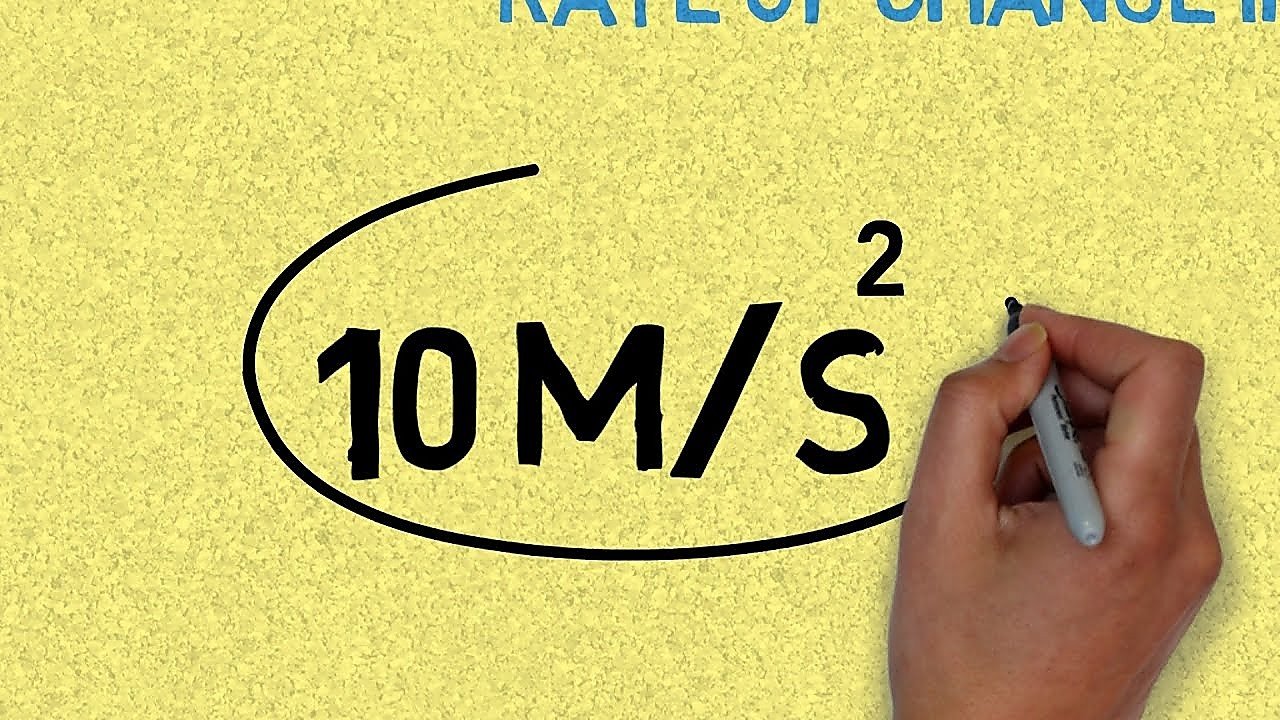
The SI unit of acceleration is meters per second squared (m/s²). An acceleration of 3 m/s² means the velocity changes by 3 m/s every second. The dimensional formula of acceleration is [L T⁻²].
The table below converts common acceleration units to m/s².
| Unit | Symbol | Equivalent in m/s² |
|---|---|---|
| Meter per second squared | m/s² | 1 |
| Standard gravity | g₀ | 9.80665 |
| Foot per second squared | ft/s² | 0.3048 |
| Gal (centimeter per second squared) | Gal | 0.01 |
| Kilometer per hour per second | km/h/s | 0.2778 |
| Mile per hour per second | mph/s | 0.4470 |
The value of standard gravity was adopted by the International Bureau of Weights and Measures and confirmed by the 5th General Conference on Weights and Measures in 1913, according to ASA Standards.
Is Acceleration a Vector or a Scalar?
Acceleration is a vector quantity. It has magnitude and direction, and it points in the same direction as the change in velocity, according to OpenStax University Physics. Vector quantities include displacement, velocity, acceleration, and force.
OpenStax College Physics notes that acceleration does not always point in the direction of motion. The table below shows 4 relationships between the velocity direction and the acceleration direction.
| Acceleration Direction Relative to Velocity | Effect on Motion |
|---|---|
| Same direction | Speed increases |
| Opposite direction | Speed decreases |
| Perpendicular direction | Direction changes, speed stays constant |
| Zero acceleration | Velocity stays constant |
What Are the 9 Types of Acceleration?
Physics describes 9 main types of acceleration. The table below lists each type with its definition and equation.
| No. | Type | Definition | Equation |
|---|---|---|---|
| 1 | Average acceleration | Change in velocity over a time interval | a = Δv / Δt |
| 2 | Instantaneous acceleration | Acceleration at one moment | a = dv/dt |
| 3 | Uniform acceleration | Acceleration with constant magnitude and direction | a = constant |
| 4 | Non-uniform acceleration | Acceleration that changes with time | a = a(t) |
| 5 | Positive acceleration | Acceleration vector along the positive axis | a > 0 |
| 6 | Negative acceleration | Acceleration vector along the negative axis | a < 0 |
| 7 | Centripetal acceleration | Acceleration toward the center of a circular path | ac = v² / r |
| 8 | Gravitational acceleration | Acceleration caused by gravity | g = 9.80665 m/s² (standard) |
| 9 | Angular acceleration | Rate of change of angular velocity | α = Δω / Δt |
What Is Average Acceleration?
Average acceleration is the change in velocity divided by the elapsed time, a = Δv / Δt. OpenStax defines it as the rate at which velocity changes over an interval. A car that changes from 0 to 27 m/s in 9 s has an average acceleration of 3 m/s².
What Is Instantaneous Acceleration?
Instantaneous acceleration is the acceleration at a specific moment, a = dv/dt. Average acceleration approaches instantaneous acceleration as the time interval approaches zero, according to OpenStax University Physics. Instantaneous acceleration equals the derivative of velocity with respect to time.
A velocity function v(t) = 4t² m/s gives a(t) = 8t m/s². At t = 3 s, the acceleration is 24 m/s².
What Are Positive and Negative Acceleration?
Positive acceleration points along the positive axis, and negative acceleration points along the negative axis. The sign depends on the chosen coordinate system. Deceleration is acceleration that opposes the direction of motion and reduces speed.
A negative sign does not always mean slowing down. An object moving in the negative direction with increasing speed has negative acceleration, as shown in the OpenStax College Physics examples of velocity becoming more negative.
What Are Uniform and Non-Uniform Acceleration?
Uniform acceleration has constant magnitude and direction, and non-uniform acceleration changes with time. Examples of uniform acceleration include free fall near Earth's surface without air resistance. Examples of non-uniform acceleration include a car with a changing throttle position and a rocket that loses mass as it burns fuel.
Uniform acceleration follows v = v₀ + at and x = x₀ + v₀t + ½at². Galileo's inclined plane experiments showed that distance from rest is directly proportional to the square of elapsed time under uniform acceleration, as described in a Honolulu Community College physics lab.
What Is Centripetal Acceleration?
Centripetal acceleration is the acceleration toward the center of a circular path, ac = v² / r. OpenStax Physics states that an object in uniform circular motion has a changing velocity direction, so the object accelerates even at constant speed. The acceleration points toward the center of rotation.
A car moving at 20 m/s on a curve with a 50 m radius has a centripetal acceleration of 8 m/s².
What Is Gravitational Acceleration?
Gravitational acceleration near Earth's surface is about 9.8 m/s², and the standard value is 9.80665 m/s². The symbol is g. A freely falling object gains about 9.8 m/s of downward velocity every second, if air resistance is ignored.
The actual value varies with latitude and elevation, according to ASA Standards.
What Is Angular Acceleration?
Angular acceleration is the rate of change of angular velocity, α = Δω / Δt. The SI unit is radians per second squared (rad/s²). Examples include a spinning wheel speeding up and a fan slowing down after power is cut.
How Do You Calculate Acceleration Step by Step?
To calculate acceleration, divide the change in velocity by the elapsed time. Follow these 5 steps:
- Identify the initial velocity and the final velocity.
- Subtract the initial velocity from the final velocity to get the change in velocity.
- Record the elapsed time.
- Divide the change in velocity by the elapsed time.
- State the result with a unit and a direction.
What Are Examples of Acceleration Calculations?
The table below shows 7 worked examples. Each row lists the type, known values, calculation, and result.
| No. | Type | Known Values | Calculation | Result |
|---|---|---|---|---|
| 1 | Speeding up | v₀ = 0 m/s, v = 27 m/s, Δt = 9 s | (27 – 0) / 9 | 3 m/s² |
| 2 | Braking | v₀ = 20 m/s, v = 0 m/s, Δt = 5 s | (0 – 20) / 5 | -4 m/s² |
| 3 | Newton's second law | Fnet = 600 N, m = 150 kg | 600 / 150 | 4 m/s² |
| 4 | Without time | v₀ = 10 m/s, v = 30 m/s, Δx = 200 m | (30² – 10²) / (2 × 200) | 2 m/s² |
| 5 | Centripetal | v = 20 m/s, r = 50 m | 20² / 50 | 8 m/s² |
| 6 | Free fall | v₀ = 0 m/s, v = 29.4 m/s, Δt = 3 s | 29.4 / 3 | 9.8 m/s² |
| 7 | Angular | ω₀ = 0 rad/s, ω = 12 rad/s, Δt = 4 s | 12 / 4 | 3 rad/s² |
How Does Acceleration Differ From Speed and Velocity?
Speed measures distance per unit time, velocity measures displacement per unit time, and acceleration measures velocity change per unit time. The table below compares the 3 quantities.
| Quantity | Type | Measures | Equation | SI Unit |
|---|---|---|---|---|
| Speed | Scalar | Rate of change of distance | d / t | m/s |
| Velocity | Vector | Rate of change of position | Δx / Δt | m/s |
| Acceleration | Vector | Rate of change of velocity | Δv / Δt | m/s² |
Position, velocity, and acceleration form a chain of derivatives. Velocity is the derivative of position with respect to time. Acceleration is the derivative of velocity with respect to time.
How Does a Graph Show Acceleration?
The slope of a velocity-time graph shows acceleration, according to the OpenStax University Physics summary. The list below summarizes 5 graph relationships.
- Slope of a velocity-time graph represents acceleration.
- Straight sloped line on a velocity-time graph represents constant acceleration.
- Horizontal line on a velocity-time graph represents zero acceleration.
- Curvature of a position-time graph represents acceleration.
- Area under an acceleration-time graph represents change in velocity.
How Is Acceleration Related to Newton's Second Law?
Acceleration equals net force divided by mass, a = Fnet / m. Acceleration is directly proportional to net force and inversely proportional to mass. The SI unit of force, the newton (N), equals 1 kg·m/s².
Two relationships follow from the equation:
- Doubling the net force doubles the acceleration.
- Doubling the mass halves the acceleration.
What Is g-Force?
The g-force is acceleration expressed as a multiple of standard gravity, 9.80665 m/s². ASA Standards notes that the magnitude of acceleration is often expressed as a multiplier of standard gravity. An acceleration of 4 g equals about 39.2 m/s².
What Are Common Misconceptions About Acceleration?
Four misconceptions occur most often.
- Assuming zero velocity means zero acceleration: a ball at the top of a vertical toss has zero velocity and a downward acceleration of about 9.8 m/s², if air resistance is ignored.
- Assuming constant speed means zero acceleration: uniform circular motion has constant speed and a nonzero centripetal acceleration.
- Equating negative acceleration with slowing down: an object moving in the negative direction and speeding up has negative acceleration.
- Confusing acceleration with velocity: velocity describes how fast position changes, and acceleration describes how fast velocity changes.
Where Is Acceleration Used in Real Life?
Acceleration applies to 5 main fields.
- Automotive: rating vehicle performance, where a car reaching 100 km/h (27.8 m/s) in 5 s has an average acceleration of 5.6 m/s²
- Aviation: measuring load on aircraft in multiples of g
- Spaceflight: describing launch and orbital motion
- Electronics: sensing motion with accelerometers in smartphones and vehicles
- Sports science: analyzing sprint starts and changes of direction
What Do People Also Ask About Acceleration in Physics?
What is acceleration in simple words?
Acceleration is how quickly velocity changes.
What is the formula for acceleration?
The formula for acceleration is a = Δv / Δt.
What is the SI unit of acceleration?
The SI unit of acceleration is meters per second squared (m/s²).
Can acceleration be negative?
Yes, acceleration is negative when the acceleration vector points along the negative axis.
What is deceleration?
Deceleration is acceleration that opposes the direction of motion and reduces speed.
Is acceleration a vector?
Yes, acceleration has magnitude and direction.
What is the acceleration due to gravity?
The acceleration due to gravity near Earth's surface is about 9.8 m/s², and the standard value is 9.80665 m/s².
Can an object accelerate at constant speed?
Yes, an object accelerates at constant speed if the direction of motion changes, as in uniform circular motion.
What does zero acceleration mean?
Zero acceleration means velocity stays constant in magnitude and direction.
What is the difference between velocity and acceleration?
Velocity measures the rate of change of position, and acceleration measures the rate of change of velocity.
What Does Acceleration Mean in Physics in Summary?
Acceleration in physics means the rate of change of velocity with time, a = Δv / Δt. The SI unit is m/s². Acceleration is a vector that points in the direction of the change in velocity. Acceleration occurs when speed changes, direction changes, or both. Physics describes 9 types: average, instantaneous, uniform, non-uniform, positive, negative, centripetal, gravitational, and angular acceleration. Newton's second law links acceleration to net force and mass through a = Fnet / m.
SEO title: Distinction Between Speed and Velocity: 8 Differences With Examples

The University of the West Indies
My passion as a teacher and leader in education is to contribute to students’ enhanced learning by creation of a positive teaching/learning environment, where they are motivated to develop strong critical thinking, analytical and problem-solving skills.
As acting Vice-Principal and head of Physics, I have amassed five years of experience in leading meetings, implementing strategies to maintain discipline and school ethos, liaise with stakeholders in planning for future development of the institution; successfully negotiated the implementation of various projects for student development as well as supervising effective execution of such. For the past 19 years, I have incorporated discovery learning within the classroom through practical activities, problem solving and cooperative learning and have realized that students retention in Physics and Mathematics have increased significantly.
I am always cognizant that students have different learning styles, and as such teaching strategies during planning and delivery must take this crucial factor into consideration and be tailored to meet such differences.