

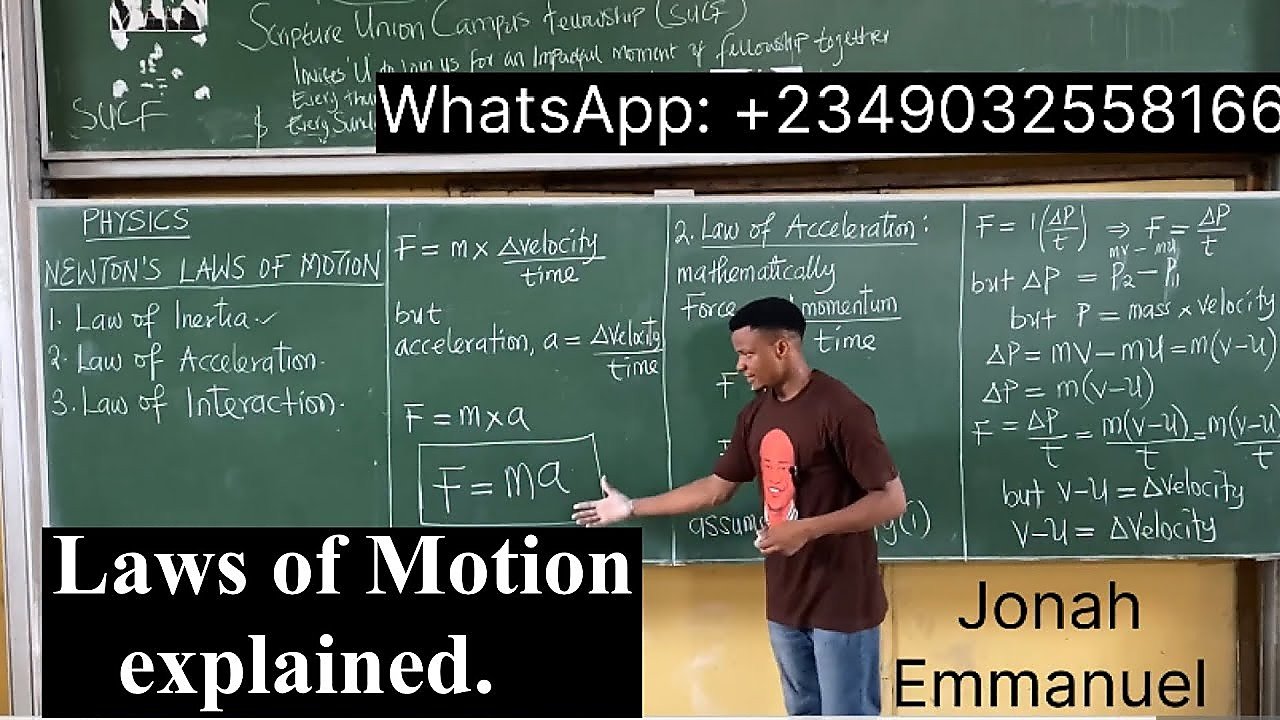
Definition of Newton's Second Law of Motion: Formula, 3 Forms, and Worked Examples
Newton's second law of motion states that the acceleration of an object is directly proportional to the net force on it and inversely proportional to its mass (a = F_net / m). The law is written as F_net = ma. Force is expressed in newtons (N), mass in kilograms (kg), and acceleration in meters per second squared (m/s²). The 3 forms use force and mass, momentum, and components.
For a reliable reference, consult OpenStax section on forces and Newton’s laws.
What Is Newton's Second Law of Motion and What Are Examples of It?
Newton's second law of motion is the law that links the net force on an object to its mass and its acceleration. According to OpenStax University Physics Volume 1, the acceleration of a system is proportional to the net external force and inversely proportional to the mass of the system. Acceleration points in the same direction as the net force.
Isaac Newton published the law in Philosophiae Naturalis Principia Mathematica in 1687. Other names include the law of acceleration and the fundamental equation of dynamics.
Examples of the law include a pushed shopping cart, a kicked soccer ball, a braking car, and a launching rocket. Each object accelerates in the direction of the net force, and a larger mass gives a smaller acceleration for the same force.
The table below lists 5 examples with the mass, the net force, and the acceleration calculated with a = F / m.
| Example | Mass (kg) | Net Force (N) | Acceleration (m/s²) |
|---|---|---|---|
| Shopping cart | 15 | 30 | 2.0 |
| Car | 1,000 | 3,500 | 3.5 |
| Soccer ball during a kick | 0.43 | 1,075 | 2,500 |
| Sprinter at the start | 70 | 210 | 3.0 |
| Rocket at launch | 20,000 | 54,000 | 2.7 |
What Does Newton's Second Law Mean in Simple Terms?
Newton's second law means a bigger push gives a bigger acceleration, and a heavier object accelerates less under the same push. Net force is the push that remains after all forces are added. Mass is the amount of matter in an object, and it measures resistance to acceleration.
The law has 3 simple consequences:
- Doubling the net force doubles the acceleration.
- Doubling the mass halves the acceleration.
- Zero net force gives zero acceleration.
Example: A 10 N push moves a 5 kg box with an acceleration of 2 m/s². The same push moves a 10 kg box with an acceleration of 1 m/s².
What Is the Formula for Newton's Second Law of Motion?
The formula is F_net = ma, which states that net force equals mass multiplied by acceleration. The vector form is ΣF⃗ = m a⃗. The symbol Σ means the sum of all forces on the object.
The table below defines each symbol used in the second law and lists its SI unit.
| Symbol | Meaning | SI Unit |
|---|---|---|
| F_net or ΣF | Net force, the vector sum of all forces on the object | newton (N) |
| m | Mass of the object | kilogram (kg) |
| a | Acceleration of the object | m/s² |
| p | Momentum (p = mv) | kg·m/s |
| t | Time | second (s) |
| W | Weight (W = mg) | newton (N) |
| g | Gravitational acceleration | m/s² |
The formula rearranges to solve for each variable:
- Find acceleration with a = F_net / m.
- Find net force with F_net = ma.
- Find mass with m = F_net / a.
What Are the 3 Forms of Newton's Second Law?
The 3 forms are the standard form (F = ma), the momentum form (F = dp/dt), and the component form (ΣFx = max, ΣFy = may, ΣFz = maz). The table below lists each form with the condition for its use.
| No. | Form | Equation | Applies When |
|---|---|---|---|
| 1 | Standard form | ΣF⃗ = m a⃗ | Mass stays constant |
| 2 | Momentum form | ΣF⃗ = dp⃗/dt | Mass is constant or changing |
| 3 | Component form | ΣFx = max, ΣFy = may, ΣFz = maz | Forces act at angles |
What Is the Momentum Form of Newton's Second Law?
The momentum form states that the net force equals the rate of change of momentum (F_net = dp/dt). Newton wrote the law in this form, using the term quantity of motion for momentum. For constant mass, dp/dt = m(dv/dt) = ma, so both forms agree.
The impulse form follows from the momentum form: F_avg × Δt = Δp. Impulse is the product of the average force and the time of its action, expressed in newton-seconds (N·s).
Example: A 0.43 kg soccer ball leaves a foot at 25 m/s from rest, with a contact time of 0.01 s. The momentum change is 0.43 × 25 = 10.75 kg·m/s. The average force is 10.75 / 0.01 = 1,075 N.
What Is the Component Form of Newton's Second Law?
The component form applies the law separately along each axis, because acceleration along 1 axis depends only on the net force along that axis. Axes are chosen to simplify the problem. Example: A 5 kg object receives 30 N east and 40 N north.
- The net force along the x-axis is 30 N, so ax = 30 / 5 = 6 m/s².
- The net force along the y-axis is 40 N, so ay = 40 / 5 = 8 m/s².
- The net force magnitude is √(30² + 40²) = 50 N.
- The acceleration magnitude is 50 / 5 = 10 m/s².
- The direction is arctan(40 / 30) = 53.1° north of east.
What Does Newton's Second Law Say About Force, Mass, and Acceleration?
The law states that acceleration is proportional to net force (a ∝ F) and inversely proportional to mass (a ∝ 1/m). The table below lists 5 changes with the effect on acceleration and a numeric example based on a 10 N force on a 5 kg object, which gives 2 m/s².
| Change | Effect on Acceleration | Example Result |
|---|---|---|
| Doubling the net force | Doubles | 20 N on 5 kg gives 4 m/s² |
| Tripling the net force | Triples | 30 N on 5 kg gives 6 m/s² |
| Doubling the mass | Halves | 10 N on 10 kg gives 1 m/s² |
| Halving the mass | Doubles | 10 N on 2.5 kg gives 4 m/s² |
| Doubling both force and mass | No change | 20 N on 10 kg gives 2 m/s² |
A graph of force against acceleration is a straight line through the origin, and the slope equals the mass. Example: The points (1 m/s², 2 N), (2 m/s², 4 N), and (3 m/s², 6 N) give a slope of 2 N per m/s², so the mass is 2 kg.
What Is Net Force in Newton's Second Law?
Net force is the vector sum of all forces acting on an object. Forces along 1 line add with signs, and forces at angles add by components. Only forces that act on the object enter the sum. Forces that the object exerts on other objects do not enter the sum.
Common forces include weight, normal force, friction, tension, drag, and applied force.
Example: A 10 kg box receives a 50 N push to the right and 15 N of friction to the left.
- The net force is 50 − 15 = 35 N to the right.
- The acceleration is 35 / 10 = 3.5 m/s².
- The velocity after 4 s from rest is 3.5 × 4 = 14 m/s.
- The displacement after 4 s is ½ × 3.5 × 4² = 28 m.
What Is the Direction of Acceleration in Newton's Second Law?
The acceleration points in the same direction as the net force. The direction of the velocity can differ from the direction of the net force. The table below lists 4 situations with the direction of the net force and the effect on the motion.
| Situation | Net Force Direction | Effect on Motion | Example |
|---|---|---|---|
| Speeding up | Along the velocity | Speed increases | A car accelerating from a stop |
| Slowing down | Opposite to the velocity | Speed decreases | A braking bicycle |
| Turning | Perpendicular to the velocity | Direction changes at constant speed | A car on a curve |
| Constant velocity | Net force is zero | No change | A cruise-control car on a level road |
The force for circular motion at constant speed is F = mv² / r. Example: A 1,000 kg car travels at 10 m/s around a curve with a radius of 25 m. The net force toward the center is 1,000 × 10² / 25 = 4,000 N, and the acceleration is 4 m/s².
What Is the Newton and How Is It Defined?
The newton is the SI unit of force, defined as the force that gives a mass of 1 kg an acceleration of 1 m/s². The relationship is 1 N = 1 kg·m/s². The unit is named after Isaac Newton. The table below lists 5 force units and the value of each in newtons.
| Unit Name | Symbol | Value in Newtons |
|---|---|---|
| Newton | N | 1 |
| Dyne | dyn | 0.00001 |
| Pound-force | lbf | 4.44822 |
| Kilogram-force | kgf | 9.80665 |
| Poundal | pdl | 0.138255 |
NIST defines standard gravity as exactly 9.80665 m/s², and this value sets the kilogram-force. Convert all quantities to SI units before applying F = ma. Example: A 500 g object with a 2 N force has a mass of 0.5 kg, and its acceleration is 2 / 0.5 = 4 m/s².
How Do You Solve a Newton's Second Law Problem Step by Step?
A problem is solved by drawing a free-body diagram, writing the net force along each axis, and applying ΣF = ma. The 6 steps are:
- Draw the object and mark every force acting on it.
- Choose axes, with 1 axis along the direction of the acceleration.
- Resolve each force into components.
- Write ΣF = ma along each axis, with signs for direction.
- Solve for the unknown quantity.
- Check the units and the sign of the result.
The table below lists 4 solved problems with the known quantities, the method, and the result. Values use g = 9.8 m/s².
| Problem | Known Quantities | Calculation | Result |
|---|---|---|---|
| Braking car | m = 1,200 kg, braking force = 9,600 N, v₀ = 25 m/s | a = −9,600 / 1,200 = −8 m/s², then Δx = 25² / (2 × 8) | a = −8 m/s², stopping distance 39.06 m |
| Frictionless incline | θ = 30° | a = g sin θ = 9.8 × 0.5 | a = 4.9 m/s² |
| Incline with friction | θ = 30°, μ = 0.2 | a = g (sin θ − μ cos θ) = 9.8 × (0.5 − 0.1732) | a = 3.20 m/s² |
| Atwood machine | m₁ = 3 kg, m₂ = 1 kg | a = (m₁ − m₂) g / (m₁ + m₂) = 2 × 9.8 / 4, T = 1 × (9.8 + 4.9) | a = 4.9 m/s², T = 14.7 N |
The tension check for the Atwood machine uses the heavier mass: 3 × (9.8 − 4.9) = 14.7 N.
How Does Newton's Second Law Apply in an Elevator?
The scale reading in an elevator equals the normal force, which is N = m(g + a) for an upward acceleration a. The reading rises when the elevator accelerates upward and falls when it accelerates downward. The table below lists 4 cases for a 70 kg person with a weight of 686 N.
| Elevator Motion | Acceleration (m/s², up positive) | Normal Force (N) | Scale Reading (kg) |
|---|---|---|---|
| At rest or constant velocity | 0 | 686 | 70.0 |
| Accelerating upward | +2 | 826 | 84.3 |
| Accelerating downward | −2 | 546 | 55.7 |
| Free fall | −9.8 | 0 | 0 |
The apparent weight changes, and the true weight (mg) stays at 686 N.
What Is the Difference Between Mass and Weight in Newton's Second Law?
Mass measures the amount of matter and the resistance to acceleration, and weight is the gravitational force on the object (W = mg). Weight is the special case of the second law with a = g. The table below compares 2 quantities by 5 features.
| Feature | Mass | Weight |
|---|---|---|
| Definition | Amount of matter, a measure of inertia | Gravitational force on the object |
| Formula | m = F / a | W = mg |
| Quantity type | Scalar | Vector |
| SI unit | kilogram (kg) | newton (N) |
| Changes with location | No | Yes |
The table below lists the weight of a 70 kg person on 3 bodies.
| Body | Surface Gravity (m/s²) | Weight of a 70 kg Person (N) |
|---|---|---|
| Earth | 9.8 | 686 |
| Moon | 1.62 | 113 |
| Mars | 3.71 | 260 |
Free-falling objects share the same acceleration, because the weight (mg) and the mass (m) cancel in a = mg / m = g. In 1971, Apollo 15 commander David Scott dropped a hammer and a feather on the Moon, and both reached the surface at the same time.
What Is the Difference Between Newton's 3 Laws of Motion?
Newton's 3 laws describe inertia, acceleration, and force pairs. The table below compares the 3 laws by statement, formula, and example.
| Law | Statement | Formula | Example |
|---|---|---|---|
| First law | An object keeps its state of motion if the net force is zero | ΣF = 0 gives a = 0 | A hockey puck slides at constant velocity on frictionless ice |
| Second law | Acceleration equals net force divided by mass | ΣF = ma | A 1,000 kg car with a 3,500 N net force accelerates at 3.5 m/s² |
| Third law | Forces between 2 objects form equal and opposite pairs | F_AB = −F_BA | A swimmer pushes water backward, and water pushes the swimmer forward |
The first law is the special case of the second law with zero net force. The first law also identifies inertial reference frames, in which the second law holds in its simple form. The third law supplies the forces that the second law then converts into accelerations, 1 object at a time.
How Does Newton's Second Law Apply to Variable Mass and Rockets?
The momentum form (F = dp/dt) applies to systems with changing mass, and the form F = ma applies only to constant mass. A rocket loses mass as it expels exhaust, so the rocket mass changes during the burn.
The thrust of a rocket is F = ṁ × v_e, where ṁ is the exhaust mass flow rate and v_e is the exhaust velocity relative to the rocket. According to NASA Glenn Research Center, the full thrust equation includes a pressure term.
Example: A rocket expels 100 kg/s of exhaust at 2,500 m/s. The thrust is 100 × 2,500 = 250,000 N. The rocket has a mass of 20,000 kg and a weight of 196,000 N. The net force is 250,000 − 196,000 = 54,000 N, and the initial acceleration is 54,000 / 20,000 = 2.7 m/s². The acceleration rises as the mass falls, if the thrust stays constant.
When Does Newton's Second Law Not Apply in Its Simple Form?
The simple form (F = ma) does not apply at speeds near the speed of light, at atomic scales, in non-inertial frames, and for variable mass. The table below lists 4 limits with the condition and the needed correction.
| Limit | Condition | Needed Correction |
|---|---|---|
| Relativistic speeds | Speed comparable to the speed of light (c) | Use F = dp/dt with p = γmv |
| Quantum scale | Electrons, atoms, and nuclei | Use quantum mechanics and the Schrödinger equation |
| Non-inertial frames | Accelerating or rotating reference frames | Add fictitious forces, such as centrifugal and Coriolis forces |
| Variable mass | Rockets, leaking tanks, and growing raindrops | Use F = dp/dt for the full system |
At 10% of the speed of light, γ equals 1.005, so the relativistic momentum exceeds mv by 0.5%. At 90% of the speed of light, γ equals 2.29. Albert Einstein published special relativity in 1905, which showed the limits of the classical law.
How Did Newton's Second Law Develop?
Newton stated the second law in the Principia in 1687, building on the earlier work of Galileo Galilei. Galileo showed in Two New Sciences in 1638 that the distance covered from rest grows with the square of time, which describes constant acceleration.
Newton's wording said the change of motion is proportional to the motive force and acts along the line of the force. The term motion meant momentum. Leonhard Euler wrote the law in the differential form for point masses in the 1750s, and this form gave the modern equation F = ma.
How Do You Measure Newton's Second Law Experimentally?
The law is tested by applying known forces to a cart of known mass and measuring the acceleration. Instruments include a low-friction track, photogates, motion detectors, and force sensors. The 5 steps are:
- Place a cart of mass M on a level, low-friction track.
- Attach a string over a pulley to a hanging mass m_h.
- Release the cart from rest and record the time t over a distance d.
- Calculate the acceleration with a = 2d / t².
- Repeat for 3 hanging masses and plot acceleration against force.
The theoretical acceleration is a = m_h g / (M + m_h). Example: M = 1.0 kg and m_h = 0.1 kg give a = 0.98 / 1.1 = 0.891 m/s². The cart covers 1.0 m in t = √(2 × 1.0 / 0.891) = 1.50 s. The string tension is 1.0 × 0.891 = 0.891 N, which is less than the 0.98 N weight of the hanging mass.
The plot of acceleration against net force has a slope of 1/m. A slope of 0.5 (m/s²)/N indicates a mass of 2 kg.
What Are the Common Mistakes When Applying Newton's Second Law?
7 common mistakes cause incorrect results. Halloun and Hestenes published a study in the American Journal of Physics in 1985 and found that many students hold common sense beliefs about motion that conflict with Newtonian mechanics, such as the belief that motion requires a continuing force. Hestenes, Wells, and Swackhamer introduced the Force Concept Inventory in The Physics Teacher in 1992 to test these beliefs.
The mistakes include:
- Using 1 force instead of the net force.
- Treating mass in kilograms as force in newtons.
- Mixing units, such as grams with newtons.
- Dropping the sign or direction of a force.
- Believing that constant velocity requires a net force.
- Applying F = ma to a system with changing mass.
- Including forces that the object exerts on other objects.
Example of the first mistake: A 12 kg crate receives an 80 N push with 20 N of friction. Using 80 N gives a = 6.67 m/s². The net force of 60 N gives the correct a = 5 m/s².
What Are Real-Life Applications of Newton's Second Law?
The second law applies to 6 fields. Examples include vehicle safety, aerospace, sports science, structural engineering, elevators, and robotics.
- Vehicle safety: Crumple zones lengthen the collision time, which reduces the force. A 1,000 kg car at 15 m/s that stops in 0.1 s experiences an average force of 150,000 N. A stop in 0.5 s gives 30,000 N.
- Aerospace: Engineers calculate engine thrust, mass, and acceleration for rockets and aircraft.
- Sports science: Force plates measure the force that an athlete applies to the ground, and the second law converts it to acceleration.
- Structural engineering: Engineers compute the forces on buildings and bridges from accelerations during earthquakes.
- Elevators: Designers limit the acceleration to control the forces on passengers.
- Robotics: Controllers compute the actuator forces needed for a desired acceleration of an arm or a vehicle.
What Do People Also Ask About Newton's Second Law of Motion?
What is the definition of Newton's second law of motion?
Newton's second law states that the acceleration of an object equals the net force on it divided by its mass, in the direction of the net force.
What is the formula for Newton's second law?
The formula is F_net = ma.
What is the momentum form of Newton's second law?
The momentum form is F_net = dp/dt, which states that net force equals the rate of change of momentum.
What is the unit of force in Newton's second law?
The SI unit of force is the newton (N), which equals 1 kg·m/s².
What is another name for Newton's second law?
Another name is the law of acceleration.
Who discovered Newton's second law?
Isaac Newton published the law in the Principia in 1687.
What is an example of Newton's second law?
A 1,000 kg car with a net force of 3,500 N accelerates at 3.5 m/s².
What happens to acceleration when mass increases?
Acceleration decreases in proportion to the mass increase, if the net force stays the same.
What happens to acceleration when force increases?
Acceleration increases in proportion to the force increase, if the mass stays the same.
Does Newton's second law apply at constant velocity?
Newton's second law applies at constant velocity, and the net force equals zero.
Is force a vector in Newton's second law?
Force is a vector, and the acceleration points in the same direction as the net force.
How does Newton's second law differ from the first law?
The first law describes motion with zero net force, and the second law gives the acceleration for a nonzero net force.
How does Newton's second law differ from the third law?
The second law relates net force to acceleration for 1 object, and the third law states that forces between 2 objects are equal and opposite.
Why does a heavier object accelerate less?
A heavier object has more inertia, so the same force produces a smaller acceleration (a = F / m).
When does Newton's second law fail?
The simple form fails near the speed of light, at atomic scales, in non-inertial frames, and for variable mass.
What Is the Definition of Newton's Second Law of Motion and How Is It Applied?
Newton's second law of motion states that the acceleration of an object equals the net force divided by its mass (a = F_net / m), in the direction of the net force. The 3 forms are F = ma, F = dp/dt, and the component form along each axis. Doubling the force doubles the acceleration, and doubling the mass halves it. The newton equals 1 kg·m/s², and weight is the special case W = mg. The simple form applies to constant mass in inertial frames at speeds far below the speed of light. Applications include vehicle safety, rocketry, elevators, sports science, structural engineering, and robotics.

The University of the West Indies
My passion as a teacher and leader in education is to contribute to students’ enhanced learning by creation of a positive teaching/learning environment, where they are motivated to develop strong critical thinking, analytical and problem-solving skills.
As acting Vice-Principal and head of Physics, I have amassed five years of experience in leading meetings, implementing strategies to maintain discipline and school ethos, liaise with stakeholders in planning for future development of the institution; successfully negotiated the implementation of various projects for student development as well as supervising effective execution of such. For the past 19 years, I have incorporated discovery learning within the classroom through practical activities, problem solving and cooperative learning and have realized that students retention in Physics and Mathematics have increased significantly.
I am always cognizant that students have different learning styles, and as such teaching strategies during planning and delivery must take this crucial factor into consideration and be tailored to meet such differences.