

How to Find Velocity: 11 Methods, Units, and Worked Examples
Velocity is found by dividing displacement by elapsed time: v = Δx / Δt. The result is expressed in meters per second (m/s), miles per hour (mph), or another unit of distance per time, with a direction. Other situations use acceleration, graphs, calculus, energy, momentum, or orbital mechanics. This guide explains how to find velocity with 11 methods, the units of velocity, and a worked example for each method.
For a reliable reference, consult OpenStax section on velocity and speed.
What Is Velocity and What Are Examples of Velocity?
Velocity is the rate of change of an object's position with respect to time, in a specific direction. Velocity is a vector quantity with magnitude and direction. Its SI unit is the meter per second (m/s).
According to NASA Glenn Research Center, speed is the scalar magnitude of a velocity vector. NASA gives the example of a car with a speed of 50 mph and a velocity of 50 mph in the northeast direction.
Here are 4 examples of velocity:
- A car driving 60 mph north
- A plane flying 500 mph east
- A sprinter running 10.44 m/s forward
- A ball falling 9.8 m/s downward after 1 second
How Does Velocity Differ From Speed?
Velocity includes direction, and speed does not. The table compares velocity and speed across 5 properties.
| Property | Velocity | Speed |
|---|---|---|
| Quantity type | Vector | Scalar |
| Measures | Displacement per unit time | Distance per unit time |
| Direction | Included | Not included |
| Possible values | Positive, negative, or zero | Zero or positive |
| Example | 60 mph north | 60 mph |
What Is the Formula to Find Velocity?
The formula to find average velocity is v = Δx / Δt, which divides displacement by elapsed time. The 3 variables are:
- v: average velocity in m/s
- Δx: displacement in meters, equal to the final position minus the initial position
- Δt: elapsed time in seconds, equal to the final time minus the initial time
How to Find Velocity Step by Step?
Follow 5 steps to calculate average velocity:
- Record the initial position and the final position along one direction.
- Subtract the initial position from the final position to get displacement.
- Record the elapsed time.
- Divide the displacement by the elapsed time.
- State the result with units and direction.
Example 1: A car travels 150 miles north in 2.5 hours. Velocity = 150 mi / 2.5 h = 60 mph north.
Example 2: A runner completes one 400 m lap in 80 s and finishes at the starting line. Displacement is 0 m, so average velocity is 0 m/s. Average speed is 400 m / 80 s = 5 m/s.
Usain Bolt's 100 m world record of 9.58 s gives an average velocity of 100 m / 9.58 s = 10.44 m/s (23.35 mph). A 2019 study by Milan Čoh in Facta Universitatis: Physical Education and Sport reported a maximum speed of 12.42 m/s (27.78 mph) for Bolt, reached between the 70 m and 90 m marks.
What Units Measure Velocity?
Velocity is measured in units of distance divided by time. The SI unit is the meter per second (m/s). US customary units include miles per hour (mph) and feet per second (ft/s).
The table lists 5 velocity units and the value of 1 unit in meters per second.
| Unit | Symbol | System | Value of 1 unit in m/s |
|---|---|---|---|
| Meter per second | m/s | SI | 1 |
| Kilometer per hour | km/h | Metric | 0.27778 |
| Mile per hour | mph | US customary | 0.44704 |
| Foot per second | ft/s | US customary | 0.3048 |
| Knot | kn | Nautical | 0.51444 |
How to Convert Velocity Units?
Multiply the velocity by the conversion factor between the two units. Here are 3 conversions:
- m/s to mph: multiply by 2.23694, so 20 m/s × 2.23694 = 44.74 mph
- mph to ft/s: multiply by 1.46667, so 60 mph × 1.46667 = 88 ft/s
- miles per second to mph: multiply by 3,600, so 5 mi/s × 3,600 = 18,000 mph
NASA states that the International Space Station travels at a speed of 5 miles per second, which equals 18,000 mph.
How to Find Final Velocity With Acceleration and Time?
Final velocity equals initial velocity plus acceleration multiplied by time: v = u + at. The formula applies when acceleration is constant.
The variables are u (initial velocity), a (acceleration in m/s²), and t (time in seconds). Galileo Galilei described uniformly accelerated motion in Two New Sciences (1638).
Example: A car moving at 10 m/s accelerates at 3 m/s² for 4 s. Final velocity = 10 + (3 × 4) = 22 m/s (49.2 mph).
How to Find Final Velocity Without Time?
Final velocity without time is found with v² = u² + 2as, so v = √(u² + 2as), where s is displacement.
Example: A car starts from rest (u = 0) and accelerates at 2 m/s² over 100 m. Final velocity = √(0 + 2 × 2 × 100) = √400 = 20 m/s (44.7 mph).
How to Find Average Velocity From Initial and Final Velocity?
Average velocity under constant acceleration equals the mean of the initial and final velocities: v_avg = (u + v) / 2.
Example: For u = 10 m/s and v = 22 m/s, v_avg = (10 + 22) / 2 = 16 m/s. This matches the 64 m of displacement in 4 s from the earlier acceleration example (64 / 4 = 16).
How to Find Instantaneous Velocity?
Instantaneous velocity is the derivative of position with respect to time: v = dx/dt. OpenStax University Physics Volume 1 defines instantaneous velocity as the limit of average velocity as the time interval approaches zero.
Example: A position function is x(t) = 3t² + 2t, in meters. The derivative is v(t) = 6t + 2. At t = 4 s, v = 6(4) + 2 = 26 m/s.
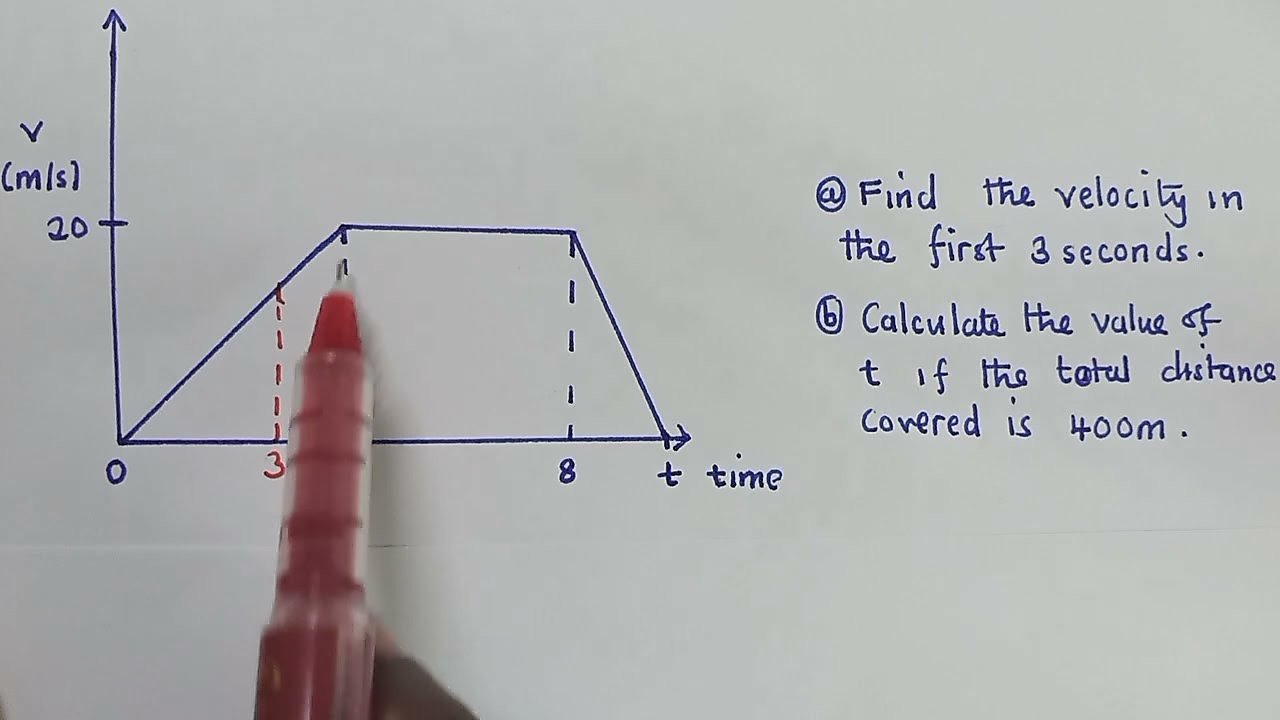
How to Find Velocity From a Graph?
Velocity on a graph is found from the slope of a position-time line. Here are 3 graph rules:
- The slope of a straight position-time line gives constant velocity.
- The slope of a tangent line on a curved position-time graph gives instantaneous velocity.
- The height of a velocity-time graph at a given time gives velocity at that time.
Example: A position-time line runs from (0 s, 2 m) to (4 s, 18 m). Slope = (18 – 2) / (4 – 0) = 4 m/s.
The area under a velocity-time graph gives displacement, and dividing that area by the elapsed time gives average velocity.
How to Find Velocity in Free Fall?
Velocity of an object dropped from rest is found with v = gt, or with v = √(2gh) when the drop height is known. NIST defines standard gravity (g) as 9.80665 m/s², rounded to 9.8 m/s² or 32.2 ft/s².
Both examples ignore air resistance:
- Time known: after 3 s, v = 9.8 × 3 = 29.4 m/s (65.8 mph).
- Height known: after a 20 m drop, v = √(2 × 9.8 × 20) = √392 = 19.8 m/s (44.3 mph).
Terminal velocity is reached when drag equals weight: v_t = √(2mg / (ρ × Cd × A)). In the formula, m is mass, ρ is air density, Cd is the drag coefficient, and A is cross-sectional area.
How to Find Velocity Components in Projectile Motion?
The horizontal and vertical velocity components are vx = v cos θ and vy = v sin θ, where θ is the launch angle above the horizontal.
Example: A ball is launched at 20 m/s and 30°. Horizontal velocity = 20 × cos 30° = 17.32 m/s. Vertical velocity = 20 × sin 30° = 10 m/s.
The magnitude from components is v = √(vx² + vy²), and the direction is θ = tan⁻¹(vy / vx). For vx = 3 m/s and vy = 4 m/s, v = √(9 + 16) = 5 m/s at θ = 53.1°.
How to Find Velocity in Circular Motion?
Tangential velocity equals angular velocity multiplied by radius: v = ωr. The equivalent formula is v = 2πr / T, where T is the period of one revolution.
Example: A point at r = 0.5 m rotates at ω = 10 rad/s. Velocity = 10 × 0.5 = 5 m/s.
The NASA Earth Fact Sheet lists the mean orbital velocity of Earth as 29.78 km/s. The formula confirms this value: 2π × 149.598 million km / (365.256 days × 86,400 s per day) = 29.78 km/s.
How to Find Velocity From Kinetic Energy and Momentum?
Velocity is found from kinetic energy with v = √(2KE / m) and from momentum with v = p / m.
How to Find Velocity From Kinetic Energy?
Example: A 4 kg object has 200 J of kinetic energy. Velocity = √(2 × 200 / 4) = √100 = 10 m/s.
How to Find Velocity From Momentum?
Example: A 12 kg object has a momentum of 60 kg·m/s. Velocity = 60 / 12 = 5 m/s.
How to Find Relative Velocity?
Relative velocity of object A with respect to object B equals the velocity of A minus the velocity of B: v(A/B) = vA – vB. Direction is assigned a sign, with east positive in these examples.
- Same direction: Car A moves 60 mph east and car B moves 45 mph east. v(A/B) = 60 – 45 = 15 mph east.
- Opposite directions: Car A moves 60 mph east and car B moves 45 mph west (-45 mph). v(A/B) = 60 – (-45) = 105 mph east.
How to Find Orbital and Escape Velocity?
Escape velocity is found with v = √(2GM / r), and circular orbital velocity is found with v = √(GM / r).
In both formulas, G is 6.674 × 10⁻¹¹ N·m²/kg², M is the planet's mass, and r is the distance from the planet's center.
Example: Earth has M = 5.972 × 10²⁴ kg and r = 6.371 × 10⁶ m. Escape velocity = √(2 × 6.674 × 10⁻¹¹ × 5.972 × 10²⁴ / 6.371 × 10⁶) = 11,186 m/s, or 11.19 km/s (25,022 mph). The NASA Earth Fact Sheet lists the same value, 11.186 km/s.
How Is Velocity Measured in Real Life?
Velocity is measured with 4 devices: radar guns, GPS receivers, photogates, and ultrasonic motion sensors. Each device uses a different principle:
- Radar guns calculate velocity from the Doppler shift of reflected radio waves.
- GPS receivers calculate velocity from position changes and satellite signal Doppler shifts.
- Photogates calculate velocity from the time an object blocks a light beam across a known length.
- Ultrasonic motion sensors calculate velocity from the change in measured distance over time.
What Are Common Mistakes When Finding Velocity?
Velocity calculations contain 5 common mistakes:
- Mixing units, such as miles with seconds
- Using distance in place of displacement
- Omitting direction or sign
- Applying constant-acceleration formulas to changing acceleration
- Entering degrees where radians are required
What Are People Also Asking About How to Find Velocity?
What is the formula for velocity?
Velocity equals displacement divided by time: v = Δx / Δt.
How do you find velocity with distance and time?
Divide the displacement by the time, because distance divided by time gives average speed.
How do you find velocity without time?
Use v = √(u² + 2as) with acceleration and displacement, or v = p / m with momentum and mass.
How do you find velocity from force and mass?
Divide force by mass to get acceleration, then apply v = u + (F / m) × t.
How do you find velocity from power and force?
Divide power by force, using v = P / F, when the force acts along the direction of motion.
How do you find wave velocity?
Multiply frequency by wavelength: v = fλ, so a 440 Hz sound wave with a 0.78 m wavelength travels at 343.2 m/s.
How do you find fluid velocity in a pipe?
Divide the volumetric flow rate by the cross-sectional area: v = Q / A, so 0.02 m³/s through 0.005 m² gives 4 m/s.
Can velocity be negative?
Yes, negative velocity indicates motion in the negative direction of the chosen axis.
What is the difference between average and instantaneous velocity?
Average velocity covers a time interval, and instantaneous velocity applies at a single moment.
How to Find Velocity: Which Method Fits Each Situation?
Velocity is found by matching the known quantities to the right formula. The table summarizes 11 methods by situation, formula, and known quantities.
| Method | Situation | Formula | Known quantities |
|---|---|---|---|
| 1 | Average velocity | v = Δx / Δt | Displacement, time |
| 2 | Constant acceleration, time known | v = u + at | Initial velocity, acceleration, time |
| 3 | Constant acceleration, time unknown | v² = u² + 2as | Initial velocity, acceleration, displacement |
| 4 | Instantaneous velocity | v = dx/dt | Position function or graph |
| 5 | Free fall | v = gt or v = √(2gh) | Time or height |
| 6 | Projectile components | vx = v cos θ, vy = v sin θ | Launch velocity, angle |
| 7 | Circular motion | v = ωr | Angular velocity, radius |
| 8 | Kinetic energy | v = √(2KE / m) | Kinetic energy, mass |
| 9 | Momentum | v = p / m | Momentum, mass |
| 10 | Relative velocity | v(A/B) = vA – vB | Two velocities |
| 11 | Orbital and escape velocity | v = √(2GM / r) | Planet mass, radius |
The basic formula to find velocity is v = Δx / Δt when displacement and time are known. The other 10 methods apply when acceleration, energy, momentum, angles, or planetary data are known instead.

The University of the West Indies
My passion as a teacher and leader in education is to contribute to students’ enhanced learning by creation of a positive teaching/learning environment, where they are motivated to develop strong critical thinking, analytical and problem-solving skills.
As acting Vice-Principal and head of Physics, I have amassed five years of experience in leading meetings, implementing strategies to maintain discipline and school ethos, liaise with stakeholders in planning for future development of the institution; successfully negotiated the implementation of various projects for student development as well as supervising effective execution of such. For the past 19 years, I have incorporated discovery learning within the classroom through practical activities, problem solving and cooperative learning and have realized that students retention in Physics and Mathematics have increased significantly.
I am always cognizant that students have different learning styles, and as such teaching strategies during planning and delivery must take this crucial factor into consideration and be tailored to meet such differences.