

Newton’s 3rd Law of Motion Example: 10 Everyday Examples, Formula, and Calculations
For a reliable reference, consult OpenStax section on forces and Newton’s laws.
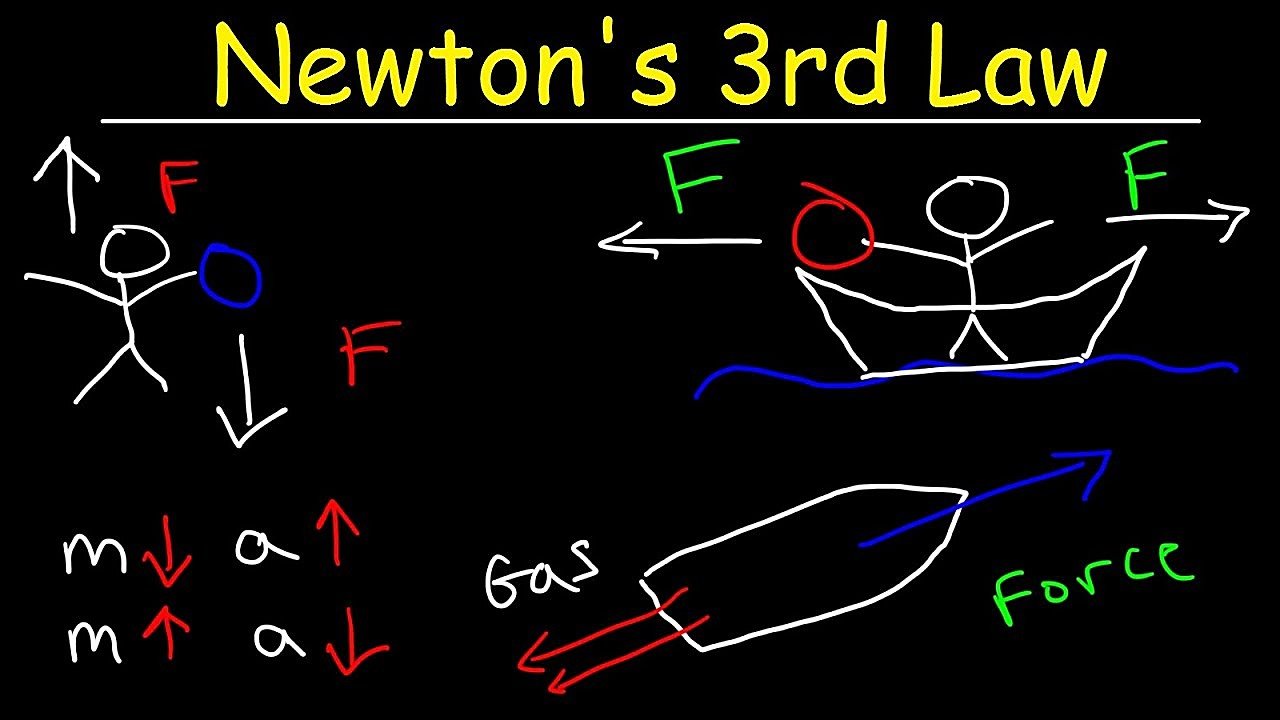
Newton’s 3rd law of motion states that when object A exerts a force on object B, object B exerts an equal and opposite force on object A. Common examples include walking, swimming, rocket launches, and gun recoil. This article covers 10 examples, the formula, the characteristics of action-reaction pairs, 4 worked calculations, and common misconceptions.
What Is Newton’s Third Law of Motion?
Newton’s third law of motion states that when object A exerts a force on object B, object B exerts a force of equal magnitude and opposite direction on object A.
The law is also called the law of action and reaction. The popular wording is that every action has an equal and opposite reaction. According to NASA Glenn Research Center, the 2 forces act on different objects.
The law applies to all types of forces. Examples include contact forces, gravitational forces, and electromagnetic forces.
What Is the Formula for Newton’s Third Law?
The formula for Newton’s third law is FAB = −FBA, where FAB is the force of object A on object B, and FBA is the force of object B on object A. The magnitudes are equal: |FAB| = |FBA|. The SI unit of force is the newton (N).
Newton’s second law links the equal forces to the accelerations: mA × aA = −mB × aB. The object with the smaller mass has the larger acceleration.
What Are the 5 Characteristics of an Action-Reaction Pair?
An action-reaction pair has 5 characteristics:
- Equal magnitude: Both forces have the same size.
- Opposite direction: The forces point in opposite directions along the same line.
- Different objects: Each force acts on a different object.
- Same type: Both forces belong to the same type, such as gravitational or contact.
- Simultaneous timing: Both forces start and stop at the same instant.
What Are 10 Examples of Newton’s Third Law of Motion?
The 10 examples of Newton’s third law are walking, swimming, a rocket launch, gun recoil, jumping, rowing, a balloon, bird flight, Earth and Moon gravity, and a car collision. Table 1 lists the action force, the reaction force, and the result for each example.
Table 1: Action-reaction pairs in 10 examples
| Example | Action force | Reaction force | Result |
|---|---|---|---|
| Walking | Foot pushes backward on the ground | Ground pushes forward on the foot | Person moves forward |
| Swimming | Hands push water backward | Water pushes the swimmer forward | Swimmer moves forward |
| Rocket launch | Engine pushes exhaust gas downward | Gas pushes the rocket upward | Rocket accelerates upward |
| Gun recoil | Gun pushes the bullet forward | Bullet pushes the gun backward | Gun recoils backward |
| Jumping | Legs push the ground downward | Ground pushes the jumper upward | Jumper leaves the ground |
| Rowing | Oars push water backward | Water pushes the oars forward | Boat moves forward |
| Inflated balloon | Balloon pushes air backward | Air pushes the balloon forward | Balloon moves forward |
| Bird flight | Wings push air downward | Air pushes the wings upward | Bird gains lift |
| Earth and Moon | Earth pulls the Moon | Moon pulls Earth | Both bodies accelerate |
| Car collision | Car A pushes car B | Car B pushes car A | Both cars change velocity |
What Is an Example of Newton’s Third Law in Walking?
The foot pushes backward on the ground, and the ground pushes forward on the foot. The forward force from the ground is static friction. On ice, the friction is small, so the foot slips and the forward force is small.
What Is an Example of Newton’s Third Law in Swimming?
The hands push water backward, and the water pushes the swimmer forward. A larger volume of water pushed backward in each stroke produces a larger forward force.
What Is an Example of Newton’s Third Law in a Rocket Launch?
The engine pushes exhaust gas downward, and the gas pushes the rocket upward. The thrust is F = (dm/dt) × v, where dm/dt is the mass flow rate of the exhaust and v is the exhaust speed relative to the rocket. Rockets work in a vacuum, because the thrust comes from the push between the rocket and its exhaust, not from a push against air.
What Is an Example of Newton’s Third Law in Gun Recoil?
The gun pushes the bullet forward, and the bullet pushes the gun backward. The forces are equal, but the bullet has the larger acceleration because its mass is smaller. The gun therefore recoils slowly, and the bullet leaves quickly.
What Is an Example of Newton’s Third Law in Jumping?
The legs push the ground downward, and the ground pushes the jumper upward. Earth also accelerates downward, but its mass of 5.97 × 10²⁴ kg makes the effect negligible. A 1,400 N push accelerates Earth by 1,400 / (5.97 × 10²⁴) = 2.3 × 10⁻²² m/s².
What Is an Example of Newton’s Third Law in Rowing?
The oars push water backward, and the water pushes the oars forward. The forward force on the oars moves the boat in the direction opposite to the water flow.
What Is an Example of Newton’s Third Law in a Balloon?
The balloon pushes air backward out of the opening, and the air pushes the balloon forward. The balloon follows the same action and reaction principle as a rocket, without combustion.
What Is an Example of Newton’s Third Law in Bird Flight?
The wings push air downward, and the air pushes the wings upward. NASA Glenn Research Center describes lift on an airfoil in the same way: the wing deflects air downward, and the wing is pushed upward in reaction.
What Is an Example of Newton’s Third Law Between Earth and the Moon?
Earth pulls the Moon with a gravitational force of about 2.0 × 10²⁰ N, and the Moon pulls Earth with a force of equal magnitude. The Moon’s acceleration is 2.0 × 10²⁰ N / 7.34 × 10²² kg = 2.7 × 10⁻³ m/s². Earth’s acceleration is 2.0 × 10²⁰ N / 5.97 × 10²⁴ kg = 3.3 × 10⁻⁵ m/s². The pair acts across empty space, which shows that the law covers non-contact forces.
What Is an Example of Newton’s Third Law in a Car Collision?
Each car pushes the other car with an equal force, regardless of the masses. A 1,000 kg car and a 2,000 kg car that collide with a contact force of 20,000 N have accelerations of 20 m/s² and 10 m/s². The less massive car has the larger acceleration.
What Are 4 Worked Examples of Newton’s Third Law?
The 4 worked examples below calculate forces and accelerations for 2 ice skaters, a rifle, a rocket, and an apple.
How Do You Find the Accelerations of 2 Skaters Who Push Each Other?
- Given: A 60 kg skater pushes a 40 kg skater with a force of 120 N on frictionless ice.
- Law: The 40 kg skater pushes back on the 60 kg skater with 120 N in the opposite direction.
- Calculation: a1 = 120 / 60 = 2.0 m/s², and a2 = 120 / 40 = 3.0 m/s².
- Answer: The 60 kg skater accelerates at 2.0 m/s², and the 40 kg skater accelerates at 3.0 m/s² in the opposite direction.
How Do You Find the Recoil Speed of a Rifle?
- Given: A 4.0 kg rifle fires a 0.020 kg bullet at 600 m/s. The total momentum is 0 before firing.
- Law: Equal and opposite forces over the same time give equal and opposite momentum changes.
- Calculation: 0.020 × 600 + 4.0 × v = 0, so v = −(0.020 × 600) / 4.0.
- Answer: The rifle recoils at 3.0 m/s opposite to the bullet.
How Do You Find the Acceleration of a Rocket at Liftoff?
- Given: The exhaust speed is 3,000 m/s, the mass flow rate is 500 kg/s, and the rocket mass is 50,000 kg.
- Law: The rocket pushes the gas downward, and the gas pushes the rocket upward with the thrust F = (dm/dt) × v.
- Calculation: F = 500 × 3,000 = 1.5 × 10⁶ N. The weight is 50,000 × 9.8 = 4.9 × 10⁵ N. The acceleration is (1.5 × 10⁶ − 4.9 × 10⁵) / 50,000.
- Answer: The thrust is 1.5 × 10⁶ N upward, and the acceleration at liftoff is 20.2 m/s² upward.
How Do You Find the Force of a Falling Apple on Earth?
- Given: A 0.20 kg apple falls toward Earth, which has a mass of 5.97 × 10²⁴ kg.
- Law: Earth pulls the apple with a force mg, and the apple pulls Earth with a force of equal magnitude.
- Calculation: F = 0.20 × 9.8 = 1.96 N. Earth’s acceleration is 1.96 / (5.97 × 10²⁴).
- Answer: The apple pulls Earth with 1.96 N upward, and Earth accelerates at 3.3 × 10⁻²⁵ m/s².
How Does Newton’s Third Law Relate to Newton’s First and Second Laws?
Newton’s first law describes inertia, the second law describes acceleration from a net force, and the third law describes the interaction between 2 objects. Table 2 compares the 3 laws.
Table 2: Newton’s 3 laws of motion
| Law | Statement | Focus | Formula |
|---|---|---|---|
| First law | An object keeps its velocity without a net force | Inertia of 1 object | ΣF = 0 gives constant velocity |
| Second law | The net force equals mass times acceleration | Motion of 1 object | ΣF = ma |
| Third law | The forces between 2 objects are equal and opposite | Interaction of 2 objects | FAB = −FBA |
Why Do Action and Reaction Forces Not Cancel Each Other?
Action and reaction forces do not cancel, because they act on different objects. Cancellation requires 2 forces on the same object. The motion of each object depends on the net force on that object. When a person walks, the ground pushes the person forward, and the person pushes the ground backward. Only the force on the person changes the motion of the person.
Is the Normal Force the Reaction to Weight?
The normal force and the weight of a book on a table are not an action-reaction pair, because both forces act on the book. The reaction to the weight is the gravitational pull of the book on Earth. The reaction to the normal force is the push of the book down on the table. The weight and the normal force are also different types of force.
How Does Newton’s Third Law Relate to Conservation of Momentum?
Newton’s third law implies conservation of momentum for an isolated system of 2 objects. The equal and opposite forces act for the same time, so the impulses are equal and opposite. The momentum changes cancel, and the total momentum stays constant. The rifle recoil example uses this result.
Who Formulated Newton’s Third Law of Motion?
Isaac Newton formulated the third law of motion in the Principia, published in 1687. The full title is Philosophiæ Naturalis Principia Mathematica. NASA Glenn Research Center dates the presentation of the 3 laws of motion in the Principia to 1686.
What Are the Applications of Newton’s Third Law?
Newton’s third law applies to 5 technologies: rockets, jet engines, aircraft wings, propellers, and firearms.
- Rockets: Engines push exhaust gas backward, and the gas pushes the rocket forward.
- Jet engines: Hot exhaust gases flow out of the back of the engine, and a thrust force acts in the opposite direction, according to NASA Glenn Research Center.
- Aircraft wings: Wings deflect air downward, and the air pushes the wings upward to produce lift.
- Propellers: Blades push air or water backward, and the fluid pushes the blades forward.
- Firearms: Recoil mechanisms absorb the backward force that the projectile exerts on the weapon.
What Are Common Misconceptions About Newton’s Third Law?
5 misconceptions occur most often with Newton’s third law. Table 3 lists each misconception with the correct fact.
Table 3: Misconceptions and facts about Newton’s third law
| Misconception | Fact |
|---|---|
| Action and reaction forces cancel each other | The forces act on different objects, so they do not cancel |
| The action force occurs before the reaction force | The forces occur simultaneously |
| The larger object exerts a larger force | Both objects exert forces of equal magnitude, and the accelerations differ |
| The law applies only to contact forces | The law applies to all forces, including gravitational and electromagnetic forces |
| Weight and the normal force form an action-reaction pair | Both forces act on the same object, so they are not a pair |
How Can You Demonstrate Newton’s Third Law?
To demonstrate Newton’s third law, build a balloon rocket on a string. The 5 steps are:
- Thread a string through a straw and tie the string between 2 fixed points.
- Inflate a balloon and pinch the neck closed.
- Tape the balloon to the straw with the opening facing backward.
- Release the neck of the balloon.
- Observe the balloon move forward as the air exits backward.
A second demonstration uses 2 spring scales hooked together. Both scales show the same reading when 1 scale is pulled.
What Do People Also Ask About Newton’s Third Law Example?
What Is the Best Example of Newton’s Third Law?
A rocket launch is the most cited example, because the engine pushes exhaust gas downward and the gas pushes the rocket upward.
What Is a Simple Example of Newton’s Third Law?
Pushing a wall is a simple example, because the wall pushes back on the hand with an equal force.
What Is the Formula for Newton’s Third Law?
The formula is FAB = −FBA.
Do Action and Reaction Forces Cancel?
Action and reaction forces do not cancel, because they act on different objects.
Are Action and Reaction Forces Always Equal?
The forces are equal in magnitude and opposite in direction in every interaction.
Does Newton’s Third Law Apply to Gravity?
Newton’s third law applies to gravity, because Earth and the Moon pull on each other with equal forces.
Who Discovered Newton’s Third Law?
Isaac Newton formulated the law in the Principia, published in 1687.
Why Does a Rocket Work in Space?
A rocket works in space because the engine pushes exhaust gas backward and the gas pushes the rocket forward, so no air is required.
What Is an Example of Newton’s Third Law in Sports?
A sprinter pushes backward on the starting blocks, and the blocks push the sprinter forward.
Is Newton’s Third Law the Same as Conservation of Momentum?
The 2 concepts are not the same, because conservation of momentum follows from the third law for an isolated system.
What Are the Key Takeaways About Newton’s Third Law Examples?
Newton’s third law states that the forces between 2 objects are equal in magnitude and opposite in direction. The 6 key takeaways are:
- Statement: When object A pushes object B, object B pushes object A with an equal and opposite force.
- Formula: FAB = −FBA.
- Characteristics: The forces are equal, opposite, simultaneous, of the same type, and act on different objects.
- Examples: Walking, swimming, rocket launches, gun recoil, jumping, rowing, balloons, bird flight, Earth and Moon gravity, and car collisions.
- Misconception: The forces do not cancel, because each force acts on a different object.
- Calculation: The object with the smaller mass has the larger acceleration, according to a = F / m.

The University of the West Indies
My passion as a teacher and leader in education is to contribute to students’ enhanced learning by creation of a positive teaching/learning environment, where they are motivated to develop strong critical thinking, analytical and problem-solving skills.
As acting Vice-Principal and head of Physics, I have amassed five years of experience in leading meetings, implementing strategies to maintain discipline and school ethos, liaise with stakeholders in planning for future development of the institution; successfully negotiated the implementation of various projects for student development as well as supervising effective execution of such. For the past 19 years, I have incorporated discovery learning within the classroom through practical activities, problem solving and cooperative learning and have realized that students retention in Physics and Mathematics have increased significantly.
I am always cognizant that students have different learning styles, and as such teaching strategies during planning and delivery must take this crucial factor into consideration and be tailored to meet such differences.