

Physics Equation Sheet: 12 Topic Tables, Constants, SI Units, and Prefixes for Mechanics, Waves, Thermodynamics, Electricity, Magnetism, Optics, and Modern Physics
What Is a Physics Equation Sheet?
A physics equation sheet is a reference document that lists the formulas, constants, and units used to solve physics problems. Synonyms include formula sheet, formula list, reference table, and data booklet. Examples include the College Board equation sheets for AP Physics and the IB Physics data booklet.
For a reliable reference, consult OpenStax University Physics Volume 1.
An equation sheet groups formulas by topic. The 12 topics in this article are kinematics, dynamics, energy, rotation, gravitation, oscillations and waves, fluids, thermodynamics, electricity, magnetism, optics, and modern physics.
What Is the Difference Between an Equation Sheet and a Cheat Sheet?
An equation sheet lists formulas, constants, and units only, and a cheat sheet adds notes, definitions, and solved examples. Exam boards issue equation sheets. Students write cheat sheets, and exam rules decide whether a cheat sheet is permitted.
Is a Physics Equation Sheet Allowed in Exams?
Exam boards decide whether a sheet is provided or allowed. The College Board provides an equation sheet with AP Physics 1, 2, and C exams. The International Baccalaureate provides a data booklet for IB Physics exams. Provided sheets list selected formulas only. Some exam papers print constants such as g and c at the start. WAEC, NECO, and JAMB publish their own rules, so confirm the rule in the current exam instructions.
What Equations Does a Physics Equation Sheet Include?
A physics equation sheet includes equations for 12 topics, from kinematics to modern physics. Each table below lists equations in rows. Columns show the equation name, the formula, and the meaning of the symbols. All formulas use SI units.
What Are the Kinematics Equations?
Kinematics equations describe motion with constant acceleration. The table below lists 7 kinematics equations. [internal link: What Is Displacement]
| Equation | Formula | Symbols |
|---|---|---|
| Average velocity | v_avg = Δx/Δt | Δx displacement, Δt time interval |
| Final velocity | v = u + at | u initial velocity, v final velocity, a acceleration, t time |
| Displacement from time | s = ut + ½at² | s displacement |
| Velocity-displacement relation | v² = u² + 2as | s displacement |
| Displacement from average velocity | s = ½(u + v)t | s displacement |
| Projectile range | R = u² sin2θ / g | θ launch angle, g gravitational acceleration, level ground |
| Projectile time of flight | T = 2u sinθ / g | T time in the air, level ground |
What Are the Dynamics and Momentum Equations?
Dynamics equations relate force, mass, and motion. The table below lists 8 dynamics and momentum equations. [internal link: Definition for Impulse]
| Equation | Formula | Symbols |
|---|---|---|
| Newton's second law | F_net = ma | F_net net force, m mass |
| Weight | W = mg | W weight |
| Friction force | f = μN | μ friction coefficient, N normal force |
| Momentum | p = mv | p momentum |
| Impulse | J = FΔt = Δp | J impulse, Δp change in momentum |
| Momentum conservation | m₁u₁ + m₂u₂ = m₁v₁ + m₂v₂ | u initial velocities, v final velocities, isolated system |
| Hooke's law | F = −kx | k spring constant, x extension |
| Centripetal force | F_c = mv²/r | r radius of the circular path |
What Are the Work, Energy, and Power Equations?
Work, energy, and power equations link force and distance to energy transfer. The table below lists 7 equations.
| Equation | Formula | Symbols |
|---|---|---|
| Work | W = Fd cosθ | d distance, θ angle between force and motion |
| Kinetic energy | KE = ½mv² | KE kinetic energy |
| Gravitational potential energy | PE = mgh | h height |
| Elastic potential energy | PE = ½kx² | k spring constant, x extension |
| Work-energy theorem | W_net = ΔKE | W_net net work |
| Power | P = W/t = Fv | P power |
| Efficiency | η = (useful output ÷ total input) × 100% | η efficiency |
What Are the Rotational Motion Equations?
Rotational motion equations describe spinning objects. The table below lists 8 rotational equations.
| Equation | Formula | Symbols |
|---|---|---|
| Angular velocity | ω = Δθ/Δt | ω angular velocity, Δθ angular displacement |
| Linear speed | v = rω | r radius |
| Angular acceleration | α = Δω/Δt | α angular acceleration |
| Torque | τ = rF sinθ | τ torque, r distance from the pivot, θ angle between r and F |
| Rotational second law | τ = Iα | I moment of inertia |
| Angular momentum | L = Iω | L angular momentum |
| Rotational kinetic energy | KE = ½Iω² | KE kinetic energy |
| Moment of inertia | mr² (point mass), ½MR² (solid cylinder), (2/5)MR² (solid sphere) | M mass, R radius |
What Are the Gravitation Equations?
Gravitation equations describe attraction between masses and orbital motion. The table below lists 5 equations.
| Equation | Formula | Symbols |
|---|---|---|
| Law of gravitation | F = Gm₁m₂/r² | G gravitational constant, r distance between centres |
| Gravitational field strength | g = GM/r² | M mass of the body |
| Orbital speed | v = √(GM/r) | r orbital radius |
| Escape velocity | v_e = √(2GM/r) | r distance from the centre |
| Kepler's third law | T² = 4π²r³/(GM) | T orbital period |
What Are the Oscillation and Wave Equations?
Oscillation and wave equations describe periodic motion, sound, and waves on strings. The table below lists 8 equations.
| Equation | Formula | Symbols |
|---|---|---|
| Period and frequency | T = 1/f | T period, f frequency |
| Wave speed | v = fλ | λ wavelength |
| Spring-mass period | T = 2π√(m/k) | m mass, k spring constant |
| Simple pendulum period | T = 2π√(L/g) | L length, small angles |
| Intensity | I = P/A | I intensity, P power, A area |
| Sound level | β = 10 log₁₀(I/I₀) | β level in decibels, I₀ = 1.0 × 10⁻¹² W/m² |
| Doppler effect | f′ = f(v ± v_o)/(v ∓ v_s) | v_o observer speed, v_s source speed, upper signs for approach |
| Standing wave on a string | f_n = nv/(2L) | n = 1, 2, 3 and so on, L string length |
What Are the Fluid Equations?
Fluid equations describe density, pressure, buoyancy, and flow. The table below lists 6 equations.
| Equation | Formula | Symbols |
|---|---|---|
| Density | ρ = m/V | ρ density, V volume |
| Pressure | P = F/A | P pressure, A area |
| Pressure at depth | P = P₀ + ρgh | P₀ surface pressure, h depth |
| Buoyant force | F_b = ρ_f V g | ρ_f fluid density, V submerged volume |
| Continuity equation | A₁v₁ = A₂v₂ | A cross-sectional area, v flow speed |
| Bernoulli's equation | P + ½ρv² + ρgh = constant | h height |
What Are the Thermodynamics Equations?
Thermodynamics equations describe heat, temperature, and gases. The table below lists 9 equations.
| Equation | Formula | Symbols |
|---|---|---|
| Heat from temperature change | Q = mcΔT | Q heat, c specific heat capacity, ΔT temperature change |
| Heat during phase change | Q = mL | L latent heat |
| Linear thermal expansion | ΔL = αL₀ΔT | α expansion coefficient, L₀ original length |
| Ideal gas law | PV = nRT | n moles, R gas constant, T temperature in kelvin |
| Average molecular kinetic energy | KE_avg = (3/2)k_BT | k_B Boltzmann constant |
| First law of thermodynamics | ΔU = Q − W | ΔU change in internal energy, W work done by the gas |
| Carnot efficiency | e = 1 − T_C/T_H | T_C cold reservoir, T_H hot reservoir, both in kelvin |
| Conduction rate | H = kAΔT/L | k thermal conductivity, L thickness |
| Radiation power | P = εσAT⁴ | ε emissivity, σ Stefan-Boltzmann constant |
What Are the Electricity and Circuit Equations?
Electricity equations describe charge, fields, potential, and circuits. The table below lists 13 equations. [internal link: Electric Potential Formula]
| Equation | Formula | Symbols |
|---|---|---|
| Coulomb's law | F = kq₁q₂/r² | k Coulomb constant, q charge |
| Electric field of a point charge | E = kq/r² | E field strength |
| Electric potential of a point charge | V = kq/r | V potential |
| Potential difference in a uniform field | ΔV = Ed | d distance along the field |
| Capacitance | C = Q/V | C capacitance, Q stored charge |
| Capacitor energy | U = ½CV² | U stored energy |
| Current | I = ΔQ/Δt | I current |
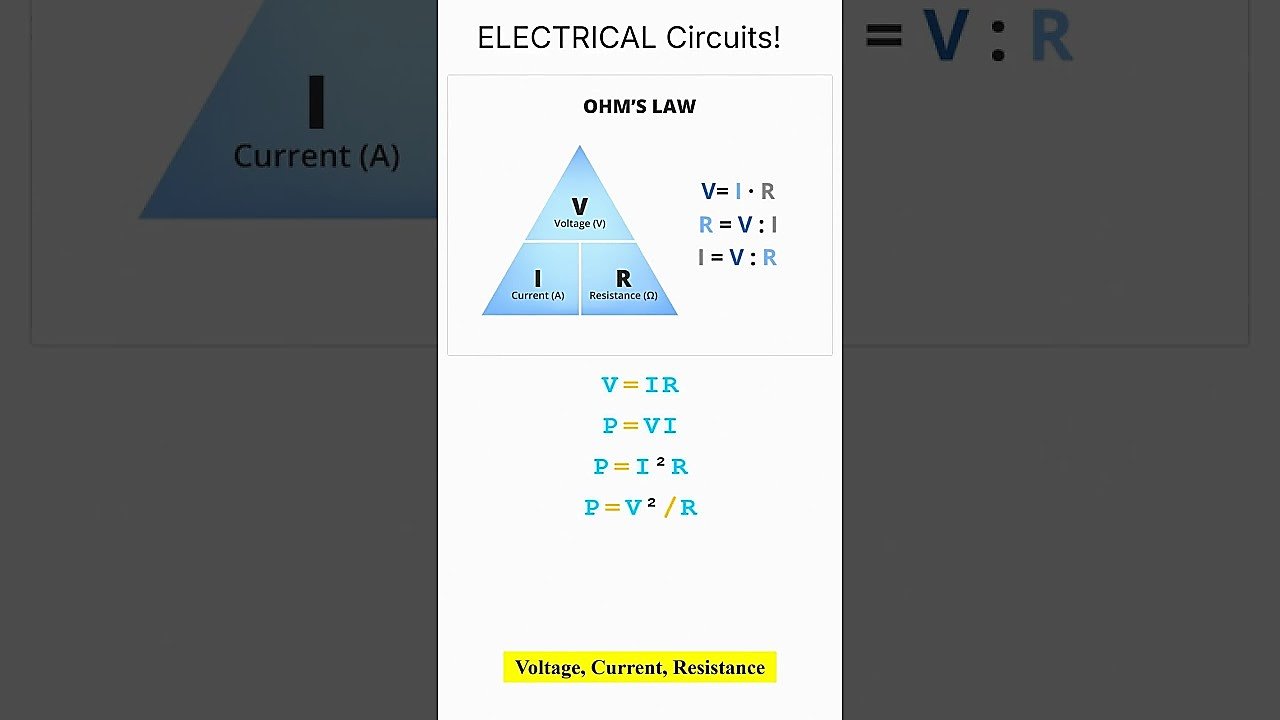
| Ohm's law | V = IR | R resistance |
| Resistance of a wire | R = ρL/A | ρ resistivity, L length, A cross-sectional area |
| Electric power | P = IV = I²R = V²/R | P power |
| Resistors in series | R = R₁ + R₂ + … | R total resistance |
| Resistors in parallel | 1/R = 1/R₁ + 1/R₂ + … | R total resistance |
| Kirchhoff's rules | ΣI_in = ΣI_out and ΣΔV = 0 around a loop | junction rule and loop rule |
What Are the Magnetism and Induction Equations?
Magnetism equations describe forces from magnetic fields and induced voltage. The table below lists 8 equations.
| Equation | Formula | Symbols |
|---|---|---|
| Force on a moving charge | F = qvB sinθ | B magnetic field, θ angle between v and B |
| Force on a current-carrying wire | F = BIL sinθ | L length of wire in the field |
| Radius of a charged particle's path | r = mv/(qB) | velocity perpendicular to the field |
| Field of a long straight wire | B = μ₀I/(2πr) | μ₀ vacuum permeability, r distance from the wire |
| Field inside a solenoid | B = μ₀nI | n turns per metre |
| Magnetic flux | Φ = BA cosθ | Φ flux, A area |
| Faraday's law | ε = −NΔΦ/Δt | ε induced emf, N number of turns |
| Ideal transformer | V_s/V_p = N_s/N_p | s secondary coil, p primary coil |
What Are the Optics Equations?
Optics equations describe refraction, mirrors, lenses, and interference. The table below lists 7 equations.
| Equation | Formula | Symbols |
|---|---|---|
| Refractive index | n = c/v | n index, c light speed in vacuum, v light speed in the medium |
| Snell's law | n₁ sinθ₁ = n₂ sinθ₂ | θ angle from the normal |
| Critical angle | sinθ_c = n₂/n₁ | n₁ greater than n₂ |
| Mirror and thin lens equation | 1/f = 1/d_o + 1/d_i | f focal length, d_o object distance, d_i image distance |
| Magnification | m = −d_i/d_o = h_i/h_o | h_i image height, h_o object height |
| Spherical mirror focal length | f = R/2 | R radius of curvature |
| Double-slit maxima | d sinθ = mλ | d slit separation, m order number 0, 1, 2 and so on |
What Are the Modern Physics Equations?
Modern physics equations describe photons, matter waves, atoms, nuclei, and relativity. The table below lists 8 equations.
| Equation | Formula | Symbols |
|---|---|---|
| Photon energy | E = hf = hc/λ | h Planck constant, f frequency |
| Mass-energy equivalence | E = mc² | m mass, c speed of light |
| Photoelectric effect | K_max = hf − φ | K_max maximum kinetic energy, φ work function |
| de Broglie wavelength | λ = h/p | p momentum |
| Hydrogen energy levels | E_n = −13.6 eV/n² | n principal quantum number |
| Radioactive decay | N = N₀e^(−λt) | N₀ initial nuclei, λ decay constant |
| Half-life | t½ = ln2/λ | t½ half-life |
| Time dilation | Δt = γΔt₀ | γ = 1/√(1 − v²/c²), Δt₀ proper time |
Which Constants Does a Physics Equation Sheet Include?
A physics equation sheet includes constants such as g, c, G, h, and e. The table below lists 17 constants rounded from NIST CODATA values. Rows represent constants. Columns show the symbol, the value, and the unit.
| Constant | Symbol | Value | Unit |
|---|---|---|---|
| Gravitational acceleration | g | 9.81 | m/s² |
| Speed of light | c | 3.00 × 10⁸ | m/s |
| Gravitational constant | G | 6.674 × 10⁻¹¹ | N·m²/kg² |
| Planck constant | h | 6.626 × 10⁻³⁴ | J·s |
| Planck constant times light speed | hc | 1240 | eV·nm |
| Coulomb constant | k | 8.99 × 10⁹ | N·m²/C² |
| Vacuum permittivity | ε₀ | 8.85 × 10⁻¹² | F/m |
| Vacuum permeability | μ₀ | 1.257 × 10⁻⁶ | T·m/A |
| Elementary charge | e | 1.602 × 10⁻¹⁹ | C |
| Electron mass | m_e | 9.109 × 10⁻³¹ | kg |
| Proton mass | m_p | 1.673 × 10⁻²⁷ | kg |
| Boltzmann constant | k_B | 1.381 × 10⁻²³ | J/K |
| Avogadro constant | N_A | 6.022 × 10²³ | 1/mol |
| Gas constant | R | 8.314 | J/(mol·K) |
| Stefan-Boltzmann constant | σ | 5.670 × 10⁻⁸ | W/(m²·K⁴) |
| Atomic mass unit | u | 1.661 × 10⁻²⁷ | kg |
| Standard atmosphere | atm | 1.013 × 10⁵ | Pa |
The standard value of g is 9.80665 m/s². Some papers specify g = 10 m/s² or 9.8 m/s². Use the value stated in the question.
What Are the SI Units and Prefixes Used With Physics Equations?
The SI system has 7 base units: metre (m), kilogram (kg), second (s), ampere (A), kelvin (K), mole (mol), and candela (cd). All other units derive from these 7. The table below lists 11 derived units. Rows represent units. Columns show the quantity, the unit, and the equivalent.
| Quantity | Unit | Equivalent |
|---|---|---|
| Force | newton (N) | kg·m/s² |
| Energy | joule (J) | N·m |
| Power | watt (W) | J/s |
| Pressure | pascal (Pa) | N/m² |
| Frequency | hertz (Hz) | 1/s |
| Charge | coulomb (C) | A·s |
| Potential difference | volt (V) | J/C |
| Resistance | ohm (Ω) | V/A |
| Capacitance | farad (F) | C/V |
| Magnetic field | tesla (T) | N/(A·m) |
| Magnetic flux | weber (Wb) | T·m² |
The table below lists 8 common prefixes. Rows represent prefixes. Columns show the symbol and the factor.
| Prefix | Symbol | Factor |
|---|---|---|
| giga | G | 10⁹ |
| mega | M | 10⁶ |
| kilo | k | 10³ |
| centi | c | 10⁻² |
| milli | m | 10⁻³ |
| micro | μ | 10⁻⁶ |
| nano | n | 10⁻⁹ |
| pico | p | 10⁻¹² |
Kelvin and Celsius relate by T(K) = T(°C) + 273.15.
How Do You Choose the Right Equation From a Physics Equation Sheet?
Choose the equation that contains the known variables and the 1 unknown variable. Follow these 5 steps:
- List the known variables with units.
- Identify the unknown variable.
- Find the equation that contains only those variables.
- Rearrange the equation for the unknown variable.
- Substitute the values and check the unit of the answer.
Worked example: a car starts from rest and accelerates at 3 m/s² for 4 s. The known values are u = 0, a = 3 m/s², and t = 4 s. The unknown value is s. The equation s = ut + ½at² gives s = 0 + ½ × 3 × 4² = 24 m.
Dimensional analysis checks whether both sides of an equation have the same units. The equation F = ma gives kg·m/s², which equals the newton.
How Do You Make a Physics Equation Sheet?
Make a physics equation sheet in 6 steps:
- List the topics in the syllabus.
- Collect the formulas for each topic from the syllabus or textbook.
- Define every symbol and its SI unit.
- Group the formulas by topic.
- Add the constants and unit conversions.
- Test the sheet on 10 past-paper problems and add any missing formula.
How Do You Memorize Physics Equations?
Practice active recall to memorize physics equations. A 2006 study by Roediger and Karpicke in Psychological Science found that students who practiced retrieval recalled more after 1 week than students who restudied the material. Four methods apply retrieval to equations:
- Recall each formula without looking at the sheet
- Derive each formula from a basic principle
- Solve mixed problems from several topics
- Check the units after each solution
Where Can You Find a Physics Equation Sheet?
Physics equation sheets are available from 6 sources:
- College Board AP Central, which publishes the AP Physics equation sheets
- The IB Physics data booklet
- University physics course pages
- Textbook appendices
- HyperPhysics, hosted by Georgia State University and known for its concept maps of physics topics
- NIST, which publishes the CODATA values of fundamental constants
What Is the Difference Between Algebra-Based and Calculus-Based Equation Sheets?
Algebra-based sheets use algebraic forms, and calculus-based sheets add derivatives and integrals. AP Physics 1 and 2 are algebra-based, and AP Physics C is calculus-based. Calculus forms include v = dx/dt, a = dv/dt, W = ∫F dx, and E = −dV/dx.
What Are Common Mistakes When Using a Physics Equation Sheet?
Five common mistakes occur when using a physics equation sheet:
- Mixing units, such as centimetres with metres
- Applying constant-acceleration equations to variable acceleration
- Using the wrong angle mode, degrees or radians, on a calculator
- Using the wrong value of g for the exam
- Choosing an equation before listing the known variables
What Does a Physics Equation Sheet Include in Summary?
A physics equation sheet lists formulas, constants, and units for 12 topics: kinematics, dynamics, energy, rotation, gravitation, oscillations and waves, fluids, thermodynamics, electricity, magnetism, optics, and modern physics. The sheet adds 17 constants, 7 SI base units, and 8 prefixes. Choosing an equation requires matching the known variables and the 1 unknown variable. Exam boards decide whether a sheet is provided.
People Also Ask About a Physics Equation Sheet
What is on a physics equation sheet?
A physics equation sheet lists formulas, constants, SI units, and prefixes grouped by topic.
What are the 4 kinematic equations?
The 4 kinematic equations for constant acceleration are v = u + at, s = ut + ½at², v² = u² + 2as, and s = ½(u + v)t.
What is the formula for force?
The formula for force is F = ma, where m is mass and a is acceleration.
What is the formula for kinetic energy?
The formula for kinetic energy is KE = ½mv².
What is the formula for power?
The formula for power is P = W/t, which equals work divided by time.
What value of g does a physics equation sheet use?
A physics equation sheet uses g = 9.81 m/s², and some papers specify 9.8 m/s² or 10 m/s².
Does AP Physics provide an equation sheet?
The College Board provides an equation sheet with AP Physics 1, 2, and C exams.
Is a formula sheet the same as an equation sheet?
Yes, both terms describe a reference list of physics formulas.
What is the SI unit of force?
The SI unit of force is the newton, which equals 1 kg·m/s².
How many SI base units exist?
The SI system has 7 base units.

The University of the West Indies
My passion as a teacher and leader in education is to contribute to students’ enhanced learning by creation of a positive teaching/learning environment, where they are motivated to develop strong critical thinking, analytical and problem-solving skills.
As acting Vice-Principal and head of Physics, I have amassed five years of experience in leading meetings, implementing strategies to maintain discipline and school ethos, liaise with stakeholders in planning for future development of the institution; successfully negotiated the implementation of various projects for student development as well as supervising effective execution of such. For the past 19 years, I have incorporated discovery learning within the classroom through practical activities, problem solving and cooperative learning and have realized that students retention in Physics and Mathematics have increased significantly.
I am always cognizant that students have different learning styles, and as such teaching strategies during planning and delivery must take this crucial factor into consideration and be tailored to meet such differences.