

Displacement in Physics: Definition, Formulas, and 16 Worked Examples for Straight-Line, Two-Dimensional, and Circular Motion
Meta title: What Is Displacement in Physics? Definition, Formula, Units, and 16 Examples
For a reliable reference, see OpenStax on position, displacement, and average velocity.
Displacement in physics is the change in an object's position, measured as a straight-line vector from the starting point to the ending point. Its SI unit is the meter (m).
What Is Displacement in Physics?
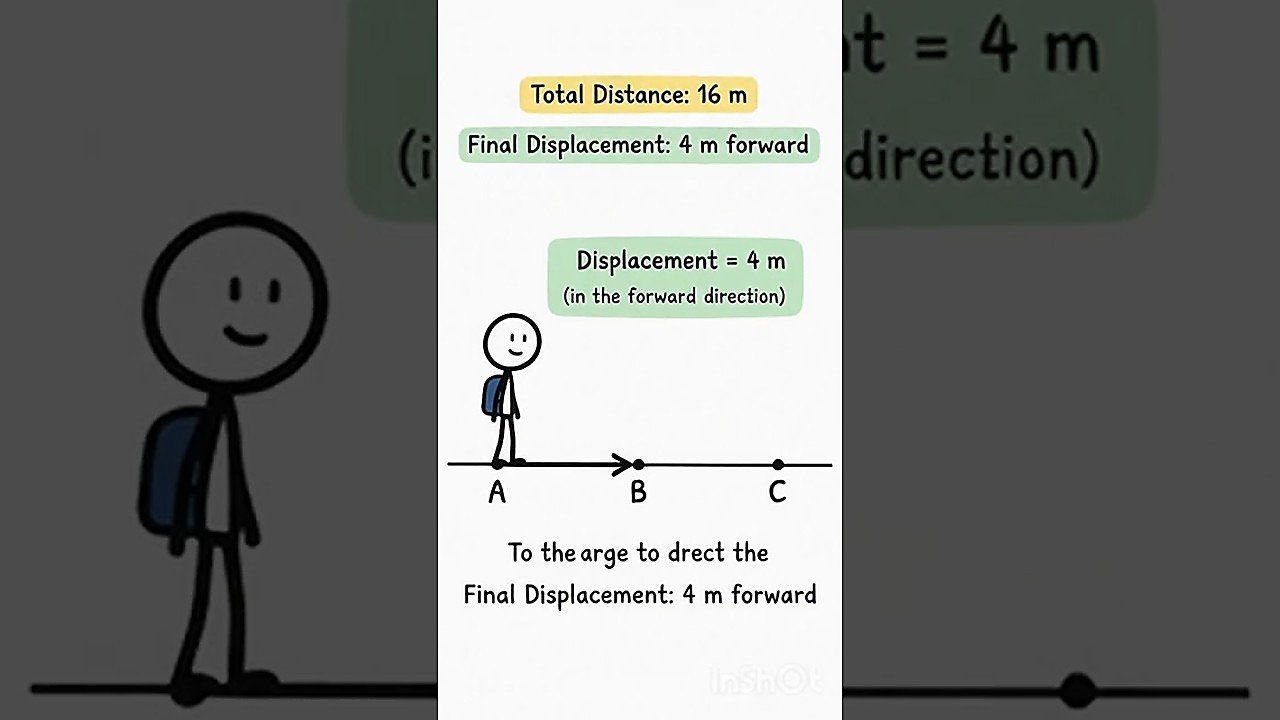
Displacement is the vector quantity that gives the change in an object's position from its initial point to its final point. The magnitude equals the straight-line distance between the 2 points, and the direction points from the initial point to the final point. Examples include a car moving 55 m east, a ball falling 20 m downward, and a runner finishing a lap with zero displacement.
What Is the Formula for Displacement?
The formula for displacement is Δx = x_f − x_i in one dimension, and Δr = r_f − r_i in vector form. The table below defines each symbol. Rows list the quantities, and columns show the symbol, the meaning, and the SI unit.
| Quantity | Symbol | Meaning | SI Unit |
|---|---|---|---|
| Displacement | Δx or Δr | Change in position | m |
| Final position | x_f or r_f | Position at the end of the motion | m |
| Initial position | x_i or r_i | Position at the start of the motion | m |
In 2 dimensions, the magnitude is |Δr| = √(Δx² + Δy²), and the direction is θ = tan⁻¹(Δy/Δx).
What Are the Units of Displacement?
The SI unit of displacement is the meter (m), and the dimensional formula is L. The table below lists 5 units. Rows list the units, and columns show the symbol, the system, and the equivalent value in meters.
| Unit | Symbol | System | Equivalent in Meters |
|---|---|---|---|
| Meter | m | SI | 1 |
| Kilometer | km | SI | 1,000 |
| Centimeter | cm | SI | 0.01 |
| Mile | mi | Imperial | 1,609.344 |
| Foot | ft | Imperial | 0.3048 |
Is Displacement a Vector or a Scalar Quantity?
Displacement is a vector quantity because it has both magnitude and direction. In one dimension, the sign gives the direction. The table below shows the 3 cases. Rows list the sign of Δx, and columns show the meaning.
| Sign of Δx | Meaning |
|---|---|
| Positive | Final position lies in the positive direction from the initial position |
| Negative | Final position lies in the negative direction from the initial position |
| Zero | Final position equals the initial position |
What Are the 5 Properties of Displacement?
Displacement has 5 properties:
- Vector nature: has magnitude and direction.
- Path independence: depends only on the initial and final positions.
- Sign: positive, negative, or zero.
- Magnitude limit: never exceeds the distance traveled.
- Unit: meter (m) in the SI.
What Is the Difference Between Distance and Displacement?
Distance is the total length of the path traveled and is a scalar, and displacement is the straight-line change in position and is a vector. The table below compares the 2 quantities. Rows list the properties, and columns show the values for distance and displacement.
| Property | Distance | Displacement |
|---|---|---|
| Definition | Total length of the path | Change in position |
| Quantity type | Scalar | Vector |
| Direction | Not included | Included |
| Sign | Zero or positive | Positive, negative, or zero |
| Depends on the path | Yes | No |
| Value for a round trip | Greater than 0 | 0 |
| Related average quantity | Average speed | Average velocity |
| SI unit | m | m |
When Are Distance and Displacement Equal in Magnitude?
Distance and displacement are equal in magnitude for straight-line motion without a reversal of direction. A reversal or a curved path makes the distance larger than the magnitude of the displacement.
How Do You Calculate Displacement in One Dimension?
Calculate one-dimensional displacement by subtracting the initial position from the final position. The method has 5 steps:
- Choose an origin and a positive direction.
- Read the initial position.
- Read the final position.
- Subtract the initial position from the final position.
- State the sign and the direction.
Example 1: A car moves from x = 20 m to x = 75 m.
- Δx = 75 − 20 = +55 m, which is 55 m in the positive direction
Example 2: An object moves from x = 50 m to x = 10 m.
- Δx = 10 − 50 = −40 m, which is 40 m in the negative direction
Example 3: A person walks 30 m east, then 10 m west.
- Displacement: 30 − 10 = 20 m east
- Distance: 30 + 10 = 40 m
How Do You Calculate Displacement in Two Dimensions?
Calculate two-dimensional displacement by adding the x components and the y components of each leg, then combining them with the Pythagorean theorem. The method has 5 steps:
- Resolve each leg into x and y components.
- Sum the x components.
- Sum the y components.
- Calculate the magnitude with √(Δx² + Δy²).
- Calculate the direction with tan⁻¹(Δy/Δx).
Example 4: A person walks 6 m east, then 8 m north.
- Magnitude: √(6² + 8²) = √100 = 10 m
- Direction: tan⁻¹(8 ÷ 6) = 53.1° north of east
- Distance: 6 + 8 = 14 m
Example 5: A displacement of 50 m points 37° north of east.
- East component: 50 × cos 37° = 39.9 m
- North component: 50 × sin 37° = 30.1 m
Example 6: A person walks 3 m east, 4 m north, then 3 m west.
- East-west sum: 3 − 3 = 0 m
- North sum: 4 m
- Displacement: 4 m north
- Distance: 3 + 4 + 3 = 10 m
How Do You Calculate Displacement in Circular Motion?
Calculate displacement in circular motion as the chord between the start and end points, |Δr| = 2r sin(Δθ/2), where r is the radius and Δθ is the angle swept. The distance equals the arc length, s = rΔθ, with Δθ in radians.
Example 7: An object moves along a circle of radius 5 m. The table below compares 3 paths. Rows list the paths, and columns show the displacement and the distance.
| Path | Displacement | Distance |
|---|---|---|
| Quarter circle (Δθ = π/2) | 2 × 5 × sin 45° = 7.07 m | 5 × π/2 = 7.85 m |
| Half circle (Δθ = π) | 2 × 5 = 10 m | 5 × π = 15.71 m |
| Full circle (Δθ = 2π) | 0 m | 5 × 2π = 31.42 m |
Example 8: A runner completes one 400 m lap in 50 s.
- Displacement: 0 m
- Average velocity: 0 ÷ 50 = 0 m/s
- Average speed: 400 ÷ 50 = 8 m/s
Why Can Displacement Be Zero When the Distance Is Not Zero?
Displacement is zero when an object returns to its starting position, because displacement depends only on the initial and final positions. The distance counts the entire path. A full lap, a round trip, and a full orbit all have zero displacement and a positive distance.
How Do You Calculate Displacement With Velocity, Acceleration, and Time?
Select the kinematic formula that contains the known quantities and the displacement. The table below lists 5 formulas. Rows list the known quantities, and columns show the formula and its condition.
| Known Quantities | Formula | Condition |
|---|---|---|
| Constant velocity, time | Δx = vt | Velocity is constant |
| Average velocity, time | Δx = v_avg t | Any motion in one dimension |
| Initial velocity, acceleration, time | Δx = v₀t + ½at² | Acceleration is constant |
| Initial velocity, final velocity, time | Δx = ½(v₀ + v)t | Acceleration is constant |
| Initial velocity, final velocity, acceleration | Δx = (v² − v₀²)/(2a) | Acceleration is constant |
Galileo Galilei showed in 1638 that the distance covered from rest grows in proportion to the square of the elapsed time, which corresponds to Δx = ½at².
Example 9: An object moves at a constant 8 m/s for 5 s.
- Δx = 8 × 5 = 40 m
Example 10: An object with v₀ = 5 m/s accelerates at 2 m/s² for 4 s. The final velocity is 5 + 2 × 4 = 13 m/s.
- Δx = v₀t + ½at² = 5 × 4 + ½ × 2 × 4² = 36 m
- Δx = ½(v₀ + v)t = ½ × (5 + 13) × 4 = 36 m
- Δx = (v² − v₀²)/(2a) = (169 − 25) ÷ 4 = 36 m
Example 11: An object falls from rest for 2 s near Earth's surface, with g = 9.81 m/s² and negligible air resistance.
- Δy = −½gt² = −½ × 9.81 × 2² = −19.62 m, which is 19.62 m downward
How Do You Find Displacement From a Velocity-Time Graph?
Find displacement from a velocity-time graph by calculating the area between the line and the time axis. Area above the axis is positive displacement, and area below the axis is negative displacement.
Example 12: Velocity rises uniformly from 0 to 12 m/s over 6 s.
- Δx = ½ × 6 × 12 = 36 m
How Do You Find Displacement From a Position-Time Graph?
Read the position at the start and at the end of the interval, then subtract (Δx = x_f − x_i). The slope of a position-time graph gives velocity.
How Do You Find Displacement Using Calculus?
Find displacement by integrating velocity over time (Δx = ∫v dt). Calculus applies if acceleration changes with time.
Example 13: Velocity is v(t) = 3t² + 2, in m/s. Find the displacement from t = 0 to t = 3 s.
- Δx = ∫₀³ (3t² + 2) dt = [t³ + 2t]₀³ = 27 + 6 = 33 m
How Do You Calculate Displacement in Projectile Motion?
Calculate projectile displacement by finding the horizontal and vertical components separately, then combining them. The horizontal component is x = v₀cos θ · t, and the vertical component is y = v₀sin θ · t − ½gt². Air resistance is negligible.
Example 14: A ball launches at 20 m/s at 30° above the horizontal, with g = 9.81 m/s². Find the displacement at t = 1 s.
- Horizontal: x = 20 × cos 30° × 1 = 17.32 m
- Vertical: y = 20 × sin 30° × 1 − ½ × 9.81 × 1² = 5.10 m
- Magnitude: √(17.32² + 5.10²) = 18.05 m
- Direction: tan⁻¹(5.10 ÷ 17.32) = 16.4° above the horizontal
What Is Angular Displacement?
Angular displacement is the change in the angular position of a rotating object (Δθ = θ_f − θ_i). The SI unit is the radian (rad), and 1 revolution equals 2π rad. The arc length traveled by a point at radius r is s = rΔθ.
Example 15: A wheel starts from rest with α = 3 rad/s² and rotates for 4 s. The radius is 0.30 m.
- Δθ = ½αt² = ½ × 3 × 4² = 24 rad
- Revolutions: 24 ÷ 2π = 3.82 rev
- Arc length at the rim: 0.30 × 24 = 7.2 m
What Is Displacement in Simple Harmonic Motion and Waves?
In oscillations and waves, displacement is the signed distance of a particle from its equilibrium position, and the maximum displacement is the amplitude. Position in simple harmonic motion follows x(t) = A cos(ωt + φ), where A is the amplitude, ω is angular frequency, and φ is the phase angle.
Example 16: A mass on a spring has A = 0.10 m and T = 2 s, so x(t) = 0.10 cos(πt) meters. The table below shows 5 times in one period. Rows list the times, and columns show the displacement from equilibrium.
| Time | Displacement |
|---|---|
| 0 s | +0.10 m |
| 0.5 s | 0 m |
| 1.0 s | −0.10 m |
| 1.5 s | 0 m |
| 2.0 s | +0.10 m |
- Maximum displacement: 0.10 m
- Displacement over 1 full period: 0 m
- Distance over 1 full period: 4A = 0.40 m
What Are Examples of Displacement in Daily Life?
Displacement appears in any motion that changes position, including walking, driving, swimming, and orbiting. The table below lists 6 examples. Rows list the motions, and columns show the distance and the displacement.
| Motion | Distance | Displacement |
|---|---|---|
| Walking 30 m east, then 10 m west | 40 m | 20 m east |
| Driving once around a square block with 100 m sides | 400 m | 0 m |
| Throwing a ball up 5 m and catching it at the launch height | 10 m | 0 m |
| Swimming 1 length and back in a 50 m pool | 100 m | 0 m |
| Riding an elevator from floor 1 to floor 10, with 3.0 m between floors | 27 m | 27 m upward |
| A satellite completing 1 circular orbit of radius r | 2πr | 0 m |
How Does Displacement Relate to Velocity and Acceleration?
Velocity is the rate of change of displacement, and acceleration is the rate of change of velocity. The table below shows 4 relations. Rows list the quantities, and columns show the formula and the link to displacement.
| Quantity | Formula | Link to Displacement |
|---|---|---|
| Average velocity | v_avg = Δx/Δt | Displacement divided by time |
| Instantaneous velocity | v = dx/dt | Derivative of position |
| Acceleration | a = d²x/dt² | Second derivative of position |
| Displacement from velocity | Δx = ∫v dt | Integral of velocity |
What Are Common Misconceptions About Displacement?
Research on student understanding documents confusion among kinematic quantities. Trowbridge and McDermott (1980) found that introductory physics students confuse position with velocity in one-dimensional motion.
The table below lists 5 misconceptions. Rows show each misconception, and columns show the incorrect belief and the correct fact.
| Misconception | Incorrect Belief | Correct Fact |
|---|---|---|
| Same as distance | Distance and displacement are the same | They are equal only for straight-line motion without a reversal |
| Always positive | Displacement cannot be negative | The sign gives the direction along the chosen axis |
| Path length | Displacement is the total length of the path | Displacement is the straight-line change in position |
| Zero means no motion | Zero displacement means the object did not move | The object may have returned to its start |
| Origin dependence | Displacement changes with the chosen origin | Position changes with the origin, and displacement does not |
People Also Ask About Displacement in Physics
What Is the Definition of Displacement in Physics?
Displacement is the change in an object's position, expressed as a vector from the initial point to the final point.
What Is the Formula for Displacement?
The formula is Δx = x_f − x_i, the final position minus the initial position.
What Is the SI Unit of Displacement?
The SI unit of displacement is the meter (m).
Can Displacement Be Zero?
Yes, displacement is zero when an object ends at its starting position.
Can Displacement Be Negative?
Yes, a negative sign shows that the displacement points in the negative direction of the chosen axis.
Is Displacement a Vector Quantity?
Yes, displacement has magnitude and direction.
How Do You Find Displacement From Velocity and Time?
Multiply constant velocity by time (Δx = vt), or find the area under a velocity-time graph.
What Is the Main Summary of Displacement in Physics?
Displacement in physics is the vector change in an object's position from its initial point to its final point. There are 6 key facts:
- The formula is Δx = x_f − x_i, with the unit meter (m).
- Displacement is a vector, and distance is a scalar.
- Displacement depends only on the endpoints, and distance depends on the path.
- The magnitude of displacement never exceeds the distance traveled.
- Displacement equals the area under a velocity-time graph, and it equals ∫v dt in calculus.
- Angular displacement, Δθ = θ_f − θ_i, uses the radian as its unit.
Sources:
- Galileo Galilei, Discourses and Mathematical Demonstrations Relating to Two New Sciences (1638)
- Bureau International des Poids et Mesures (BIPM), The International System of Units (SI Brochure), definitions of the meter and the radian
- Trowbridge, D. E., and McDermott, L. C. (1980), "Investigation of student understanding of the concept of velocity in one dimension," American Journal of Physics, volume 48

The University of the West Indies
My passion as a teacher and leader in education is to contribute to students’ enhanced learning by creation of a positive teaching/learning environment, where they are motivated to develop strong critical thinking, analytical and problem-solving skills.
As acting Vice-Principal and head of Physics, I have amassed five years of experience in leading meetings, implementing strategies to maintain discipline and school ethos, liaise with stakeholders in planning for future development of the institution; successfully negotiated the implementation of various projects for student development as well as supervising effective execution of such. For the past 19 years, I have incorporated discovery learning within the classroom through practical activities, problem solving and cooperative learning and have realized that students retention in Physics and Mathematics have increased significantly.
I am always cognizant that students have different learning styles, and as such teaching strategies during planning and delivery must take this crucial factor into consideration and be tailored to meet such differences.