

Quadratic Formula: 5 Steps, 3 Discriminant Cases, and 2 Worked Examples for ax² + bx + c = 0
Quadratic formula is the formula that solves ax² + bx + c = 0 for x, with a not equal to 0. Quadratic formula gives 2 answers in 5 steps, and discriminant gives 3 cases for number of real roots. Quadratic formula uses a, b, and c from standard form.
What Is the Quadratic Formula?
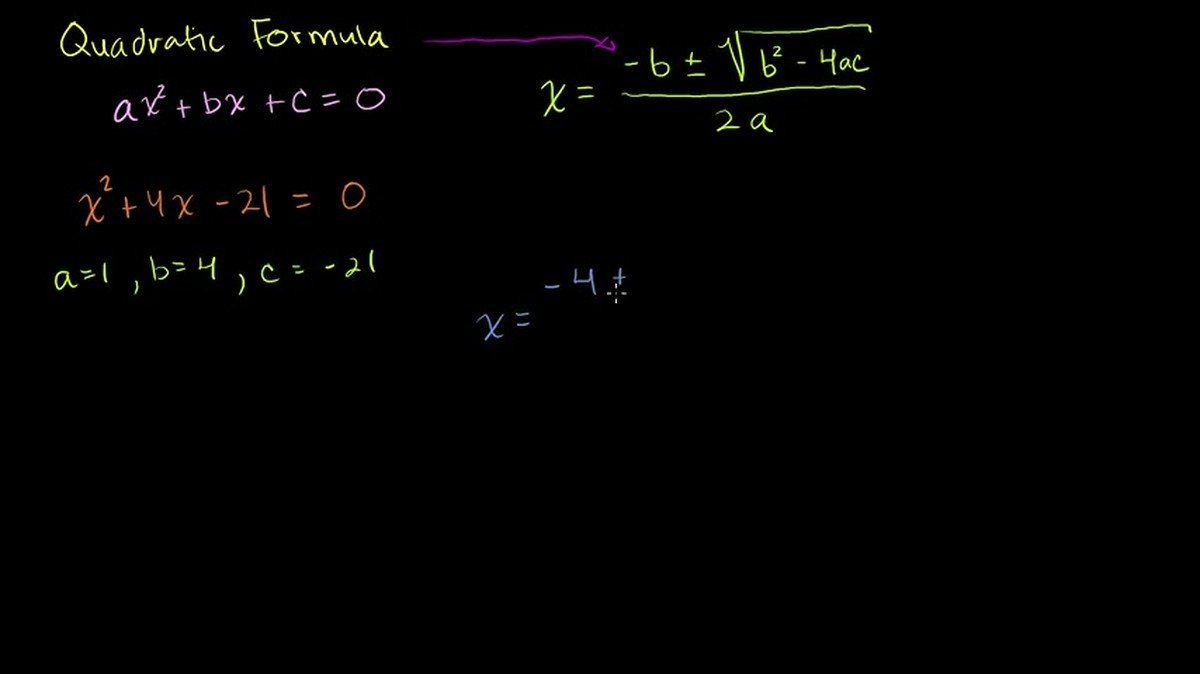
Quadratic formula is a formula that finds roots of a quadratic equation. A quadratic equation is an equation in form ax² + bx + c = 0, with a not equal to 0. Examples include x² + 4x – 21 = 0, x² + 5x + 6 = 0, and -3x² + 10x – 3 = 0. Formula is x = (-b ± √(b² – 4ac)) / 2a. Symbol ± gives 2 answers. Roots are x-intercepts of parabola y = ax² + bx + c. According to Khan Academy, quadratic formula solves for roots, or zeroes, of quadratic equations, and it comes from completing square on ax² + bx + c = 0.
What Is the Formula for a Quadratic Equation?
Formula is x = (-b ± √(b² – 4ac)) / 2a. Formula uses 3 coefficients from ax² + bx + c = 0.
| Symbol | Meaning | Detail |
|---|---|---|
| a | Coefficient of x² | Number in front of x²; a is not 0 |
| b | Coefficient of x | Number in front of x |
| c | Constant term | Number with no x |
| Discriminant | b² – 4ac | Number under square root |
Discriminant is b² – 4ac.
How Do You Use the Quadratic Formula in 5 Steps?
- Write equation in standard form ax² + bx + c = 0.
- Identify a, b, and c, with signs.
- Substitute a, b, and c into x = (-b ± √(b² – 4ac)) / 2a.
- Simplify discriminant, then simplify square root.
- Check each answer by substitution into original equation.
What Is the Discriminant in the Quadratic Formula?
Discriminant is Δ = b² – 4ac. Discriminant gives number and type of roots before full calculation ends.
| Discriminant | Number of real roots | What the parabola does |
|---|---|---|
| b² – 4ac > 0 | 2 distinct real roots | Parabola crosses x-axis at 2 points |
| b² – 4ac = 0 | 1 repeated real root | Parabola touches x-axis at 1 point |
| b² – 4ac < 0 | 0 real roots | Parabola does not touch x-axis |
According to Khan Academy, discriminant greater than 0 gives 2 real roots, discriminant equal to 0 gives 1 real solution, and discriminant less than 0 gives 2 complex solutions. Complex solutions are conjugates.
What Are 2 Worked Examples of the Quadratic Formula?
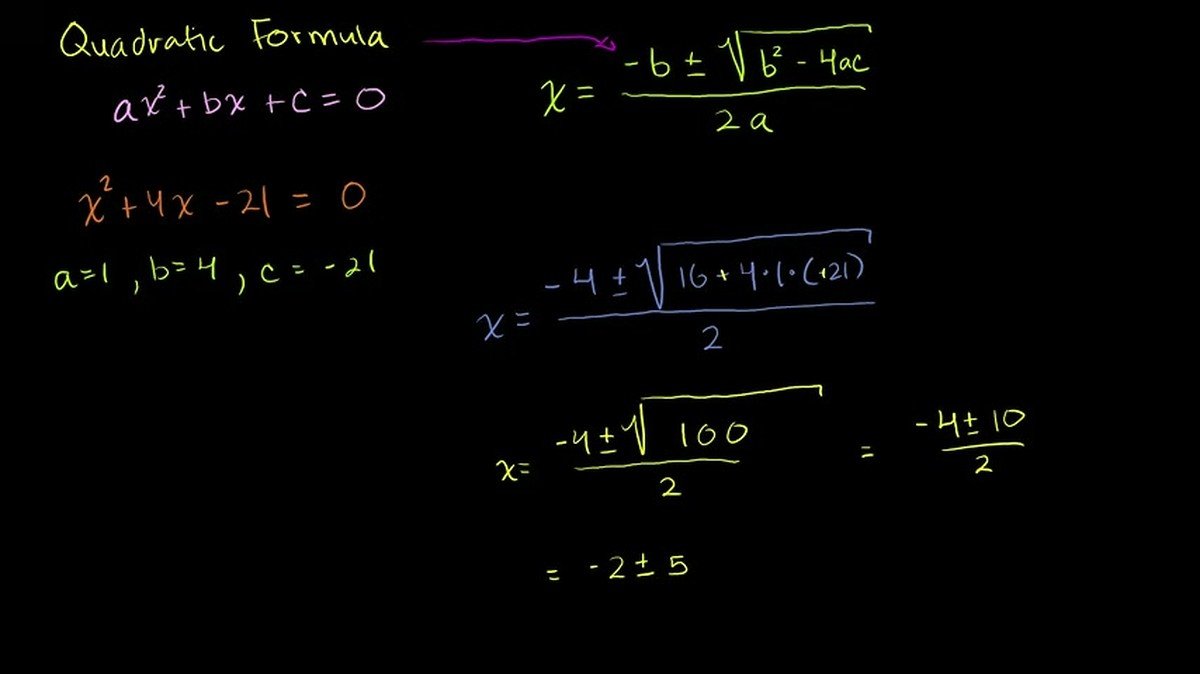
Example 1 solves x² + 4x – 21 = 0. Coefficients a = 1, b = 4, c = -21. Discriminant 16 – 4(1)(-21) = 100. Square root of 100 is 10. Substitution gives x = (-4 ± 10) / 2. Answers are 3 and -7.
Example 2 solves -3x² + 10x – 3 = 0. Coefficients a = -3, b = 10, c = -3. Discriminant 100 – 4(-3)(-3) = 64. Square root of 64 is 8. Substitution gives x = (-10 ± 8) / -6. Answers are 1/3 and 3.
When Does the Quadratic Formula Give No Real Solutions?
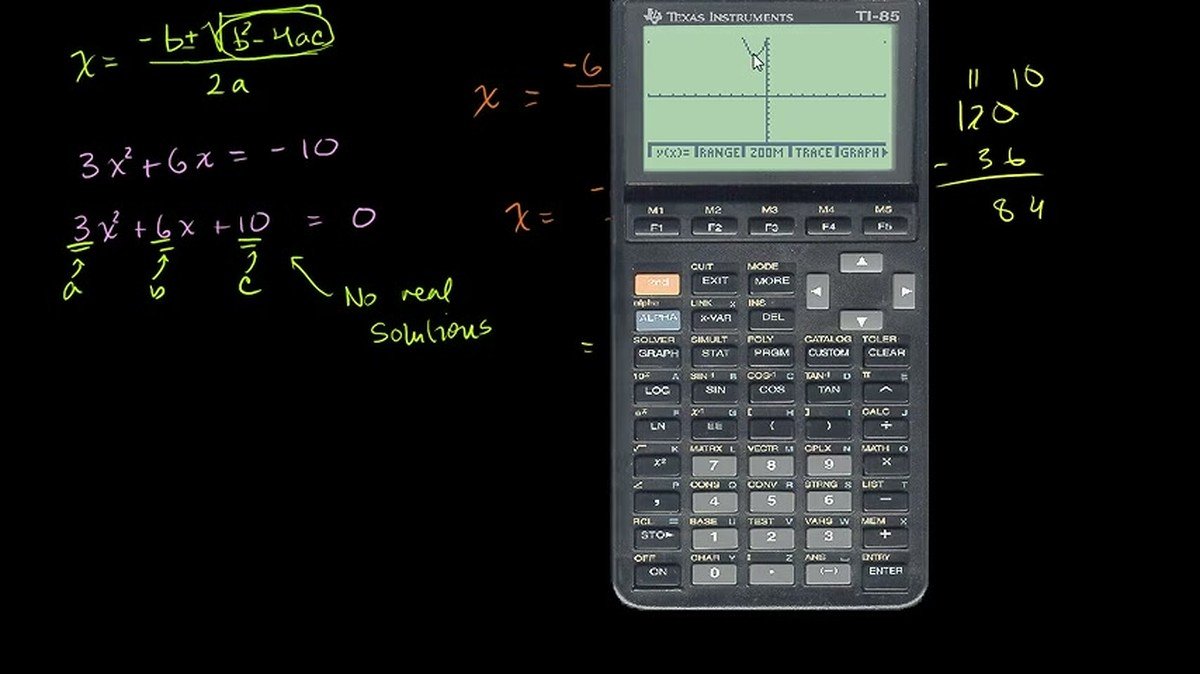
Quadratic formula gives no real solutions when discriminant is less than 0. Example: 3x² + 6x + 10 = 0. Coefficients a = 3, b = 6, c = 10. Discriminant 36 – 4(3)(10) = -84. Discriminant is -84. Negative discriminant gives no real roots. Roots are complex numbers, with i as square root of -1.
What Is the Difference Between the Quadratic Formula and Factoring?
Both solve quadratic equations, but quadratic formula solves every quadratic equation in standard form and factoring solves only equations that factor over rational numbers. Quadratic formula uses a, b, and c directly. Factoring uses pairs of numbers with product c and sum b, after division by a in some cases. Use factoring first, if numbers are simple. Use quadratic formula for equations that do not factor easily, for equations with large coefficients, and for equations with negative discriminant.
What Are 5 Common Mistakes With the Quadratic Formula?
- Missing sign on b or c in substitution.
- Dividing only square root by 2a, not full numerator.
- Forgetting plus-or-minus sign in formula.
- Using a = 0 in formula, with no x² term.
- Skipping check by substitution into original equation.
What Do People Also Ask About the Quadratic Formula?
What is quadratic formula? x = (-b ± √(b² – 4ac)) / 2a for ax² + bx + c = 0, with a not equal to 0.
What is discriminant of a quadratic equation? b² – 4ac, part under square root in quadratic formula.
How many solutions does a quadratic equation have? 2 solutions, with 2 distinct real roots, 1 repeated real root, or 2 complex roots.
When do you use quadratic formula? For any quadratic equation in standard form ax² + bx + c = 0, with a not equal to 0.
How Does the Quadratic Formula Solve ax² + bx + c = 0?
Quadratic formula solves ax² + bx + c = 0 in 5 steps with a, b, and c. Quadratic formula gives 2 answers from x = (-b ± √(b² – 4ac)) / 2a. Quadratic formula uses discriminant b² – 4ac to give 3 cases: 2 real roots, 1 repeated root, or 0 real roots.
Sources: Khan Academy, Newcastle University.

The University of the West Indies
My passion as a teacher and leader in education is to contribute to students’ enhanced learning by creation of a positive teaching/learning environment, where they are motivated to develop strong critical thinking, analytical and problem-solving skills.
As acting Vice-Principal and head of Physics, I have amassed five years of experience in leading meetings, implementing strategies to maintain discipline and school ethos, liaise with stakeholders in planning for future development of the institution; successfully negotiated the implementation of various projects for student development as well as supervising effective execution of such. For the past 19 years, I have incorporated discovery learning within the classroom through practical activities, problem solving and cooperative learning and have realized that students retention in Physics and Mathematics have increased significantly.
I am always cognizant that students have different learning styles, and as such teaching strategies during planning and delivery must take this crucial factor into consideration and be tailored to meet such differences.