

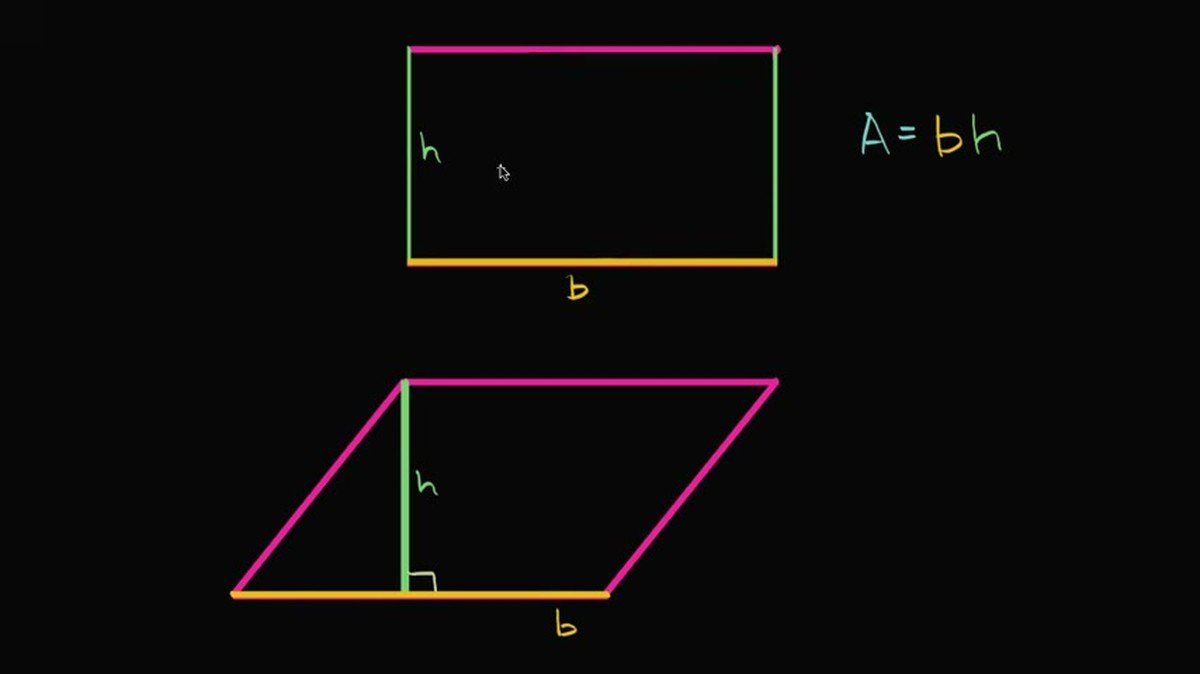
Parallelogram area formula gives 3 formulas for area. Main formula A = b x h. Other 2 use sine. This article gives definitions, 4 worked examples, 1 table, and 5 steps.
What Is the Parallelogram Area Formula?
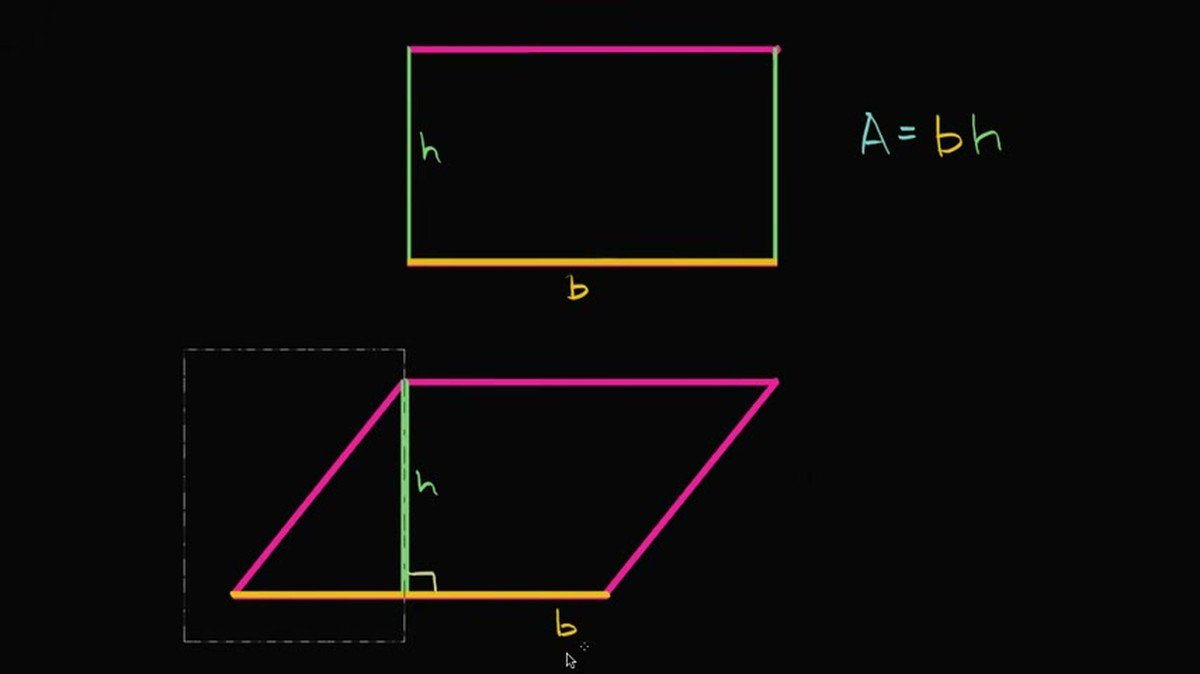
A = b x h. A is area, b is base, and h is perpendicular height. Height is perpendicular distance between base and opposite side, not slant side. A parallelogram is quadrilateral with 2 pairs parallel sides. Includes rectangles, rhombuses, squares as special cases. Opposite sides equal, opposite angles equal, 4 interior angles add to 360 degrees. According to Khan Academy, area is base times height, height measured at 90 degrees to base. Example base 5 height 6, area 30 square units.
What Are the 3 Parallelogram Area Formulas?
| No. | Uses | Formula |
|---|---|---|
| 1 | Base and height | A = b x h |
| 2 | Adjacent sides and angle | A = a x b x sin(θ) |
| 3 | Diagonals and angle | A = 1/2 x d1 x d2 x sin(φ) |
What Is the Formula for Area Using Base and Height?
A = b x h.
Worked example: Base 12 cm height 8 cm area 96 cm². Calculation: A = 12 x 8 = 96 cm².
Second worked example: Base 5 cm height 6 cm area 30 cm², matches Khan Academy. Calculation: A = 5 x 6 = 30 cm².
What Is the Formula for Area Using Sides and Angle?
A = a x b x sin(θ). Height equals b x sin(θ).
Worked example: Sides 7 cm and 8 cm angle 60 degrees sin 0.8660 area 48.5 cm². Calculation: A = 7 x 8 x sin(60 degrees) = 56 x 0.8660 = 48.5 cm².
What Is the Formula for Area Using Diagonals and Angle?
A = 1/2 x d1 x d2 x sin(φ). Diagonals bisect each other.
Worked example: Diagonals 9 cm and 12 cm angle 30 degrees sin 0.5 area 27 cm². Calculation: A = 1/2 x 9 x 12 x sin(30 degrees) = 1/2 x 9 x 12 x 0.5 = 27 cm².
How Do You Use the Parallelogram Area Formula in 5 Steps?
- Identify parallelogram and measurements.
- Measure base, height, sides, diagonals, angle in same unit.
- Select formula matching measurements.
- Substitute values.
- Calculate result and add square units.
What Are 5 Common Mistakes With the Parallelogram Area Formula?
- Use slant side in place of perpendicular height.
- Mix centimetres and metres.
- Omit sin(θ).
- Use vertex angle in place of diagonal angle.
- Give result in linear units in place of square units.
What Are People Also Asking About the Parallelogram Area Formula?
What is parallelogram area formula? A = b x h.
What is area with base 12 height 8? 96 square units.
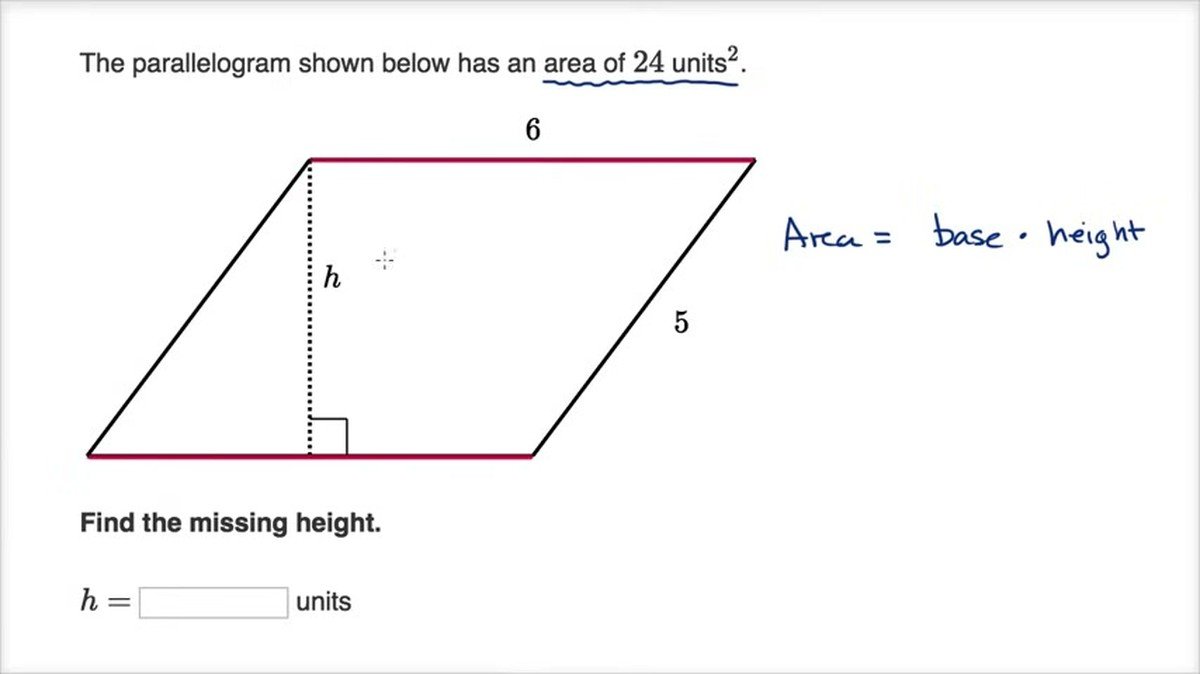
How do you find height from area and base? Height equals area divided by base.
What is area formula using diagonals? A = 1/2 x d1 x d2 x sin(φ).
How Does the Parallelogram Area Formula Connect to Rectangle, Triangle, and Rhombus Area?
Both rectangle and parallelogram use base times height, but rectangle height equals a side and parallelogram height is perpendicular distance. Triangle uses 1/2 x base x height. Rhombus uses 1/2 x d1 x d2. Parallelogram with diagonals at 90 degrees is a rhombus.
Sources: Khan Academy; OmniCalculator; InchCalculator.

The University of the West Indies
My passion as a teacher and leader in education is to contribute to students’ enhanced learning by creation of a positive teaching/learning environment, where they are motivated to develop strong critical thinking, analytical and problem-solving skills.
As acting Vice-Principal and head of Physics, I have amassed five years of experience in leading meetings, implementing strategies to maintain discipline and school ethos, liaise with stakeholders in planning for future development of the institution; successfully negotiated the implementation of various projects for student development as well as supervising effective execution of such. For the past 19 years, I have incorporated discovery learning within the classroom through practical activities, problem solving and cooperative learning and have realized that students retention in Physics and Mathematics have increased significantly.
I am always cognizant that students have different learning styles, and as such teaching strategies during planning and delivery must take this crucial factor into consideration and be tailored to meet such differences.