

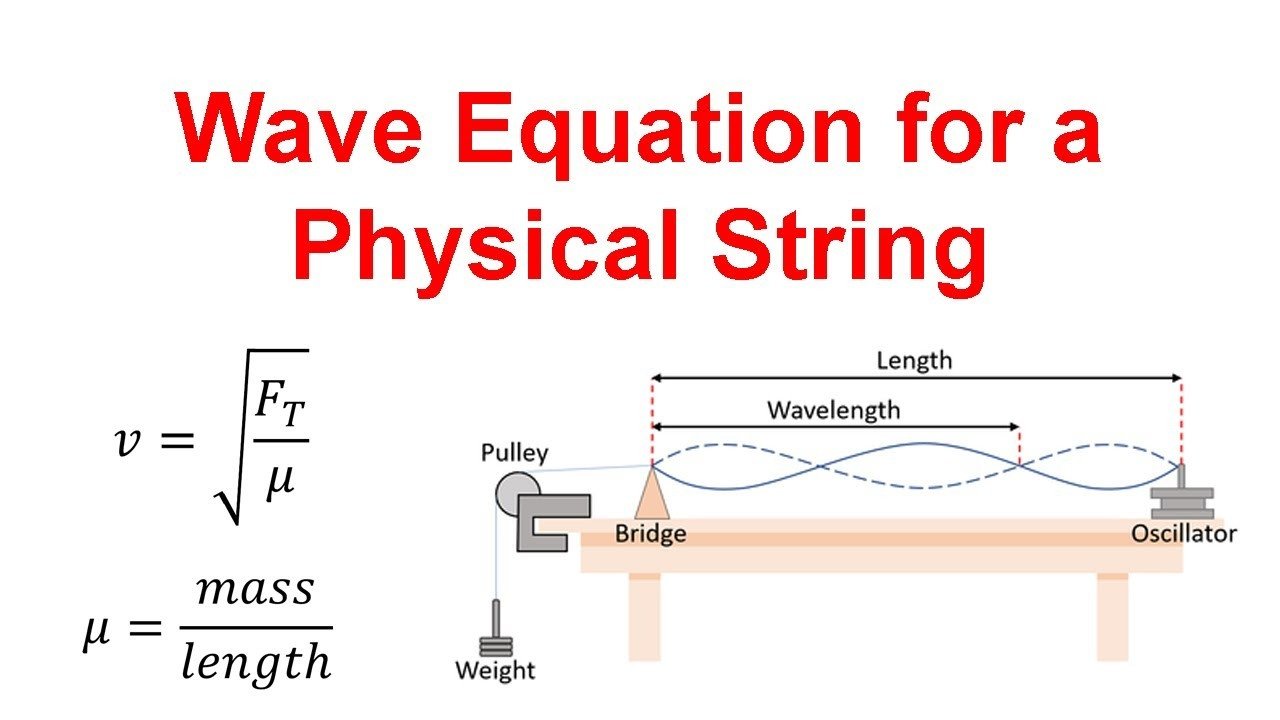
What Is a Wave on a String and How Is Its Speed Calculated?
A wave on a string is a transverse disturbance that travels along a stretched string at speed v = √(F_T / μ). The speed depends on the square root of the tension divided by the linear density, which is the mass per unit length.
For a reliable reference, see OpenStax derives wave speed on a stretched string from tension and linear mass density.
The periodic motion of a vibrating string connects to Simple Harmonic Motion: Definition, Equations, and Worked Examples.
The 3 core relationships are:
- Wave speed: v = √(F_T / μ)
- Traveling wave function: y(x,t) = A sin(kx − ωt + φ)
- Standing wave frequencies on a string fixed at both ends: f_n = nv / (2L)
What Is a Wave on a String?
A wave on a string is a disturbance that moves along a taut string while each string element oscillates perpendicular to the direction of travel. A wave is a disturbance that moves from its point of origin with a wave velocity v. Examples include a plucked guitar string, a piano string, and a pulse sent along a rope.
Is a Wave on a String Transverse or Longitudinal?
A wave on a string is transverse. In a transverse wave, the velocity of the medium is perpendicular to the direction of propagation of the wave. A string element moves up and down while the wave moves along the string.
What Is the Difference Between a Pulse and a Periodic Wave?
A pulse is a single disturbance, and a periodic wave is a repeating disturbance. A pulse can be sent down a taut string to study how the wave speed depends on tension and linear density. A periodic wave is modeled by y(x,t) = A sin(kx − ωt + φ).
What Are the Symbols and Units for a Wave on a String?
The equations for a wave on a string use SI units: meters, seconds, kilograms, newtons, and radians. Table 1 defines every symbol used in this article.
Table 1: Symbols and SI Units
| Quantity | Symbol | SI Unit |
|---|---|---|
| Transverse displacement | y | meter (m) |
| Amplitude | A | meter (m) |
| Wavelength | λ | meter (m) |
| Frequency | f | hertz (Hz) |
| Period | T | second (s) |
| Wave number | k | radian per meter (rad/m) |
| Angular frequency | ω | radian per second (rad/s) |
| Phase constant | φ | radian (rad) |
| Wave speed | v | meter per second (m/s) |
| Tension | F_T | newton (N) |
| Linear mass density | μ | kilogram per meter (kg/m) |
| String mass | m | kilogram (kg) |
| String length | L | meter (m) |
| Harmonic number | n | Dimensionless integer |
| Average power | P_avg | watt (W) |
What Are the Equations for a Wave on a String?
A wave on a string has 14 core equations, which Table 2 lists with the unit of each result. OpenStax lists the wave speed, wave number, wave function, linear wave equation, standing wave function, and harmonic frequency equations among its key equations for waves.
Table 2: Equations for a Wave on a String
| Quantity | Equation | Unit of Result |
|---|---|---|
| Linear mass density | μ = m / L |
kg/m |
| Wave speed on a string | v = √(F_T / μ) |
m/s |
| Wave speed from frequency and wavelength | v = λf |
m/s |
| Wave number | k = 2π / λ |
rad/m |
| Angular frequency | ω = 2π / T = 2πf |
rad/s |
| Wave speed from wave number and angular frequency | v = ω / k |
m/s |
| Traveling wave function | y(x,t) = A sin(kx − ωt + φ) |
m |
| Linear wave equation | ∂²y/∂x² = (1/v²) ∂²y/∂t² |
1/m |
| Maximum transverse speed of a string element | v_y,max = ωA |
m/s |
| Average power of a sinusoidal wave | P_avg = ½ μ A² ω² v |
W |
| Standing wave function | y(x,t) = [2A sin(kx)] cos(ωt) |
m |
| Wavelength of the nth harmonic | λ_n = 2L / n |
m |
| Frequency of the nth harmonic | f_n = n v / (2L) = n f₁ |
Hz |
| Fundamental frequency from tension | f₁ = (1 / 2L) √(F_T / μ) |
Hz |
What Is the Formula for the Speed of a Wave on a String?
The formula for the speed of a wave on a string is v = √(F_T / μ). The linear density is the mass of the string divided by its length, μ = m / L. A 2.00 m string with a mass of 0.06 kg has a linear density of 0.03 kg/m.
What Factors Affect the Speed of a Wave on a String?
Tension and linear mass density are the only 2 factors that affect the speed of a wave on a string. Higher tension raises the wave speed, and higher linear density lowers it. The speed does not depend on the amplitude or the frequency of the wave. The speed is inversely proportional to the square root of the linear mass density, so a lower-density string supports faster waves under the same tension.
Table 3 shows how changes in each factor change the speed.
Table 3: Effect of Each Change on Wave Speed
| Change | Effect on Wave Speed |
|---|---|
| Tension doubled | Speed multiplied by √2 ≈ 1.414 |
| Tension quadrupled | Speed doubled |
| Linear mass density quadrupled | Speed halved |
| Linear mass density reduced to one quarter | Speed doubled |
| Amplitude changed | No change |
| Frequency changed | No change (wavelength changes) |
Quadrupling the tension doubles the wave speed.
What Is the Wave Function for a Wave on a String?
The wave function for a sinusoidal wave on a string is y(x,t) = A sin(kx − ωt + φ). The wave number is k = 2π / λ, the angular frequency is ω = 2π / T, and φ is the phase shift. The minus sign describes a wave moving in the positive x-direction, and the plus sign describes a wave moving in the negative x-direction.
The wave speed also equals ω / k. Wave velocity and wavelength relate to frequency and period by v = λ / T = λf.
What Is the Transverse Velocity of a String Element?
The transverse velocity of a string element is the partial derivative of y with respect to time, v_y = ∂y/∂t = −ωA cos(kx − ωt + φ). The velocity of the medium is found by taking the partial derivative of the position equation with respect to time. The maximum transverse speed is ωA, and it differs from the wave speed v.
What Is the Wave Equation for a String?
The linear wave equation for a string is ∂²y/∂x² = (1/v²) ∂²y/∂t². OpenStax lists this equation as the linear wave equation. Applying Newton’s second law to a small string segment under tension F_T gives v² = F_T / μ.
What Is the Power of a Wave on a String?
The average power of a sinusoidal wave on a string is P_avg = ½ μ A² ω² v. The energy and power of a wave are proportional to the square of the amplitude and the square of the angular frequency. Doubling the amplitude multiplies the power by 4, and doubling the frequency multiplies the power by 4.
What Happens When a Wave on a String Reaches a Boundary?
A wave on a string reflects at a boundary, and the reflection depends on whether the end is fixed or free. A fixed boundary produces an inverted reflection. A pulse reflects right side up from a free boundary. Table 4 lists the 4 cases.
Table 4: Reflection and Transmission on a String
| Boundary | Reflected Pulse | End Behavior | Phase Change of Reflected Pulse |
|---|---|---|---|
| Fixed end | Inverted | Node | π |
| Free end | Upright | Antinode | 0 |
| Light string to heavier string (μ₂ > μ₁) | Inverted, partial | Partial reflection and transmission | π |
| Heavy string to lighter string (μ₂ < μ₁) | Upright, partial | Partial reflection and transmission | 0 |
A fixed end always has a node, and a free end always has an antinode. At a boundary between a light and a heavy string, the wave undergoes partial reflection and partial transmission. When the tension is the same in both strings, the wave speed is higher in the string with the lower linear mass density.
What Is the Superposition of Waves on a String?
Superposition is the combination of overlapping waves into a single resulting wave on the string. Two identical pulses with inverted shapes cancel each other when they overlap, according to the superposition principle. A standing wave can be viewed as the superposition of 2 oppositely directed traveling waves.
What Are Standing Waves on a String?
A standing wave on a string is a stationary pattern of nodes and antinodes formed by reflected waves. For a string fixed at both ends, the displacement at each end is always zero, so each end is a node. The standing wave function is y(x,t) = [2A sin(kx)] cos(ωt).
What Are the Harmonics of a String Fixed at Both Ends?
The harmonics of a string fixed at both ends have wavelengths λ_n = 2L / n and frequencies f_n = nv / (2L). The length must satisfy 2L = nλ. The nth harmonic has n + 1 nodes and n antinodes. The fundamental frequency is f₁ = v / (2L), and higher harmonics are integer multiples of it.
Combining v = √(F_T / μ) with f₁ = v / (2L) gives f₁ = (1 / 2L) √(F_T / μ). Pitch changes with string length, tension, and linear density.
Table 5 lists the first 4 harmonics for a 2.00 m string with a wave speed of 20.0 m/s.
Table 5: Harmonics of a 2.00 m String Fixed at Both Ends (v = 20.0 m/s)
| Harmonic n | Frequency f_n (Hz) | Wavelength λ_n (m) | Nodes | Antinodes |
|---|---|---|---|---|
| 1 | 5.0 | 4.00 | 2 | 1 |
| 2 | 10.0 | 2.00 | 3 | 2 |
| 3 | 15.0 | 1.33 | 4 | 3 |
| 4 | 20.0 | 1.00 | 5 | 4 |
How Are the Equations for a Wave on a String Used in Worked Examples?
The equations are applied by listing the known quantities and selecting the equation that contains them. Examples 1 to 4 use the same string: m = 0.060 kg, L = 2.00 m, and F_T = 12.0 N.
Example 1: What Is the Wave Speed on the String?
- Calculate linear density: μ = m / L = 0.060 kg / 2.00 m = 0.030 kg/m.
- Select the equation: v = √(F_T / μ).
- Substitute: v = √(12.0 N / 0.030 kg/m) = √400 m²/s².
- Solve: v = 20.0 m/s.
Example 2: What Is the Wave Function for a 5.0 Hz Wave With a 0.020 m Amplitude?
- Wavelength: λ = v / f = 20.0 m/s / 5.0 Hz = 4.0 m.
- Wave number: k = 2π / λ = 2π / 4.0 m = 1.571 rad/m.
- Angular frequency: ω = 2πf = 2π(5.0 Hz) = 31.42 rad/s.
- Check the speed: v = ω / k = 31.42 / 1.571 = 20.0 m/s.
- Wave function: y(x,t) = (0.020 m) sin(1.571 m⁻¹ x − 31.42 s⁻¹ t).
Example 3: What Are the Maximum Transverse Speed and Average Power?
- Maximum transverse speed: v_y,max = ωA = (31.42 rad/s)(0.020 m) = 0.628 m/s.
- Select the power equation: P_avg = ½ μ A² ω² v.
- Substitute: P_avg = ½(0.030)(0.020)²(31.42)²(20.0).
- Solve: P_avg ≈ 0.118 W.
The maximum transverse speed of 0.628 m/s is much smaller than the wave speed of 20.0 m/s.
Example 4: What Are the Standing Wave Frequencies if the String Is Fixed at Both Ends?
- Fundamental frequency: f₁ = v / (2L) = 20.0 / (2 × 2.00) = 5.0 Hz.
- Second harmonic: f₂ = 2f₁ = 10.0 Hz.
- Third harmonic: f₃ = 3f₁ = 15.0 Hz.
- Fundamental wavelength: λ₁ = 2L = 4.00 m.
The fundamental frequency of 5.0 Hz equals the frequency of the traveling wave in Example 2, so a 5.0 Hz wave of wavelength 4.0 m fits the string as a standing wave.
Example 5: What Tension Tunes a Guitar String to 329.63 Hz?
A steel string with a diameter of 0.254 mm has a linear density of about 3.98 × 10⁻⁴ kg/m, and the vibrating length is 0.648 m.
- Wave speed from the fundamental: v = 2Lf₁ = 2(0.648 m)(329.63 Hz) ≈ 427.2 m/s.
- Rearrange v = √(F_T / μ): F_T = μv².
- Substitute: F_T = (3.98 × 10⁻⁴ kg/m)(427.2 m/s)² ≈ 72.6 N.
What Are the Wave Speeds on Guitar Strings?
The wave speed on a guitar string increases from the low E string to the high E string. Standard tuning uses fundamental frequencies of 82.41, 110.00, 146.83, 196.00, 246.94, and 329.63 Hz. A Stratocaster-style guitar has a string length of about 648 mm. The fundamental wavelength of a string equals twice the scale length.
Table 6 lists the wave speed v = f₁ × 2L for each string at L = 0.648 m.
Table 6: Fundamental Frequency and Wave Speed on Standard-Tuned Guitar Strings
| String | Note | Fundamental Frequency (Hz) | Wave Speed at L = 0.648 m (m/s) |
|---|---|---|---|
| 1 | High E | 329.63 | 427.2 |
| 2 | B | 246.94 | 320.0 |
| 3 | G | 196.00 | 254.0 |
| 4 | D | 146.83 | 190.3 |
| 5 | A | 110.00 | 142.6 |
| 6 | Low E | 82.41 | 106.8 |
What Are People Also Asking About a Wave on a String?
What is the formula for the speed of a wave on a string?
The formula is v = √(F_T / μ), where F_T is the tension and μ is the linear mass density.
What factors affect the speed of a wave on a string?
Tension and linear mass density affect the speed, and amplitude and frequency do not.
What is linear mass density?
Linear mass density is the mass per unit length of the string, μ = m / L, measured in kg/m.
Is a wave on a string transverse or longitudinal?
A wave on a string is transverse, because the string moves perpendicular to the direction of the wave.
What is the wave equation for a string?
The wave equation is ∂²y/∂x² = (1/v²) ∂²y/∂t², with the sinusoidal solution y(x,t) = A sin(kx − ωt + φ).
What happens when a wave on a string reflects from a fixed end?
The reflected pulse is inverted, and the fixed end is a node.
What happens when a wave on a string reflects from a free end?
The reflected pulse is not inverted, and the free end is an antinode.
What is the fundamental frequency of a string fixed at both ends?
The fundamental frequency is f₁ = v / (2L) = (1 / 2L) √(F_T / μ).
How many nodes does the nth harmonic have on a string fixed at both ends?
The nth harmonic has n + 1 nodes and n antinodes.
How do you raise the pitch of a string?
Increase the tension, shorten the vibrating length, or use a string with a lower linear mass density.
Which Equation for a Wave on a String Applies to Each Situation?
The applicable equation depends on the known quantities. Table 7 maps 10 situations to an equation.
Table 7: Equation for a Wave on a String by Known Quantities
| Known Quantities | Equation | Result |
|---|---|---|
| String mass and length | μ = m / L |
Linear mass density |
| Tension and linear mass density | v = √(F_T / μ) |
Wave speed |
| Frequency and wavelength | v = λf |
Wave speed |
| Wavelength | k = 2π / λ |
Wave number |
| Frequency | ω = 2πf |
Angular frequency |
| Amplitude, wave number, angular frequency, phase | y = A sin(kx − ωt + φ) |
Displacement |
| Amplitude and angular frequency | v_y,max = ωA |
Maximum transverse speed |
| Linear density, amplitude, angular frequency, speed | P_avg = ½ μ A² ω² v |
Average power |
| Wave speed and length, fixed ends | f_n = n v / (2L) |
Harmonic frequency |
| Length, tension, and linear density | f₁ = (1 / 2L) √(F_T / μ) |
Fundamental frequency |
A wave on a string travels at v = √(F_T / μ), follows the wave function y(x,t) = A sin(kx − ωt + φ), and forms the standing wave frequencies f_n = nv / (2L) when both ends are fixed.

The University of the West Indies
My passion as a teacher and leader in education is to contribute to students’ enhanced learning by creation of a positive teaching/learning environment, where they are motivated to develop strong critical thinking, analytical and problem-solving skills.
As acting Vice-Principal and head of Physics, I have amassed five years of experience in leading meetings, implementing strategies to maintain discipline and school ethos, liaise with stakeholders in planning for future development of the institution; successfully negotiated the implementation of various projects for student development as well as supervising effective execution of such. For the past 19 years, I have incorporated discovery learning within the classroom through practical activities, problem solving and cooperative learning and have realized that students retention in Physics and Mathematics have increased significantly.
I am always cognizant that students have different learning styles, and as such teaching strategies during planning and delivery must take this crucial factor into consideration and be tailored to meet such differences.