

How to Calculate Velocity: 10 Formulas and Worked Examples
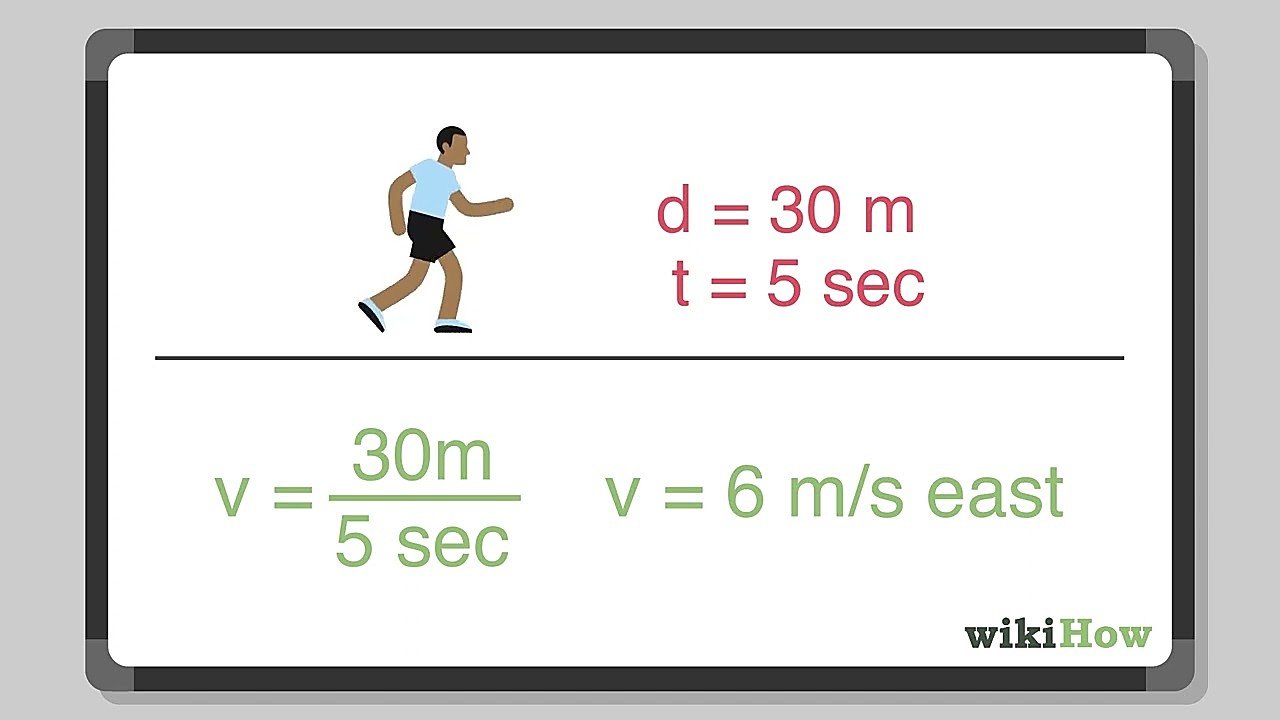
Velocity is calculated by dividing displacement by the time interval (v = Δx / Δt). The result is a vector, expressed in meters per second (m/s) with a direction. This guide covers 10 velocity formulas, SI units, graph methods, vector rules, and worked examples.
What Is Velocity in Physics?
Velocity is the rate of change of position with respect to time, including the direction of motion. NASA Glenn Research Center classifies velocity as a vector quantity with both magnitude and direction. The direction matches the direction of the displacement.
Vector quantities include velocity, displacement, and acceleration. Scalar quantities include speed, distance, and time.
Velocity examples include:
- A delivery van moving at 60 km/h north
- A cyclist moving at 5 m/s east
- A spacecraft leaving Earth at 11.2 km/s outward
- A tectonic plate drifting at a rate measured in millimeters per year
A Southern California Earthquake Center education module describes velocity maps that show how fast and in which direction GPS sites on tectonic plates move.
What Is the Formula for Velocity?
The formula for velocity is v = Δx / Δt. Velocity (v) equals displacement (Δx) divided by the elapsed time (Δt).
The expanded form is v = (x₂ − x₁) / (t₂ − t₁). NASA Glenn defines average velocity along the x direction as displacement divided by the time interval. The object might speed up and slow down between the 2 points.
The table below defines each symbol in the average velocity formula.
| Symbol | Quantity | SI unit | Definition |
|---|---|---|---|
| v | Velocity | m/s | Displacement per unit of time, with direction |
| Δx | Displacement | m | Final position minus initial position (x₂ − x₁) |
| Δt | Time interval | s | Final time minus initial time (t₂ − t₁) |
What Are the Units of Velocity?
The SI unit of velocity is the meter per second (m/s). 4 other units are in common use: centimeters per second, kilometers per hour, miles per hour, and knots.
The table below lists 5 velocity units with their equivalents in m/s and typical uses.
| Unit | Symbol | Equivalent in m/s | Typical use |
|---|---|---|---|
| Meter per second | m/s | 1 | Physics and engineering |
| Centimeter per second | cm/s | 0.01 | Laboratory measurements |
| Kilometer per hour | km/h | 0.2778 | Road vehicles |
| Mile per hour | mph | 0.4470 | Road vehicles in the United States and United Kingdom |
| Knot | kn | 0.5144 | Ships and aircraft |
The conversions between common units follow 4 rules:
- Multiply by 3.6 to convert m/s to km/h
- Divide by 3.6 to convert km/h to m/s
- Multiply by 2.237 to convert m/s to mph
- Multiply by 0.4470 to convert mph to m/s
Example: 10 m/s × 3.6 = 36 km/h.
How Do You Calculate Velocity Step by Step?
Calculate velocity in 5 steps: measure the displacement, record the time, convert the units, divide, and state the direction.
- Measure the displacement by subtracting the initial position from the final position.
- Record the time interval by subtracting the initial time from the final time.
- Convert all values to consistent units, such as meters and seconds.
- Divide the displacement by the time interval.
- State the direction with a positive or negative sign or a compass bearing.
Worked example: A cyclist moves from 0 m to 600 m east in 120 s. Velocity = 600 m / 120 s = 5 m/s east.
How Do You Calculate Average Velocity?
Average velocity equals total displacement divided by total time: v_avg = Δx / Δt. The value depends only on the start and end positions, not on the path.
Worked Example 1: Car Journey
A car travels 150 km east in 2 hours. Average velocity = 150 km / 2 h = 75 km/h east.
Worked Example 2: Round Trip
A runner completes one 400 m lap in 80 s and returns to the start. The displacement is 0 m, so the average velocity is 0 m/s. The average speed is 400 m / 80 s = 5 m/s.
The Smithsonian National Air and Space Museum describes the same case. A runner circling a 100 meter track in 1 minute has a speed of 6 km/h and a velocity of zero, because the runner returns to the start.
Worked Example 3: 100 Meter Sprint
Usain Bolt ran the 100 m world record in 9.58 s at the 2009 World Championships. Average velocity = 100 m / 9.58 s = 10.44 m/s (37.58 km/h) in the forward direction. IAAF split data, reported by Top End Sports, show the fastest 20 m interval (60 to 80 m) averaged 12.42 m/s.
Average velocity equals average speed in a straight-line run with no reversal of direction.
How Do You Calculate Instantaneous Velocity?
Instantaneous velocity is the velocity at a single moment, calculated as the derivative of position with respect to time: v = dx/dt. The derivative is the limit of Δx / Δt as Δt approaches zero.
OpenStax University Physics states that the velocity vector becomes tangent to the path of the object as Δt approaches zero.
Worked example: The position of an object is x(t) = 3t² + 2t, with x in meters and t in seconds.
- Differentiate the position function: v(t) = 6t + 2.
- Substitute t = 2 s: v = 6(2) + 2 = 14 m/s.
The average velocity from 0 s to 2 s is 16 m / 2 s = 8 m/s. The instantaneous velocity at 2 s is 14 m/s. The 2 values differ because the object accelerates.
How Do You Calculate Final Velocity?
Use v = u + at, if the time is known. Use v² = u² + 2as, if the time is unknown. Both formulas apply when acceleration is constant.
The table below defines the 5 symbols in the final velocity formulas.
| Symbol | Quantity | SI unit |
|---|---|---|
| v | Final velocity | m/s |
| u | Initial velocity | m/s |
| a | Acceleration | m/s² |
| t | Time | s |
| s | Displacement | m |
What Is the Final Velocity Formula With Time?
The final velocity formula with time is v = u + at. Final velocity equals initial velocity plus the product of acceleration and time.
Worked example: A car starts from rest (u = 0 m/s) and accelerates at 3 m/s² for 8 s. v = 0 + (3 × 8) = 24 m/s.
What Is the Final Velocity Formula Without Time?
The final velocity formula without time is v² = u² + 2as. Take the square root of the result to find v.
Worked example: A car has u = 10 m/s and a = 2 m/s² over a displacement of s = 100 m. v² = 10² + 2(2)(100) = 100 + 400 = 500. v = √500 = 22.4 m/s.
How Does Negative Acceleration Change Final Velocity?
Negative acceleration reduces a positive velocity. A braking car has an acceleration opposite to its velocity.
Worked example: A car has u = 20 m/s and a = −4 m/s² for t = 3 s. v = 20 + (−4 × 3) = 8 m/s.
An Institute of Physics research review reports that many students assume acceleration always points in the direction of motion. The review cites Trowbridge and McDermott (1981).
How Do You Calculate Velocity From a Graph?
Calculate velocity from a position-time graph by finding the slope: the change in position divided by the change in time.
Worked example: A graph passes through (2 s, 10 m) and (5 s, 40 m). Slope = (40 − 10) / (5 − 2) = 30 / 3 = 10 m/s.
The table below interprets 4 line shapes on a position-time graph.
| Line shape | Meaning |
|---|---|
| Straight line | Constant velocity |
| Steeper line | Higher velocity |
| Horizontal line | Zero velocity |
| Line sloping downward | Negative velocity |
A velocity-time graph gives velocity directly on the vertical axis. The slope equals acceleration, and the area under the line equals displacement.
McDermott, Rosenquist, and van Zee (1987) studied several hundred university students in the American Journal of Physics. The study identified difficulties in connecting graphs to physical concepts, including relating one type of graph to another and representing negative velocity.
How Do You Calculate Velocity in Two Dimensions?
Calculate velocity in 2 dimensions by combining the x and y components with the Pythagorean theorem: v = √(vx² + vy²). The direction angle is θ = arctan(vy / vx).
Worked example: vx = 3 m/s and vy = 4 m/s. v = √(3² + 4²) = √25 = 5 m/s. θ = arctan(4 / 3) = 53.1° above the x axis.
What Is a Textbook Example of 2D Velocity?
A physics textbook example by Cutnell and Johnson uses a spacecraft with vx0 = 22 m/s, ax = 24 m/s², vy0 = 14 m/s, and ay = 12 m/s². The x and y motions are solved separately with the same time value, t = 7.0 s.
- Calculate vx = 22 + 24(7.0) = 190 m/s.
- Calculate vy = 14 + 12(7.0) = 98 m/s.
- Calculate v = √(190² + 98²) = √45,704 = 213.8 m/s.
- Calculate θ = arctan(98 / 190) = 27°.
The textbook reports the result as 210 m/s at 27° above the positive x axis, using 2 significant figures.
Shaffer and McDermott (2005) conducted a long-term, large-scale investigation of how university students treat velocity and acceleration as vectors in 1 and 2 dimensions. The findings guided new instructional materials.
How Do You Calculate Velocity in Circular Motion?
Calculate the linear velocity of circular motion with v = ωr. The symbol ω is angular velocity in radians per second, and r is the radius in meters. The direction is tangent to the circle.
An alternative formula is v = 2πr / T, where T is the period in seconds.
Worked examples:
- Angular velocity: ω = 10 rad/s and r = 0.3 m give v = 10 × 0.3 = 3 m/s.
- Period: r = 0.5 m and T = 2 s give v = 2π(0.5) / 2 = 1.57 m/s.
The direction changes continuously in circular motion. The velocity changes even when the speed is constant.
How Do You Calculate Velocity From Momentum or Kinetic Energy?
Calculate velocity from momentum with v = p / m. Calculate velocity from kinetic energy with v = √(2KE / m).
The table below shows 2 worked examples with the known quantities, formula, and result.
| Known quantities | Formula | Example values | Result |
|---|---|---|---|
| Momentum (p) and mass (m) | v = p / m | p = 60 kg·m/s, m = 12 kg | 5 m/s |
| Kinetic energy (KE) and mass (m) | v = √(2KE / m) | KE = 200 J, m = 4 kg | 10 m/s |
The kinetic energy formula gives the magnitude only. Direction requires separate information.
How Do You Calculate Relative Velocity?
Calculate relative velocity by subtracting the velocity of the reference object from the velocity of the other object: v_AB = v_A − v_B. The result is the velocity of A as seen from B.
Worked examples:
- Same direction: Car A moves at 80 km/h east and car B at 60 km/h east. v_AB = 80 − 60 = 20 km/h east.
- Opposite directions: Car A moves at 80 km/h east and car B at 60 km/h west (−60 km/h). v_AB = 80 − (−60) = 140 km/h east.
NASA Glenn's Beginner's Guide to Aerodynamics applies vector components to relative velocities, including the vector equation of airspeed.
How Do You Calculate Escape Velocity?
Calculate escape velocity with v = √(2GM / R). Escape velocity is the minimum speed that lets an object leave the gravitational pull of a body without further propulsion, ignoring air resistance.
The formula uses 3 values: the gravitational constant G (6.674 × 10⁻¹¹ N·m²/kg²), the mass M of the body in kilograms, and the radius R of the body in meters.
Worked example for Earth: M = 5.972 × 10²⁴ kg and R = 6.371 × 10⁶ m.
v = √(2 × 6.674 × 10⁻¹¹ × 5.972 × 10²⁴ / 6.371 × 10⁶) = √(1.251 × 10⁸) = 11,185 m/s, or about 11.2 km/s.
The table below lists the approximate escape velocity of 4 bodies.
| Body | Escape velocity (km/s) |
|---|---|
| Earth | 11.2 |
| Moon | 2.38 |
| Mars | 5.03 |
| Mercury | 4.25 |
A University of Connecticut mathematics handout states that orbital velocity near the surface of Earth is about 7.9 km/s. This value equals the escape velocity divided by √2.
What Is the Difference Between Velocity and Speed?
Velocity is a vector that includes direction, and speed is a scalar that includes magnitude only. The Smithsonian National Air and Space Museum defines speed as distance over time and velocity as displacement over time.
The table below compares velocity and speed across 6 properties.
| Property | Velocity | Speed |
|---|---|---|
| Quantity type | Vector | Scalar |
| Formula | Displacement ÷ time | Distance ÷ time |
| Direction | Included | Not included |
| Possible values | Positive, negative, or zero | Zero or positive |
| Result after a round trip | Average velocity of 0 m/s | Non-zero average speed |
| Example | 10 m/s north | 10 m/s |
The magnitude of instantaneous velocity equals instantaneous speed. The average speed is greater than or equal to the magnitude of the average velocity.
What Mistakes Occur When Calculating Velocity?
5 mistakes occur most often when calculating velocity:
- Confusing distance with displacement
- Ignoring direction and sign
- Mixing units, such as kilometers with seconds
- Averaging velocities without weighting by time
- Applying constant-acceleration formulas to variable acceleration
Worked example of the time-weighting mistake: A car travels at 60 km/h for 1 h and at 40 km/h for 2 h in the same direction. The total displacement is 60 + 80 = 140 km over 3 h. The average velocity is 140 / 3 = 46.7 km/h, not (60 + 40) / 2 = 50 km/h.
Trowbridge and McDermott (1980) investigated the understanding of velocity among introductory physics students at the University of Washington. The study judged understanding by the ability to interpret simple motions of real objects. A summary of the work reports that students often judge 2 objects to move at equal speed at the moment they pass each other.
An Institute of Physics research review reports that many students do not clearly distinguish instantaneous speed from average speed.
People Also Ask About Calculating Velocity
What Is the Formula for Velocity?
Velocity equals displacement divided by time, written as v = Δx / Δt.
What Is the SI Unit of Velocity?
The SI unit of velocity is the meter per second (m/s).
How Do You Calculate Velocity With Distance and Time?
Distance divided by time gives speed, and displacement divided by time gives velocity.
How Do You Calculate Velocity Without Time?
Use v² = u² + 2as, which links final velocity, initial velocity, acceleration, and displacement.
How Do You Calculate Velocity From Acceleration?
Use v = u + at, which adds the product of acceleration and time to the initial velocity.
Can Velocity Be Negative?
Yes, negative velocity indicates motion opposite to the chosen positive direction.
How Do You Calculate Velocity From a Graph?
The slope of a position-time graph equals the velocity.
How Do You Convert m/s to km/h?
Multiply the value in m/s by 3.6 to get km/h.
What Is the Difference Between Velocity and Speed?
Velocity is a vector that includes direction, and speed is a scalar that excludes direction.
Which Formula Calculates Velocity for Each Situation?
Match the known values to the formula in the table below. The table summarizes 10 methods for how to calculate velocity.
| Situation | Known values | Formula | Example result |
|---|---|---|---|
| Average velocity | Displacement = 150 km, time = 2 h | v = Δx / Δt | 75 km/h |
| Instantaneous velocity | Position function x(t) = 3t² + 2t | v = dx/dt | 14 m/s at t = 2 s |
| Final velocity with time | u = 0 m/s, a = 3 m/s², t = 8 s | v = u + at | 24 m/s |
| Final velocity without time | u = 10 m/s, a = 2 m/s², s = 100 m | v² = u² + 2as | 22.4 m/s |
| Velocity in 2 dimensions | vx = 3 m/s, vy = 4 m/s | v = √(vx² + vy²) | 5 m/s at 53.1° |
| Circular motion | ω = 10 rad/s, r = 0.3 m | v = ωr | 3 m/s |
| From momentum | p = 60 kg·m/s, m = 12 kg | v = p / m | 5 m/s |
| From kinetic energy | KE = 200 J, m = 4 kg | v = √(2KE / m) | 10 m/s |
| Relative velocity | vA = 80 km/h, vB = 60 km/h | v_AB = v_A − v_B | 20 km/h |
| Escape velocity | Mass and radius of Earth | v = √(2GM / R) | 11.2 km/s |
To calculate velocity, divide displacement by time (v = Δx / Δt). The other 9 formulas apply when acceleration, vector components, rotation, momentum, energy, reference frames, or gravity are known.
Sources cited in this article:
- NASA Glenn Research Center, Beginner's Guide to Aeronautics: https://www.grc.nasa.gov/www/k-12/airplane/disvelac.html
- NASA Glenn Research Center, Vectors in Relative Velocities: https://www.grc.nasa.gov/www/k-12/BGA/Corrine/Relative_velocities_int.htm
- Smithsonian National Air and Space Museum, How Things Fly: https://howthingsfly.si.edu/ask-an-explainer/what-difference-between-speed-and-velocity-0
- OpenStax, University Physics Volume 1, Section 4.1 Displacement and Velocity Vectors
- Southern California Earthquake Center, GPS velocity activity: https://ceo.scec.org/education/k12/learn/gpsact2.htm
- Cutnell and Johnson, Physics, spacecraft example: https://www.webassign.net/ebooks/cj6demo/xlinks/c03-box-0004.htm
- Trowbridge and McDermott (1980), American Journal of Physics: https://www.compadre.org/portal/items/detail.cfm?ID=2964
- Shaffer and McDermott (2005), American Journal of Physics: https://www.compadre.org/portal/items/detail.cfm?ID=12094
- McDermott, Rosenquist, and van Zee (1987), American Journal of Physics 55(6): https://webspace.science.uu.nl/~doorm101/proo/literatuur/Literatuur-37.html
- Institute of Physics, Spark research reviews: https://spark.iop.org/many-pupils-do-not-clearly-distinguish-ideas-instantaneous-and-average-speed
- Top End Sports, Sporting Speed Records: https://www.topendsports.com/resources/records/speed.htm
- Keith Conrad, University of Connecticut, Escape Velocity handout: https://kconrad.math.uconn.edu/math1132s20/handouts/escapevelocity.pdf

The University of the West Indies
My passion as a teacher and leader in education is to contribute to students’ enhanced learning by creation of a positive teaching/learning environment, where they are motivated to develop strong critical thinking, analytical and problem-solving skills.
As acting Vice-Principal and head of Physics, I have amassed five years of experience in leading meetings, implementing strategies to maintain discipline and school ethos, liaise with stakeholders in planning for future development of the institution; successfully negotiated the implementation of various projects for student development as well as supervising effective execution of such. For the past 19 years, I have incorporated discovery learning within the classroom through practical activities, problem solving and cooperative learning and have realized that students retention in Physics and Mathematics have increased significantly.
I am always cognizant that students have different learning styles, and as such teaching strategies during planning and delivery must take this crucial factor into consideration and be tailored to meet such differences.