

What Is the AP Physics C Mechanics Formula Sheet, and Which Equations, Constants, and Rules Does It Include?
The AP Physics C: Mechanics formula sheet is the College Board reference provided with the exam. It has 2 parts: a Table of Information and equation tables grouped by topic. The Table of Information lists the constants G and g, 9 metric prefixes, 7 unit symbols, trigonometric values for 7 angles, and 3 problem assumptions. The equations fall into 7 groups: kinematics, dynamics, work and energy, momentum, rotation, oscillations, and gravitation. The exam is hybrid digital, and calculators are permitted.
For a reliable reference, consult College Board AP Physics C Mechanics course information.
What Is the AP Physics C Mechanics Formula Sheet?
The AP Physics C Mechanics formula sheet is a College Board reference that combines a Table of Information with equation tables. The College Board publishes the Mechanics version as an appendix of the Course and Exam Description.
The equation tables are grouped by the major content category in which each equation appears, and each equation uses the symbol that textbooks commonly use for it. Mechanics relationships include Newton's second law, the work-energy theorem, and the period of a spring-mass system.
The tables in this article list standard Mechanics formulas by group. The official sheet defines the exact equations and notation available on exam day.
Is the AP Physics C Mechanics Formula Sheet Provided on Exam Day?
Yes, the College Board provides the Table of Information and the equation tables to students taking the AP Physics C exams. College Board documentation directs students to the AP Central course pages for the latest versions of the tables.
The AP Central Mechanics exam page links to the reference sheets and exam day details. The College Board states that students are responsible for understanding the physical principles behind each equation and the conditions under which each equation applies.
Where Can Students Download the Official Sheet?
The official sheet is a PDF on AP Central, and the same content appears in the appendix of the Mechanics Course and Exam Description. The Mechanics exam page on AP Central links to the reference sheets.
Editions differ across years. The 2019 to 2020 edition of the Table of Information listed more than 10 constants, including proton mass, electron charge, and the speed of light. The 2024 edition for Mechanics lists the gravitational constant and the gravitational acceleration at Earth's surface. Third-party sheets often copy older editions, so the AP Central PDF is the reference for current content.
What Does the Table of Information Contain?
The Table of Information contains 5 parts: constants, metric prefixes, unit symbols, trigonometric values, and problem assumptions.
Which Constants Does the Mechanics Table Include?
The 2024 Mechanics table lists the universal gravitational constant as 6.67 × 10⁻¹¹ N·m²/kg² and the gravitational acceleration at Earth's surface as 9.8 m/s², which equals 9.8 N/kg as a field strength.
| Constant | Symbol | Value |
|---|---|---|
| Universal gravitational constant | G | 6.67 × 10⁻¹¹ N·m²/kg² |
| Acceleration due to gravity at Earth's surface | g | 9.8 m/s² |
| Gravitational field strength at Earth's surface | g | 9.8 N/kg |
Which Metric Prefixes Does the Table Include?
The table lists 9 prefixes from tera to pico.
| Prefix | Symbol | Factor |
|---|---|---|
| tera | T | 10¹² |
| giga | G | 10⁹ |
| mega | M | 10⁶ |
| kilo | k | 10³ |
| centi | c | 10⁻² |
| milli | m | 10⁻³ |
| micro | μ | 10⁻⁶ |
| nano | n | 10⁻⁹ |
| pico | p | 10⁻¹² |
Which Unit Symbols Does the Table Include?
The table lists 7 unit symbols: hertz, newton, joule, second, kilogram, watt, and meter.
| Unit | Symbol | Quantity | Base Units |
|---|---|---|---|
| hertz | Hz | Frequency | 1/s |
| newton | N | Force | kg·m/s² |
| joule | J | Energy and work | kg·m²/s² |
| second | s | Time | s |
| kilogram | kg | Mass | kg |
| watt | W | Power | kg·m²/s³ |
| meter | m | Length | m |
Which Trigonometric Values Does the Table Include?
The table gives sine, cosine, and tangent values for 0°, 30°, 37°, 45°, 53°, 60°, and 90°.
| Angle | sin | cos | tan |
|---|---|---|---|
| 0° | 0 | 1 | 0 |
| 30° | 1/2 | √3/2 | √3/3 |
| 37° | 3/5 | 4/5 | 3/4 |
| 45° | √2/2 | √2/2 | 1 |
| 53° | 4/5 | 3/5 | 4/3 |
| 60° | √3/2 | 1/2 | √3 |
| 90° | 1 | 0 | undefined |
What Assumptions Does the AP Physics C Mechanics Exam Use?
The exam uses 3 default assumptions: an inertial frame of reference, negligible air resistance, and ideal springs and strings. Each assumption holds unless a problem states otherwise.
- Inertial frame: Newton's laws hold without fictitious forces.
- Negligible air resistance: projectile and falling motion involve gravity alone, unless a problem gives a drag force.
- Ideal springs and strings: springs follow F = −kx, and strings have negligible mass and do not stretch.
What Equations Are in the AP Physics C Mechanics Formula Sheet?
Mechanics equations fall into 7 groups: kinematics, dynamics, work and energy, momentum, rotation, oscillations, and gravitation. The tables add a conditions column, since the College Board holds students responsible for knowing when each equation applies.
What Are the Kinematics Equations?
Kinematics equations relate position, velocity, acceleration, and time, with constant-acceleration forms limited to constant acceleration.
| Quantity | Formula | Variables and Conditions |
|---|---|---|
| Velocity | v = dx/dt | Position x (m), time t (s) |
| Acceleration | a = dv/dt | Velocity v (m/s) |
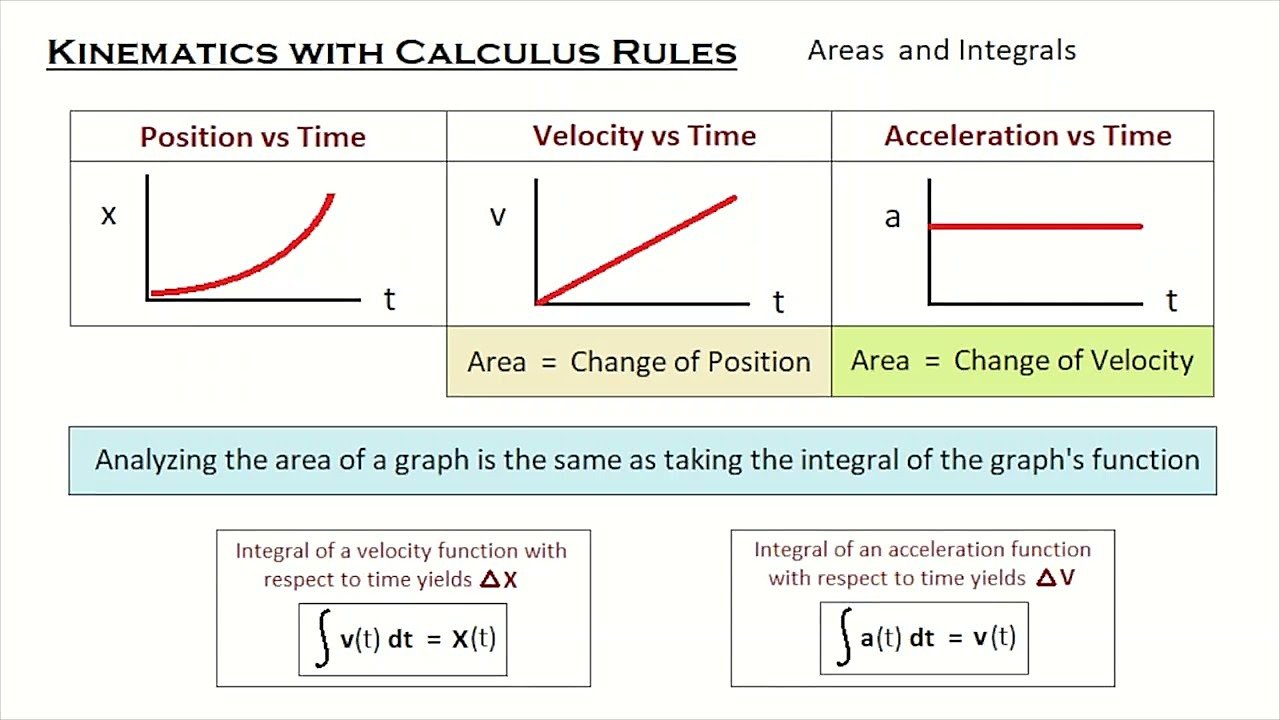
| Displacement and velocity change | Δx = ∫v dt and Δv = ∫a dt | Valid for any motion |
| Velocity | v = v₀ + at | Initial velocity v₀ (m/s), constant acceleration a (m/s²) |
| Position | x = x₀ + v₀t + ½at² | Initial position x₀ (m), constant acceleration |
| Velocity and position | v² = v₀² + 2a(x − x₀) | Constant acceleration |
| Projectile components | vₓ = v₀ cos θ and v_y = v₀ sin θ − gt | Launch angle θ, negligible air resistance |
What Are the Dynamics Equations?
Dynamics equations relate force to motion through Newton's second law, ΣF = ma = dp/dt.
| Quantity | Formula | Variables and Conditions |
|---|---|---|
| Newton's second law | ΣF = ma = dp/dt | Net force ΣF (N), mass m (kg), momentum p (kg·m/s); ΣF = ma needs constant mass |
| Weight | W = mg | Near Earth's surface, g = 9.8 m/s² |
| Kinetic friction | f_k = μ_k N | Coefficient μ_k, normal force N (N) |
| Maximum static friction | f_s ≤ μ_s N | Coefficient μ_s |
| Spring force | F = −kx | Spring constant k (N/m), displacement x (m), ideal spring |
| Linear drag | F = −bv | Drag coefficient b (kg/s), used when a problem states drag |
| Velocity with linear drag, from rest | v(t) = (mg/b)(1 − e^(−bt/m)) | Falling object, terminal velocity v_t = mg/b |
| Centripetal acceleration and force | a_c = v²/r = ω²r and F_c = mv²/r | Uniform circular motion, radius r (m) |
What Are the Work, Energy, and Power Equations?
Work, energy, and power equations relate force and displacement to changes in kinetic and potential energy.
| Quantity | Formula | Variables and Conditions |
|---|---|---|
| Work | W = ∫F·dr | Force F (N), path element dr (m); W = Fd cos θ for constant force |
| Kinetic energy | K = ½mv² | Mass m (kg), speed v (m/s) |
| Work-energy theorem | W_net = ΔK | Net work W_net (J) |
| Gravitational potential energy near Earth | U_g = mgh | Height h (m), small changes in height |
| Spring potential energy | U_s = ½kx² | Ideal spring |
| Force from potential energy | F = −dU/dx | Conservative forces |
| Power | P = dW/dt = F·v | Power P (W) |
| Mechanical energy | K + U = constant | No non-conservative work |
What Are the Linear Momentum Equations?
Linear momentum equations relate mass, velocity, and impulse, and momentum is conserved in isolated systems.
| Quantity | Formula | Variables and Conditions |
|---|---|---|
| Momentum | p = mv | Mass m (kg), velocity v (m/s) |
| Impulse | J = ∫F dt = Δp | Force F (N), time t (s) |
| Conservation of momentum | Σp_before = Σp_after | Zero net external force |
| Center of mass | x_cm = Σmᵢxᵢ/Σmᵢ = (1/M)∫x dm | Total mass M (kg) |
| Elastic collision | Kinetic energy and momentum conserved | One-dimensional case: v₁ − v₂ = −(v₁′ − v₂′) |
| Perfectly inelastic collision | v′ = Σp/Σm | Objects move together after impact |
What Are the Rotation Equations?
Rotation equations relate torque, moment of inertia, angular acceleration, and angular momentum.
| Quantity | Formula | Variables and Conditions |
|---|---|---|
| Angular velocity | ω = dθ/dt | Angle θ (rad) |
| Angular acceleration | α = dω/dt | Angular velocity ω (rad/s) |
| Rotational kinematics | ω = ω₀ + αt and θ = θ₀ + ω₀t + ½αt² | Constant angular acceleration |
| Torque | τ = r × F, with magnitude τ = rF sin θ | Position vector r (m), force F (N) |
| Rotational second law | Στ = Iα | Net torque Στ (N·m), moment of inertia I (kg·m²) |
| Moment of inertia | I = ∫r² dm = Σmr² | Mass element dm (kg), distance r from the axis (m) |
| Parallel axis theorem | I = I_cm + Md² | Axis parallel to a center-of-mass axis, offset d (m) |
| Angular momentum | L = r × p = Iω | Rigid body about a fixed axis |
| Torque and angular momentum | τ = dL/dt | Net torque (N·m) |
| Rotational kinetic energy | K = ½Iω² | Angular velocity ω (rad/s) |
| Tangential motion | v = ωr and a_t = αr | Radius r (m) |
| Rolling without slipping | v_cm = ωR and K = ½Mv_cm² + ½I_cmω² | Radius R (m), mass M (kg) |
What Are the Oscillation Equations?
Oscillation equations describe simple harmonic motion through displacement, angular frequency, and period.
| Quantity | Formula | Variables and Conditions |
|---|---|---|
| Displacement | x = A cos(ωt + φ) | Amplitude A (m), phase constant φ (rad) |
| Frequency and period | ω = 2πf = 2π/T | Frequency f (Hz), period T (s) |
| Spring-mass period | T = 2π√(m/k) | Mass m (kg), spring constant k (N/m) |
| Simple pendulum | T = 2π√(ℓ/g) | Length ℓ (m), small angles |
| Physical pendulum | T = 2π√(I/(mgd)) | Pivot-to-center distance d (m), small angles |
| Velocity and acceleration | v = ±ω√(A² − x²) and a = −ω²x | Simple harmonic motion |
| Total energy | E = ½kA² | Spring-mass system, no friction |
What Are the Gravitation Equations?
Gravitation equations relate mass and distance to gravitational force, field, potential energy, and orbits.
| Quantity | Formula | Variables and Conditions |
|---|---|---|
| Gravitational force | F_g = Gm₁m₂/r² | Masses m₁ and m₂ (kg), separation r (m) |
| Gravitational field | g = GM/r² | Central mass M (kg) |
| Gravitational potential energy | U_g = −Gm₁m₂/r | Zero at infinite separation |
| Circular orbital speed | v = √(GM/r) | Orbital radius r (m) |
| Escape speed | v_esc = √(2GM/r) | Zero total energy at infinity |
| Total energy of a circular orbit | E = −GMm/(2r) | Orbiting mass m (kg) |
| Kepler's third law | T² = (4π²/GM)r³ | Orbital period T (s) |
What Are Common Moments of Inertia in AP Physics C Mechanics?
Common moments of inertia include MR² for a hoop, ½MR² for a solid cylinder, and ⅖MR² for a solid sphere. The official sheet defines which of these values appear on exam day.
| Shape | Axis | Moment of Inertia |
|---|---|---|
| Hoop or thin cylindrical shell | Through center, perpendicular to plane | MR² |
| Solid cylinder or disk | Through center, along the symmetry axis | ½MR² |
| Solid sphere | Through center | ⅖MR² |
| Thin spherical shell | Through center | ⅔MR² |
| Thin rod | Through center, perpendicular to length | (1/12)ML² |
| Thin rod | Through one end, perpendicular to length | ⅓ML² |
How Do Calculus Definitions Connect the Mechanics Equations?
Many Mechanics equations are derivatives or integrals of other equations. Derivative forms define a quantity as a rate of change, and integral forms accumulate the quantity over time or distance.
| Quantity Pair | Derivative Form | Integral Form |
|---|---|---|
| Position and velocity | v = dx/dt | Δx = ∫v dt |
| Velocity and acceleration | a = dv/dt | Δv = ∫a dt |
| Momentum and force | F = dp/dt | J = ∫F dt |
| Work and power | P = dW/dt | W = ∫P dt |
| Potential energy and force | F = −dU/dx | ΔU = −∫F dx |
| Angle and angular velocity | ω = dθ/dt | Δθ = ∫ω dt |
| Angular velocity and angular acceleration | α = dω/dt | Δω = ∫α dt |
| Angular momentum and torque | τ = dL/dt | ΔL = ∫τ dt |
The Mechanics exam tests the ability to use calculus in problems on kinematics, linear momentum, and other topics.
How Are Common Mechanics Formulas Derived?
Most Mechanics formulas derive from a few starting relationships by integration or substitution. The table lists 7 derivations.
| Derived Formula | Starting Relationship | Method |
|---|---|---|
| v = v₀ + at | a = dv/dt with constant a | Integrate from 0 to t |
| x = x₀ + v₀t + ½at² | v = dx/dt with v = v₀ + at | Integrate velocity over time |
| v² = v₀² + 2aΔx | a = v dv/dx | Integrate a dx = v dv |
| W_net = ΔK | W = ∫F dx with F = mv dv/dx | Integrate m v dv from v₀ to v |
| T = 2π√(m/k) | m d²x/dt² = −kx | Substitute x = A cos ωt, which gives ω² = k/m |
| v_esc = √(2GM/r) | ½mv² − GMm/r = 0 | Set total energy equal to zero at infinity |
| a_c = v²/r | Velocity vectors on a circle | Compute Δv/Δt for a small angle Δθ |
What Is the Format of the AP Physics C Mechanics Exam?
The AP Physics C Mechanics exam is hybrid digital, with multiple-choice questions in the Bluebook app and handwritten free-response answers in paper booklets. Students view free-response questions in Bluebook and write answers in booklets that are returned for scoring.
- 2025-26 Section I: 40 multiple-choice questions, 80 minutes, 50% of the score
- 2025-26 Section II: 4 free-response questions, 100 minutes, 50% of the score
- Calculators: permitted on the exam
- Change from May 2027: the College Board announced updates to the number of multiple-choice questions and the timing of each section
- Reported 2027 format: a third-party guide lists 42 multiple-choice questions in 85 minutes and 4 free-response questions in 95 minutes
The College Board lists 42 questions in 85 minutes and 4 free-response questions in 95 minutes for the E&M exam from May 2027, which matches the figures reported for Mechanics.
The 4 free-response questions cover mathematical routines, translation between representations, experimental design and analysis, and qualitative and quantitative translation. The earlier format had 35 multiple-choice questions in 45 minutes and 3 free-response questions in 45 minutes.
How to Use the AP Physics C Mechanics Formula Sheet?
Using the sheet takes 6 steps: list, locate, check, convert, solve, and verify.
- List the given quantities and the unknown quantity.
- Locate the equation group that contains the relationship.
- Check the conditions of the equation, such as constant acceleration, small angles, or ideal springs.
- Convert all values to SI units with the prefix table.
- Solve for the unknown quantity, using calculus where the quantity varies.
- Verify the units and the size of the result.
Worked Example 1: How to Calculate Work From a Variable Force?
A force F(x) = 3.0x² N acts from x = 0 to x = 2.0 m.
- Formula: W = ∫F dx
- Integral: W = ∫₀².⁰ 3.0x² dx = [x³]₀².⁰
- Result: W = 8.0 J
Worked Example 2: How to Calculate Velocity and Position From Varying Acceleration?
An object has a(t) = 4.0t m/s², v₀ = 1.0 m/s, and x₀ = 0 m.
- Velocity: v(t) = 1.0 + 2.0t²
- Velocity at 3.0 s: v = 1.0 + 2.0(9.0) = 19 m/s
- Position: x(t) = t + (2/3)t³
- Position at 3.0 s: x = 3.0 + 18 = 21 m
Worked Example 3: How to Calculate Angular Acceleration From a Tangential Force?
A 6.0 N force acts tangentially on the rim of a hoop with M = 1.5 kg and R = 0.40 m.
- Torque: τ = RF = 0.40 × 6.0 = 2.4 N·m
- Moment of inertia: I = MR² = 1.5 × 0.16 = 0.24 kg·m²
- Angular acceleration: α = τ/I = 10 rad/s²
Worked Example 4: How to Calculate the Acceleration of a Rolling Sphere?
A solid sphere rolls without slipping down a 30° incline.
- Formula: a = g sin θ / (1 + I/(MR²)), with I = ⅖MR²
- Substitution: a = 9.8 × 0.500 / 1.40
- Result: a = 3.5 m/s² down the incline
Worked Example 5: How to Calculate Spring-Mass Oscillation Values?
A mass of 2.0 kg on a spring with k = 50 N/m oscillates with amplitude 0.20 m.
- Angular frequency: ω = √(50/2.0) = 5.0 rad/s
- Period: T = 2π/5.0 = 1.26 s
- Maximum speed: v_max = Aω = 1.0 m/s
- Maximum acceleration: a_max = Aω² = 5.0 m/s²
- Total energy: E = ½kA² = ½ × 50 × 0.040 = 1.0 J
Worked Example 6: How to Calculate Gravitational Field Strength at a Distance?
The field at Earth's surface is 9.8 N/kg. At a distance of 2R from Earth's center, the field follows g = GM/r².
- Ratio: r doubles, so g becomes 1/4 of the surface value
- Result: g = 9.8/4 = 2.45 N/kg
How Does the Mechanics Sheet Differ From the E&M Sheet?
The Mechanics sheet covers motion, force, energy, rotation, oscillations, and gravitation, while the E&M sheet covers electric fields, circuits, magnetic fields, and induction.
| Attribute | AP Physics C: Mechanics | AP Physics C: Electricity and Magnetism |
|---|---|---|
| Topic groups | 7 groups, kinematics through gravitation | 5 groups, electrostatics through induction |
| Central law | Newton's second law, ΣF = ma | Maxwell's equations |
| Constants | Gravitational constants G and g | Electromagnetic constants |
| Typical integrals | W = ∫F dx and I = ∫r² dm | Φ_B = ∫B·dA and E = ∫k dq/r² |
| Time constants | Not applicable | τ = RC and τ = L/R |
How Does the Mechanics Sheet Differ From the AP Physics 1 Sheet?
The Physics C Mechanics sheet uses calculus forms, while the AP Physics 1 sheet uses algebra forms.
| Quantity | AP Physics C: Mechanics Form | AP Physics 1 Form |
|---|---|---|
| Work | W = ∫F·dr | W = FΔr cos θ |
| Impulse | J = ∫F dt | J = FΔt |
| Moment of inertia | I = ∫r² dm | I = Σmr² |
| Center of mass | x_cm = (1/M)∫x dm | x_cm = Σmx/Σm |
| Velocity from acceleration | Δv = ∫a dt | Δv = aΔt, constant a |
What Are Common Mistakes With the Mechanics Formula Sheet?
Common mistakes involve applying equations outside their conditions, mixing units, and dropping signs.
| Mistake | Correction |
|---|---|
| Applying constant-acceleration equations to varying acceleration | Integrate a(t) |
| Using T = 2π√(ℓ/g) at large angles | The formula holds for small angles, up to about 15 degrees |
| Using I = ½MR² for a hoop | A hoop has I = MR² |
| Using only ½Mv² for a rolling object | Add ½Iω² |
| Using U_g = mgh for orbital problems | Use U_g = −Gm₁m₂/r |
| Treating ΣF = ma as valid for variable mass | Use ΣF = dp/dt on a defined system |
| Entering radian quantities in degree mode | Match the calculator mode to the angle units |
| Omitting the negative sign in F = −kx | The sign indicates a restoring force |
People Also Ask About the AP Physics C Mechanics Formula Sheet
Does AP Physics C Mechanics provide a formula sheet?
Yes, the College Board provides the Table of Information and equation tables to students.
Where can I download the AP Physics C Mechanics formula sheet?
The official PDF is on AP Central, and the same content appears in the Course and Exam Description appendix.
What constants are on the AP Physics C Mechanics formula sheet?
The 2024 table lists the gravitational constant G and the gravitational acceleration g = 9.8 m/s².
Is the formula sheet the same every year?
No, the 2019 to 2020 edition listed more constants than the 2024 edition.
What assumptions does AP Physics C Mechanics use?
The exam assumes an inertial frame, negligible air resistance, and ideal springs and strings, unless a problem states otherwise.
Do students need to memorize the equations?
The College Board provides the tables, and students are responsible for understanding each equation's principles and conditions.
Are calculators permitted on AP Physics C Mechanics?
Yes, calculators are permitted.
How many questions are on AP Physics C Mechanics?
The 2025-26 format has 40 multiple-choice questions and 4 free-response questions. The College Board announced updated question counts and timing from May 2027.
Is AP Physics C Mechanics digital?
The exam is hybrid digital, with multiple-choice questions in Bluebook and handwritten free-response answers.
Is AP Physics C Mechanics calculus-based?
Yes, the exam requires derivatives and integrals in problem solving.
What is the formula for Newton's second law in AP Physics C?
The formula is ΣF = ma = dp/dt.
What is the formula for the period of a spring-mass system?
The formula is T = 2π√(m/k).
What is the value of g on the AP Physics C Mechanics sheet?
The value is 9.8 m/s², which equals 9.8 N/kg as a field strength.
What is the AP Physics C Mechanics formula sheet in one sentence?
The AP Physics C Mechanics formula sheet is the College Board reference of constants, assumptions, and equations provided with the Mechanics exam.

The University of the West Indies
My passion as a teacher and leader in education is to contribute to students’ enhanced learning by creation of a positive teaching/learning environment, where they are motivated to develop strong critical thinking, analytical and problem-solving skills.
As acting Vice-Principal and head of Physics, I have amassed five years of experience in leading meetings, implementing strategies to maintain discipline and school ethos, liaise with stakeholders in planning for future development of the institution; successfully negotiated the implementation of various projects for student development as well as supervising effective execution of such. For the past 19 years, I have incorporated discovery learning within the classroom through practical activities, problem solving and cooperative learning and have realized that students retention in Physics and Mathematics have increased significantly.
I am always cognizant that students have different learning styles, and as such teaching strategies during planning and delivery must take this crucial factor into consideration and be tailored to meet such differences.