

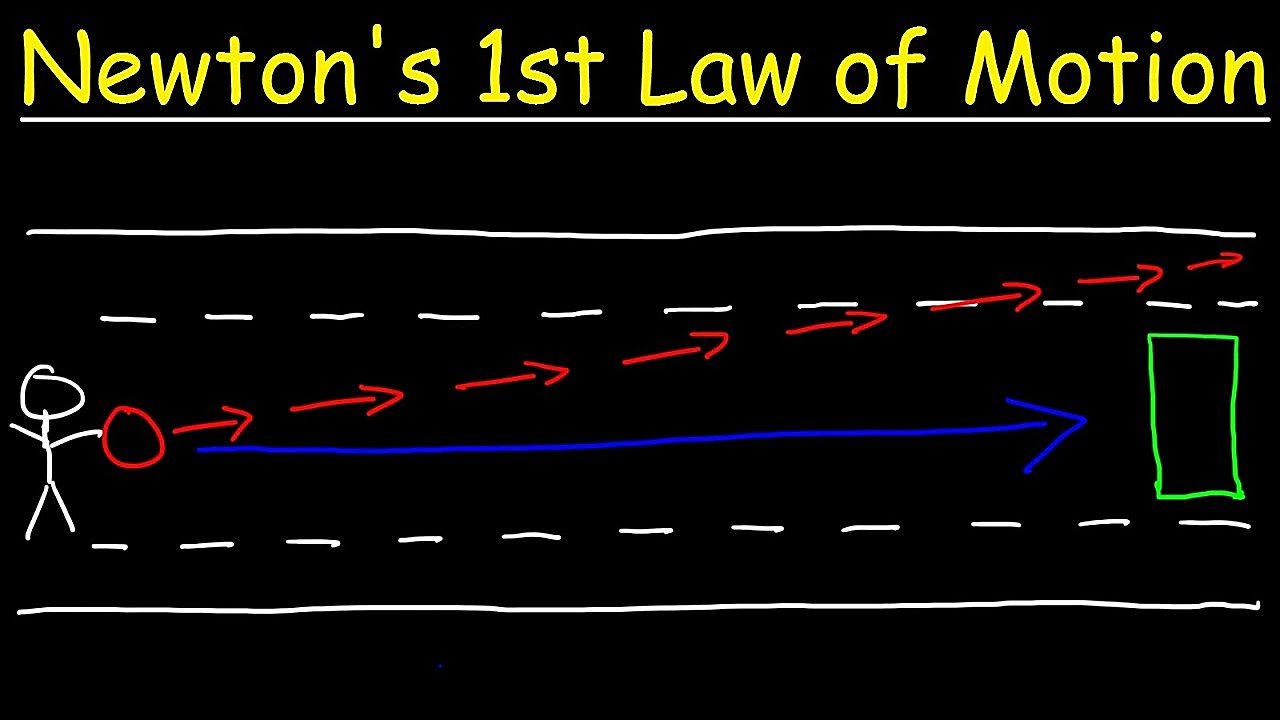
What Is the First Law of Motion, and Which Statement, Formula, Inertia Concept, and Examples Describe It?
The first law of motion is Newton's first law, which states that an object keeps its state of rest or its constant velocity along a straight line unless a net external force acts on it. The law is also called the law of inertia. The condition is ΣF = 0, which gives a = 0. Mass measures inertia in kilograms (kg). Isaac Newton published the law in 1687.
For a reliable reference, consult OpenStax University Physics Volume 1.
What Is the First Law of Motion?
The first law of motion states that an object at rest stays at rest, and an object in motion keeps a constant velocity, unless a net external force acts on it. Constant velocity means constant speed and constant direction.
Isaac Newton published the law in 1687 in Philosophiæ Naturalis Principia Mathematica, where it is labeled Lex I, the first of 3 laws of motion. According to OpenStax University Physics Volume 1, the velocity of an object stays constant when the net external force equals zero. The law is named the law of inertia, since it describes the tendency of an object to resist changes in velocity.
How Did Newton Word the First Law?
Newton stated that every body continues in its state of rest, or of uniform motion in a straight line, unless impressed forces compel a change. The Latin key phrase is uniformiter in directum, which means uniformly in a straight line.
The table lists 4 versions of the statement and the emphasis of each version.
| Version | Source | Emphasis |
|---|---|---|
| Original Latin | Principia, 1687 | Body, state of rest or uniform motion, impressed forces |
| English translation | Andrew Motte, 1729 | Same content in English |
| University textbook | OpenStax University Physics | Constant velocity when the net external force is zero |
| Classroom statement | School physics courses | An object keeps doing what it is doing unless a net force acts |
What Is the First Law of Motion in Simple Terms?
The first law of motion means that an object changes its velocity only when a net force acts on it. The law covers 3 cases.
- Rest: an object at rest stays at rest when the net force equals 0 N.
- Uniform motion: an object in motion keeps its speed and direction when the net force equals 0 N.
- Change: an object speeds up, slows down, or turns when a net force acts on it.
Examples of net force include a push, a pull, friction, and gravity. A book on a desk stays at rest until a hand pushes it. A puck on smooth ice keeps sliding until friction or a stick changes its velocity.
What Is the Formula for the First Law of Motion?
The formula for the first law of motion is ΣF = 0, which gives a = 0 and a constant velocity v.
The table lists 7 forms of the law and the meaning of each form.
| Statement | Equation | Meaning |
|---|---|---|
| Zero net force | ΣF = 0 | Forces on the object sum to zero as vectors |
| Balance along each axis | ΣFₓ = 0 and ΣF_y = 0 | Forces balance in the x and y directions |
| Zero acceleration | a = dv/dt = 0 | Velocity does not change |
| Constant velocity | v = constant | Speed and direction stay fixed |
| Constant momentum | p = mv = constant | Momentum stays fixed when mass is constant |
| Zero net torque | Στ = 0 | Rotation does not change |
| Constant angular velocity | ω = constant | Spin rate stays fixed when net torque is zero |
How Is the First Law Derived From the Second Law?
The first law follows from the second law, F_net = dp/dt, when the net force equals zero.
- Write the second law: F_net = dp/dt.
- Set the net force to zero: 0 = dp/dt.
- Conclude that momentum is constant: p = mv = constant.
- Divide by the constant mass: v = constant.
Textbooks state the first law separately for 2 reasons. The first law identifies the inertial frames in which the second law holds, and it introduces inertia before force and acceleration are related.
What Does Inertia Mean in the First Law?
Inertia is the resistance of an object to a change in its velocity, and mass measures inertia in kilograms. An object with greater mass has greater inertia.
Inertia is a property of matter and is not a force. Inertia has no direction and no unit of newtons.
What Are the 3 Types of Inertia?
The 3 types of inertia are inertia of rest, inertia of motion, and inertia of direction.
- Inertia of rest: an object at rest stays at rest until a net force acts on it.
- Inertia of motion: an object in motion keeps its speed until a net force acts on it.
- Inertia of direction: a moving object keeps its direction until a net force acts on it.
What Are the Conditions for the First Law?
The first law holds under 3 conditions: zero net external force, an inertial frame of reference, and constant mass.
- Net external force: the vector sum of forces from outside the object equals 0 N.
- Inertial frame: the frame of reference does not accelerate.
- Constant mass: the object does not gain or lose mass.
Internal forces between parts of an object cancel in pairs, so only external forces count in the net force.
How Do You Know Whether the First Law Applies to a Situation?
The first law applies when the object has zero acceleration, which means constant speed along a straight line or rest. A change in speed or direction indicates a nonzero net force.
The table lists 7 observations, the net force for each, and whether the first law applies.
| Observation | Net Force | First Law Result |
|---|---|---|
| Object at rest | 0 N | Applies |
| Constant speed along a straight line | 0 N | Applies |
| Speeding up along a straight line | Nonzero, along the motion | Does not apply |
| Slowing down along a straight line | Nonzero, opposite to the motion | Does not apply |
| Constant speed along a circle | Nonzero, toward the center | Does not apply |
| Falling at terminal velocity | 0 N | Applies |
| Thrown ball at the top of its path | Nonzero, equal to the weight | Does not apply |
A ball at the top of its path has a velocity of 0 m/s for an instant, but the acceleration equals 9.81 m/s² downward. The net force is the weight, so the first law does not apply at that instant.
What Are Examples of the First Law of Motion in Daily Life?
Examples of the first law of motion include a book on a table, a passenger in a braking bus, a coin on a card, a pulled tablecloth, a shaken ketchup bottle, and mud leaving a wheel.
The table lists 12 examples, the type of inertia involved, and the explanation for each.
| Example | Inertia Type | Explanation |
|---|---|---|
| Book on a table | Rest | Weight and normal force sum to 0 N, so the book stays at rest |
| Parked car on level ground | Rest | The car stays at rest until the engine force exceeds static friction |
| Passenger lurching backward as a bus starts | Rest | The body tends to stay at rest while the seat accelerates forward |
| Dust leaving a carpet when beaten | Rest | The carpet moves, and the dust tends to stay in place |
| Coin dropping into a glass when a card is flicked away | Rest | The coin tends to stay at rest, and gravity pulls it down |
| Dishes staying on a quickly pulled tablecloth | Rest | Friction acts for a very short time, which gives a small velocity change |
| Passenger lurching forward as a bus brakes | Motion | The body keeps its forward velocity while the bus slows |
| Ketchup leaving a bottle that is swung down and stopped | Motion | The bottle stops, and the ketchup keeps moving |
| Hammer head tightening when the handle strikes the ground | Motion | The handle stops, and the head keeps moving down |
| Runner overshooting a stopping line | Motion | The body keeps its velocity until friction slows it |
| Mud leaving a turning wheel | Direction | Mud moves along the tangent when adhesion fails to supply the inward force |
| Car skidding straight on an icy curve | Direction | Low friction cannot supply the net inward force, so the car keeps its direction |
How to Apply the First Law to a Problem?
Applying the first law takes 4 steps: identify, set, solve, and check.
- Identify every force acting on the object.
- Set the sum of forces equal to zero along each axis.
- Solve for the unknown force.
- Check that the object has zero acceleration.
Worked Example 1: How to Calculate the Push at Constant Velocity?
A 25 kg box slides at constant velocity on a floor with μ_k = 0.20.
- Normal force: N = mg = 25 × 9.81 = 245.25 N
- Kinetic friction: f_k = 0.20 × 245.25 = 49.05 N
- Applied force: 49.05 N, since ΣFₓ = 0
Worked Example 2: How to Calculate Cable Tension in Static Equilibrium?
A 40 kg sign hangs from 2 cables, each at 30 degrees above the horizontal.
- Weight: W = 40 × 9.81 = 392.4 N down
- Vertical balance: 2T sin 30° = 392.4 N
- Tension: T = 392.4 N in each cable, since sin 30° equals 0.500
- Horizontal balance: the horizontal components of the 2 cables are equal and opposite
Worked Example 3: How to Calculate Forces on an Aircraft at Cruise?
An airliner of 70,000 kg flies at constant velocity and constant altitude, with 60 kN of thrust.
- Horizontal balance: drag = thrust = 60 kN
- Vertical balance: lift = weight = 70,000 × 9.81 = 686,700 N, which equals 687 kN
Why Do Moving Objects Stop on Earth if the First Law Applies?
Moving objects stop on Earth because friction and air resistance supply a net force that opposes the motion. The first law states that velocity stays constant when the net force equals zero. The law does not state that objects stop.
The table lists the stopping distance of a block that slides at 3.0 m/s on 4 surfaces. The formulas are a = μ_k g, d = v²/(2a), and t = v/a, with illustrative values of μ_k.
| Surface | Coefficient μ_k | Deceleration (m/s²) | Stopping Distance (m) | Stopping Time (s) |
|---|---|---|---|---|
| Rubber on dry concrete | 0.70 | 6.87 | 0.66 | 0.44 |
| Wood on wood | 0.30 | 2.94 | 1.53 | 1.02 |
| Ice | 0.03 | 0.29 | 15.3 | 10.2 |
| Ideal frictionless surface | 0 | 0 | No stopping | No stopping |
A lower coefficient of friction gives a longer sliding distance. The frictionless limit matches the condition of the first law, with a constant velocity of 3.0 m/s.
What Experiments Demonstrate the First Law of Motion?
Five experiments demonstrate the first law: the coin and card, the tablecloth pull, the cart and block, the air track glider, and the hanging ball in a vehicle.
| Experiment | Setup | Observation | Explanation |
|---|---|---|---|
| Coin and card | A card rests on a glass with a coin on top | The coin drops into the glass when the card is flicked horizontally | The coin has inertia of rest, and friction acts for a short time |
| Tablecloth pull | Light dishes rest on a smooth cloth | The dishes stay nearly in place when the cloth is pulled quickly | A short friction time gives a small velocity change |
| Cart and block | A block rests on a low-friction cart | The block continues forward when the cart hits a stop | The block keeps its velocity |
| Air track glider | A glider rides on a leveled air track | The glider keeps a constant velocity after a push | The air cushion lowers friction to nearly 0 N |
| Hanging ball in a vehicle | A ball hangs on a string inside a car | The string tilts backward when the car accelerates forward | The ball resists the change in velocity |
How Does the First Law Relate to the Second and Third Laws?
The first law covers the case of zero net force, the second law relates a nonzero net force to acceleration, and the third law describes force pairs on different objects.
| Law | Question Answered | Key Quantity | Equation |
|---|---|---|---|
| First law | What happens when the net force is zero? | Velocity stays constant | ΣF = 0 |
| Second law | What happens when the net force is not zero? | Acceleration | F_net = ma |
| Third law | How do 2 objects interact? | Force pair | F_AB = −F_BA |
The 2 forces of a third-law pair act on different objects, so the pair does not cancel in the net force on one object.
What Is the Rotational Version of the First Law?
The rotational version states that an object keeps a constant angular velocity unless a net external torque acts on it. The equation is Στ = 0, which gives dL/dt = 0 and a constant angular momentum L.
The table maps the linear law to the rotational law.
| Attribute | Linear Law | Rotational Law |
|---|---|---|
| Inertia measure | Mass m (kg) | Moment of inertia I (kg·m²) |
| Condition | ΣF = 0 | Στ = 0 |
| Constant quantity | Velocity v (m/s) | Angular velocity ω (rad/s) |
| Conserved quantity | Momentum p = mv (kg·m/s) | Angular momentum L = Iω (kg·m²/s) |
A bicycle wheel that spins on a low-friction axle keeps its angular velocity until friction at the axle changes it. Earth rotates with an angular velocity of 7.29 × 10⁻⁵ rad/s, which corresponds to 1 revolution in about 86,164 s.
What Is a Frame of Reference in the First Law?
A frame of reference is a coordinate system used to measure motion, and the first law holds in inertial frames, which move at constant velocity.
The table classifies 4 frames.
| Frame | Inertial | Reason |
|---|---|---|
| Train at constant velocity on a straight track | Yes | No acceleration |
| Braking train | No | The frame accelerates |
| Turning car | No | The direction of velocity changes |
| Earth's surface | Approximately | The centripetal acceleration at the equator is 0.034 m/s², about 0.35% of g |
Galileo described the effect with a ship that moves uniformly. Experiments inside the ship give the same results as experiments on shore.
Numerical example: a train moves at 30 m/s, and a passenger tosses a ball straight up at 5.0 m/s.
- Time in the air: t = 2v/g = 2 × 5.0/9.81 = 1.02 s
- Horizontal distance traveled with the train: 30 × 1.02 = 30.6 m
- Result: the ball lands in the hand, since the ball and the passenger share the same horizontal velocity
A braking train is a non-inertial frame. A ball on the floor appears to roll forward without a real force acting on it, and physicists call the effect a fictitious force.
What Are the Limits of the First Law?
The first law in its simple form fails in non-inertial frames, and the classical picture of force changes at atomic scales and in strong gravity.
| Condition | Effect on the First Law | Adjustment |
|---|---|---|
| Non-inertial frame | Objects accelerate with no real net force | Add fictitious forces |
| Atomic and subatomic scales | Particle behavior is probabilistic | Use quantum mechanics |
| Strong gravitational fields | Free-falling objects follow curved paths in spacetime | Use general relativity |
The first law keeps its form in special relativity for inertial frames, including at speeds near the speed of light.
What Is the History of the First Law of Motion?
The first law developed over about 2,000 years, from Aristotle's view that motion requires a force to Newton's statement in 1687.
| Contributor | Period | Contribution |
|---|---|---|
| Aristotle | 384 to 322 BCE | Held that a continuing force keeps an object moving |
| John Philoponus | 6th century CE | Proposed that a moving object receives an impressed motive power |
| Jean Buridan | 14th century | Developed the impetus theory of continued motion |
| Galileo Galilei | 1564 to 1642 | Argued from inclined-plane experiments that motion on a level surface persists, published in 1632 and 1638 |
| René Descartes | 1596 to 1650 | Stated in 1644 that motion continues in a straight line |
| Isaac Newton | 1643 to 1727 | Published the law as Lex I in 1687 |
Galileo rolled balls down one incline and up a second incline. The balls rose nearly to the starting height, and the rise approached the starting height as friction decreased. The result supported the conclusion that a ball on a frictionless level surface keeps its velocity.
What Are the Applications of the First Law of Motion?
The first law applies in 5 fields: vehicle safety, spaceflight, sports, cargo transport, and structural engineering.
- Vehicle safety: seat belts apply a force that changes the velocity of an occupant during a crash. Calculation: a 70 kg occupant at 15 m/s stops over 0.60 m of crush distance, which gives a = v²/(2d) = 187.5 m/s², F = 13,125 N, and a stopping time of 0.080 s.
- Spaceflight: probes coast with nearly constant velocity after the final engine burn, since gravity and drag are small far from planets.
- Sports: a curling stone glides a long distance on ice, since friction is low.
- Cargo transport: straps and barriers apply forces that stop cargo from continuing forward when a truck brakes.
- Structural engineering: buildings and bridges satisfy ΣF = 0 in each direction in static equilibrium.
What Are Common Misconceptions About the First Law of Motion?
Common misconceptions about the first law involve force and motion, rest, circular motion, and the meaning of inertia.
| Misconception | Correct Statement |
|---|---|
| A force is required to keep an object moving | Constant velocity requires a net force of 0 N |
| An object at rest has no forces acting on it | Forces act on the object, and they sum to 0 N |
| Objects naturally come to rest | Friction and air resistance slow moving objects |
| Constant speed means zero net force | Constant speed along a circle requires a net force toward the center |
| Inertia is a force that keeps objects moving | Inertia is a property of matter measured by mass |
| The first law applies only in space | The first law applies wherever the net force equals 0 N |
People Also Ask About the First Law of Motion
What is the first law of motion in simple words?
The first law of motion states that an object keeps its velocity unless a net force acts on it.
Who discovered the first law of motion?
Isaac Newton published the law in 1687, building on the work of Galileo Galilei and René Descartes.
What is the formula for the first law of motion?
The formula is ΣF = 0, which gives a = 0.
What is another name for the first law of motion?
Another name is the law of inertia.
What is inertia?
Inertia is the resistance of an object to a change in velocity, and mass measures it.
What is the SI unit of inertia?
Inertia is measured by mass, with the SI unit kilogram (kg).
What are the 3 types of inertia?
The 3 types are inertia of rest, inertia of motion, and inertia of direction.
What is an example of the first law of motion?
A book on a table stays at rest because the weight and the normal force sum to 0 N.
Why do objects stop moving on Earth?
Friction and air resistance apply a net force that opposes the motion.
Does the first law apply to a moving object?
Yes, a moving object keeps a constant velocity when the net force equals zero.
Does the first law apply to circular motion?
No, an object that moves along a circle has a changing direction, so a net force acts toward the center.
Is the first law a special case of the second law?
Yes, setting F_net = 0 in the second law gives the first law.
What is the difference between the first and second laws of motion?
The first law describes motion with zero net force, and the second law relates a nonzero net force to acceleration.
What is the first law of motion in one sentence?
The first law of motion states that an object keeps its state of rest or constant velocity unless a net external force acts on it.

The University of the West Indies
My passion as a teacher and leader in education is to contribute to students’ enhanced learning by creation of a positive teaching/learning environment, where they are motivated to develop strong critical thinking, analytical and problem-solving skills.
As acting Vice-Principal and head of Physics, I have amassed five years of experience in leading meetings, implementing strategies to maintain discipline and school ethos, liaise with stakeholders in planning for future development of the institution; successfully negotiated the implementation of various projects for student development as well as supervising effective execution of such. For the past 19 years, I have incorporated discovery learning within the classroom through practical activities, problem solving and cooperative learning and have realized that students retention in Physics and Mathematics have increased significantly.
I am always cognizant that students have different learning styles, and as such teaching strategies during planning and delivery must take this crucial factor into consideration and be tailored to meet such differences.